The man entered the shelter carrying a large red plastic basket.
Inside it lay a golden-brown dog named Vàng.
He was a striking mix of Vietnamese Bắc Hà dog and German Shepherd, with a broad face, intelligent eyes, and the body of an animal who should have been moving confidently beside his person.
Instead, Vàng barely moved.
When the basket was lowered and shelter workers carefully placed him on the floor, the reason became immediately clear.
His front legs still worked.
His back legs did not.
Vàng pressed his paws against the ground and slowly pulled himself forward, dragging the rest of his body behind him.
Every small distance required effort.
Yet when rescuers knelt beside him, he did not bark or attempt to defend himself.
He simply raised his head and watched them.
His body had lost much of its strength.
His willingness to respond gently to people had somehow remained.
Vàng Arrived in a Basket Because He Could No Longer Walk
The old plastic basket was not designed for transporting a dog of Vàng’s size.
But without the use of his hind legs, walking into the shelter was no longer possible.
The man supporting him lowered the basket carefully while volunteers gathered nearby. They did not pull Vàng out by his legs or force him to stand.
Instead, they supported his chest, hips, and lower body before placing him on a clean section of the floor.
Vàng remained still for a moment.
Then he tried to move.
His front paws reached forward.
His shoulders tightened.
Using only the strength in the front half of his body, he pulled himself several inches across the ground.
The back legs followed without supporting his weight.
Watching him move made the seriousness of his condition impossible to overlook.
A dog who cannot use his hind legs faces challenges far beyond the loss of ordinary walking.
Dragging the body can cause abrasions and pressure injuries.
The front legs and shoulders must carry far more weight than they were designed to support.
Reaching food, water, or a comfortable resting position may require assistance.
Some paralyzed dogs also need help with bladder and bowel care, depending on the location and severity of the neurological damage.
The shelter team could not determine all of those needs simply by watching Vàng cross the floor.
He would require a full veterinary evaluation.
For the moment, they focused on making him comfortable.
A quieter resting area was prepared.
Soft material replaced the hard floor beneath his body.
The volunteers moved calmly around him, allowing him to observe the unfamiliar shelter without becoming surrounded.
Other rescued dogs barked from nearby enclosures, curious about the newcomer.
Vàng listened.
He looked in their direction.
But he did not react with panic or aggression.
He remained remarkably gentle while the shelter workers adjusted his bedding and examined how he positioned his body.
The dog had entered a completely unfamiliar place.
He could not stand up and walk away if he became uncomfortable.
Still, he allowed people to help him.
Video: Vàng Arrives in a Red Basket and Pulls Himself Forward Using Only His Front Legs
His Weakness Had Developed After a Serious Illness
The man who brought Vàng to the shelter explained that the dog’s condition had not begun overnight.
According to his account, Vàng had previously suffered from a severe blood-parasite infection.
Such illnesses can place considerable strain on a dog’s body. Depending on the parasite involved and how advanced the condition becomes, symptoms may include anemia, weakness, fever, loss of appetite, and damage affecting multiple organs.
Treatment reportedly helped Vàng survive the infection.
But afterward, his hind legs became increasingly weak.
At first, standing became difficult.
Then walking grew unstable.
Eventually, Vàng could no longer support himself with the back half of his body.
The footage and account could not confirm whether the infection directly caused the paralysis. Neurological weakness can have many possible explanations, including spinal injury, nerve damage, complications from illness, degenerative conditions, or problems unrelated to the earlier infection.
Only veterinary testing could identify the cause with confidence.
What was clear was that Vàng’s care had become increasingly demanding.
The man said that long working hours and difficult circumstances had made it harder to provide the constant assistance the dog needed.
Caring for a large paralyzed animal can involve lifting, cleaning, repositioning, medical appointments, physical therapy, and monitoring throughout the day.
Acknowledging those challenges does not remove the responsibility to seek appropriate care.
But it helps explain why the man eventually brought Vàng somewhere he believed might have access to greater support.
The surrender was not filmed as an angry confrontation.
The man remained near Vàng while speaking with the shelter team. Before leaving, he reportedly promised to return with old clothing and blankets that could make the dog’s resting area more comfortable.
That promise did not resolve Vàng’s medical condition.
It showed that the separation was more complicated than a simple story of someone walking away without concern.
The shelter workers did not spend those first moments assigning blame.
They had a dog on the floor who could not use his back legs.
He needed immediate care.
Questions about the past could wait.
Vàng’s body could not.
The Shelter Began With Comfort Before Promising Recovery
There was no instant cure waiting when Vàng arrived.
No one lifted him from the basket and discovered that he could suddenly stand.
The shelter could offer protection, clean bedding, food, and attention.
Restoring movement—if it was possible at all—would require medical expertise, time, and resources.
Volunteers carried Vàng into a quieter section where he would not need to drag himself repeatedly across the main floor.
They arranged padding beneath the areas of his body most likely to experience pressure.
Because he could not reposition himself normally, caregivers would need to check him regularly and help him change sides.
Remaining in one position for too long can cause discomfort and pressure wounds, especially in a heavy dog with limited mobility.
His skin also needed to be inspected where it touched the ground.
Any small scrape could become worse through repeated friction.
Food and water were placed within easy reach.
The shelter team watched whether Vàng could eat independently and whether he showed interest in his surroundings.
They also needed to observe his bladder function, response to touch, and any movement remaining in the hind legs.
These details would help veterinarians understand whether his paralysis appeared complete or partial and whether he still had sensation in the affected areas.
Vàng remained calm throughout the initial care.
He watched volunteers moving around him.
When someone touched him gently, he did not pull away.
His expression appeared tired, but he continued following people with his eyes.
That behavior should not be interpreted as proof that he felt no fear or pain.
Dogs often remain quiet when they are exhausted, unwell, or uncertain.
Yet Vàng’s willingness to accept help made each necessary task easier.
Caregivers could position the blankets beneath him.
They could check his body.
They could sit beside him without causing visible distress.
The atmosphere around Vàng was not one of celebration.
His future was too uncertain for that.
Instead, the first hours were shaped by practical kindness.
Give him somewhere soft.
Reduce the need to drag himself.
Keep his body clean.
Make sure he can reach food and water.
Let him rest.
Rescue often begins with these quiet actions long before anyone knows how much recovery will be possible.
The Team Began Searching for a Way to Help Him Move Again
Once Vàng was settled, the shelter began seeking professional guidance.
They contacted veterinarians and people experienced with paralyzed dogs.
They looked for clinics capable of evaluating spinal and neurological conditions.
The hope was simple to express but difficult to guarantee.
They wanted to see Vàng stand again.
To understand whether that dream was realistic, he would need diagnostic testing.
A veterinary neurological examination could check reflexes, muscle tone, pain response, and remaining sensation in the hind limbs.
Imaging such as X-rays might reveal fractures, spinal changes, or abnormalities affecting the bones.
More advanced testing could be needed if the problem involved discs, nerves, or soft tissue not clearly visible through ordinary imaging.
The results would determine what came next.
Some dogs regain movement through treatment, rehabilitation, or surgery.
Others improve only partially.
For some, paralysis becomes permanent.
The shelter did not know which future belonged to Vàng.
That uncertainty made honesty important.
Love alone could not repair a damaged spinal cord.
Hope alone could not replace veterinary care.
But an uncertain prognosis was not a reason to stop helping him.
Even if Vàng never walked normally again, supportive care could still improve his comfort and independence.
Physical therapy might help preserve flexibility and prevent severe muscle loss.
Gentle range-of-motion exercises could keep the joints moving when performed under professional instruction.
A properly fitted wheelchair might eventually allow him to explore without dragging the back half of his body.
Protective clothing could reduce friction against the ground when he moved without wheels.
Weight management would be essential because additional weight would increase strain on his front legs and shoulders.
These options required funding, equipment, and consistent human effort.
The shelter began searching because Vàng could not search for them himself.
He could not contact a specialist.
He could not explain where he felt pain or whether sensation remained in his paws.
He could only continue pulling himself forward in the way his body still allowed.
The people around him now had to turn that determination into a practical care plan.
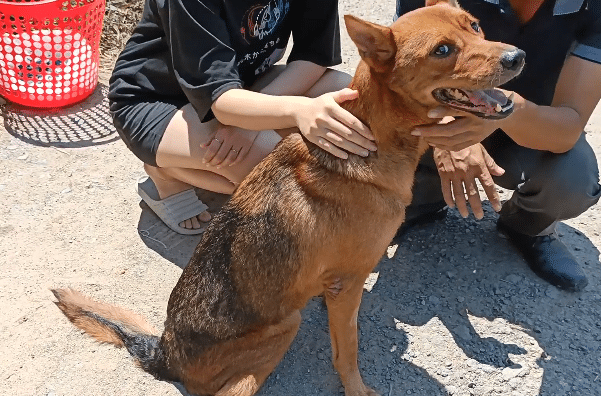
His Gentle Response to People Became the Part No One Forgot
Vàng’s paralysis was the most visible part of his condition.
His temperament became the part that stayed with the volunteers.
He was surrounded by unfamiliar dogs.
New people entered and left the room.
Hands touched parts of his body he could no longer move normally.
For an animal without the ability to stand or retreat, every interaction required vulnerability.
Vàng continued responding with quiet attention.
He looked toward voices.
He allowed people to sit near him.
When volunteers adjusted his bedding or supported his body, he remained cooperative.
It would be easy to turn that behavior into a dramatic claim that Vàng had forgiven everyone or understood that he was finally safe.
No one could know his thoughts with that certainty.
What people could observe was meaningful enough.
Vàng had not withdrawn completely from human contact.
He continued looking toward people rather than only away from them.
He accepted gentle handling.
He remained interested in what happened around him.
That openness gave the shelter something important to protect.
Medical recovery was uncertain.
His ability to connect was still present.
The volunteers could strengthen that connection through consistency.
The same voices could greet him each day.
Meals could arrive on a reliable schedule.
Hands could move slowly and stop when he became uncomfortable.
His resting area could remain clean.
Instead of being expected to drag himself everywhere, he could be lifted with proper support.
Those experiences would help Vàng understand the shelter routine, regardless of whether his back legs improved.
Quality of life for a disabled animal is not measured only by walking.
Comfort matters.
Interest in food matters.
Social connection matters.
The ability to rest without untreated pain matters.
Opportunities to explore safely matter.
Many paralyzed dogs live engaged, affectionate lives when their medical and mobility needs are properly supported.
Vàng’s future would depend on whether those needs could be met consistently.
The shelter’s task was not merely to keep him alive.
It was to discover what kind of life could still be built around the body he had.
His Journey Remains Unfinished—But He No Longer Faces It Alone
The video does not end with Vàng running across a field.
It does not show a sudden medical breakthrough.
There is no confirmed surgery, wheelchair, or permanent home waiting in the final scene.
His condition remains serious.
His prognosis remains uncertain.
That unfinished ending makes his story more honest.
Real rescue does not always produce a complete transformation within a few minutes of footage.
Sometimes the first success is simply removing an animal from a situation where his needs can no longer be met.
Sometimes it is providing soft bedding after months of dragging across hard floors.
Sometimes it is finding people willing to ask specialists one more question.
Vàng still could not use his back legs.
He still needed help moving.
He still faced examinations and decisions that might bring difficult answers.
But several important things had already changed.
Someone noticed when he needed repositioning.
Someone placed food where he could reach it.
Someone began checking his skin and protecting his weakened body.
People were searching for treatment instead of accepting paralysis without investigation.
And when Vàng pulled himself across the floor, he was no longer moving toward an uncertain corner alone.
Hands were nearby to support him.
The peaceful green fields surrounding the shelter offered a striking contrast to the struggle taking place inside.
Outside, the landscape stretched openly toward the horizon.
Inside, Vàng’s world remained limited by a body that would not follow where his front legs tried to go.
Perhaps one day, a wheelchair would allow him to explore those paths.
Perhaps treatment would restore some movement.
Perhaps his future would be built around permanent assistance rather than recovery of his back legs.
None of those outcomes could yet be promised.
What could be promised was care in the present.
Vàng had spent months losing strength.
Now people were working to preserve what remained.
He had reached a point where he could no longer stand.
Now a shelter was searching for ways to help him move.
He had been carried through the door in an old red basket because there was no other way to bring him inside.
But once that basket touched the ground, his story did not end with surrender.
It began again with examination, patience, and the belief that a dog’s life can still hold value even when his body no longer works as it once did.
Vàng’s gaze remained gentle.
His front paws continued reaching forward.
The journey ahead might be difficult, and it might never lead to the recovery everyone hoped to see.
Still, he no longer had to make that journey alone.
For a dog who could only pull himself inch by inch across the floor, that was already a meaningful first step.


