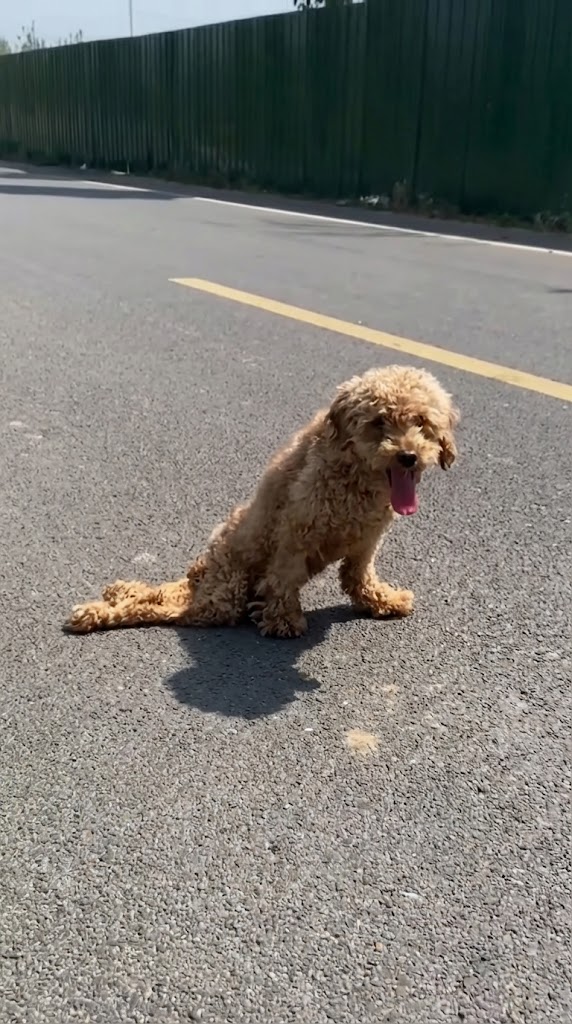
The first thing rescuers noticed was the way he moved.
He was not limping.
He was not favoring one leg.
He was pulling his entire lower body across the road using only his front legs.
Each movement required effort.
His front paws reached forward.
His shoulders pulled.
Then the rest of his body followed, with both hind legs dragging behind him.
After only a short distance, he had to stop.
His breathing became heavier.
His front legs rested.
Then, after a moment, he tried again.
For a stray dog living beside the road, losing the use of two legs changed almost everything.
Finding food became harder.
Escaping traffic became harder.
Even reaching shade or water required far more energy than it should have.
But he was still moving.
And on that day, someone finally moved toward him too.
The Examination Explained Why His Legs Would Not Respond
The dog was taken to a veterinary hospital for evaluation.
There, the medical team found that the problem appeared to involve his nervous system.
He was diagnosed with neuritis, and the condition had severely affected sensation and movement in the lower half of his body.
The news was difficult.
There was no guarantee that his legs would recover fully.
He might never walk normally again.
But that did not change the decision to care for him.
The rescuers gave him a name.
Tiao Tiao.
From that point forward, the goal was not to promise an impossible outcome.
It was to give him the best chance available.
If movement returned, they would help him use it.
If it did not, they would find another way for him to live comfortably and move through the world.
VIDEO: He Dragged Both Back Legs Across the Road — Watch Tiao Tiao’s 117-Day Recovery
A Quiet Yard Became His New World
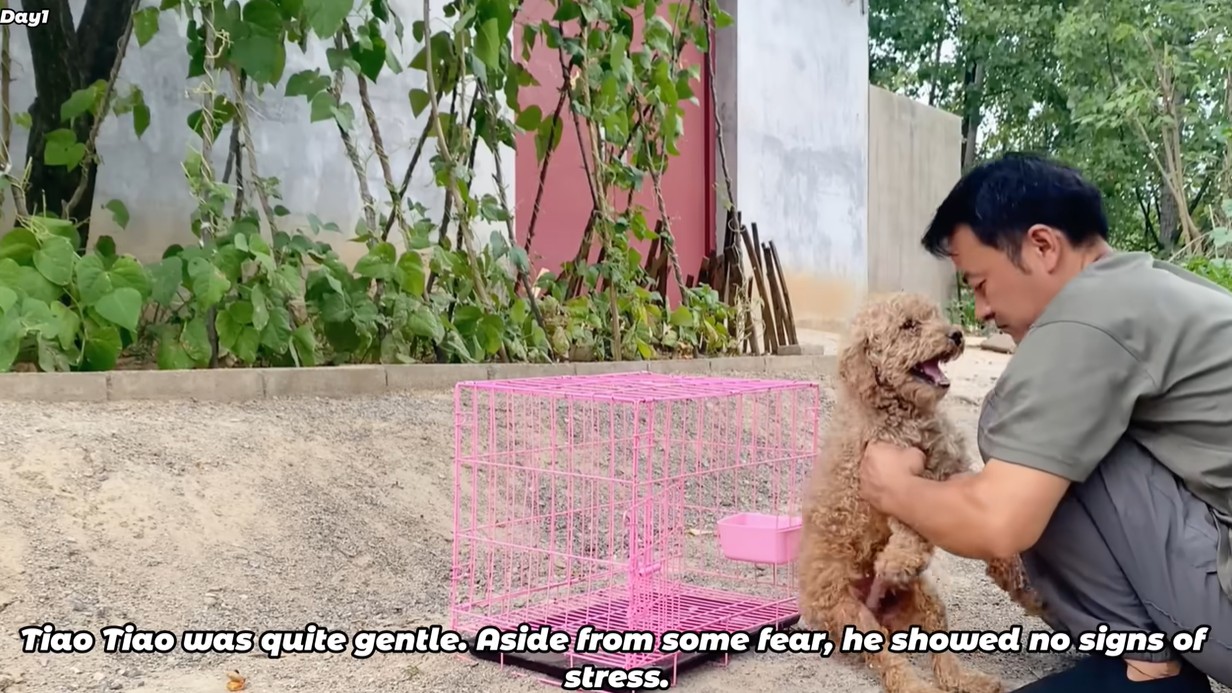
After his initial treatment, Tiao Tiao was moved to a rural yard away from busy traffic.
The surroundings were calmer.
There was open space.
Sunlight.
Fresh air.
And other rescued dogs nearby.
But Tiao Tiao did not immediately rush out to explore.
At first, he preferred staying inside his enclosure.
The open yard was unfamiliar.
The new sounds were unfamiliar.
Even safety can take time to recognize.
So nobody forced him.
He was allowed to watch.
Then move a little.
Then retreat whenever he needed to.
Gradually, the yard stopped feeling so strange.
Soon, Tiao Tiao began following the people caring for him.
He still pulled himself using his front legs, but his curiosity was growing faster than his physical limitations could contain it.
The dog who had once been found struggling beside the road now wanted to know where everyone was going.
Day 10 Revealed a More Complicated Problem
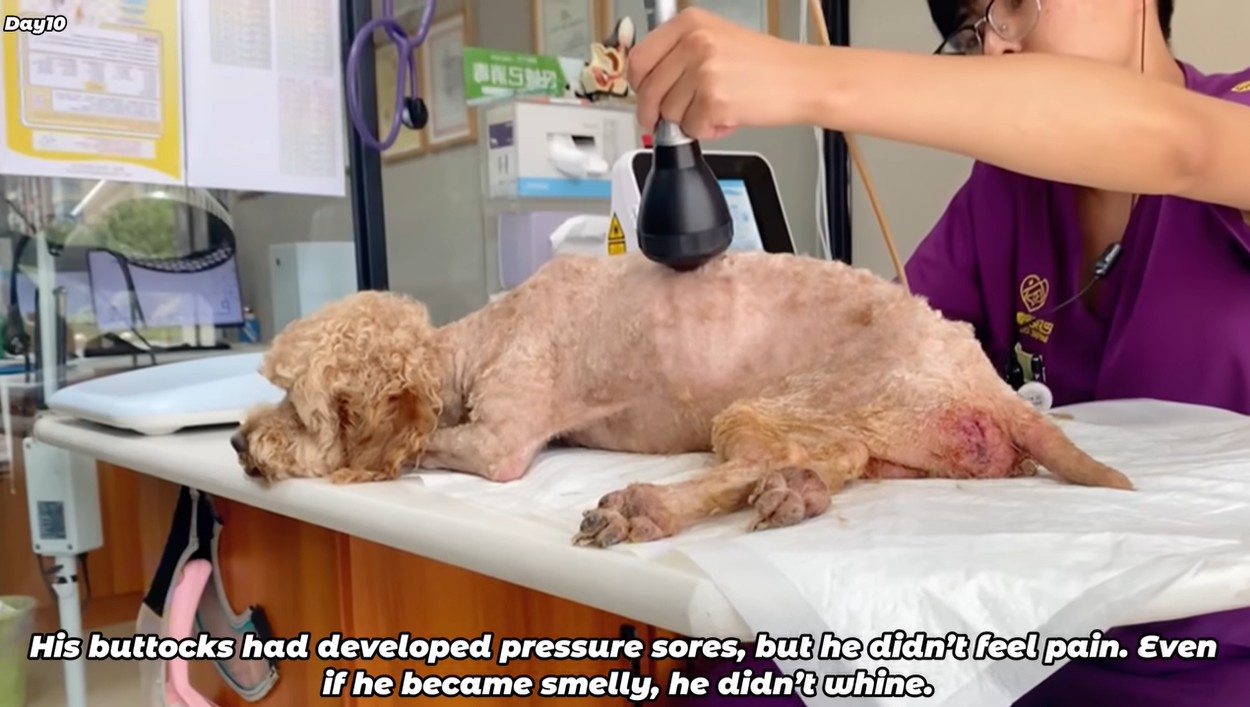
Around the tenth day, a more detailed examination showed severe nerve compression.
The condition explained why his recovery would not be simple.
There was another problem too.
Because Tiao Tiao had been dragging his hindquarters across hard surfaces, the skin around his hips and rear had become badly irritated.
Pressure injuries were beginning to form.
For animals with limited mobility, these injuries can become serious because the same areas of skin repeatedly bear friction and pressure.
Preventing further damage became almost as important as treating the original neurological condition.
Surgery was considered.
But according to the rescuers, it carried significant risks, substantial expense, and no certainty that it would restore normal movement.
So they chose a different path.
Acupuncture.
Physical therapy.
And long-term rehabilitation.
Recovery Became a Routine
Tiao Tiao’s treatment required repetition.
There were acupuncture sessions.
Electrotherapy.
Exercises designed to stimulate weak muscles and nerves.
Positioning to reduce pressure on vulnerable areas of skin.
And careful monitoring of how his body responded.
These sessions were not always comfortable.
But the caregivers stayed close and kept the process controlled.
There was no expectation that one treatment would suddenly make him stand.
The goal was to create enough stimulation and support for his nervous system to show any sign of improvement.
Some days offered little visible change.
Then another session came.
And another.
This is often what rehabilitation looks like.
Not one dramatic breakthrough.
Just the same work repeated long enough for the smallest improvement to become possible.
Day 22 Brought the First Sign Everyone Had Been Waiting For
Then, around day 22, something changed.
Tiao Tiao began showing signs that sensation was returning to his hind legs.
It was not full recovery.
He did not suddenly stand and walk across the room.
But for a dog whose lower body had previously shown very little response, the change mattered enormously.
His caregivers now had something concrete to build on.
Nerve response.
Movement potential.
A reason to continue.
Tiao Tiao was brought home so rehabilitation could continue in a more familiar environment.
There, therapy became part of daily life.
Exercises were no longer something that happened only during clinical appointments.
They became part of the routine.
Morning.
Afternoon.
Again the next day.
Small movements.
Repeated patiently.
Then Came the Cart
Even with returning sensation, Tiao Tiao still could not move normally on four legs.
So his caregivers had a rehabilitation cart made for him.
The device supported his hindquarters while allowing his front legs to provide propulsion.
At first, the mechanics were unfamiliar.
Tiao Tiao had spent so much time dragging himself that rolling forward required a completely different sense of balance.
He had to learn how wide the cart was.
How turning worked.
How much effort was needed to move.
How to stop.
How to change direction.
But once he understood the system, the difference became immediate.
He no longer had to scrape his lower body against the ground.
His hips were lifted.
His back legs were protected.
And the world suddenly became much easier to reach.
Mobility Changed More Than Distance
With the cart, Tiao Tiao could move through the yard more freely.
He could follow other dogs.
He could explore longer stretches of the countryside.
He could travel without placing constant friction on his injured skin.
The device did not cure his paralysis.
But it removed one of the biggest barriers created by it.
That distinction mattered.
Tiao Tiao did not need to wait until his body was completely healed before he was allowed to enjoy movement.
He could participate now.
He could go outside now.
He could interact with the world now.
Rehabilitation continued in parallel.
The cart gave him mobility while therapy continued giving his body opportunities to improve.
By Day 117, He Was No Longer Simply Rolling Forward
Over the following weeks, Tiao Tiao became increasingly confident with his equipment.
Then came another major milestone.
Around day 117, he received a better-quality cart.
By then, he understood exactly what to do with it.
He was not cautiously learning anymore.
He was moving with purpose.
Soon, Tiao Tiao was jogging along countryside roads.
His front legs powered the cart while the wheels supported everything behind him.
Other rescue dogs joined him.
One of them, Ping An, often accompanied him on these outings.
Together, the dogs moved through the rural paths like a small neighborhood patrol.
It was a remarkable contrast.
A little more than three months earlier, Tiao Tiao had been dragging his hind legs across pavement.
Now he was covering distance quickly enough that the other dogs had to keep up.
His Legs Still Had More Work to Do
The cart improved Tiao Tiao’s freedom, but his caregivers never stopped working on rehabilitation.
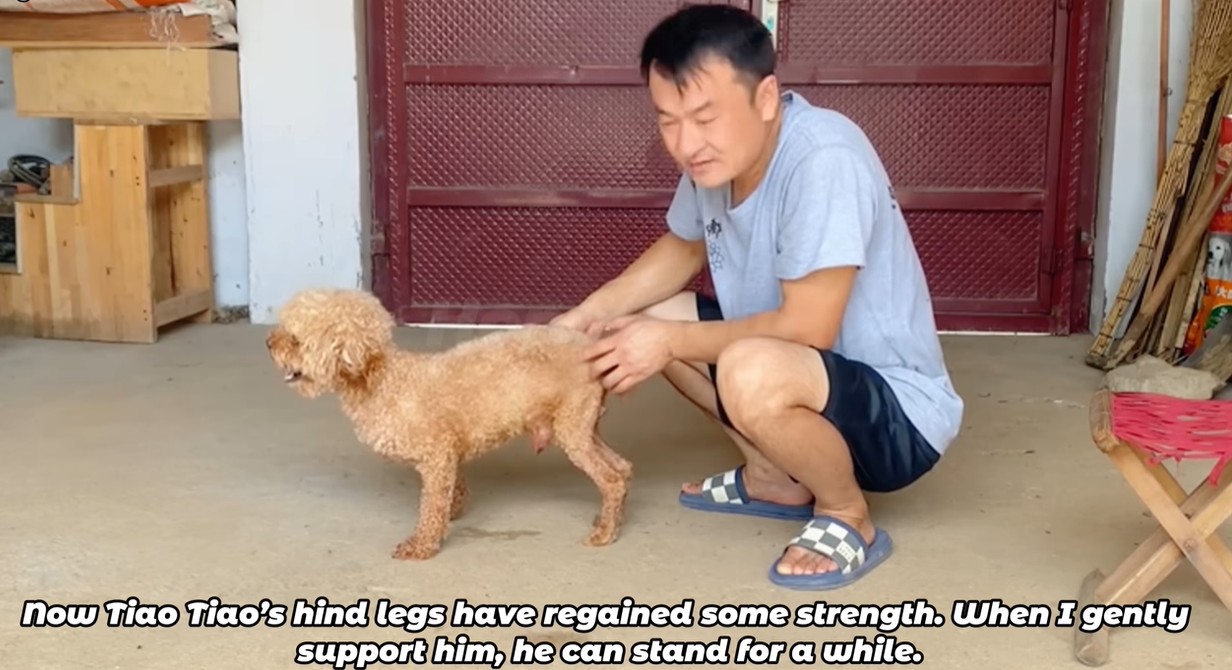
They continued encouraging his legs to bear weight.
They continued exercises.
They continued watching for changes in sensation and strength.
Eventually, Tiao Tiao reached another important stage.
He could support himself briefly.
Only for a few seconds.
But he could do it.
For a dog who had once been unable to use his hindquarters at all, those seconds represented real progress.
The movement was not stable enough for independent walking.
He still needed his cart for meaningful mobility.
But his body was doing something it had once been unable to do.
That was enough reason to keep going.
He Did Not Need to Be Fully Healed to Have a Good Life
It is easy to judge recovery by one question:
Can he walk normally again?
But Tiao Tiao’s story shows why that question can be too narrow.
Today, he can spend time outside.
He can move quickly with his cart.
He can socialize with other dogs.
He can enjoy sunlight.
He can explore.
He can participate in the routines of the rescue yard.
And he can briefly support some of his own weight.
His recovery is still incomplete.
But his life is not on hold while everyone waits for perfection.
That may be the most important part of his story.
Mobility can take many forms.
A good life can too.
The Road Where He Crawled Is No Longer His Whole Story
The image from the beginning remains powerful.
A dog beside the road.
Front legs pulling.
Back legs dragging.
Every movement paid for with effort.
But that image is only the first chapter.
Then came the hospital.
A diagnosis of neuritis.
Day 10 and the discovery of severe nerve compression.
A decision to pursue acupuncture and rehabilitation.
Day 22 and the return of sensation.
A custom cart.
More therapy.
A better cart.
Day 117.
Jogging.
And finally, those few precious seconds when Tiao Tiao could hold himself upright.
None of those moments erased the one before it.
They built on each other.
That is why his recovery matters.
Not because Tiao Tiao suddenly became a dog without limitations.
But because each limitation was met with a practical answer.
When he could not walk, people carried him.
When dragging injured his skin, they protected it.
When surgery offered uncertain results, they committed to rehabilitation.
When his legs could not carry him far enough, they gave him wheels.
And when sensation began to return, they kept helping him use it.
Tiao Tiao is still on that journey.
He may one day stand longer.
He may gain more strength.
No one can promise exactly where his recovery will end.
But one thing is already certain.
The dog who once had to drag himself forward just to survive no longer faces the road alone.
Now, whether on four paws for a few seconds or on two paws and two wheels for much longer—
Tiao Tiao keeps moving.


