The sound came before anyone understood where it was coming from.
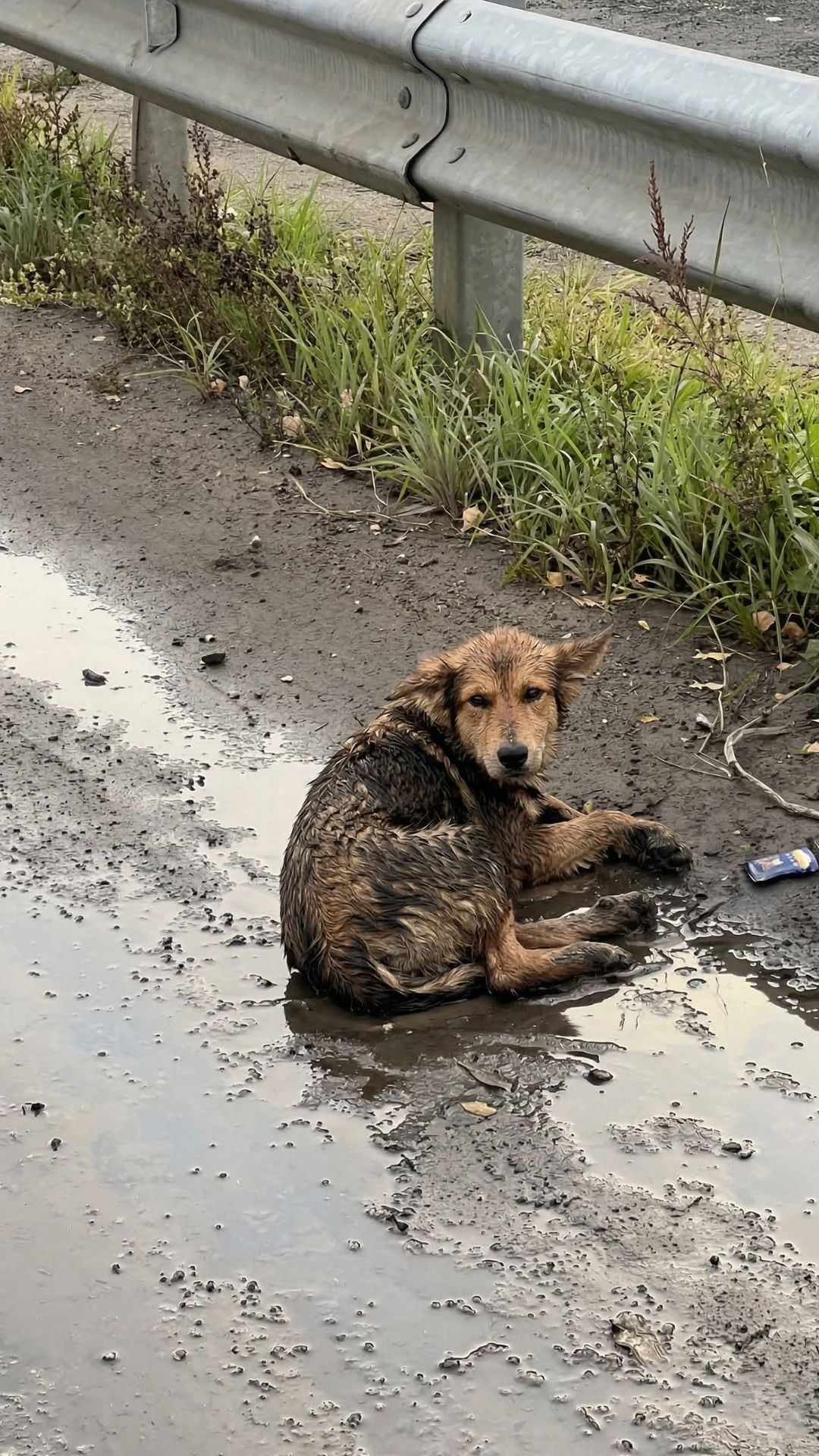
Along a wet roadside, beneath the steady rain and the noise of passing traffic, a dog was crying.
Not loudly.
Not continuously.
Just a small, repeated sound from somewhere close to the pavement.
Then they saw him.
A young dog lay soaked beside the road, unable to get up. His body remained almost completely still while rain darkened the ground around him.
He could not move himself somewhere safer.
He could not follow anyone for help.
When rescuers approached, however, Harvard made one thing very clear.
He was frightened.
And he was hurting.
He Was Injured, But He Still Tried to Protect Himself
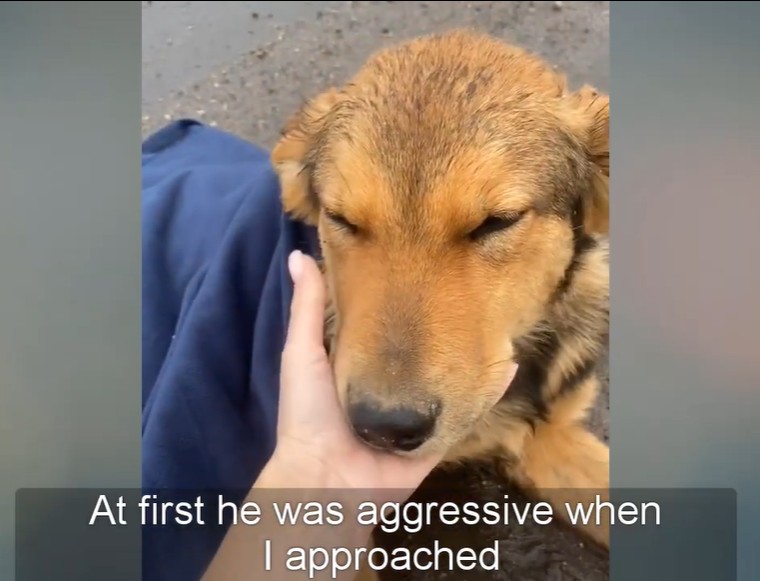
The first response was a growl.
Harvard did not wag his tail when rescuers came closer.
He did not reach toward them.
His body tensed, and his warning made them slow down immediately.
For an injured dog lying helplessly beside a road, that reaction was understandable.
Whatever had happened had left him unable to move normally. He had no way of knowing whether the unfamiliar people surrounding him were there to help or whether another frightening experience was about to begin.
So the rescuers did not reach for him immediately.
They crouched nearby.
They spoke quietly.
They allowed Harvard to see where their hands were.
Every movement was deliberate.
The growling continued at first.
Then gradually, it became less frequent.
Harvard kept watching them, but the tension in his body began to ease.
Eventually, he allowed someone to touch him.
There was no dramatic moment when fear disappeared entirely.
There was simply a dog in severe discomfort deciding, little by little, not to resist the people trying to lift him from the road.
That was enough.
The rescuers carefully supported his injured body and prepared to move him.
Their concern was no longer only about what they could see.
They were afraid of what might be happening beneath the surface.
VIDEO: Harvard Couldn’t Stand After the Road Accident — Then Rescuers Faced the Question Everyone Feared
The Trip to the Clinic Raised an Even Bigger Fear
Moving Harvard had to be done carefully.
Every shift in his position risked causing more pain.
The rescuers already suspected serious fractures, but there was another possibility they could not ignore.
A spinal injury.
Harvard’s inability to stand could have come from broken bones.
But if his spine had also been damaged, the consequences could be very different.
The ride to the veterinary clinic therefore carried an uncomfortable uncertainty.
Would he regain the ability to walk?
Or had the accident caused damage that could not be repaired?
Harvard could not answer any of those questions.
He could only lie still while the rescuers transported him away from the wet roadside.
At the clinic, veterinary staff began examining him as quickly as possible.
The rain and dirt could be cleaned away.
Pain could be treated.
But first, they needed to understand what had happened inside his body.
Imaging would provide the answer.
And the results showed that Harvard’s injuries were serious.
The X-Rays Revealed More Than One Injury
The veterinary examination confirmed that Harvard had suffered substantial trauma.
One of his legs was badly fractured.
His pelvis was also fractured, making the injury considerably more complicated than a single broken limb.
There was another concern as well.
The rescue account described internal bruising affecting his urinary system, meaning the team needed to watch more than his bones while stabilizing him.
The combination explained why Harvard had been unable to simply stand and walk away after the accident.
His body needed time.
Pain management.
Careful monitoring.
And surgery.
Still, one of the most frightening possibilities had been the uncertainty surrounding whether he would regain normal movement.
The veterinary team could repair what they could see.
What no one could promise immediately was exactly how Harvard would recover afterward.
The first night became focused on stabilization.
His pain needed to be controlled before anything else could move forward.
The surgical plan had to account for injuries involving both his leg and pelvis.
There would be no quick fix followed by an immediate return to normal.
Harvard was facing a recovery measured in days and weeks rather than hours.
For the people who had found him on the road, that meant another period of waiting.
Only now the question had changed.
They were no longer wondering whether anyone would stop for Harvard.
They were wondering whether his body could recover enough to let him stand again.
Surgery Repaired the Damage — But Standing Was Another Challenge
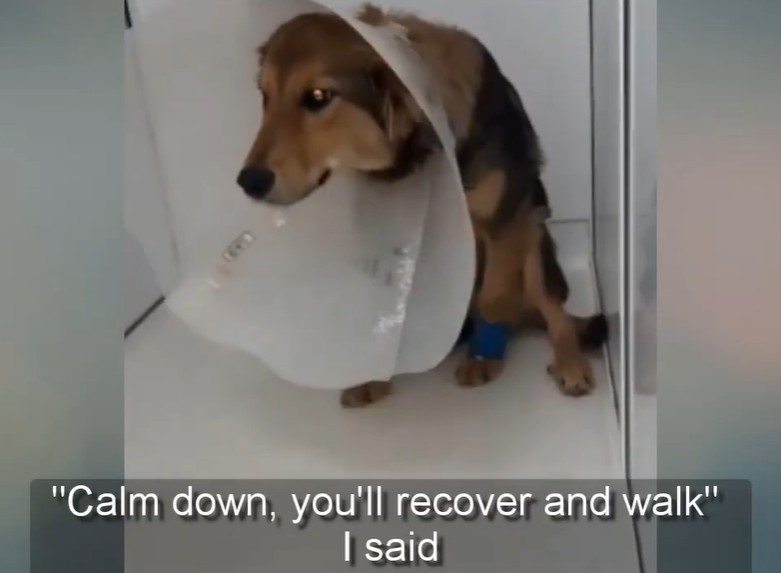
Harvard made it through surgery successfully.
That was an important milestone.
It was not the end of the difficult part.
When the anesthesia wore off, the physical reality of recovery remained.
His bones had been treated, but his body was weak.
His movements were limited.
His muscles had not suddenly forgotten the pain and trauma of the accident simply because the procedure was complete.
At some point during the early recovery, Harvard tried to push himself upward.
He could not do it.
His body sank back down.
Later, he tried again.
Still no success.
For the people caring for him, those attempts were difficult to watch.
There was no way to explain to Harvard that healing was happening even if he could not yet see the result.
They could support him.
Keep him comfortable.
Prevent him from overexerting himself.
And wait.
That patience mattered.
Because only a few days later, Harvard tried again.
This time, something changed.
He pushed upward.
His legs trembled beneath him.
His balance was uncertain.
But instead of immediately collapsing back down, Harvard remained upright.
For a few seconds, he was standing.
A Few Seconds on Four Feet Changed the Mood of the Room
Standing is such an ordinary action that most dogs do it thousands of times without anyone noticing.
For Harvard, those few seconds carried an entirely different meaning.
Only days earlier, he had been lying beside the road with no ability to move himself to safety.
Then came the fractures.
The surgery.
The first failed attempts to rise.
Now his paws were beneath him again.
His body wobbled.
The veterinary team did not expect him to suddenly start running through the clinic.
Nor would they have allowed it.
His repaired injuries still required controlled healing.
But Harvard had demonstrated something everyone desperately wanted to see.
His body could support him.
The question had not been completely resolved—full recovery would still take time—but the direction was suddenly clearer.
From there, progress continued gradually.
Harvard became more stable.
The days passed.
His surgical wounds healed enough that the stitches could eventually be removed.
And another difference became apparent.
The dog interacting with his caregivers no longer behaved exactly like the frightened animal first approached beside the road.
At the beginning, pain had made every unfamiliar hand something to be wary of.
Now the people around him had become part of his daily routine.
They brought food.
Helped him move safely.
Checked his healing injuries.
Sat near him.
And returned again the next day.
Trust had not appeared because someone told Harvard he should trust.
It was built through repetition.
Recovery Happened in Small Movements, Not One Miracle
Harvard still had work ahead of him after those first successful attempts to stand.
A repaired fracture does not immediately become a strong leg.
A healing pelvis still needs protection.
Every additional movement had to happen within what his recovering body could manage.
That made seemingly small changes important.
Standing a little longer.
Taking controlled steps.
Shifting his weight more comfortably.
Responding to people without the same defensive tension.
Eating while surrounded by familiar caregivers.
Resting instead of remaining constantly alert.
No single one of those moments was as dramatic as surgery.
Together, however, they represented Harvard getting his ordinary life back.
The dog found on the rainy roadside had originally been defined almost entirely by what he could not do.
He could not stand.
He could not walk away.
He could not protect himself from the weather.
During recovery, that list began shrinking.
His movements improved.
His body strengthened.
He became more interested in the environment around him.
And once his medical team was satisfied with his healing, another transition became possible.
Harvard could leave the hospital setting behind.
He was going home.
A New Home Asked Harvard to Learn a Different Kind of Routine
Leaving veterinary care did not mean that Harvard’s past disappeared.
But it changed what filled his days.
Instead of examination rooms and treatment, there were ordinary household sounds.
Soft places to lie down.
Regular meals.
People he could begin recognizing as part of his life rather than temporary caregivers.
Other dogs were there too.
Harvard entered this new environment carefully.
Some of the dogs were curious about him.
Others kept their own distance at first.
Harvard had to learn how to move among them while still adjusting to a body that had recently endured serious injury.
There was no need to rush that process.
He had already spent enough time being forced by circumstances to do things before he was ready.
Home gave him something different.
Routine.
He could wake up somewhere familiar.
Rest without traffic passing only feet away.
Receive affection without an examination following immediately afterward.
Over time, those simple experiences accumulated.
A hand behind his ears.
A comfortable bed waiting at night.
Other dogs moving through the house.
The knowledge that food would arrive again tomorrow.
None of it sounded extraordinary.
For Harvard, ordinary was exactly what had been missing.
The Dog Who Growled at the First Hand Began Seeking Company
One of the clearest contrasts in Harvard’s story came through his relationship with people.
When rescuers first found him, approaching hands caused him to growl.
By then, pain and uncertainty had made defensive behavior one of the few tools available to him.
No one punished him for it.
They slowed down instead.
That choice became important later.
Because as Harvard recovered, he began experiencing human contact under very different circumstances.
A hand might bring food.
Another might gently scratch his head.
Someone might help him settle onto a soft bed.
Someone else might simply sit nearby.
The repeated experience of safe contact allowed his behavior to change at its own pace.
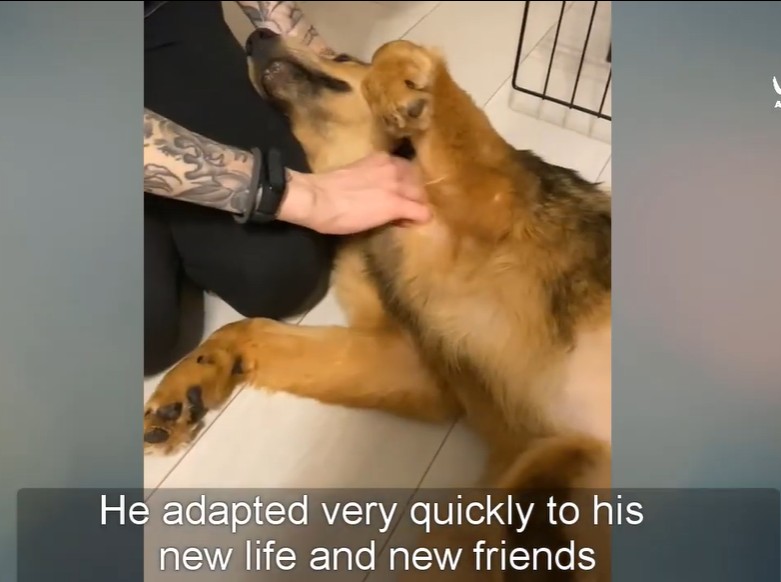
Eventually, the growling roadside dog was no longer the Harvard everyone saw.
He became more comfortable around people.
More relaxed inside the home.
More willing to participate in the life happening around him.
The same dog who once could not get up when strangers approached could now move toward the people caring for him.
That transformation did not require Harvard to forget what had happened.
It required enough new experiences to stop one frightening day from controlling every day that followed.
The Road Where Harvard Couldn’t Stand Became Part of His Past
It is easy to remember Harvard’s rescue through the biggest moments.
The accident.
The fractures.
The surgery.
The first time he stood.
But perhaps the most important part came afterward.
Harvard kept having ordinary days.
Another morning when he could get up.
Another meal.
Another walk through the house.
Another interaction with the dogs around him.
Another evening when he could lie somewhere dry and comfortable instead of beside a rain-soaked road.
Over time, the emergency became history.
Harvard continued moving.
The source account describes him later running and playing—a very different picture from the motionless dog rescuers initially found.
That contrast is what makes his journey difficult to forget.
At the beginning, Harvard had only one thing he could still do for himself.
Cry out.
Someone heard him.
Then came the careful approach, the warning growl, the drive to the clinic, the X-rays and the difficult diagnosis.
Surgery repaired what could be repaired.
Time did the rest gradually.
First, Harvard tried to stand and failed.
Then he tried again.
A few days later, his trembling legs held him upright.
Only for moments.
But moments were enough to begin.
From there came more strength.
More movement.
A home.
Other dogs.
People whose hands no longer represented danger.
And eventually, a life in which the accident was no longer the center of every day.
The dog on that wet road could not have known any of this was ahead of him.
All he could do was make enough sound for someone to notice.
Someone did.
And when Harvard finally stood again, the road behind him was no longer where his story had to end.


