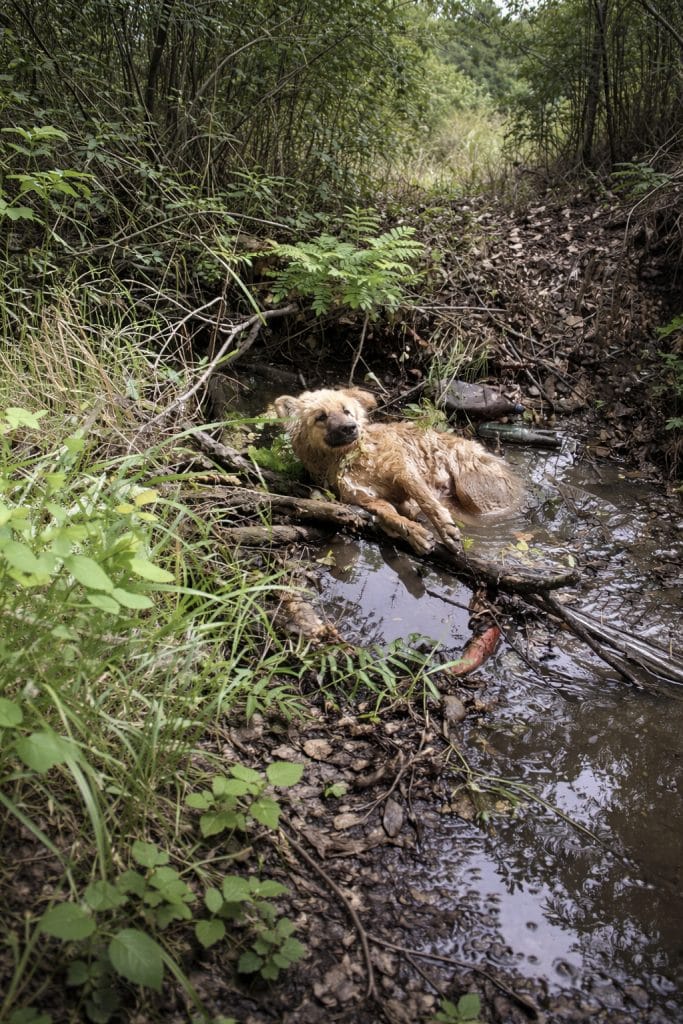
A faint cry rose from the freezing water beside the road.
Inside the ditch, an injured dog lay almost motionless. Cold water surrounded his body, and every attempt to shift position appeared to cause pain.
Cars continued passing nearby.
Hours went by.
Still, the dog remained trapped.
By the time rescuers reached him, he had reportedly spent nearly an entire day in the icy ditch. His body was trembling, his strength was fading, and fear made it difficult for him to understand that the people approaching had come to help.
The dog, later named Mulan, would survive the cold.
But the examination that followed revealed injuries severe enough to change the rest of his life.
His rescue would require more than removing him from the water.
It would involve a blood transfusion, spinal surgery, medical setbacks, months of recovery, and a family willing to love him even if he never walked again.
The Dog Crying From the Freezing Water
When rescuers first saw Mulan, he was lying low inside a roadside ditch filled with icy water.
He appeared unable to lift or support his body properly. The lower half of him remained nearly motionless, while the cold continued drawing away whatever strength he had left.
No one knew exactly how he had become injured or how he had ended up in the ditch.
They could only see what was in front of them.
Mulan was soaked.
He was in visible pain.
And he could not escape without assistance.
Whenever a rescuer tried to move closer, he reacted defensively.
His response was understandable.
He was injured, trapped, and surrounded by unfamiliar people. Any attempt to touch him may have felt like another threat.
The rescue team did not interpret his fear as a reason to leave him.
They slowed down.
They spoke gently and carefully planned how to lift him without worsening the injuries they could not yet see.
Before moving Mulan, they administered pain medication. This helped reduce some of his immediate discomfort and made it safer to handle him.
Then the rescuers entered the ditch.
Supporting his body as evenly as possible, they lifted him from the water and carried him toward the waiting vehicle.
Mulan had escaped the cold.
But the condition of his body remained deeply concerning.
His legs could not support him.
His breathing and awareness needed close attention.
And the team still had no idea how much damage had occurred beneath the surface.
They began driving toward emergency veterinary care.
Only twenty minutes into the journey, Mulan suddenly collapsed.
Video: Rescuers Lift Mulan From an Icy Ditch After His Cries Go Unanswered for Hours
He Collapsed Before Reaching the Hospital
The sudden change inside the vehicle was terrifying.
Mulan’s already weak body appeared to lose what little stability it had left. For several moments, the rescuers feared that he might not survive long enough to reach treatment.
They remained beside him.
They continued speaking calmly and tried to keep him as comfortable as possible while alerting the veterinary team that his condition had become even more urgent.
At the hospital, doctors began working immediately.
Mulan was suffering from a combination of trauma, shock, prolonged exposure to cold, and severe physical weakness.
One of the first critical treatments was a blood transfusion.
His body needed additional support before the medical team could fully evaluate the spinal injuries affecting his movement.
The transfusion was not a complete solution.
It was a necessary step toward stabilization.
Slowly, Mulan regained consciousness.
The change was fragile.
He was not suddenly alert or comfortable. He remained exhausted and frightened, but he once again reacted to the voices and movement around him.
For the rescuers, that response mattered.
Mulan had survived the icy water.
He had survived the collapse during transport.
Now he had reached the people capable of determining whether anything could be done for his damaged body.
The veterinary team monitored him closely while preparing diagnostic imaging.
They needed to understand why he could not support himself and whether the damage was temporary or permanent.
The X-rays soon provided the answer.
Mulan’s spine had suffered major trauma.
Several vertebrae had shifted from their normal positions, affecting both stability and the function of the lower half of his body.
The diagnosis changed the direction of his rescue completely.
Removing him from the ditch had saved him from freezing.
Saving him from ongoing pain would require surgery.
The Diagnosis Came With No Promise He Would Walk Again
The veterinary team explained that Mulan’s spinal injury was severe.
The displaced vertebrae were affecting movement and sensation below the damaged area. Based on the extent of the trauma, there was a serious possibility that he would never regain normal use of his legs.
For the rescuers, the news was difficult.
They had hoped that once Mulan was warmed and stabilized, his inability to stand might improve.
Instead, the imaging showed structural damage that could not simply be treated with rest.
Surgery offered the best chance to stabilize his spine.
The procedure could reduce movement at the injured area, prevent additional damage, and help relieve the pain caused by the unstable vertebrae.
But the surgeons could not promise that Mulan would walk again.
That distinction mattered.
The purpose of the operation was not to create a dramatic miracle.
It was to give Mulan a safer, more comfortable life and preserve whatever recovery remained possible.
Before surgery, he appeared deeply unsettled.
He refused food.
He remained weak after everything his body had endured.
The unfamiliar hospital environment added another layer of stress.
His rescuers stayed close.
They spoke softly and allowed him to hear voices he had begun to recognize. No one could explain the operation to him, but their presence offered something consistent in a frightening place.
Mulan did not know what would happen next.
He only knew that the people who had lifted him from the water had not disappeared.
The surgery lasted nearly four hours.
Veterinary surgeons carefully realigned and stabilized the damaged portion of his spine. A metal support rod was used to hold the affected area in a safer position and reduce further movement.
Outside the operating room, the rescuers waited through another long period of uncertainty.
Mulan had already come close to dying during transport.
Now his exhausted body had to withstand a complicated spinal procedure.
Eventually, the update arrived.
The surgery had been completed successfully.
Mulan had survived.
But surgery was only the beginning of a far longer recovery.
The First Peaceful Sleep Became a Victory
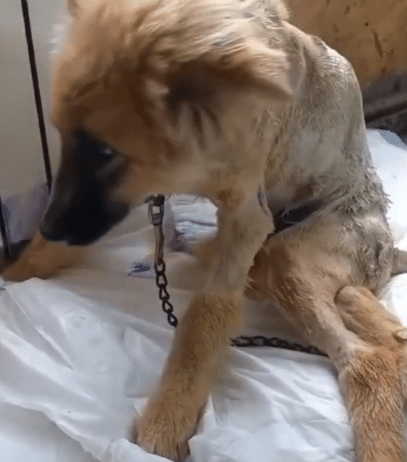
During the days immediately after surgery, Mulan remained unable to stand.
That had been expected.
His spine needed time to stabilize, and his body was still recovering from shock, cold exposure, the transfusion, and the operation itself.
The caregivers focused on basic signs of improvement.
His appetite began returning gradually.
At first, he ate only small amounts. Then meals became more consistent.
He appeared more aware of the people entering his room.
Most importantly, he could finally rest without the same overwhelming pain that had kept his body tense.
For Mulan, peaceful sleep was meaningful progress.
Before the rescue, he had been lying injured in freezing water, unable to move away from the source of his suffering.
At the hospital, he could rest on clean, dry bedding while medication and careful positioning reduced his discomfort.
He still needed help with nearly everything.
Caregivers adjusted his body regularly to prevent pressure injuries.
They monitored the surgical site.
They helped him eat, kept him clean, and watched for changes in his breathing, temperature, or behavior.
Mulan could not understand the medical purpose behind each action.
But he began observing a pattern.
People entered gently.
They touched him carefully.
They brought food.
They made him more comfortable.
Then they returned later and did the same things again.
His body remained limited.
His environment, however, had become predictable.
About one week after surgery, a new complication appeared.
Mulan’s blood sugar levels were unusually high, and the surgical wound was healing more slowly than expected.
The veterinary team had to give the area additional attention, manage the risk of infection, and make adjustments connected with the spinal support.
It was a significant setback.
The operation had succeeded, but Mulan’s body was not recovering as smoothly as everyone hoped.
Still, the team continued.
The wound was cleaned and monitored.
Treatment was adjusted.
And Mulan remained surrounded by people who refused to interpret one complication as the end of his chance.
His Body Grew Stronger Even Without Perfect Steps
After approximately one month, the improvements became easier to see.
Mulan gained weight.
His appetite became stronger.
His overall condition grew more stable.
The area around his spine continued healing, and his body no longer looked as depleted as it had when he arrived from the ditch.
He still could not walk.
The veterinary team remained cautious about his long-term mobility. The damage had been severe, and no one wanted to create false expectations around what his body might eventually be able to do.
But Mulan’s life was improving in other important ways.
He could rest comfortably.
He could eat without the same weakness.
He could interact with the people caring for him.
The frightened dog who had reacted defensively in the icy water started becoming calmer around familiar caregivers.
At first, he watched hands carefully.
Unexpected movement could still make his body tense.
Years—or perhaps only moments—of fear could not be measured precisely, but the effects of his trauma were visible.
The caregivers did not force affection.
They sat near him.
They spoke before reaching toward him.
They allowed him to observe and decide how much closeness he could tolerate.
Small behavioral changes followed.
His posture softened when familiar people approached.
He accepted gentle touch without reacting as strongly.
He rested while someone remained beside him.
Occasionally, curiosity replaced the guarded expression he had worn since the rescue.
These changes did not mean Mulan had forgotten the ditch or the pain.
They showed that he was accumulating new experiences.
A hand adjusting his blanket without hurting him.
A voice returning each morning.
A meal offered consistently.
A caregiver remaining beside him during an uncomfortable treatment.
His physical limitations were still present.
But fear no longer controlled every interaction.
Mulan was learning that a changed body could still experience comfort, attention, and companionship.
People Saw His Disability Before They Saw Him
As Mulan continued recovering, the rescue team began searching for a permanent home.
They knew the process might be difficult.
A dog with serious spinal damage can require ongoing assistance. Depending on his condition, Mulan might need help changing position, staying clean, moving safely, or preventing complications associated with limited mobility.
His future family would need patience.
They would need to understand that caring for him might look different from caring for a dog who could walk independently.
At first, no one came forward.
Some potential adopters hesitated after learning that Mulan might never walk again.
The rescuers understood the responsibility involved, but the lack of interest was painful.
They had seen more than his medical records.
They knew the dog who relaxed around familiar voices.
The dog whose expression softened when someone approached gently.
The dog who had survived freezing water, collapse, transfusion, spinal surgery, and a difficult postoperative complication.
His inability to walk did not remove his capacity to form bonds.
It did not make comfort meaningless to him.
And it did not change the fact that he needed a safe place to live.
The rescue team continued sharing his story.
They did not hide the challenges.
Mulan needed a family willing to accept that his care could be lifelong.
He might never run across a yard or climb stairs.
His future would need to be built around what his body could do rather than constant frustration over what it could not.
Still, he could enjoy food.
Rest in the sun.
Recognize familiar people.
Receive affection.
And become part of a household.
The goal was not to find someone who felt sorry for him.
It was to find someone prepared to value the life he still had.
Eventually, a family did.
A Family Chose the Dog He Had Become
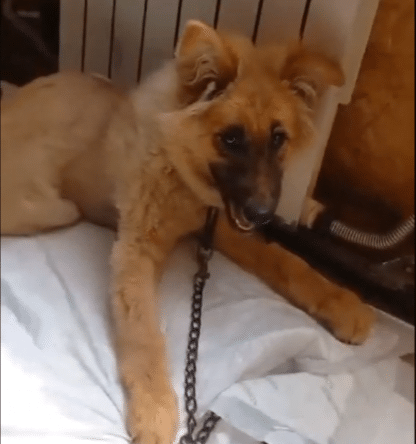
Mulan’s adopters understood the medical reality.
They knew he would likely never walk normally again.
They knew he might need continued assistance and an environment adapted to his limitations.
Still, they chose him.
They did not wait for a miraculous recovery before deciding he deserved a home.
They welcomed the dog who existed in front of them.
For Mulan, adoption meant leaving the uncertainty of temporary care behind.
Inside his new home, he had familiar voices, soft bedding, regular meals, and people learning the routines needed to keep him comfortable.
The transition required patience.
A dog who had experienced severe trauma and months of medical handling could not be expected to relax immediately in another unfamiliar place.
His family allowed him time.
They paid attention to the signals in his posture.
They approached carefully and created routines he could begin to recognize.
Gradually, Mulan understood that he was not being moved again because someone had given up on him.
This time, he had been taken somewhere to stay.
His body remained changed by the spinal injury.
The metal support, surgical scar, and limited movement were all part of his life.
But they were no longer the only parts.
There were quiet moments with his family.
Comfortable places to sleep.
Hands he recognized.
Days that did not begin with cold water or fear.
Mulan’s adoption did not erase the medical challenges ahead.
It placed those challenges inside a life that also contained love.
Rescue Gave Him More Than the Ability to Survive
Mulan’s story began in an icy roadside ditch.
For nearly a day, he reportedly remained there, injured and crying softly while the cold pressed against a body that could not escape.
When rescuers finally approached, he reacted from fear.
They helped him anyway.
They administered pain relief.
Lifted him carefully.
Stayed beside him when he collapsed.
And brought him to a medical team that could address the damage hidden inside his spine.
Nothing that followed was easy.
Mulan needed a blood transfusion.
The diagnosis suggested he might never walk again.
His spinal surgery lasted approximately four hours.
The wound healed slowly because of unusually high blood sugar, creating another complication when everyone hoped the most dangerous period had passed.
Even after his physical condition improved, finding a family willing to accept his needs took time.
His journey did not follow the simple rescue pattern of injury, treatment, and complete physical restoration.
Mulan did not necessarily recover everything he had lost.
Instead, the people around him built a safe life around the body he still had.
That is also rescue.
It is controlling pain even when perfect movement cannot return.
It is protecting dignity when an animal needs assistance.
It is recognizing that a dog does not have to walk normally to experience affection, security, curiosity, or peace.
Mulan’s life now contains things that seemed impossible while he lay in the ditch.
Warmth.
Rest.
Familiar people.
A home.
And care that does not depend on whether he ever takes another unaided step.
His past remains part of his story.
The cold water happened.
The injury changed him.
The surgery left permanent evidence of what his body endured.
But those events no longer determine every day that comes afterward.
Mulan’s future is now shaped by the family who chose him with full knowledge of his limitations.
His journey reminds us that rescue is not always about returning an animal to the life he had before.
Sometimes there is no way to restore everything.
Sometimes the most compassionate outcome is to reduce suffering, protect what remains, and create a new life worth living.
Mulan may never move through the world in the way he once did.
But he is no longer trapped.
He is no longer freezing.
And he is no longer waiting for someone to hear him cry.
He survived because rescuers refused to leave him in the water.
He began healing because veterinarians treated the pain his body could not escape.
And he found a home because one family looked beyond his damaged spine and saw a dog who still had love to give.
His story began with tragedy.
It continues with something quieter—and far more lasting.
Someone stayed.


