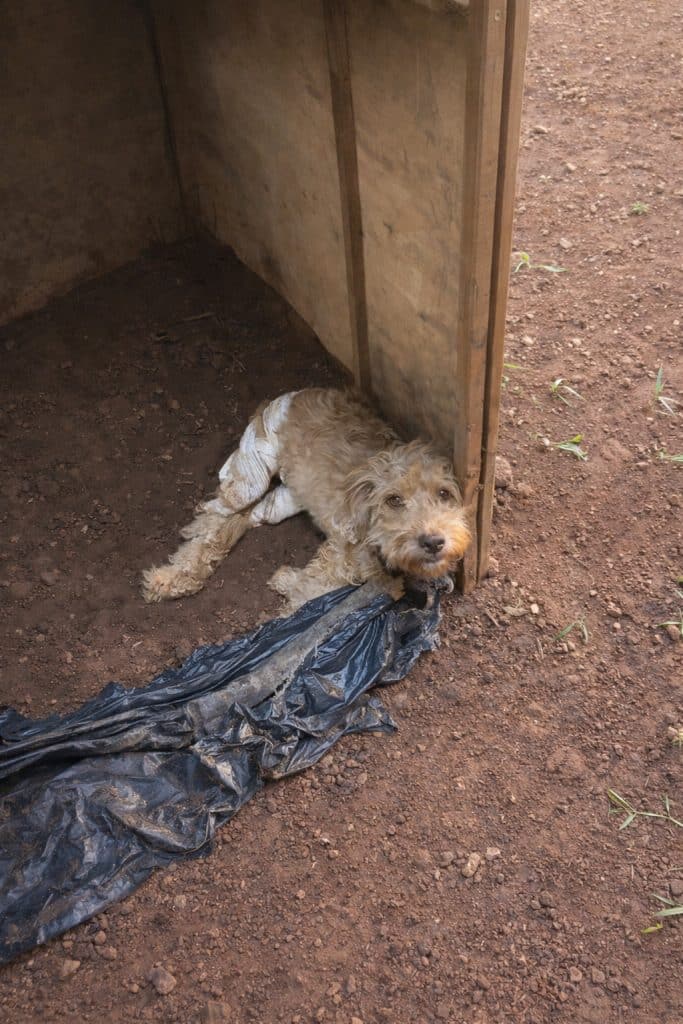
At the edge of the woods, inside a damaged wooden shelter, rescuers found a dog curled quietly in the corner.
He was dirty.
Exhausted.
And barely moving.
At first, it was difficult to understand what had happened to him.
Then they noticed his back legs.
The dog could not walk normally. To reach this place, he had been pulling himself across the ground, dragging an injured body that had already endured far more than anyone first realized.
Later, they would name him Juju.
But before he could begin a new life, rescuers had to understand the injuries he had been carrying alone.
He Had Somehow Dragged Himself Far Enough to Find Shelter
Juju had reportedly been struck by a vehicle.
The injuries were serious.
But instead of receiving immediate treatment, he had been left without the medical attention he needed.
Unable to use his body normally, Juju adapted in the only way available to him.
He pulled himself forward.
His front legs did the work while the rest of his body followed across rough ground.
Every stretch of that journey placed more pressure on already damaged areas.
Eventually, he reached the broken shelter near the woods.
There, he stopped.
By the time rescuers discovered him, Juju no longer had the strength to continue moving as he had before.
He simply remained curled inside.
There was no way to know exactly how long he had been there.
But one thing was immediately clear.
He needed veterinary help.
Video: Juju Dragged Himself Into an Abandoned Shelter — Then Rescuers Saw the Injuries He Had Been Carrying
The Damage Was Worse Than Anyone Could See From the Outside
Juju was taken to a veterinary clinic as quickly as possible.
Once he was examined, the seriousness of his condition became clearer.
His spine had been injured.
His knees were also badly damaged from repeatedly dragging himself across the ground.
They had become raw from the constant friction.
The problem was no longer simply that Juju could not walk.
Every attempt to move the way he had been moving was creating additional discomfort and injury.
The veterinary team needed to address that first.
According to the rescue account, surgery was recommended.
The goal was not presented as a promise that Juju would suddenly regain normal use of his legs.
Instead, treatment focused on relieving pain and improving his quality of life.
That distinction mattered.
Sometimes veterinary care can restore what was lost.
Other times, the most compassionate goal is helping an animal live comfortably with a body that may never function exactly as it once did.
For Juju, the team prepared for that second possibility.
Surgery Could Ease His Pain, but It Couldn’t Promise His Old Life Back
The operation required careful work.
Juju’s body had already endured the original trauma, untreated spinal damage, and the repeated strain of dragging himself across the ground.
The veterinary team proceeded with the goal of making daily life more comfortable.
After surgery, Juju entered recovery.
For the first time since he had been found, there was an opportunity for his injured body to rest without constantly scraping itself forward.
The procedure helped address his discomfort.
But one reality remained.
Juju was not expected to return immediately to normal walking.
Possibly, he never would.
That could have made his story feel like one defined entirely by loss.
Instead, his caregivers began asking a different question.
If Juju could not move through the world the way most dogs did, how could they help him move through it safely in his own way?
That question changed the direction of his recovery.
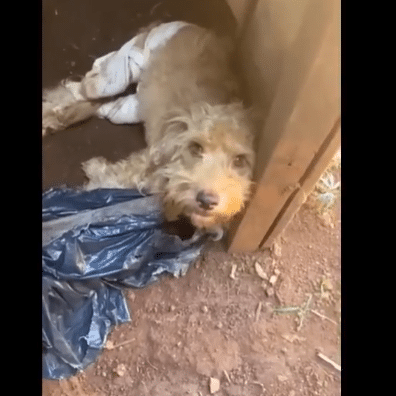
They Stopped Waiting for Him to Become the Dog He Used to Be
After surgery, Juju’s care focused less on what he could not do and more on what remained possible.
He was given a warm place to sleep.
His wounds were monitored.
His days became predictable.
He received regular attention and support that allowed him to move without repeatedly damaging his knees.
And somewhere during that process, the frightened, exhausted dog from the shelter began showing more of his personality.
His caregivers gave him the name Juju.
With regular care and a safer environment, he began adapting remarkably well to his circumstances.
He explored.
He paid attention to what was happening around him.
He became increasingly interested in people.
Instead of spending his days struggling simply to find a place where he could stop, Juju could now use his energy for something else.
Living.
Once the Pain Eased, His Personality Came Forward
The change in Juju was not limited to his physical condition.
As he became more comfortable, his personality became increasingly obvious.
He was playful.
Expressive.
Curious about his surroundings.
He interacted with other animals and seemed eager to participate rather than remain on the sidelines.
That transformation revealed something important.
The quiet dog rescuers first discovered had not necessarily lost his desire to engage with life.
He had been injured.
Exhausted.
And focused on surviving.
Once pain and immediate danger were no longer consuming his days, there was space for other behaviors to return.
Playing.
Socializing.
Exploring.
Responding enthusiastically to the people caring for him.
Juju did not appear to spend his days waiting for his old mobility to return.
He worked with the body he had.
And his caregivers worked with him.
Therapy Became a Way to Discover What He Could Still Do
Rehabilitation remained an important part of Juju’s life.
His body needed support.
His remaining strength needed to be protected and developed carefully.
But therapy did not have to mean constantly measuring him against a completely mobile dog.
Instead, it became a way to discover what Juju could accomplish safely.
He learned how to navigate his environment.
His upper body became stronger.
He became increasingly confident in moving from one place to another with assistance suited to his condition.
Over time, the physical transformation became noticeable as well.
His coat grew fuller and healthier.
His overall condition improved.
The dog who had once been found dirty and exhausted in a broken wooden shelter began to look cared for.
More importantly, he behaved like a dog who expected to be part of what was happening around him.
The difference was not that his past had been erased.
It was that his present was finally giving him something better to concentrate on.
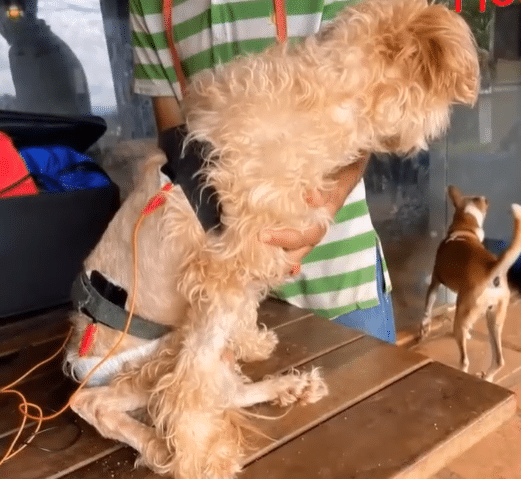
Juju Never Needed Four Working Legs to Have a Full Life
Juju’s story does not depend on a perfect medical ending.
The account does not establish that he eventually regained normal use of his legs.
And that is not what makes his recovery meaningful.
What changed was his quality of life.
He was no longer dragging himself across rough ground with untreated wounds.
He was no longer hiding exhausted inside a broken shelter.
Pain was addressed.
His injuries received medical care.
Movement became safer.
His body became stronger.
And his personality had room to emerge.
Juju formed connections.
He played.
He explored.
He took part in the life unfolding around him.
His circumstances were different from those of many other dogs, but different did not mean empty.
Moving Forward Didn’t Have to Mean Walking Again
When Juju was first discovered, almost everything about his situation pointed backward.
An accident that had already happened.
Treatment that had come too late to prevent some of the damage.
A body altered by injuries he had been forced to carry alone.
None of that could simply be undone.
But rescue gave Juju something else.
A future that did not require undoing the past.
His caregivers did not need him to become exactly the dog he had been before the accident.
They needed to relieve his pain, protect his body, and help him discover a way to live comfortably as he was.
Juju did the rest in his own way.
He adapted.
He connected.
He played.
He became stronger.
The dog once curled silently inside a broken shelter eventually became difficult to overlook for an entirely different reason.
There was life in him.
Personality.
Energy.
A desire to participate.
Juju may not take ordinary steps.
But his story is proof that moving forward can mean more than walking.
Sometimes healing is not about returning to the life an animal had before.
Sometimes it is about building a new one around what remains.
And for Juju, that new life became something worth moving toward every day.


