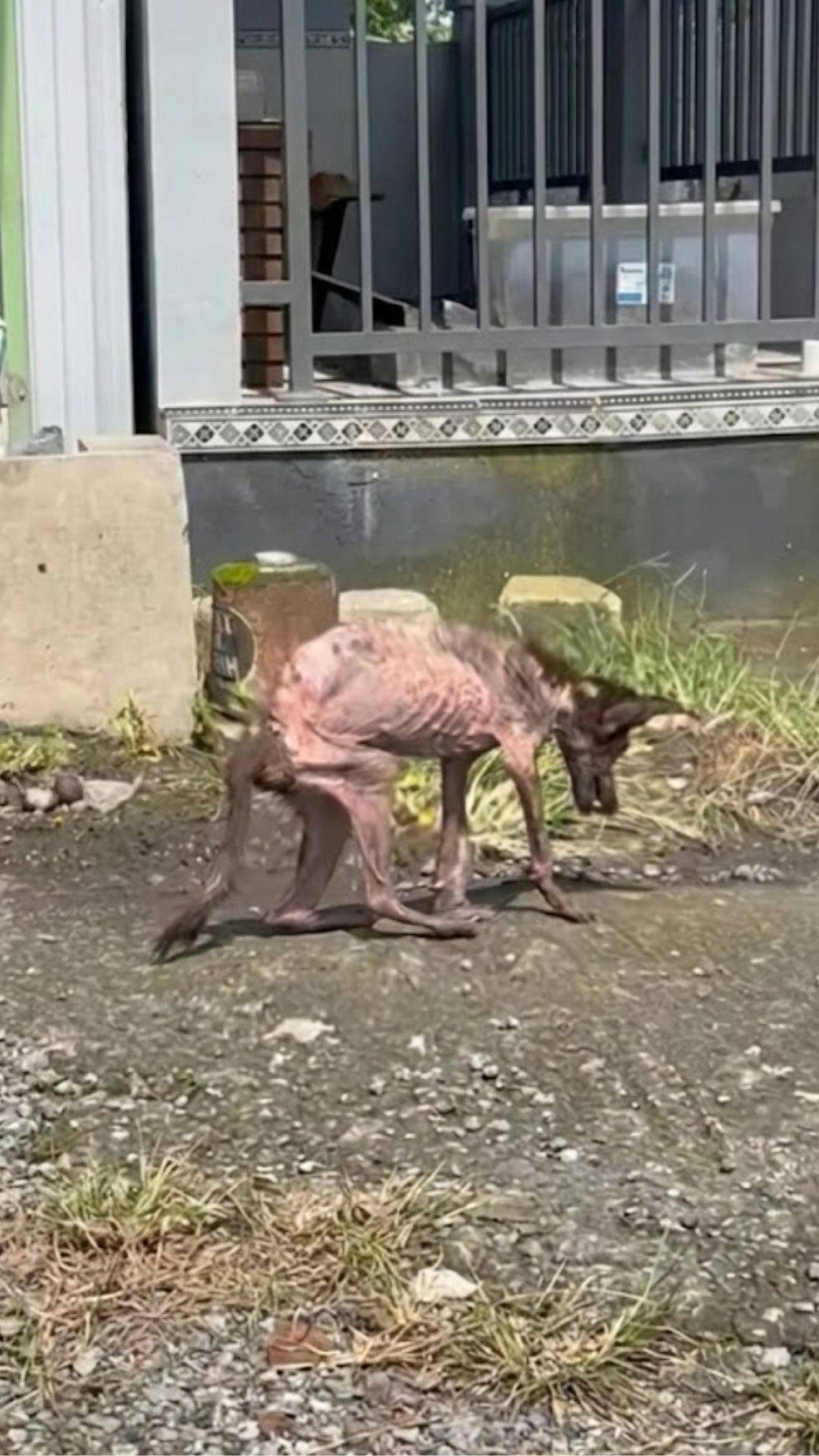
Bibo was only eight months old.
He should have been chasing leaves, discovering toys, and following people around with the restless curiosity of a puppy.
Instead, he wandered through a village with his head lowered toward the ground.
His body was painfully thin.
Large areas of his skin were damaged by severe mange, with thickened, cracked patches and signs of infection. His ribs showed beneath what little coat remained.
People noticed him.
But many kept their distance.
Some shooed him away.
So Bibo continued moving from place to place, weak enough that even walking appeared to require effort.
Then rescuers finally reached him.
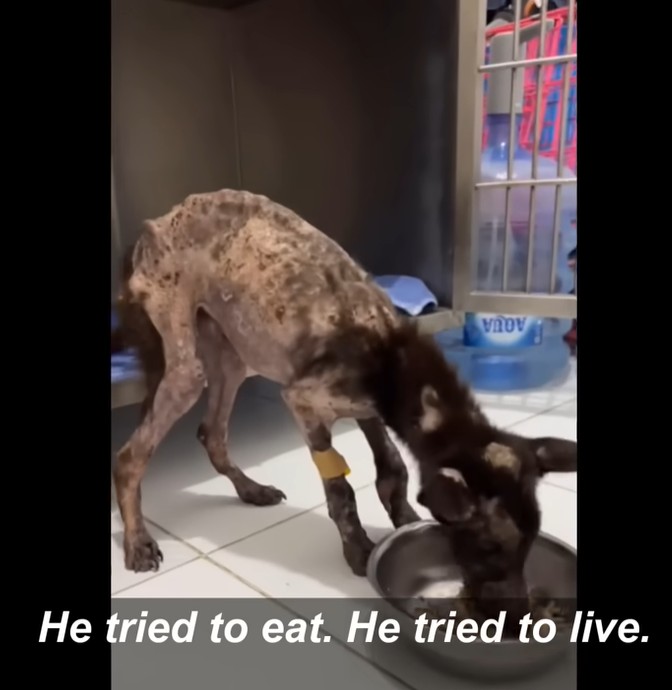
They placed food in front of the exhausted puppy.
For a moment, Bibo only stared at it.
Then he leaned forward.
And took a bite.
It was tiny.
Unsteady.
But it told his rescuers something important.
Bibo still had enough strength left to try.
One Small Bite Gave His Rescuers Something to Work With
By the time help arrived, Bibo needed more than a meal.
He was severely dehydrated.
The condition of his skin had progressed far beyond a simple irritation, and infection had become another concern.
His body was underweight and exhausted.
But when food was offered, Bibo made the effort to eat.
A few bites could not solve what had happened to him.
They could not restore the weight he had lost or heal damaged skin overnight.
But those first bites gave the rescue team a place to begin.
Treatment started quickly.
IV fluids were used to address dehydration.
Antibiotics were introduced as part of his medical care.
Medication was also given to help manage the inflammation affecting his skin.
The first goal was not to make Bibo look different.
It was to stabilize him.
Help his body recover enough to continue.
Give him somewhere clean to rest.
And make sure that when he woke up the next day, care would still be there.
VIDEO: Bibo’s Transformation — From a Sick Puppy With His Head Down to Running Again
At First, Even Gentle Touch Made Him Flinch
Medical treatment addressed only part of what rescuers were seeing.
Bibo was also cautious around people.
When hands came close, he sometimes flinched.
That reaction mattered.
His caregivers did not need to know every detail of his past to understand that forcing interaction would not help.
So they slowed everything down.
Voices remained soft.
Movements were deliberate.
No one expected Bibo to suddenly become affectionate simply because he had been rescued.
If he needed distance, he was given distance.
If he watched from several feet away, no one rushed toward him.
The goal was not to demand trust.
It was to become predictable enough that trust could eventually develop on its own.
Day after day, Bibo began reacting a little differently.
He held eye contact for slightly longer.
His body did not pull inward quite as quickly when familiar people approached.
He tolerated treatment more calmly.
These changes were easy to miss if someone was waiting for a dramatic breakthrough.
But recovery rarely works that way.
Sometimes trust begins with a dog simply choosing not to move away.
His Skin Began Healing Long Before He Looked Like a Different Dog
Bibo’s transformation took time.
There was no morning when everyone arrived to find a completely healthy puppy waiting for them.
Instead, the improvements appeared gradually.
His hydration improved.
He began eating more consistently.
His body finally had reliable nutrition to work with.
Treatment continued for his skin, and the severe irritation slowly became more manageable.
Damaged areas needed time to heal.
The coat that had been lost would need even longer to return.
For rescuers, this stage required patience because visual recovery often lags behind medical progress.
Bibo could already be feeling stronger while still looking very fragile.
He could be less dehydrated while his skin remained visibly damaged.
He could begin trusting familiar people while still reacting cautiously to something unexpected.
Progress was happening.
It simply arrived in layers.
And underneath the damaged coat, Bibo was beginning to gain enough strength for another problem to become clearer.
His leg.
A Limp Meant His Recovery Was Not Finished Yet
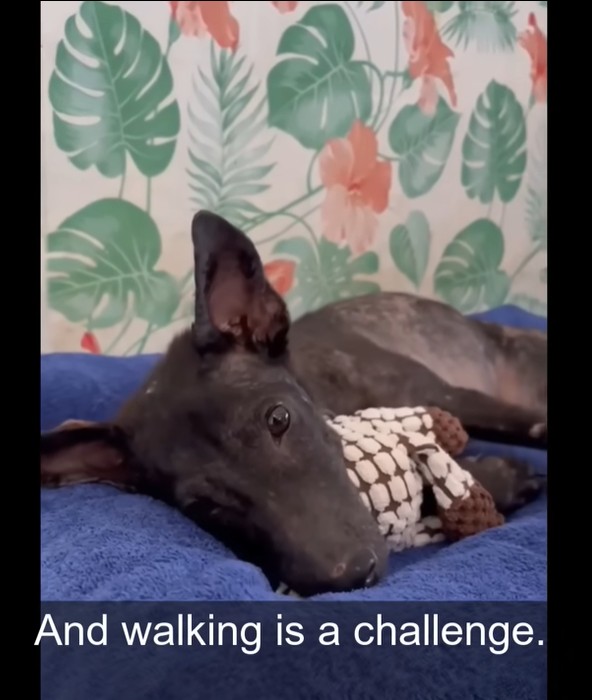
Once Bibo was stable enough to move into foster care, he entered a completely different environment.
There was a warm place to sleep.
Food appeared regularly.
Other dogs were nearby.
But as he began moving around more, caregivers noticed a persistent limp.
One of his legs had been injured.
That meant Bibo could not simply be encouraged to run around because he was feeling stronger.
His leg needed support.
A splint was fitted and remained in place for approximately two weeks to help stabilize the injury.
After that came gentle exercises.
Small movements.
Careful stretching.
Short periods of activity.
Nothing was rushed.
His foster caregivers had already watched him survive severe weakness and skin disease.
Now they had to help him rebuild movement without asking too much from a body that was still recovering.
At first, his steps remained hesitant.
But he kept taking them.
Foster Care Introduced Him to Ordinary Things He Had Been Missing
For many dogs, a bed and a full bowl are unremarkable.
For Bibo, consistency itself was something new.
He had somewhere warm to sleep.
Meals were not dependent on what he could find outside.
His water bowl did not disappear.
And when he woke up, the same people were still nearby.
Other dogs in the foster home also gave him a different kind of companionship.
They did not react to his appearance the way strangers in the village had.
They simply shared the space with him.
These ordinary routines began changing Bibo’s behavior.
He started going outside with more curiosity.
Instead of keeping his head down constantly, he began looking around.
He became more interested in the people caring for him.
Then came another small milestone.
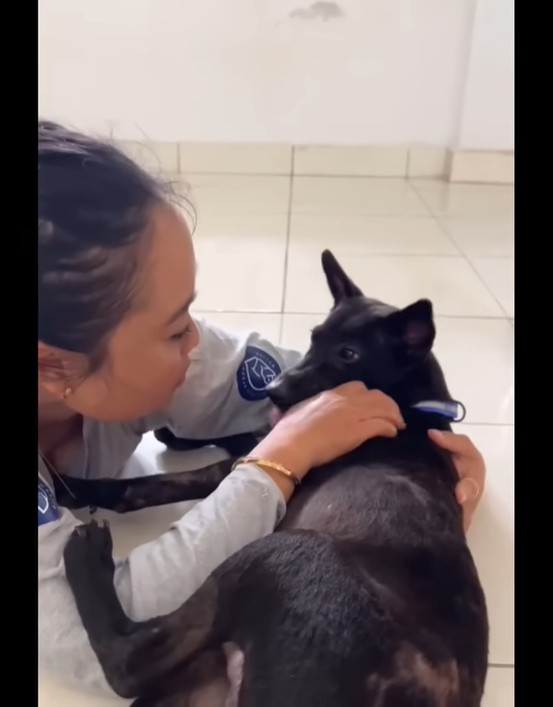
Bibo began greeting his foster family with gentle kisses.
The puppy who had once flinched when hands approached was now choosing to move closer.
That decision could not be forced.
It had to come from him.
And slowly, it did.
Then One Morning, Bibo Ran
No one needed to teach Bibo what running was.
His body simply had to become strong enough to remember.
One morning, instead of stepping cautiously into the yard, Bibo moved faster.
Then faster again.
He ran.
It was not the effortless sprint of a dog who had never been injured.
His recovery was still ongoing.
But the difference from the puppy rescuers had first encountered was unmistakable.
Bibo was moving because he wanted to.
Not because he needed to wander farther in search of food.
Not because someone was pushing him away.
He was running through a place where he was safe.
His caregivers watched as he explored the yard with increasing confidence.
The change was visible elsewhere too.
His coat was returning.
His eyes appeared brighter.
His tail moved more freely.
The puppy who once kept his head pointed toward the ground now lifted it to watch people, other dogs, and everything happening around him.
Bibo had not reached this point through one miracle.
He had arrived through repetition.
Another meal.
Another treatment.
Another day wearing the splint.
Another careful exercise.
Another gentle interaction.
Then one morning, all those small things looked like a puppy running across a yard.
His Transformation Was Built From Moments Most People Would Overlook
Before-and-after images can make rescue look almost instant.
One picture shows a severely ill animal.
Another shows the same dog weeks later with new fur and brighter eyes.
What disappears between those photographs is the work.
Bibo’s recovery lived in that middle space.
The first hesitant bites of food.
Fluids given when his body was dehydrated.
Medication administered day after day.
Skin that needed time to repair itself.
A leg that had to remain supported for two weeks.
Exercises repeated even when improvement seemed small.
Quiet moments in which caregivers approached him without forcing contact.
The first longer look.
The first time he did not flinch.
The first gentle kiss.
Then the first run.
None of those moments was enough by itself.
Together, they changed his life.
Bibo did not wake up one morning suddenly believing that every person was safe.
He learned through experience.
These hands brought treatment.
This person brought food.
This home was still here tomorrow.
And then tomorrow again.
Safety became something he could predict.
The Puppy Who Once Looked Down Finally Began Looking Ahead
The most striking change in Bibo may not be his coat.
It may not even be the fact that he can run.
It is the way he carries himself.
When rescuers first saw him, his head remained lowered.
His body appeared exhausted.
He moved through the village as a dog with very few options.
Later, in foster care, that posture began changing.
He looked toward people.
He explored.
He approached for affection.
He ran into the yard.
The transformation did not erase what had happened to him.
The mange had been real.
The infection had been serious.
His dehydration required treatment.
His injured leg needed time and support.
But none of those things became the final definition of Bibo.
He was only eight months old when rescuers found him.
There was still an entire life ahead of him.
All he needed was enough help to reach it.
And perhaps that is why the first meal remains one of the most important moments of his story.
Before the returning coat.
Before the splint came off.
Before the kisses.
Before the running.
There was one exhausted puppy looking at a bowl of food.
He leaned forward.
He took a small bite.
Then another.
For everyone around him, it was not proof that everything would be fine.
It was simply proof that there was still something to work for.
So they stayed.
They treated him.
They fed him.
They waited.
And little by little, Bibo stopped moving through the world with his head lowered.
Eventually, he lifted it.
And kept going.


