The black-and-white stray could not see where he was going.
A large plastic container had become wedged over his entire head, covering his face and turning an ordinary piece of discarded trash into a dangerous trap.
Still, he kept moving.
Through bushes.
Under parked cars.
Across dusty roads and areas littered with waste.
Every time rescuers came close, fear sent him running again.
They knew the jar had to come off.
But before they could save him, they first had to convince—or somehow manage—to get close enough.
The Jar Had Turned the Street Into an Even More Dangerous Place
For a stray dog, navigating traffic, searching for food, and finding water are already daily challenges.
Now this dog had to do all of it with his head trapped inside a rigid plastic container.
The jar covered his face.
His vision was severely limited.
Reaching food or water was nearly impossible while the container remained in place.
And because the opening had tightened around his neck, shaking or pulling backward was not enough to free him.
The dog did what frightened animals often do when they do not understand what is happening.
He ran.
Unfortunately, running could not solve the problem.
It only made finding and catching him more difficult.
Video: Rescuers Chase a Frightened Stray Until They Can Finally Remove the Plastic Jar
Every Time Help Came Close, He Disappeared Again
The rescue team began tracking the dog through the neighborhood.
At one point, he disappeared into thick bushes.
Later, they found him crouched underneath a parked vehicle.
Then he bolted again.
The search continued through dusty stretches of ground and areas scattered with discarded materials.
For the rescuers, the difficulty was obvious.
They could see exactly what needed to be done.
The dog could not.
From his perspective, unfamiliar people were pursuing him while he was already frightened and unable to see normally.
So every approaching rescuer became another reason to flee.
The team had to remain close enough not to lose track of him without pushing him into an even more dangerous area.
It became a tiring cycle.
Find him.
Approach slowly.
Watch him run.
Then begin searching again.
Catching Him Became the Hardest Part of the Rescue
Eventually, the rescuers managed to guide the dog toward an area where his escape options became limited.
This was the opportunity they had been waiting for.
Two team members moved in.
They did not swing tools toward him or try to break the jar while he was still running.
First, they secured his body with their hands.
The dog struggled against the unfamiliar contact, but the rescuers held him firmly enough to prevent him from injuring himself.
Only after he was safely restrained could they focus completely on the container.
Now they could see how tightly it was lodged around his neck.
Simply yanking it upward was not a safe option.
They would have to loosen it carefully.
The Plastic Finally Began to Move
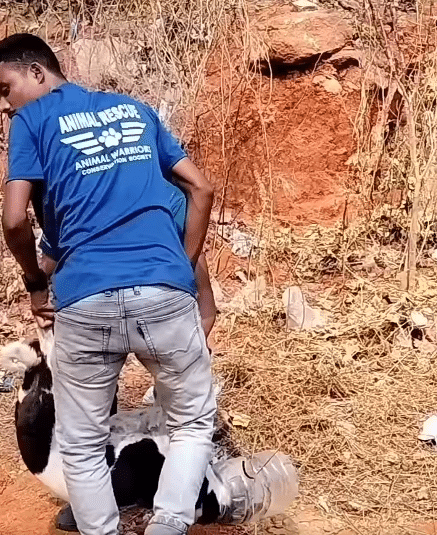
One rescuer steadied the dog while another gripped the jar.
The removal began slowly.
A small twist.
Then another.
Gentle pressure.
A careful pull.
The rescuers had to avoid scraping the skin around the dog’s neck while also preventing him from suddenly jerking his head.
For several tense moments, the jar barely seemed to move.
Then the seal began to loosen.
Another turn created a little more space.
The container shifted.
Finally, after repeated careful twisting and pulling, the opening cleared the widest part of the dog’s head.
The jar slid free.
For the First Time, Nothing Covered His Face
Once the container was removed, the rescuers released their hold.
The dog remained still for a brief moment.
After running through streets with plastic surrounding his face, he could suddenly see normally again.
There was nothing pressing around his neck.
Nothing blocking access to food or water.
Nothing moving with him every time he tried to escape.
Then his body reacted.
He jumped up.
And within moments, he was running across the open ground.
This time, however, he could actually see where he was going.
The frantic animal rescuers had been following was suddenly just a stray dog moving freely again.
The Rescuers Did One More Thing Before Leaving
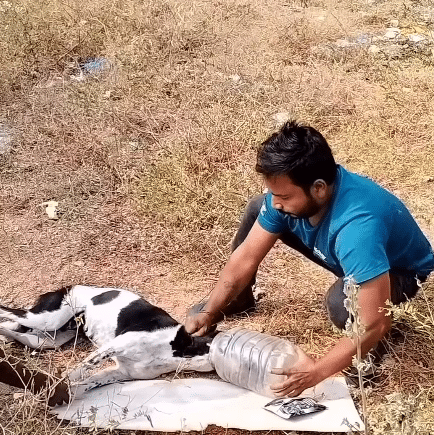
The plastic jar was no longer around the dog’s head.
But the team did not leave it behind intact.
They crushed the container underfoot.
Once broken, it was far less likely to become the same kind of trap for another animal searching through discarded waste.
It was a small step compared with the effort required to catch the dog.
But it addressed the object that had created the emergency in the first place.
Stray animals regularly investigate containers because they may smell traces of food inside.
A head can sometimes enter easily.
Pulling it back through the same narrow opening can be much harder.
That appears to have been exactly what happened here.
An Ordinary Container Nearly Became Impossible for Him to Escape
There was nothing unusual about the object.
It was simply plastic waste.
But once it became lodged around the dog’s neck, it changed almost everything he needed to do.
He could not see properly.
He could not easily eat.
He could not drink normally.
And when help arrived, his fear made him run from the very people trying to remove it.
That is what made this rescue so difficult.
The solution itself was relatively simple.
Take off the jar.
Reaching the frightened dog was not.
The team had to follow him through multiple hiding places and wait for an opportunity to restrain him safely.
Persistence mattered as much as technique.
This Time, He Ran Because He Was Free
At the beginning, the dog ran because he was frightened.
He could not understand the plastic surrounding his head.
He could not understand the people following him.
He only knew to keep moving.
At the end, he ran again.
But now there was no container covering his face.
No rescuer needed to follow.
No trap moved with him.
The same legs that had carried him blindly through bushes and beneath cars now carried him across open ground with nothing holding him back.
His rescue did not require a dramatic medical procedure.
It required people willing to keep looking after he disappeared the first time.
Then the second.
And again after that.
They stayed with the search until they could finally reach him.
Sometimes that is what rescue looks like—
not one perfect moment,
but refusing to give up until an animal can finally run away safely.


