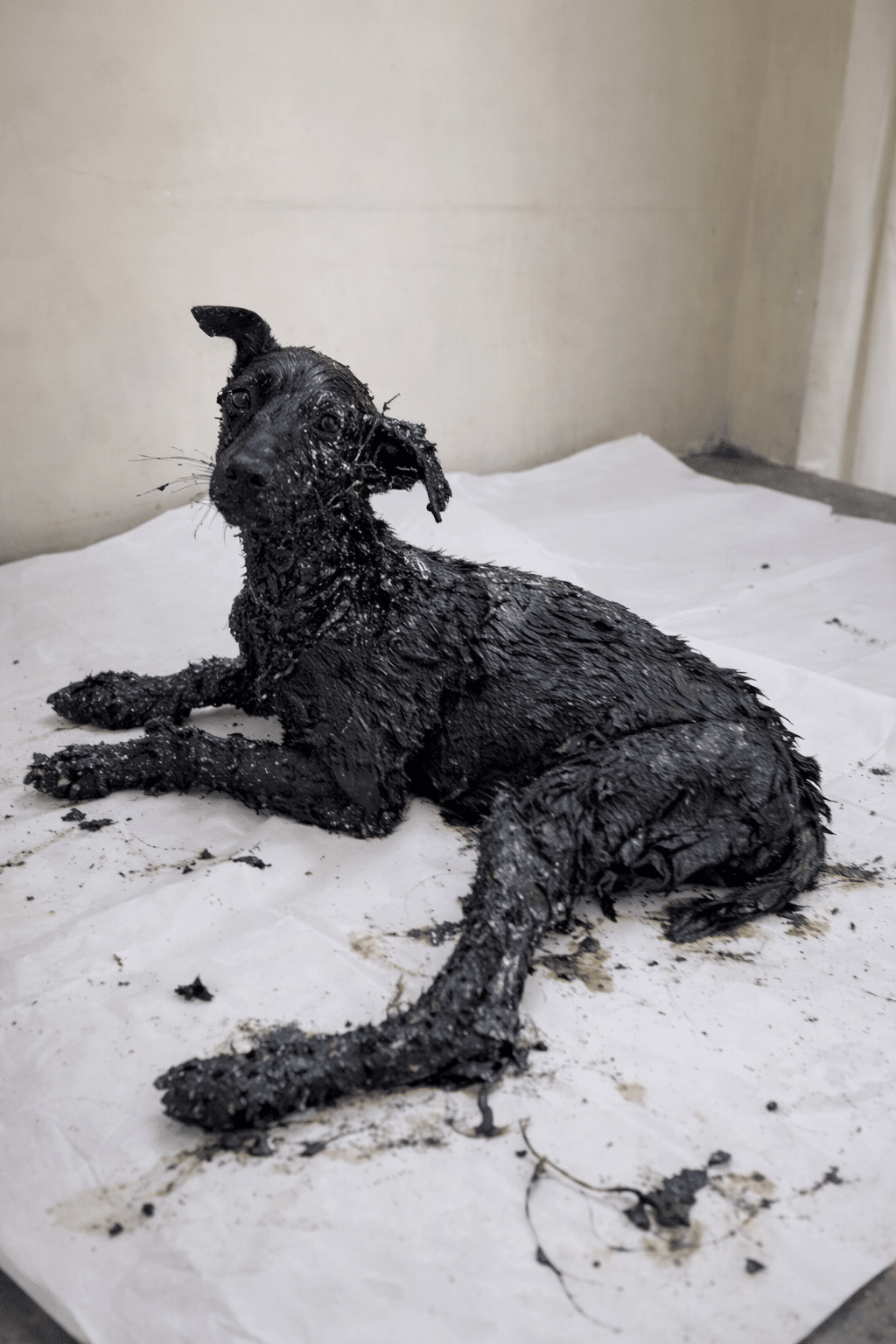
At first, there was almost nothing to distinguish him from the ground around him.
The construction area was dark with dust, debris, and thick patches of black bitumen. Somewhere inside it lay a tiny puppy, his body coated so completely that a person could have walked past without realizing an animal was there.
He could not simply stand up and leave.
The sticky substance had clung to his legs, chest, and fur until movement became nearly impossible.
Every attempt to struggle only pressed more of it against his body.
Eventually, the puppy stopped fighting.
He lay almost motionless inside the pit.
Then someone passing nearby looked twice.
A dark shape.
A small face.
And two eyes staring back.
That second glance changed everything.
One Wrong Step Had Turned the Pit Into a Trap
No one knew exactly how the little black puppy had reached the construction site.
Perhaps he had wandered there looking for food.
Perhaps he had simply followed a scent into an unfamiliar place.
What was clear was what happened after he encountered the pit.
He stepped into the bitumen.
Unlike water or mud, the thick material did not simply splash onto him and fall away.
It held on.
His paws became coated first.
Then his legs.
As he tried to pull himself free, more of his chest and fur came into contact with the sticky surface.
The harder he struggled, the more restricted his movement became.
Soon, a small accident had become a frightening trap.
The puppy could no longer move normally.
His fur was sealed beneath a heavy black coating, and much of his body blended into the surface around him.
There was no way for him to understand why every effort to escape seemed to make things worse.
Eventually, exhaustion took over.
By the time he was noticed, he was no longer frantically struggling.
He was simply there.
Still alive.
Still looking out from beneath the dark coating.
And finally, no longer invisible.
Video: The Tiny Puppy Found Immobilized Inside a Construction-Site Bitumen Pit
The Stranger Who Looked Closely Enough to See Him
From a distance, the puppy barely looked like a puppy.
His dark coat and the layer of bitumen covering him made his body difficult to distinguish from the ground.
But the passerby noticed something that did not belong there.
Movement.
Then the puppy’s eyes became visible.
That was enough.
Instead of assuming the dark shape was construction debris and continuing on, the person stopped and investigated.
Once the situation became clear, the puppy was taken for veterinary help at the clinic operated by the Nirbhaya Foundation.
He arrived frightened and exhausted.
There was no dramatic barking or struggling.
He was quiet.
Much of his body remained covered in the thick material, and the team now faced a problem that could not be solved by putting him under running water.
Bitumen does not behave like ordinary dirt.
Trying to scrub it away aggressively could damage the skin and pull painfully at the fur beneath it.
The team needed patience.
The goal was not to make the puppy look clean as quickly as possible.
It was to remove the material without causing another injury while doing so.
That meant the rescue was not over when he reached the clinic.
In many ways, the most delicate part was only beginning.
They Couldn’t Simply Scrub the Black Layer Away
The caregivers began with oil.
Rather than pulling at the hardened material, they worked gradually to soften it.
Oil was applied carefully over the affected areas and massaged into the puppy’s coat.
Then they waited and worked a little more.
The process had to be repeated.
Bit by bit.
Section by section.
There was no shortcut.
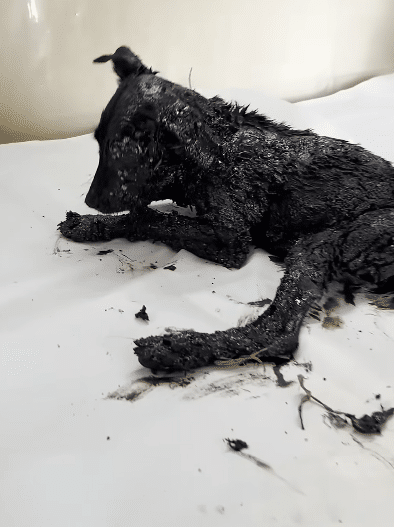
Some areas began loosening from the fur, allowing the team to remove the softened bitumen gradually.
Other patches were much more difficult.
There, the substance had become so firmly attached that attempting to separate it from the coat could pull painfully against the skin.
In those places, caregivers made a different choice.
They trimmed the affected fur.
It was safer to sacrifice sections of coat than to risk injuring the puppy beneath them.
The team continued carefully.
Oil.
Gentle massage.
Cleaning.
Trimming where necessary.
Then another section.
The puppy remained remarkably quiet throughout much of the process.
The rescuers could not know what he understood.
They could only see that he allowed them to work.
So they kept their movements slow.
Hands approached gently.
Voices remained calm.
Whenever possible, the puppy was given time between the more difficult parts of cleaning.
The transformation happened gradually.
At first, only small patches of natural fur appeared beneath the black covering.
Then more.
His legs became recognizable again.
His chest emerged.
The outline of a puppy began replacing the dark shape that had been carried into the clinic.
And eventually, his face became clearer too.
The same eyes that had helped the passerby notice him were now surrounded by clean fur instead of hardened black material.
Beneath the Bitumen Was a Very Small, Very Tired Puppy
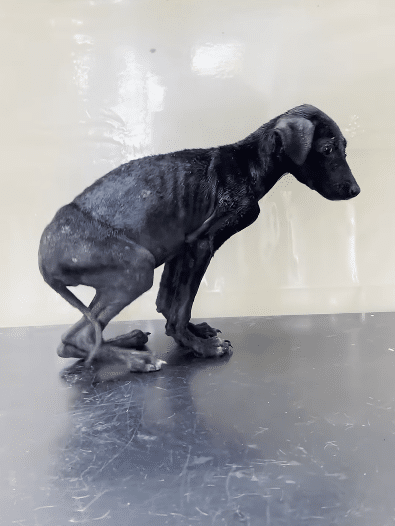
As more of the coating disappeared, the team could finally see his condition more clearly.
He was thin.
His body looked depleted from hunger and exhaustion.
With the heavy bitumen no longer hiding his shape, the puppy’s small frame became much more obvious.
The rescue had solved one immediate problem.
But cleaning him was not the same as restoring his strength.
He needed food.
Warmth.
Rest.
And continued attention to his skin after being covered for so long.
The following days became quieter.
There was no longer a dramatic layer of black material to remove.
Now recovery depended on ordinary things repeated consistently.
Meals.
A protected place to sleep.
Gentle treatment.
Time.
At first, even standing appeared difficult for him.
His body had been exhausted by the experience, and the puppy needed time before normal movement returned.
So nobody expected him to bounce immediately into play.
He was allowed to recover at his own pace.
With each meal, his body received more of what it had been missing.
With each period of uninterrupted rest, he had another opportunity to regain strength.
And slowly, small changes appeared.
His head came up more often.
He became more alert to what was happening around him.
Then came a moment that would have been completely ordinary for another dog.
The puppy stood.
On his own.
First He Stood — Then His Tail Began to Move
Standing was only the beginning.
The first attempts at walking were careful.
He moved with uncertainty, as though his body was still recovering from the hours spent unable to free itself.
A few steps were enough.
Then he rested.
Later, he tried again.
There was no need to rush him.
The important part was that he could move freely now.
His paws were no longer trapped in thick material.
His chest was no longer held against the ground.
Nothing was keeping his body in place.
Soon, his movements became steadier.
And then another small change appeared.
His tail moved.
At first, only slightly.
A small wag.
Then again.
For the caregivers who had first seen him coated almost completely in black, the gesture was difficult to miss.
The puppy who had lain virtually immobilized in a construction pit was beginning to behave like a puppy again.
He became more responsive to the people around him.
He accepted gentle contact.
His posture looked less guarded.
As his strength returned, the rescue stopped being defined entirely by what had happened in the pit.
There were now new images replacing the old ones.
A clean coat.
Bright eyes.
A puppy standing instead of lying helplessly.
A tail moving when familiar caregivers came near.
The physical change was obvious.
But perhaps the most meaningful part was how ordinary he was beginning to look.
That was exactly what everyone had been working toward.
The Dark Shape in the Pit Became a Puppy Again
The contrast between the beginning and the end of the rescue was striking.
When he was first discovered, the puppy’s body was almost hidden beneath the bitumen.
His legs could barely move.
His fur was stuck together.
From several feet away, someone could easily have mistaken him for part of the construction site itself.
Later, he looked completely different.
The thick black layer was gone.
His natural coat could be seen again.
His eyes were alert.
He could stand.
He could take steps.
And he could lean toward the people caring for him without the heavy substance restricting every movement.
Nothing about the recovery required a dramatic miracle.
It required people willing to spend time on a problem that could not be solved quickly.
The stranger had to stop long enough to notice.
The clinic had to accept the puppy and begin the careful cleaning process.
The caregivers had to keep working when one application of oil was not enough.
They had to trim fur rather than pull at stubborn sections.
Then, after the cleaning was finished, they had to continue providing the food, warmth, and rest his weakened body needed.
One action alone did not rescue him.
It was a chain of small decisions.
Look closer.
Pick him up.
Bring him somewhere safe.
Work slowly.
Feed him.
Let him rest.
Then help him recover.
That chain began because someone noticed two eyes inside what otherwise looked like a dark patch on the ground.
Sometimes Rescue Begins With Simply Not Walking Past
Construction areas are filled with things designed for people, machines, and unfinished buildings.
They are not safe places for wandering puppies.
Yet a small animal can enter one without understanding what lies ahead.
For this puppy, one step into the wrong place left him almost completely immobilized.
He could not call anyone.
He could not pull himself free.
And because the bitumen covering his body made him blend into the surroundings, even being noticed became difficult.
His survival depended on someone paying attention.
Someone did.
That person could have continued walking.
Instead, they looked again.
That second look led to veterinary care.
Veterinary care led to hours of patient cleaning.
And those hours gave the puppy the chance to do something that had seemed impossible while he lay inside the pit.
Move freely again.
Stories like his are sometimes remembered for the dramatic “before and after” photographs.
A puppy covered in black.
Then the same puppy clean and standing.
But much of rescue happens in the space between those two images.
The oil applied carefully to one small section of fur.
The person holding him steady.
The decision not to pull when something would not come loose.
The first meal after exhaustion.
The first attempt to stand.
The first few uncertain steps.
Those moments rarely look spectacular.
Together, they changed everything.
He Needed More Than Freedom From the Pit
Getting out of the bitumen saved the puppy from an immediate danger.
What came afterward gave him the chance to recover from it.
He needed nourishment because his small body was already weak.
He needed treatment for the skin that had spent so much time beneath the sticky coating.
He needed rest after struggling against something he could not understand.
And, perhaps most importantly, he needed a place where no one expected him to simply recover instantly.
He was given that time.
Gradually, the puppy became stronger.
The stillness that had defined his rescue disappeared.
Movement returned.
Curiosity returned.
His tail began to wag.
Eventually, the final images no longer looked like the same scene at all.
There was no black pit around him.
No hardened layer holding his legs in place.
No frantic struggle against something stronger than his tiny body.
There was simply a puppy receiving gentle attention from the people around him.
That may be the quietest lesson in his story.
Rescue does not always begin with someone performing an extraordinary act.
Sometimes it begins when an ordinary person notices something unusual and decides that it is worth checking.
A dark shape in a construction pit.
A pair of eyes.
A life that almost blended completely into the ground.
One person saw him.
Others took over from there.
Hours later, the black coating began disappearing.
Days later, the puppy began standing and walking again.
And the tiny animal who had once been unable to move could finally do what every puppy should be able to do.
Take his next step wherever he wanted.


