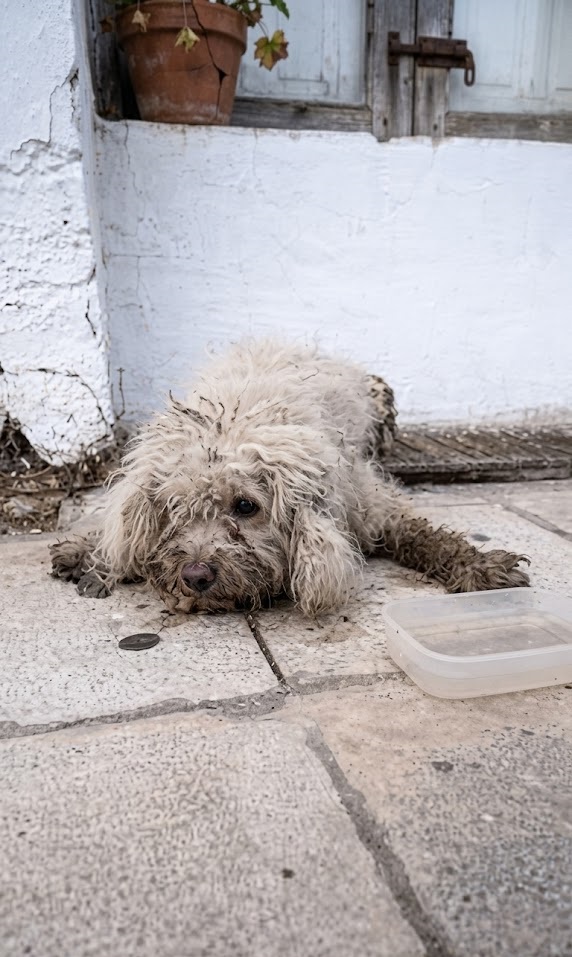
At first, Julian did not look like a dog.
Curled beside the sidewalk, his small body was hidden beneath hardened layers of tangled fur, dirt, and debris. He barely moved as people passed, making him easy to mistake for something discarded and forgotten.
Then volunteer Valya stepped closer.
Beneath the neglected coat, she saw two quiet eyes watching her.
Julian was still there.
And after being overlooked for so long, someone had finally stopped.
The Small Figure Almost Everyone Passed By
Valya had received a message asking for urgent help with a dog lying near a sidewalk.
She expected to find an animal in poor condition, but the figure in front of her was difficult to recognize.
Julian’s coat had grown into a dense, uneven shell around his body. Dust, moisture, and pieces of debris had become trapped inside the fur, making him appear larger and almost shapeless.
His legs were barely visible.
The outline of his face had disappeared.
From several steps away, there was little to suggest that a living animal was hidden underneath.
Julian remained curled against the ground while people moved around him. He did not bark or attempt to gain attention. His body appeared exhausted, and even lifting his head required effort.
Valya approached slowly.
She did not know how he might react to an unfamiliar person, especially after spending an unknown amount of time without dependable care.
A bowl of water was placed within reach.
For several moments, Julian did not move.
Then he shifted forward and began to drink.
The movement was slow but deliberate.
When Valya reached toward him carefully, Julian responded with a small gesture. He touched her hand gently with his tongue.
It lasted only a moment.
But it was enough to show that the dog beneath the neglected coat was still willing to accept kindness.
Video: Julian Was Almost Mistaken for Debris—Then Four Hours of Care Revealed the Tiny Dog Beneath
A Past That Could Not Be Fully Confirmed
As volunteers began asking about Julian, they were told that he had once lived with an elderly woman who had recently passed away.
According to the account shared with rescuers, Julian was left without care during the period that followed.
It was unclear exactly how this happened or how long he had been alone.
What could be seen clearly was the result.
Without regular grooming, Julian’s coat had continued growing and tangling. Dirt and moisture collected inside the fur, causing the mats to become increasingly dense.
The coat no longer moved naturally.
It had tightened into heavy sections around his body, restricting his legs and concealing his actual size.
Julian had also gone without the consistent medical attention an older dog may need. His quiet behavior and cautious movements suggested there could be additional health concerns hidden beneath the coat.
The volunteers did not need every detail of his past before deciding what to do.
Julian was weak.
He was exposed.
And he could not remove the burden surrounding him by himself.
Valya carefully prepared him for transport and brought him to a veterinary clinic.
There, the work of uncovering Julian could finally begin.
Four Hours to Free His Small Body
The veterinary team quickly realized that Julian’s condition required far more than an ordinary grooming appointment.
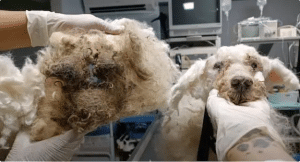
His mats sat close to the skin and had hardened into thick layers. Attempting to brush through them would have caused unnecessary pulling and discomfort.
The safest option was to remove the coat carefully with professional tools.
The process began slowly.
Each section had to be examined before scissors or clippers could be placed underneath it. Because Julian’s body was so small, the team needed to work with particular caution around his legs, ears, and face.
One volunteer helped support him while another began separating the outer layers.
Small pieces fell away first.
Then larger sections loosened from his sides.
The outline of a leg emerged.
Part of his back became visible.
Julian remained remarkably calm throughout the process.
He did not struggle against the hands helping him.
He did not attempt to flee from the table.
At times, he simply stood quietly while the team worked around him, resting when he became tired.
The grooming continued for nearly four hours.
With every removed section, Julian became a little lighter.
The thick coat had made him appear much larger than he truly was. As the final layers fell away, a tiny Poodle began to emerge.
His narrow body revealed how little weight he carried beneath all that fur.
His face was delicate.
His legs were thin.
The dog who had looked like a heavy pile beside the sidewalk was, in reality, a small senior animal who had needed help for a long time.
His Medical Examination Revealed New Challenges
Once the coat had been removed, the veterinary team could finally conduct a more complete examination.
They discovered that Julian was living with a heart condition.
He also appeared to have limited hearing and vision.
These findings helped explain some of the behavior rescuers had observed.
Julian moved slowly and carefully through unfamiliar spaces.
He did not always respond when someone called from a distance.
Sudden movement near him could cause uncertainty, especially when it occurred outside his remaining field of vision.
The team adjusted the way they interacted with him.
They approached from angles where he could notice them more easily.
They allowed him to smell their hands before touching him.
Movements remained calm and predictable.
His medical conditions would require continued monitoring, but they did not prevent Julian from enjoying comfort or companionship.
He was not constantly searching for attention.
He did not demand to be held.
Instead, Julian appeared most content when resting near people he recognized.
He watched quietly.
He settled into soft bedding.
And when a caregiver sat close, he often remained nearby, accepting the peaceful company without needing anything more.
His limitations were part of the care he required.
They were not the whole of who he was.
Learning the Comfort of a Quiet Routine
Julian’s recovery did not unfold through dramatic bursts of energy.
His progress appeared in gentler ways.
He began eating regular meals.
He rested for longer periods without needing to remain alert to every movement around him.
Clean blankets replaced the sidewalk.
Medical care replaced uncertainty.
The caregivers learned how to communicate with him in ways that respected his reduced hearing and vision. A gentle touch near his shoulder let him know someone was close. Familiar scents and repeated routines helped him understand what would happen next.
Meals arrived at predictable times.
His sleeping area remained in the same place.
Caregivers approached slowly rather than surprising him.
These small details made his environment easier to navigate.
Julian gradually became more comfortable moving around the rescue facility. His steps remained measured, but he explored when he felt secure enough to do so.
He learned where his water was kept.
He recognized the path toward his bed.
And he began resting beside caregivers instead of remaining separated from them.
Julian did not need a noisy room filled with constant excitement.
He appeared happiest in calm spaces where people allowed him to be close without overwhelming him.
His companionship was quiet.
So was his trust.
The Dog No One Noticed Became Impossible to Forget
Without the hardened coat surrounding him, Julian’s appearance changed completely.
But the most meaningful transformation was not cosmetic.
For perhaps the first time in a long while, his individual needs were being noticed.
Someone monitored his heart condition.
Someone understood that he might not hear a voice from across the room.
Someone made sure he could see a hand before it touched him.
Someone prepared a soft place where his older body could rest comfortably.
Julian was no longer treated as a shape on the sidewalk that could easily be ignored.
He was known.
The caregivers began understanding his preferences.
He enjoyed gentle companionship but did not always seek direct attention.
He appreciated a quiet resting place.
He could manage many things independently when his surroundings remained predictable.
This thoughtful, reserved personality may have been present all along.
It had simply been hidden beneath physical neglect and the assumptions people made when they passed him.
Julian did not need to become younger, louder, or more energetic to be worthy of care.
He only needed people willing to appreciate the kind of dog he already was.
A Home for Julian Will Need to Be Gentle
Julian remains under the care of a rescue organization while the team considers what kind of future would suit him best.
Finding the right adoptive family may take time.
Because of his heart condition and limited hearing and vision, Julian needs people who understand that senior and special-needs dogs often require additional patience.
His ideal home would be calm and predictable.
Furniture and essential items should remain in familiar places so he can navigate safely. Sudden approaches may need to be avoided, and his medical care must continue consistently.
In return, Julian offers a quieter kind of companionship.
He can rest beside someone while they read.
He can share a peaceful afternoon without demanding constant entertainment.
He can bring warmth to a home simply by being present.
Some dogs win attention through boundless energy.
Julian’s gift is different.
He reminds people to slow down.
To approach gently.
To notice the lives that may not be able to ask loudly for help.
His journey is not about turning into a different dog.
It is about finally being given the dignity to live as himself.
Once, Julian lay beside a sidewalk beneath so much tangled fur that people barely recognized him as a living animal.
Then one person looked more carefully.
She saw his eyes.
She offered water.
And when Julian gently touched her hand, the direction of his life began to change.
Today, he is clean, protected, and surrounded by people who understand his needs.
The dog who was almost invisible is invisible no longer.
Julian has been seen.
And now, he is valued.


