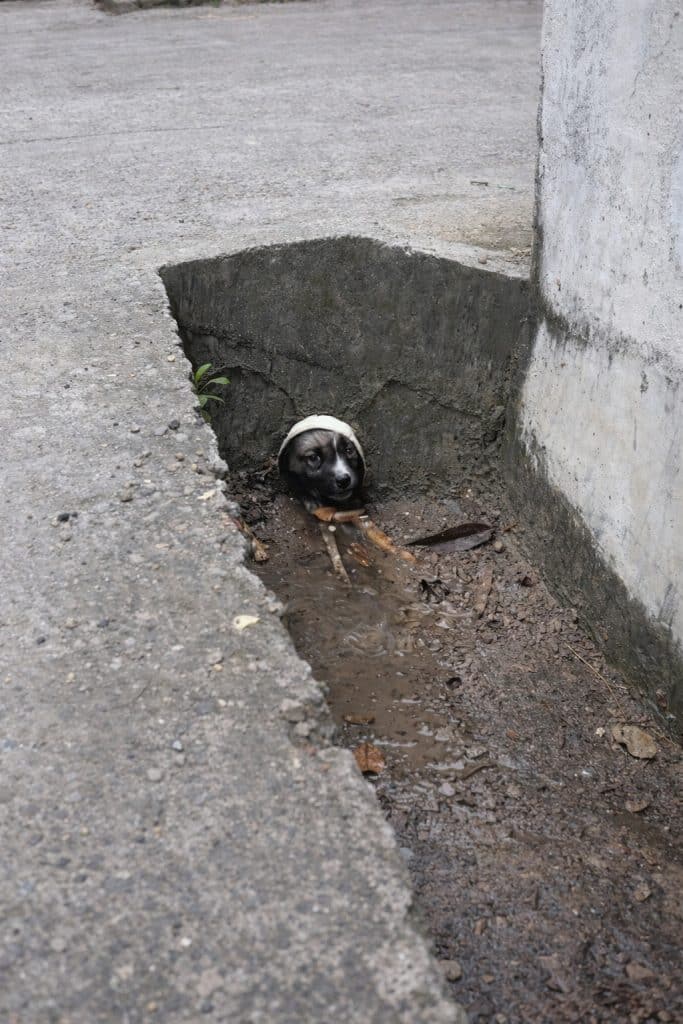
At first, there was nothing dramatic about the scene.
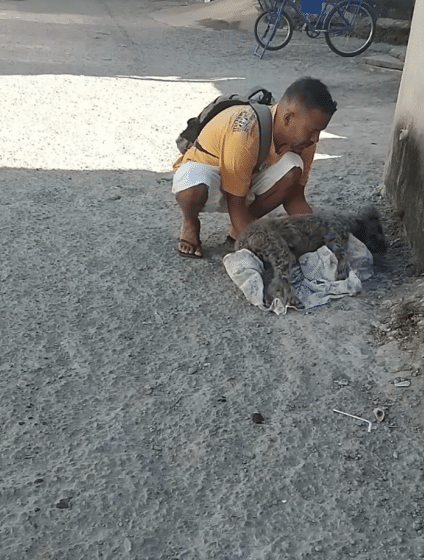
A small dog lay beside a quiet road on a thin piece of worn fabric, his body almost blending into the dusty ground around him.
Someone passing by could easily have assumed he was sleeping.
Then they noticed something strange.
He did not shift when people came near.
He did not raise his head.
He did not get up and move away.
The little dog simply remained where he was.
Only when someone stepped closer did the reason become clear.
He was not peacefully resting.
He was too weak to stand.
Later, rescuers would give him a name.
Milo.
But before any of that could happen, someone first had to recognize that the small, motionless shape beside the road was still waiting for help.
There Was Nothing Beside Him Except a Worn Piece of Cloth
The closer people looked, the more concerning Milo’s condition appeared.
His coat was badly tangled.
Sections of fur had formed rough mats, suggesting that regular grooming and care had been absent for quite some time.
Beneath the neglected coat was a fragile body.
Milo appeared exhausted and undernourished, with very little energy left for anything beyond remaining where he was.
Around him, there was almost nothing.
No bowl of water.
No visible food.
No shelter protecting him from the roadside environment.
Only the faded piece of fabric beneath his body.
No one could say exactly how long Milo had been there.
His condition could not provide a precise timeline.
But it was enough to show that he needed help.
He had reached a point where getting up and continuing on his own no longer seemed possible.
And because he was so quiet, it would have been frighteningly easy for another person to pass without realizing what they were seeing.
This time, someone stopped.
VIDEO: Milo Was Lying Motionless Beside the Road — Then Rescuers Realized He Was Still Alive
When Help Arrived, Milo Opened His Eyes
After rescuers were contacted, they came to the roadside expecting to find a dog in serious distress.
Milo remained on the fabric.
He did not attempt to escape when the team approached.
There was no barking or defensive movement.
His body appeared to have very little energy available for either.
Then, as the rescuers came closer, Milo opened his eyes.
Slowly, he looked toward them.
It was a small response.
But after seeing him lying so still, even that movement mattered.
The rescuers could not know what Milo understood about the people now surrounding him.
They could only respond to what was in front of them.
A weak dog.
A neglected coat.
A body that needed rest and nourishment.
And an animal who was no longer going to be left beside the road.
No one demanded that Milo stand.
No one tried to make him walk to safety.
Instead, they moved carefully around him and prepared to carry him.
For perhaps the first time in a long while, Milo did not need to find enough strength for the next step himself.
Someone else would take it for him.
The Dog Who Could Barely Move Was Finally Carried Away
Lifting Milo required care.
His body was fragile, and there was no reason to make an already exhausted dog struggle unnecessarily.
The rescuers supported him gently and moved him away from the roadside.
That simple moment marked an enormous change in his circumstances.
Until then, the piece of fabric beneath Milo had been the closest thing he appeared to have to a bed.
Now he was leaving it behind.
The road disappeared.
The dust disappeared.
And the small dog who had spent so much time lying unnoticed was taken somewhere people could begin attending to his needs.
There was no instant transformation during the ride.
Milo was still weak.
His coat was still matted.
Whatever had brought him to such a depleted condition could not be undone simply by picking him up.
But one major problem had already changed.
He was no longer alone.
At the rescue center, caregivers could finally begin with the most basic things his body needed.
And for Milo, the basics were enough to start.
His Recovery Began With Food, Rest, and Clean Fur
There was no complicated first step.
Milo needed care that many dogs receive every day without anyone thinking twice about it.
His dirty, tangled coat was cleaned.
Food was placed within reach.
Fresh water was available.
And he was given a warm, quiet place where he could lie down without the noise and uncertainty of the roadside.
The caregivers did not expect him to become energetic immediately.
His body needed time.
At first, Milo ate only a little.
That was enough.
Another meal would come later.
And another after that.
For a dog who had apparently been living without reliable care, the consistency itself mattered.
Food did not need to be searched for.
Water did not need to be found somewhere outside.
A comfortable resting place remained available when he woke.
Milo could finally sleep without lying exposed at the edge of a road.
Gradually, those ordinary things began producing small changes.
He started eating more.
His breathing appeared steadier while he rested.
He became increasingly responsive to the activity around him.
Then came one of the simplest signs of progress.
Milo lifted his head.
The Smallest Improvements Became the Ones Everyone Watched For
Recovery did not arrive as one dramatic moment.
It appeared in pieces.
A little more food finished.
A head held up for longer.
More awareness when someone entered the room.
Small changes in a body that had looked almost completely depleted when rescuers first approached him.
None of those milestones would seem extraordinary in a healthy dog.
For Milo, they represented movement in the right direction.
His caregivers continued giving him time.
There was no reason to rush a body that had already been pushed so far.
Instead, his days became predictable.
Eat.
Rest.
Receive care.
Sleep.
Wake up somewhere safe.
Then repeat it all again.
The tangled dog lying beside the road had existed in a world where nearly everything appeared uncertain.
Now uncertainty was slowly being replaced by routine.
Milo did not need to understand what his entire future would look like.
He only needed to discover that when he woke up, the people caring for him would still be there.
Giving Him a Name Made the Roadside Feel Even Farther Away
At some point during his care, the little dog received something he had not had when he was first discovered.
A name.
Milo.
Nothing about his physical condition changed at the exact moment someone began calling him that.
He was still recovering.
His body still needed time to regain strength.
His coat still carried evidence of the period before his rescue.
But a name changed the way his story could be told.
He was no longer simply “the weak dog beside the road.”
He was Milo.
Caregivers could watch Milo eat.
Check whether Milo was resting comfortably.
Notice when Milo became a little more alert.
Celebrate when Milo lifted his head.
Names do not heal neglected animals.
Food, appropriate care, safety, and time do that work.
But a name can mark the moment an animal stops being an anonymous shape people pass and becomes an individual whose progress someone is paying attention to.
For Milo, being noticed had already changed everything.
Being consistently cared for could now change what came next.
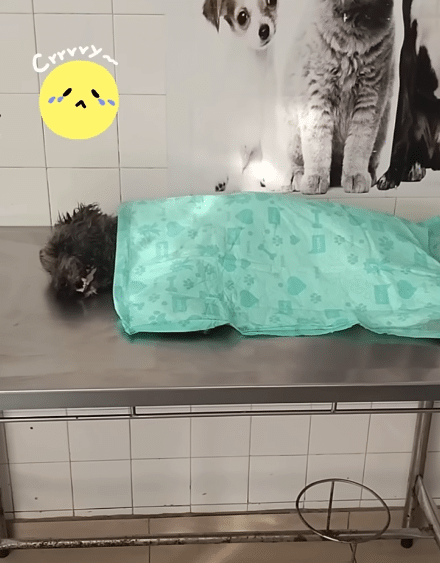
He Still Has Healing Ahead of Him
Milo’s story does not end with an unrealistic overnight transformation.
His body had been weakened enough that recovery would take time.
The effects of prolonged neglect cannot simply disappear after a bath and several meals.
Caregivers would need to continue watching him.
Continue feeding him.
Continue giving him opportunities to rest.
And allow his strength to return at the pace his body could manage.
But the difference between Milo’s situation then and now is enormous.
Beside the road, he had only a worn piece of fabric beneath him.
If he could not get up, there appeared to be no one there to help him.
If he became hungry or thirsty, he had to depend on whatever was available around him.
Now people notice those things.
They notice whether he eats.
They notice how he moves.
They notice when he responds.
They notice when something changes.
Milo does not have to become completely healthy before his life matters.
The care is happening while he heals.
That may be the most important difference of all.
He Was Almost Easy to Miss
There was nothing about Milo’s rescue that required a dramatic chase.
No one had to climb down a cliff.
No one had to enter raging water.
There was no complicated operation simply to reach him.
The difficult part came first.
Someone had to notice.
A small dog was lying beside a road.
At first glance, he looked as though he might simply be resting.
It would have taken only a few seconds to continue walking.
Instead, someone looked again.
They noticed that Milo was not moving normally.
They stepped closer.
Then help was called.
That sequence of ordinary decisions moved Milo from a piece of worn fabric beside the road to a place where food, water, rest, and care were waiting for him.
His recovery is still unfolding.
There may be stronger days ahead and slower ones too.
But whatever happens next, Milo no longer has to face it from the roadside.
The little dog who once lacked enough strength to lift his head now has people watching for every sign that strength is returning.
Sometimes rescue begins with extraordinary courage.
Sometimes it begins with something much quieter.
Someone notices a dog everyone else might mistake for sleeping.
They look twice.
And instead of continuing on their way, they stop.


