When officers found him in the woods near Dalton, Georgia, he was standing beside a tree with nowhere to go.
A wide leather belt was fastened tightly around his neck.
Attached to it was a heavy logging chain—the kind designed for pulling enormous weight, not for restraining a dog.
He was thin.
Exhausted.
And so frightened that even after he was taken to safety, he seemed to want nothing to do with the world around him.
At the Whitfield County Animal Shelter, staff gave him a name.
Stewart.
But Stewart did not greet them.
He did not approach the front of his kennel.
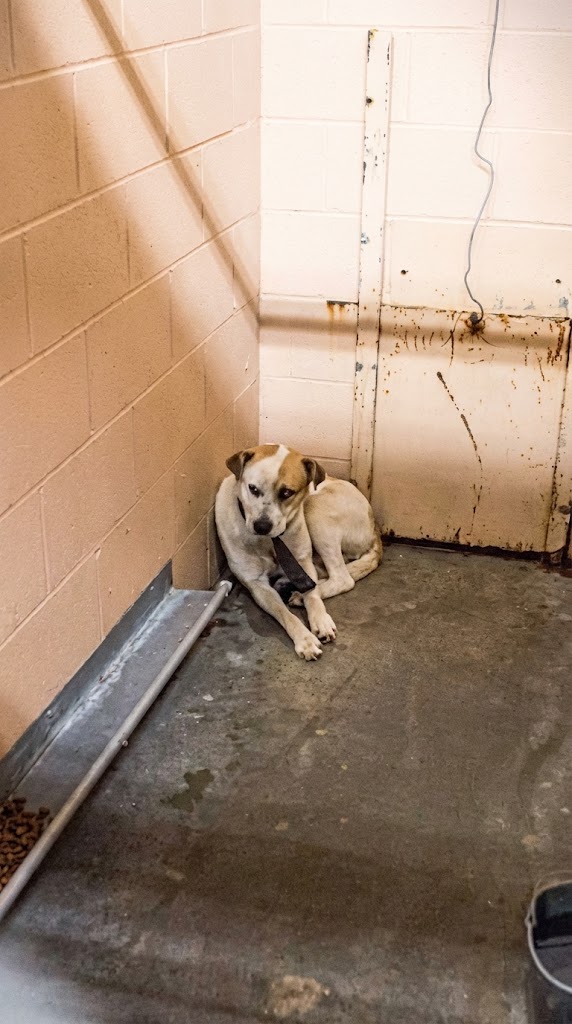
He walked into a corner, lowered his head, and pressed his face against the concrete wall.
Then he stayed there.
He had been removed from the woods.
The chain was no longer tied to a tree.
But fear had followed him inside.
Found Tied to a Tree With a Logging Chain
No one at the scene knew exactly how long Stewart had been there.
The officers could only see the condition in which he had been found.
His body was frail.
His posture was tense.
And around his neck was the wide belt connected to a chain far heavier than anything a dog should have been forced to carry.
Stewart did not appear eager to interact with anyone.
That was understandable.
Everything about his behavior suggested that unfamiliar people made him deeply uncomfortable.
Still, he allowed himself to be removed from the wooded area and transported to the shelter.
That first rescue solved the most immediate problem.
Stewart was no longer tied outside.
He had water.
Food.
Shelter.
People nearby.
But bringing him indoors did not mean he suddenly understood that he was safe.
Inside the kennel, he retreated as far as he could.
He found a corner.
Then he faced the wall.
VIDEO: Found Chained in the Woods, Stewart Was Too Frightened to Look at Anyone
At the Shelter, He Tried to Make Himself Invisible
Stewart’s response to the shelter was striking because of how little he did.
He rarely turned around.
He avoided eye contact.
He did not eagerly approach when people entered.
Instead, he kept his head low and his face close to the wall.
When someone moved too near, he sometimes growled.
The shelter staff did not interpret that sound as an invitation to push closer.
It was a warning.
Stewart was frightened.
And he was asking for distance.
A growl from a fearful dog can be valuable communication. It tells people that the animal is uncomfortable before the situation becomes more overwhelming.
So the staff listened.
They did not drag him from the corner.
They did not force affection.
They did not expect him to behave like a dog who had always known gentle handling.
They gave him space.
For Stewart, that was the beginning of something unfamiliar.
People who noticed when he was afraid—and stopped.
The Belt Around His Neck Could Not Be Removed Safely
There was still one major problem.
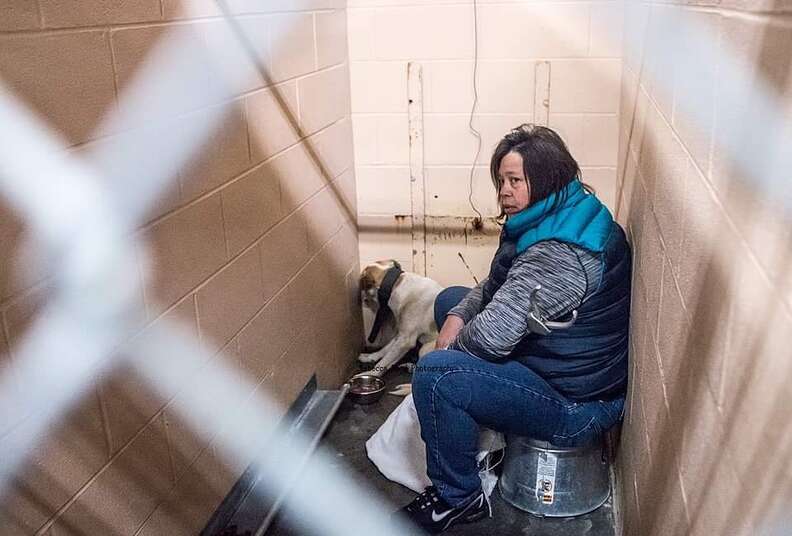
The heavy leather belt remained around Stewart’s neck.
Under ordinary circumstances, removing it would have been simple.
For Stewart, it was not.
He was too frightened to tolerate hands near that part of his body safely.
Every attempt to approach his neck risked increasing his panic.
The shelter team understood that restraining him forcefully could make future handling even harder.
So the belt stayed in place temporarily while a safer plan was arranged.
Courtney Bellew of SNARR became involved and helped coordinate specialized veterinary care for him.
The goal was not simply to cut something off his neck.
It was to do it without turning the procedure into another frightening struggle.
Stewart would need to be anesthetized.
Only then could the veterinarian work carefully around his neck while he remained still and unaware of the handling.
For the people who had watched him stare into the corner day after day, that procedure represented more than routine medical care.
It was the first real chance to remove the object that had remained with him since the woods.
Under Anesthesia, the Heavy Belt Was Finally Cut Away
At the veterinary clinic, Stewart was placed under anesthesia.
The veterinarian could finally examine the belt without causing him additional fear.
Then it was cut away.
For the first time since his rescue, there was nothing fastened around his neck.
No belt.
No logging chain hanging beneath it.
No heavy object associated with the tree where he had been found.
The physical problem was gone.
What no one knew was how Stewart would behave when he woke up.
Fear does not disappear simply because an object is removed.
Animals can continue reacting to experiences long after the immediate danger is over.
So no one expected instant trust.
But when Stewart began waking from the procedure, the people around him noticed something different.
His body appeared less rigid.
His expression seemed softer.
And then they saw a movement they had barely seen from him before.
His tail moved.
Just a little.
One Small Tail Wag Changed the Mood in the Room
For most dogs, a tail wag is ordinary.
For Stewart, it carried a different meaning.
At the shelter, much of his behavior had been about withdrawal.
He faced the wall.
He avoided interaction.
He reacted defensively when people moved too close.
Now, at the veterinary clinic, he was beginning to engage with what was around him.
The change was not an instant transformation into a carefree dog.
He still needed patience.
He still had reasons to be cautious.
But he was no longer showing only avoidance.
Then other behaviors began appearing.
Stewart became interested in toys.
At first, he explored them carefully.
Soon, that caution turned into play.
He nudged toys across the floor.
He investigated squeaky ones.
He pounced with the slightly awkward enthusiasm of a dog discovering something new.
The staff and volunteers who had seen him facing the wall now saw another side of him.
A dog capable of curiosity.
A dog capable of play.
A dog who had been hidden beneath fear.
He Began Choosing Contact Instead of Avoiding It
The next changes were subtle but meaningful.
Stewart started allowing more gentle handling.
Then he began seeking it.
Instead of keeping his body turned away, he moved closer to familiar people.
He leaned into affectionate touch.
He showed interest when someone approached.
And eventually, he began offering his paw.
None of these behaviors erased the way he had responded during his first days.
They simply added something new.
Trust.
Not complete trust.
Not trust offered to everyone immediately.
But enough trust to participate.
Enough to remain near someone instead of retreating.
Enough to play.
Enough to accept affection.
His caregivers continued following the same principle that had helped from the beginning.
They allowed Stewart to move at his own pace.
If he needed distance, he received it.
If he wanted interaction, someone was there.
This consistency gave him something more valuable than constant attention.
Predictability.
Stewart began learning that people could approach without hurting him.
That hands could stop when he was uncomfortable.
That a kennel door opening did not always mean something frightening was about to happen.
The Dog Behind the Fear Slowly Became Visible
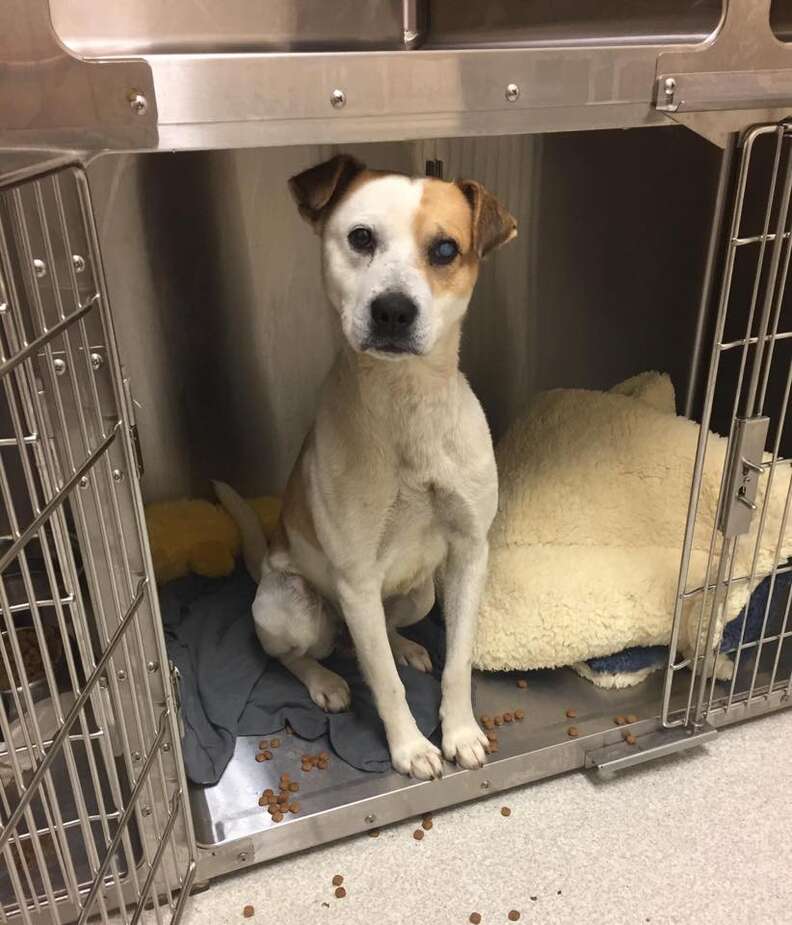
As Stewart’s comfort increased, his personality became easier to recognize.
The dog who had initially seemed unreachable was not indifferent to people.
He had simply been overwhelmed.
Once he felt safer, he showed himself to be playful and affectionate.
He enjoyed toys.
He responded to gentle attention.
He interacted with volunteers instead of always trying to disappear.
And the contrast with his first days became difficult to ignore.
The same dog who had pressed his face into concrete now looked around the room.
The dog who avoided hands began leaning toward them.
The dog who had been attached to a logging chain learned that he could move freely.
Stewart’s progress also served as a reminder that fearful behavior does not always reveal an animal’s permanent personality.
A frightened dog may growl.
Hide.
Avoid eye contact.
Refuse interaction.
Those behaviors can reflect what the dog is experiencing in that moment.
Given safety, time, and patient handling, something very different may eventually emerge.
With Stewart, it did.
What He Needed Next Was Not Another Rescue
By this point, Stewart had already been rescued from the woods.
He had already received veterinary care.
The belt had been removed.
His immediate physical needs were being addressed.
But there was still one important part of his future unresolved.
A home.
Stewart needed people who would understand that recovery does not follow a strict schedule.
He needed a household willing to respect the progress he had made without expecting every fear to disappear immediately.
A quieter environment could help him continue building confidence.
Consistent routines could help him know what to expect.
And patient people could give him the freedom to approach new experiences without pressure.
He did not need anyone to erase his past.
That was impossible.
He needed people willing to create enough good experiences that the past no longer controlled every new one.
A bowl that appears at the same time each day.
A familiar voice.
A safe bed.
A walk without anything heavy around his neck.
A hand that waits for permission before touching.
Ordinary things.
But for Stewart, ordinary could become the foundation of an entirely different life.
He No Longer Had to Face the Wall
The image from Stewart’s first days remains difficult to forget.
A dog in the corner.
Face pressed against concrete.
Body tense.
Unwilling to turn around.
At the time, no one could know whether he would eventually play with toys or lean into someone for affection.
They only knew he was frightened.
So they began there.
They respected the fear.
They gave him space.
They found a safe way to remove the belt.
Then they allowed Stewart to decide what came next.
Slowly, he turned around.
Slowly, he noticed toys.
Slowly, the tail moved.
Slowly, hands became something he could approach instead of avoid.
There was no single moment when his past disappeared.
There was simply a growing collection of moments in which the present proved safer.
Stewart’s story did not change because someone demanded that he become brave.
It changed because people allowed him to be afraid while continuing to care for him.
Once, he stood chained to a tree in the woods.
Later, he pressed his face against a shelter wall as if the safest option was not to look at anyone at all.
Then the weight around his neck was removed.
And eventually, Stewart began looking back at the people who had stayed.
Not because they forced him to.
Because, little by little, he learned that he could.


