The rescue team had walked through this neighborhood countless times before.
They knew where the stray dogs usually gathered.
They knew which ones would rush toward the sound of food being prepared, which would remain several feet away, and which would wait until everyone had gone before cautiously approaching the bowls left behind.
It was part of their daily routine.
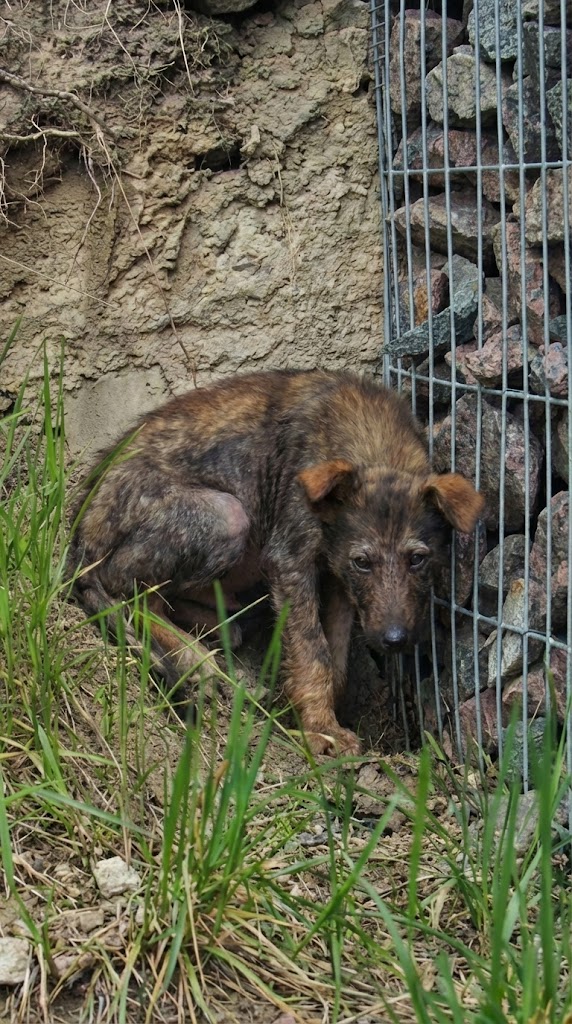
Then one day, in the middle of an empty lot, they noticed a dog they had never seen before.
He was tiny.
Young.
And almost completely without fur.
The puppy wasn’t running through the dirt or searching eagerly for food.
He simply stood there.
Still.
Alone.
From a distance, his pale, irritated skin made him look almost ghostlike against the dusty ground.
But when the rescuers moved closer, they realized that what they were seeing was not simply an unusual-looking stray.
This puppy needed help.
And judging by the way he reacted when a human hand finally came near him, earning his trust might be just as important as treating his body.
The Tiny Figure No One Recognized
The rescuers slowed their steps as they entered the lot.
They had never seen this puppy among the neighborhood dogs they regularly fed.
There was no mother nearby.
No other puppy following him.
No person looking for him.
He appeared to be completely alone.
Up close, his condition became much clearer.
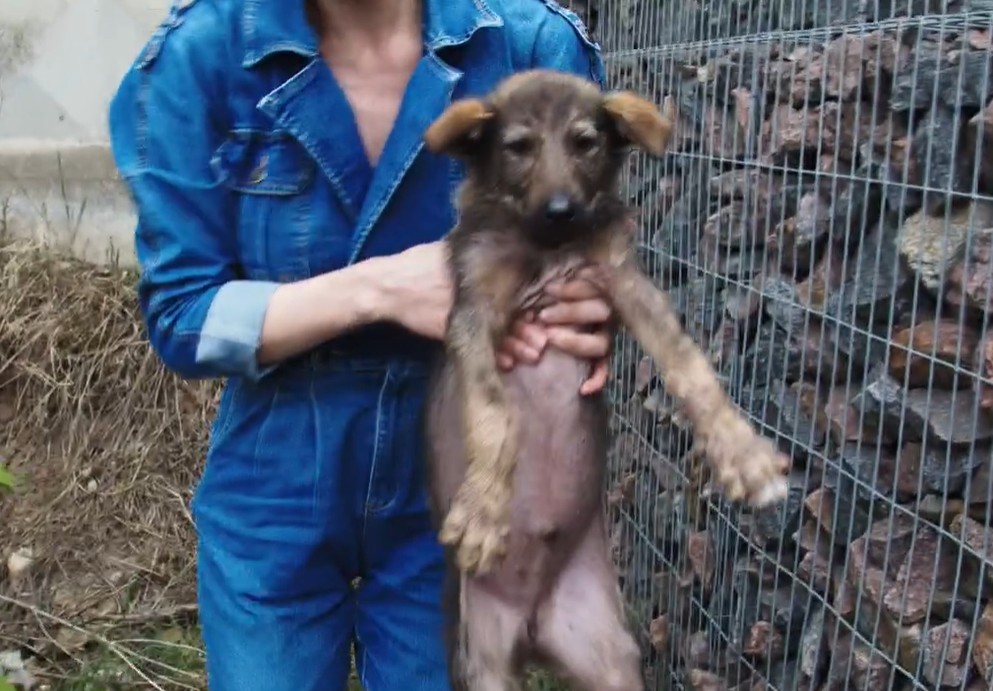
Large areas of his body had almost no fur. His exposed skin was inflamed and thickened in places, giving him the fragile appearance that had first caught their attention.
There were also signs of an older injury along his back.
Yet the puppy did not immediately try to escape.
Instead, when the rescuers came closer, he lowered himself toward the ground.
His body trembled.
He curled inward and squeezed his eyes shut.
The team could not know what experiences had taught him to react that way.
They only knew what they could see.
This young dog was frightened.
So they stopped advancing.
One person knelt nearby and slowly extended a hand.
There was no grabbing.
No pulling.
No attempt to force him to stand.
Just a gentle touch across the damaged skin of his back.
The puppy remained tense at first.
But the hand stayed soft.
And nothing bad followed.
For a dog whose body seemed prepared for danger, that quiet moment became the beginning of something different.
VIDEO: Alone in an Empty Lot, the Hairless Puppy Finally Allows a Gentle Hand to Touch Him
He Was Hungry, Yet He Turned Away From the Food
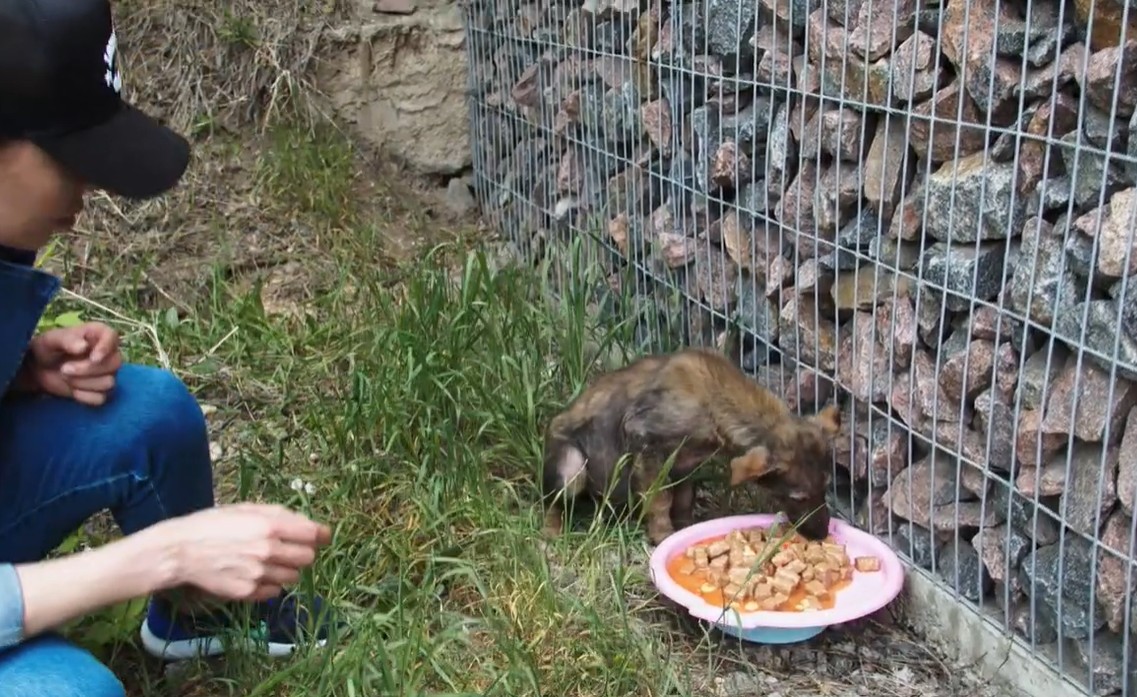
Food was brought immediately.
Given the puppy’s condition, the rescuers expected him to begin eating as soon as the bowl was placed down.
Instead, he turned his head.
Water was offered.
Again, there was almost no response.
That worried the team.
A young stray surviving outdoors would normally have good reason to be interested in both food and water. But exhaustion, illness, fear, or a combination of all three appeared to have left this puppy reluctant to engage with anything around him.
The rescuers did not push the bowl against his face.
They did not try to force-feed him.
They stayed nearby.
Someone spoke softly.
The food remained within reach.
For several minutes, nothing happened.
Then the puppy moved his nose slightly toward the bowl.
He sniffed.
Paused.
And finally took a small bite.
The rescuers stayed quiet.
He took another.
Then another.
Soon afterward, he began drinking as well.
There was nothing spectacular about the moment from the outside.
A puppy had simply eaten a little food.
But for the people sitting beside him in the dirt, it answered an important question.
He was willing to try.
That was enough.
They knew they were not going to leave him in the empty lot.
At the Clinic, the Little Stray Finally Received a Name
The puppy was carefully lifted and transported to a veterinary clinic.
He was estimated to be only around four to five months old.
Far too young to have already reached such a difficult condition.
The examination provided an explanation for the widespread hair loss and irritated skin.
The veterinary team diagnosed him with Demodex mange.
His skin required treatment and continued monitoring, and the rescue team began planning the care he would need beyond that first clinic visit.
But something else happened there too.
Until then, he had simply been the sick puppy from the empty lot.
The little hairless stray.
The frightened dog no one recognized.
The rescuers decided he needed something more personal than that.
They named him Zhora.
A name could not heal his skin.
It could not explain where he had come from.
And it could not instantly remove his fear.
But from that day forward, the people caring for him no longer had to ask about “the puppy.”
They could ask about Zhora.
Whether Zhora had eaten.
Whether Zhora’s skin was improving.
Whether Zhora had slept comfortably.
Whether Zhora seemed a little less frightened today than yesterday.
His recovery now belonged to someone with a name.
Recovery Was Built From Ordinary Things
There was no single treatment that transformed Zhora overnight.
His recovery came through repetition.
Skin care.
Regular meals.
Warm bedding.
Veterinary treatment.
Vaccinations.
And people returning every day.
In the beginning, his damaged skin remained the most visible reminder of what he had endured.
Large portions of his body were still exposed.
But slowly, the inflammation began settling.
The irritated areas became less severe.
His body started responding to care.
Then the rescuers noticed something they had been waiting to see.
Fur.
At first, it appeared only in small areas.
Soft new growth where previously there had been little more than inflamed skin.
It was easy to overlook if someone had not seen Zhora on the first day.
For the rescue team, it was impossible to miss.
Every new patch represented progress.
At the same time, Zhora’s behavior began changing.
The puppy who had curled tightly against the ground when someone approached became more comfortable around familiar caregivers.
Hands no longer seemed quite so alarming.
Food no longer required long periods of uncertainty before he would eat.
His world was becoming predictable.
And predictability appeared to help him relax.
The Biggest Change Wasn’t Just His New Coat
As Zhora’s skin improved, the physical transformation became increasingly obvious.
The ghostlike little figure from the empty lot slowly began looking like a young dog again.
But his caregivers noticed another transformation that photographs could not show as easily.
He was beginning to participate in life around him.
Instead of remaining withdrawn, Zhora became more curious.
He watched people move through the room.
He became familiar with the routines surrounding meals and care.
Gentle affection became something he could accept rather than something that immediately caused him to retreat.
None of this happened because the rescuers demanded trust from him.
They allowed it to arrive at Zhora’s pace.
That distinction mattered.
When he needed space, he was given space.
When he approached, someone was there.
When food was offered, no one took it away because he hesitated.
When a hand reached toward him, it moved slowly.
Over time, those repeated experiences gave Zhora something he had not appeared to have when he was first found:
A reason to expect that the next moment might be safe.
Eventually, he received his own pet passport as preparations for his future continued.
It was a small document.
But it represented how much his life had changed.
The puppy once standing anonymously in an empty lot now had a name, veterinary care, records, and people planning what would happen next.
His Story Traveled Far Beyond the Empty Lot
The rescue team began sharing Zhora’s progress online.
People saw the puppy as he had first appeared—almost hairless, frightened, and standing alone in the dust.
Then they saw the later photographs.
His skin improving.
His fur returning.
His posture changing.
The transformation attracted attention.
People who had never stood in that empty lot began following the little dog’s recovery from far away.
Most could only watch.
Some sent encouraging messages.
But one woman saw Zhora and began imagining something more permanent.
She contacted the rescue team.
She was interested in adopting him.
That meant discussions.
Arrangements.
Paperwork.
And careful planning to make sure the home would be appropriate for the young dog whose life had already changed so dramatically.
For Zhora, of course, none of those human details meant very much.
He could not understand applications or documents.
He did not know why his pet passport had suddenly become important.
He simply continued doing what he had learned to do since rescue.
Eat.
Heal.
Trust.
And wait for the people around him to show him what came next.
This time, what came next was not another empty lot.
It was a journey toward home.
The Puppy Who Once Curled Away Began Leaning Closer
There is an enormous difference between tolerating a human hand and choosing to move toward it.
Zhora gradually crossed that distance.
When he had first been found, his response to people had been to make himself smaller.
He curled inward.
He trembled.
He closed his eyes.
Later, as his health improved and familiar caregivers repeatedly treated him gently, that reaction softened.
Touch became normal.
Then welcome.
The puppy who had once seemed unsure of what would happen when someone reached toward him began leaning into affection.
It was not something that had to be taught through commands.
It grew from experience.
Someone touched him gently yesterday.
And returned today.
Someone brought food yesterday.
And there was food again today.
Someone gave him a warm place to rest.
And when he woke up, he was still safe.
Trust was being built from dozens of ordinary moments.
By the time arrangements for his adoption were complete, Zhora was no longer the silent puppy rescuers had approached so carefully in the dirt.
He had become a young dog ready for the next chapter.
His Passport Became a Ticket to Somewhere He Had Never Known
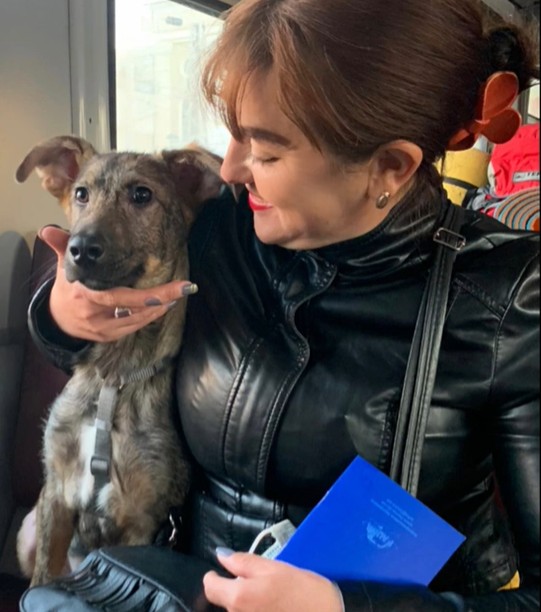
Eventually, the day came for Zhora to leave rescue care behind.
His pet passport, which had once simply represented another step in his veterinary care, now had a new purpose.
He was going home.
Not back to the neighborhood where he had been discovered.
Not to another uncertain stretch of street.
To a family waiting for him.
The woman who had followed his story online was about to become part of it.
For the rescue team, seeing Zhora leave was emotional for a simple reason.
They remembered the first version of him.
The little figure in the empty lot.
The exposed skin.
The trembling body.
The untouched bowl.
The first hesitant bite.
Now he had a healthy coat growing over the skin that once made him appear almost ghostlike.
He had the medical care he needed.
He had learned that people could offer comfort.
And there was someone waiting to continue caring for him after the rescuers said goodbye.
That was the outcome they had hoped for on the day they decided not to leave him behind.
Zhora Was Never a Ghost — He Was Simply Waiting to Be Seen
It would be easy to tell Zhora’s story only through dramatic contrasts.
Hairless to healthy.
Alone to adopted.
Empty lot to family home.
But the distance between those two lives was crossed through much smaller moments.
Someone noticed a puppy who had not been there before.
Someone walked closer instead of assuming he belonged somewhere else.
Someone knelt down when he was afraid.
Someone left food beside him long enough for him to decide whether he was ready.
Then came one tiny bite.
A drink of water.
A trip to the clinic.
A name.
Treatment.
New fur.
A passport.
And finally, a family.
No single moment did all the work.
Together, they changed everything.
Today, Zhora no longer resembles the fragile little dog first discovered standing alone in that dusty lot.
His coat has returned.
His body is healthier.
And when a caring hand reaches toward him, he no longer has to curl away and wait to see what will happen.
He can move closer.
He can accept the affection.
He can simply be a dog.
Zhora’s story is a reminder that rescue often begins before the clinic, before the medicine, and before the adoption photograph.
Sometimes it begins with something much simpler.
Someone notices.
Someone stops.
Someone decides that a small life in an ordinary place is worth paying attention to.
On that day in the empty lot, Zhora did not need the entire world to see him.
He needed only one group of people to look closely enough.
They did.
And the little “ghost” who once seemed almost invisible finally found something far more permanent than a place to recover.
He found a home.


