Mao Mao never stepped close enough to ask for food.
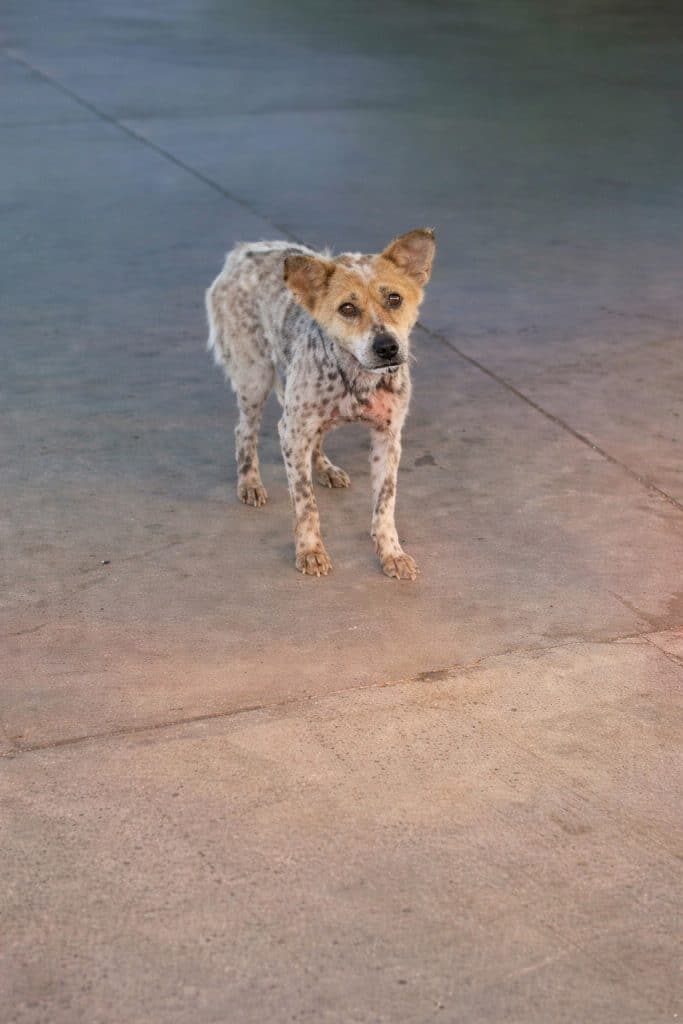
He stood several feet from a roadside meat stall, thin enough that his ribs showed clearly beneath damaged skin. Most of his fur was gone, leaving large irritated areas exposed.
Cuts of meat hung only a short distance away.
Mao Mao watched them constantly.
But he did not bark.
He did not approach the vendor.
He did not beg from the people passing beside him.
He simply remained at the edge of the stall, hungry and cautious, as though experience had taught him that getting too close to people was rarely worth the risk.
Then one passerby noticed him.
Instead of trying to catch the frightened dog, the person bought a bag of chicken liver and placed it on the ground.
Mao Mao came forward.
He ate quickly.
But even while eating, his body remained ready to retreat.
The rescuer could have considered that one meal enough.
Instead, the following evening, they came back.
That decision would eventually bring not one street dog home.
But three.
The First Meal Did Not Make Mao Mao Trust Anyone
Up close, Mao Mao’s condition was difficult to ignore.
His body was extremely thin.
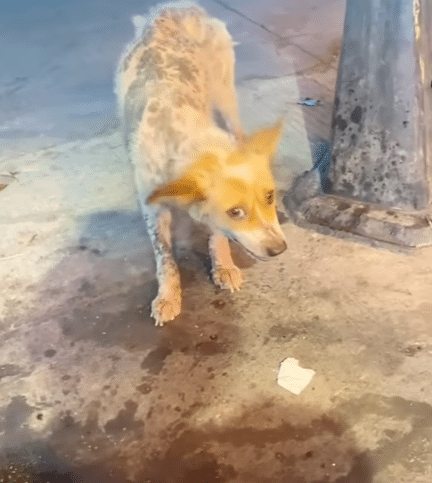
Large areas of his coat were missing, and his exposed skin appeared inflamed and unhealthy.
He needed more than scraps from a roadside stall.
But approaching him too quickly would accomplish little if fear sent him running.
So the passerby began with food.
Chicken liver was placed where Mao Mao could reach it without allowing anyone too close.
He hesitated.
Then hunger took over.
Mao Mao ate rapidly, but there was nothing relaxed about the meal.
His head repeatedly lifted.
His body stayed tense.
Any unexpected movement seemed capable of sending him away.
A bowl of clean water was placed nearby.
The rescuer waited until Mao Mao drank.
Then they left.
There was no leash around his neck.
No dramatic attempt to grab him.
No instant rescue.
Just one hungry dog receiving a meal from someone who had noticed him.
But the image stayed with the rescuer afterward.
The nearly hairless body.
The cautious eyes.
The way Mao Mao had remained just far enough from the meat stall to avoid attracting too much attention.
So the next evening, the rescuer returned.
VIDEO: Mao Mao Stood Bald and Starving Beside a Meat Stall — Then One Person Started Coming Back Every Day
When He Returned, Mao Mao Brought Two Other Dogs With Him
Mao Mao was not there the following evening.
The rescuer searched but could not find him.
Another day passed.
Then another.
It would have been easy to assume the encounter was over.
Eventually, Mao Mao appeared again.
This time, he was not alone.
A small white dog followed nearby.
She was cautious too, clearly familiar with the uncertainty of street life.
The rescuer placed food on the ground and stepped away.
Soon another stray joined them.
Three dogs were now sharing the meals.
They were given names.
Mao Mao.
Xiao Hua.
Doudou.
From then on, the rescuer began returning regularly with food and clean water.
Sometimes it was kibble.
Sometimes canned food.
Other meals included homemade broth prepared with meat and carrots.
There was no attempt to immediately touch the dogs or force them into a vehicle.
The first goal was consistency.
The same person appeared.
Food was placed down.
The dogs were allowed to eat.
Then the person returned again the next day.
For animals accustomed to finding meals wherever they could, repetition began changing the situation.
At first, the three dogs maintained distance.
Then the distance became slightly smaller.
They watched the rescuer differently.
They began recognizing the routine.
Mao Mao still had not been brought home.
But something necessary for that rescue was already forming.
Trust.
Mao Mao Was Hungry Enough to Enter a Cage — But Too Careful to Put His Feet Inside
Eventually, feeding the dogs on the street no longer seemed sufficient.
Mao Mao’s skin needed attention.
All three dogs needed somewhere safer than the roadside.
But catching them required more than simply placing down a bowl and reaching forward.
Mao Mao had survived by being cautious.
The rescuer first tried using a metal cage.
Food was placed inside.
Mao Mao approached.
He wanted the meal.
But he also understood that stepping completely into the unfamiliar structure would remove his easiest way out.
So he found a compromise.
He stretched his head and neck inside far enough to reach the food.
His paws remained outside.
He ate without surrendering the distance he needed to escape.
The attempt revealed something important.
Mao Mao was not refusing help.
He simply was not ready to give up control.
The rescuer did not chase him after the plan failed.
They went back to thinking.
Eventually, another strategy was prepared.
While Mao Mao, Xiao Hua, and Doudou were focused on eating, a lightweight plastic barrier was carefully arranged around the group.
Timing mattered.
There could be no frantic pursuit through traffic.
The enclosure was closed while the dogs remained together.
At last, all three were secured.
The daily roadside meals had led to the moment the rescuer had been working toward.
Mao Mao was finally leaving the street.
Being Indoors Did Not Feel Safe to Him Yet
Bringing Mao Mao home solved one problem.
It created several new ones.
The street had been dangerous, but it was familiar.
The house was safe, but Mao Mao did not know that yet.
Everyday sounds were unfamiliar.
Different surfaces felt strange beneath his paws.
Doors, furniture, rooms, and human routines were all new.
Even going outside for a walk required encouragement.
Mao Mao hesitated.
For a dog who had spent so much time deciding where to stand and when to retreat, suddenly living inside someone else’s space required adjustment.
So the rescuer returned to the same method that had worked on the street.
Routine.
Meals arrived consistently.
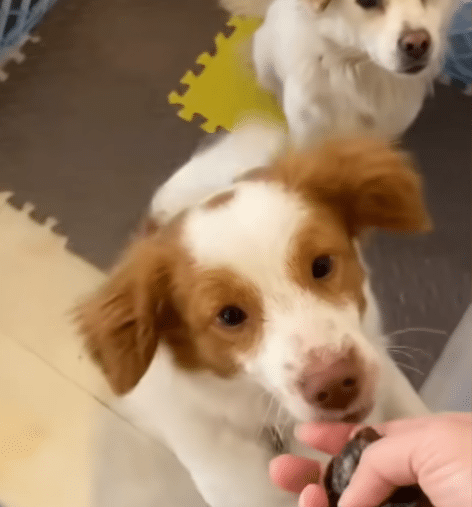
Homemade dried chicken heart treats quickly became something Mao Mao enjoyed.
The same person moved through the home each day.
Nothing terrible followed when Mao Mao relaxed.
Gradually, curiosity began competing with caution.
The dogs started exploring.
At a veterinary visit, Mao Mao remained calm while receiving vaccinations and having his nails trimmed.
That response was a major contrast with the dog who once refused to put all four paws inside a rescue cage.
He had not suddenly forgotten how to be cautious.
He had simply accumulated enough safe experiences to respond differently.
Once Mao Mao Felt Secure, He Became Surprisingly Mischievous
The dog standing silently beside the meat stall had seemed almost invisible.
At home, Mao Mao gradually became anything but.
As he grew comfortable, his personality appeared.
He explored the house.
He followed the others.
He greeted his caregiver with increasing enthusiasm.
Before long, tables became interesting enough to investigate.
Anything left within reach might attract his attention.
Xiao Hua and Doudou were changing too.
The once-cautious street trio brought movement and noise into the home.
There were now three dogs learning that they could walk through rooms without being chased away.
Three dogs discovering that meals belonged to them.
Three dogs realizing that resting did not require choosing a hidden roadside corner.
Mao Mao’s increasing mischief was almost reassuring.
When he had first been seen, nearly all of his attention had been directed toward food and maintaining distance from people.
Now he had enough security to become curious about things that had nothing to do with survival.
He could investigate.
Play.
Seek interaction.
Even get into places his caregiver might have preferred he leave alone.
He was beginning to act like a dog who expected to still be there tomorrow.
His Skin Needed Far More Time Than His Trust
Although Mao Mao’s behavior was improving, his physical recovery remained slower.
The severe skin condition that had left him nearly bald did not disappear simply because he was indoors.
According to his caregiver’s account, precautions such as gloves were used during some of his early handling.
Regular medicated baths also became part of the care routine.
Mao Mao did not appreciate them at first.
He resisted.
The process was unfamiliar and probably uncomfortable.
But, as with everything else, repetition changed his response.
Bath after bath, he became easier to handle.
Eventually, he could relax through more of the routine.
The thick scabs along his back began loosening and falling away.
Then something appeared beneath them.
New fur.
At first, the growth came in small patches.
Then more areas filled in.
The change was gradual enough that someone seeing Mao Mao every day might not notice the full transformation until comparing him with photographs from the roadside.
The fragile, nearly hairless dog was disappearing.
A healthier coat was taking his place.
But his physical appearance was not the only difference.
Mao Mao had once treated human hands as something to monitor carefully.
Now he began moving toward them.
He Went From Tolerating Touch to Asking for It
Trust can be difficult to measure.
For Mao Mao, the signs appeared through behavior.
At first, he accepted food only if enough distance remained between himself and the person providing it.
Later, he allowed himself to be transported home.
Then he tolerated veterinary handling.
As time passed, he began approaching people voluntarily.
Touch stopped being something he merely endured.
He started seeking affection.
That difference mattered.
Mao Mao no longer needed food to provide the reason for every interaction.
Sometimes he came close because he wanted company.
Sometimes he wanted attention.
The same dog who had carefully kept his paws outside a metal cage was now choosing to put himself within reach of the person who had once fed him beside the road.
Nothing forced that change.
There had been no single moment when someone convinced Mao Mao to trust.
It came from hundreds of smaller experiences.
A meal that appeared when expected.
A hand that did not hurt him.
A bath that ended.
A veterinary appointment followed by a return home.
A person leaving the room and coming back.
Repeated enough times, those experiences built something Mao Mao had little reason to assume during his street life.
Safety could continue.
The Three Street Dogs Became Part of the Home
Mao Mao’s story is closely connected to Xiao Hua and Doudou.
The rescuer initially noticed one nearly bald dog watching a meat stall.
Continuing to return eventually revealed an entire little street group.
The three dogs ate together.
They were rescued together.
And they adjusted to indoor life alongside one another.
Their presence transformed the home as much as the home transformed them.
There was more noise.
More movement.
More food preparation.
More mess.
But there was also something the dogs had not previously been able to depend on.
A place to return to.
Mao Mao no longer needed to stand outside a food stall hoping scraps might appear.
Xiao Hua and Doudou no longer needed to search alongside him.
They had names people used every day.
Bowls that belonged to them.
Places to sleep.
And someone who noticed when one of them needed care.
The street had required independence.
Home allowed something else.
Belonging.
His Rescue Started Long Before the Day He Was Brought Home
It would be easy to identify Mao Mao’s rescue as the moment the plastic barrier closed and the three dogs were finally secured.
But the real rescue started earlier.
It started beside the meat stall.
One person saw a nearly hairless dog staring at food.
They bought chicken liver.
They put down water.
Then they left.
And came back.
That last part made everything else possible.
If the rescuer had tried to force Mao Mao into captivity during their first encounter, the frightened dog might simply have disappeared.
Instead, they allowed trust to develop at the pace street life had taught him to require.
One meal became several.
Several meals became a routine.
The routine made the rescuer familiar.
Familiarity eventually made capture possible without a desperate chase.
Then came the home.
The veterinary care.
The treats.
The baths.
The falling scabs.
The new fur.
And the dog jumping onto tables to investigate things he once would have been too frightened to approach.
Mao Mao’s transformation did not begin with him trusting a human.
It began with a human behaving consistently enough to become trustworthy.
The Dog Who Once Watched Food From a Distance No Longer Has to Wait
Today, Mao Mao is no longer the nearly bald figure standing several cautious steps away from a roadside meat stall.
His skin has improved.
His fur has returned.
His body no longer carries the same fragile appearance.
But the most important difference is visible in where he chooses to stand.
Not far away.
Close.
He approaches the people he knows.
He seeks affection.
He plays alongside Xiao Hua and Doudou.
He sleeps somewhere protected instead of searching for a safe corner outdoors.
And food no longer requires a calculation about how close he is willing to get to a stranger.
It arrives at home.
Mao Mao’s story never depended on one dramatic act of heroism.
The person who helped him did something much less spectacular.
They kept returning.
When Mao Mao disappeared, they returned.
When he would not enter the cage, they changed the plan.
When home frightened him, they gave him time.
When his skin remained unhealthy, care continued.
And eventually, the dog who had learned to survive by keeping his distance discovered that there was one place where he no longer needed to.
Sometimes rescue begins when someone picks an animal up and carries it away.
Mao Mao’s began differently.
A starving dog stood silently beside food he was afraid to approach.
Someone noticed him.
Fed him.
And then, perhaps most importantly of all, came back the next day.


