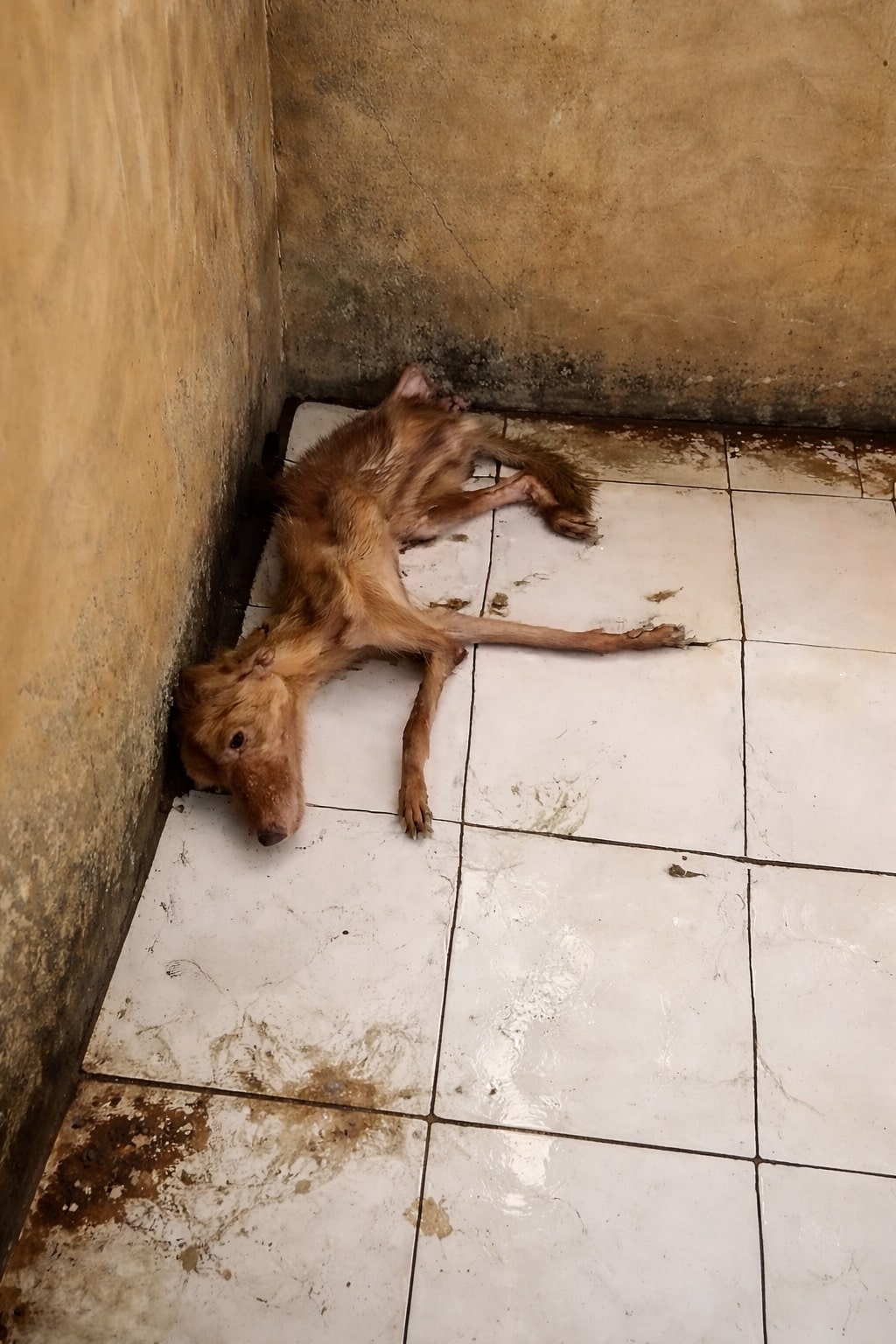
The house was supposed to be empty.
A new buyer arrived to inspect the property, expecting quiet rooms, old fixtures, and the ordinary details that come with a home waiting to be sold.
Then a bathroom door opened.
And someone was still inside.
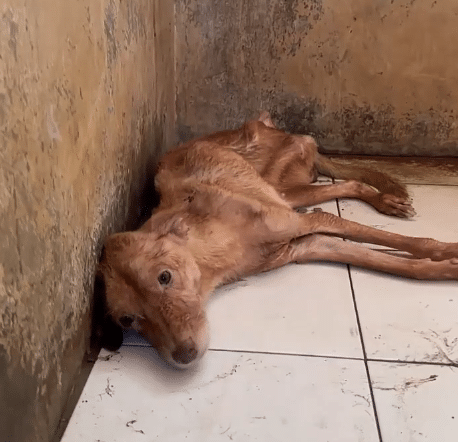
Curled against the cold tile was a dog so thin that his ribs stood out beneath his skin.
He barely moved.
He did not bark.
He did not attempt to stand.
But his eyes followed the people entering the room.
The dog was alive.
Only just.
Later, rescuers would learn that his owner had died and the property had been closed up for sale.
Somehow, the dog had remained inside.
No reliable food.
No bowl of water.
No way to leave.
He would eventually be named Benedict.
And by the time the door finally opened, he had already been waiting far too long.
He Had Been Living Behind a Door No One Thought to Open
The bathroom had become Benedict’s entire world.
There was no yard to walk into.
No person returning with food.
No open door leading somewhere safer.
According to those involved in his rescue, he had survived by licking moisture from the bathroom floor.
That small source of water may have been one of the few things keeping him alive.
His body showed the consequences.
He was severely underweight.
His strength was almost gone.
Even lifting his head required effort.
Yet when people entered, Benedict remained aware of them.
He watched.
That detail stayed with the rescuers.
After so much time alone, there was still some response left.
So they moved quickly.
VIDEO: Benedict Was Found Behind a Locked Door — His Final Week Was Filled With the Care He Had Been Missing
He Was Too Weak to Fight the Hands Trying to Help Him
When volunteers arrived, Benedict had very little energy.
There was no difficult capture.
No chase.
No need to persuade him into a carrier.
He simply did not have the strength.
As rescuers lifted him, faint cries escaped him.
They handled him as carefully as possible, aware that even ordinary movement could be uncomfortable for a body this depleted.
During transport, voices stayed soft.
The goal was not to overwhelm him with attention.
It was to get him somewhere warm.
Somewhere he could be examined.
Somewhere people could finally begin replacing what had been missing.
Food.
Fluids.
Rest.
Medical care.
And company.
At the clinic, Benedict received his name.
For a dog who had spent so much time unseen behind a locked door, that simple act mattered.
He was no longer just “the dog in the house.”
He was Benedict.
And now people were watching over him.
The First Days Gave Everyone a Reason to Hope
Veterinary care began cautiously.
Benedict was too weak to simply be offered a large meal and expected to recover.
His body needed support.
He received IV fluids.
He was kept warm.
Caregivers cleaned him gently.
Because eating normally was difficult at first, food was given slowly by syringe.
Drop by drop.
Small amounts.
Careful observation.
Then came several encouraging changes.
His bloodwork showed some improvement.
He managed to sit upright on his own.
Later, he nibbled at soft food.
These were tiny milestones.
But when an animal arrives with so little strength, tiny milestones can change the atmosphere in an entire room.
For a moment, the possibility of recovery felt closer.
Benedict was responding.
And everyone around him wanted to believe his body could continue.
Then Someone Gave Him a Small Teddy Bear
Among all the medical care, one of the simplest gestures became one of the most memorable.
A small teddy bear was placed beside Benedict.
He leaned into it.
Then rested his head against the soft fabric.
There was nothing medically important about the toy.
It could not correct dehydration.
It could not restore lost weight.
It could not change laboratory results.
But it gave him somewhere soft to rest his head.
After weeks of cold tile and an empty room, comfort itself mattered.
The teddy bear remained close.
Caregivers continued feeding him.
Talking to him.
Keeping him warm.
And for a short time, Benedict seemed to have something he had been missing for far too long.
Not simply treatment.
Companionship.
Further Testing Brought More Difficult News
The early improvements did not tell the whole story.
Additional testing revealed a serious viral illness affecting Benedict’s nervous system.
His body had also been weakened by prolonged starvation and dehydration.
Together, those problems made recovery far more difficult.
The veterinary team continued caring for him.
But Benedict’s strength began declining again.
The dog who had managed to sit up and taste food became weaker.
There are times in rescue when treatment creates a path back to health.
There are other times when the damage and illness have progressed too far before help arrives.
Benedict’s case became one of those harder stories.
The focus gradually shifted.
Not away from care.
Toward comfort.
His Final Days Were Nothing Like the Weeks Before Them
Benedict did not spend his final week behind a locked bathroom door.
He spent it with people.
There were blankets beneath him.
Food offered carefully.
Medical staff monitoring his condition.
Voices nearby.
The teddy bear beside him.
Those things could not change the outcome.
But they changed his experience of it.
One week after being rescued, Benedict died.
He was not alone.
The same dog who had spent weeks in silence now had people close enough to speak softly to him.
People knew his name.
People noticed when he needed comfort.
People stayed.
Sometimes rescue reaches an animal early enough to rebuild an entire life.
Sometimes the time available is much shorter.
That does not make the care meaningless.

His Goodbye Was Prepared With the Same Gentleness
After Benedict died, the people who had cared for him prepared a quiet farewell.
He was placed in a woven basket.
Green leaves and fresh flowers surrounded him.
The small teddy bear that had stayed beside him during his final days was placed there too.
A simple message accompanied him:
Run free, Benedict.
There was no attempt to pretend the ending was easy.
The people who rescued him wished they had found him sooner.
Anyone who sees the condition in which he was discovered can understand why.
But his last chapter was different from the weeks that came before it.
He had been found.
He had been named.
And when his body could no longer continue, he was treated as a life that mattered.
Rescue Does Not Always Mean Recovery
Benedict’s story is difficult because it does not offer the ending people usually hope for.
There is no final image of him running across a yard.
No adoption announcement.
No dramatic before-and-after transformation.
But rescue is not meaningful only when an animal survives.
Sometimes it means ending hunger.
Even temporarily.
Sometimes it means replacing a cold floor with a blanket.
Sometimes it means placing something soft beneath a tired head.
Sometimes it means ensuring that when the final moment comes, there is another living being nearby.
Benedict could not be given back the weeks he had spent alone.
The people who found him could not undo the circumstances that left him inside that house.
What they could change was the final part.
And they did.
The Door Opened Late — But Benedict Was Finally No Longer Invisible
The first image of Benedict is almost entirely about absence.
No owner.
No food.
No open door.
No one knowing he was still inside.
Then someone entered the house.
The bathroom door opened.
And suddenly Benedict existed in other people’s lives.
That led to the carrier.
The clinic.
The fluids.
The syringe feeding.
The small improvement in his bloodwork.
The moment he sat up.
The teddy bear beneath his head.
And eventually, the people who remained beside him when treatment could no longer give him more time.
His story is not a reminder that every rescue ends happily.
It is a reminder that every animal deserves care, even when the ending cannot be changed.
Benedict was found too late for the future everyone wanted for him.
But he was not too late to be given warmth.
Not too late to be comforted.
Not too late to be called by a name.
And not too late to leave this world surrounded by people who had finally seen him.


