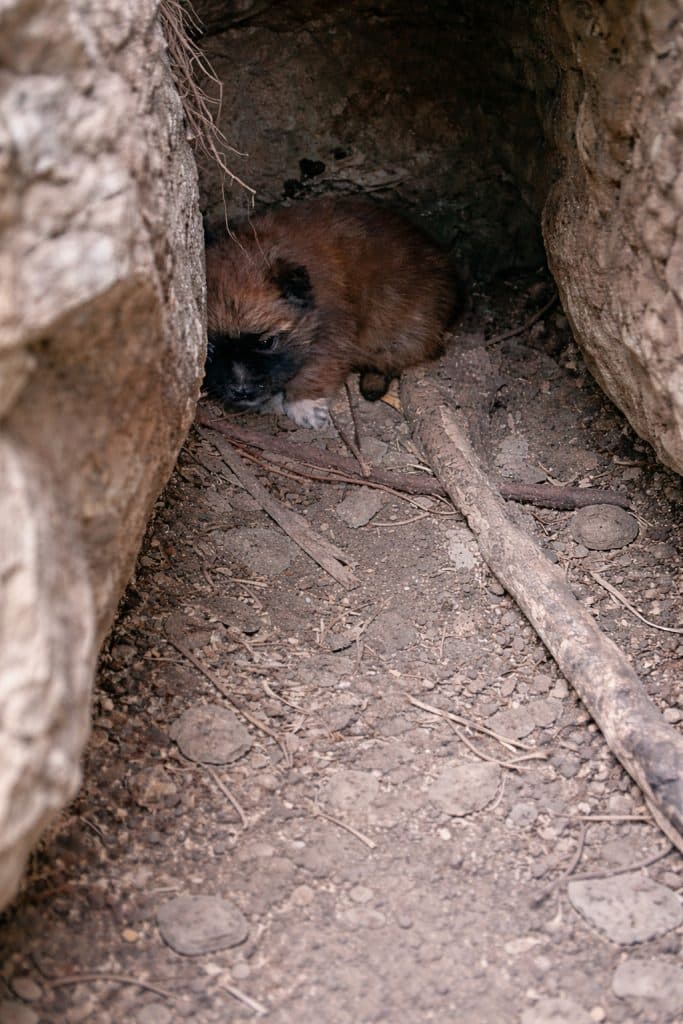
At first, the man almost walked past him.
There was no barking to attract attention. No movement across the road. No small paw reaching out from the shadows.
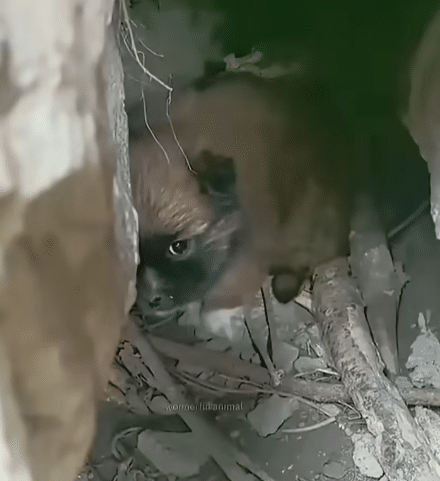
Only a pair of frightened eyes watching from a narrow space between several jagged rocks.
The puppy had pressed his tiny body so deeply into the opening that he nearly disappeared against the cold gray stone. He remained completely still whenever someone came near, as though being unnoticed was the safest thing he could hope for.
Every sound made him tense.
Every unfamiliar movement caused his eyes to widen.
Even from a distance, it was clear that the little dog did not believe the person approaching him would bring anything good.
The man could have reached into the rocks and tried to pull him out.
Instead, he stopped.
He lowered a bowl of food onto the ground, stepped several feet away, and waited.
That quiet decision became the beginning of a life the puppy could not yet imagine.
A Tiny Puppy Trying Not to Be Seen
The rocky hiding place offered little comfort.
There was no soft ground beneath the puppy’s body and no shelter capable of protecting him for long. Sharp stone surrounded him on both sides, leaving only a narrow opening through which he could watch the world outside.
Yet he refused to come out.
His body remained low.
His ears reacted to every sound.
His eyes followed the man’s movements without looking away.
The puppy did not bark or approach. He did not show the excited curiosity people usually expect from a young dog.
Instead, he watched as though he needed to understand every movement before deciding whether it was safe to breathe normally again.
No one could know exactly how long he had been hiding there or what experiences had made him so cautious. His behavior, however, revealed how little confidence he had in the people around him.
When the man stepped closer, the puppy tried to retreat farther into the rocks.
There was nowhere else to go.
His small body pressed tightly against the stone, and for a moment, fear appeared to hold him completely still.
The man recognized that reaching for him would likely make the situation worse.
A frightened animal does not understand good intentions simply because someone speaks kindly. To the puppy, an unfamiliar hand moving toward his hiding place could still feel like a threat.
So the man did not grab him.
He did not corner him.
He offered something the puppy could understand without being touched.
Food.
The bowl was placed close enough for the puppy to smell but far enough from the rocks that he would need to make a choice.
Remain hidden.
Or take one uncertain step into the open.
Video: A Frightened Puppy Hides Between the Rocks—Until Hunger Leads Him Toward Help
One Bowl of Food and a Great Deal of Patience
At first, the puppy did not move.
The smell of food reached him, but fear remained stronger than hunger.
He stared at the bowl.
Then he looked at the man.
His front paw shifted slightly before pulling back again.
The man understood that waiting was now the most important thing he could do. He moved farther away, reducing the pressure on the little dog and allowing him to examine the food without anyone standing directly above him.
Several quiet moments passed.
The puppy leaned forward.
He stopped.
He looked around again.
Then, with his body still held low to the ground, he took one small step out from between the rocks.
Every movement was cautious. He appeared ready to retreat at the slightest sound.
Another step brought him closer to the bowl.
Then another.
When he finally reached the food, he did not immediately begin eating. He sniffed carefully and glanced back toward the man, checking once more for movement.
Nothing happened.
No one rushed toward him.
No hand reached out.
The puppy lowered his head and took the first bite.
He ate quickly, pausing every few moments to look around. His muscles remained tense, and he never moved far from the direction of his hiding place.
Still, he continued eating.
Each bite gave the man another opportunity to show that his presence did not bring danger. He stayed calm and allowed the puppy to control the distance between them.
That first meal did not suddenly erase the dog’s fear.
It did something smaller and more important.
It created one experience in which approaching a human had not caused harm.
The man watched the puppy finish and realized he could not leave him among the rocks.
The little dog needed more than a single meal. He needed protection, regular food, and a place where he would not have to spend every moment watching for danger.
Bringing him home, however, would not instantly make him feel safe.
Physical rescue could happen in one afternoon.
Trust would take much longer.
A New Home Still Felt Like Another Unknown Place
The puppy was taken away from the rocks and brought into a home where food, clean water, blankets, and shelter were waiting for him.
To a person, the difference was obvious.
The rooms were warm.
The floor was dry.
There were no exposed rocks, passing vehicles, or dangers hidden in the open landscape.
But the puppy did not understand the meaning of those comforts yet.
Everything was unfamiliar.
New smells filled every room. Doors opened and closed. Footsteps echoed across the floor. Household objects created sounds he had never learned to recognize.
Instead of relaxing, the puppy remained close to the walls.
He kept space between himself and the man.
When someone changed direction too quickly, his body tensed.
If a hand moved toward him without warning, he pulled away.
The puppy had been removed from the place where he was hiding, but part of his behavior remained shaped by the need to protect himself.
The man resisted the temptation to force affection.
He did not pick the puppy up each time he withdrew.
He did not block the corners where the little dog felt most secure.
He avoided loud voices and sudden movements, offering food and gentle companionship without demanding a response.
That restraint mattered.
The puppy was allowed to observe his new surroundings at his own pace.
From a safe distance, he watched the man walk through the rooms.
He noticed that food arrived regularly.
He saw that the water bowl remained available.
He learned that footsteps passing nearby did not always lead to unwanted touch.
Day after day, the same calm routine continued.
Nothing frightening followed the meals.
No one chased him when he moved away.
The man returned each morning and remained present each evening.
Slowly, the puppy began paying attention for a different reason.
He was no longer only watching for danger.
He was beginning to study the person who cared for him.
Following From a Distance Became the First Sign of Trust
The first changes were easy to miss.
The puppy did not suddenly run into the man’s arms.
He did not wake one morning completely free of fear.
Instead, he began following.
At first, he remained several feet behind.
When the man walked from one room into another, the puppy quietly appeared near the doorway. If the man turned around, the little dog stopped and watched.
Sometimes he retreated.
Other times, he remained where he was.
The distance between them gradually became smaller.
The puppy seemed curious about where the man was going and what he was doing. Staying close still made him nervous, but being left alone no longer appeared to be what he wanted.
That conflict—caution pulling him backward while curiosity brought him forward—became an important part of his recovery.
The puppy began entering rooms he had previously avoided.
He sniffed furniture.
He investigated corners.
He stood near objects that had once caused him to retreat.
Each discovery showed him that the house contained ordinary things rather than hidden threats.
A blanket became somewhere to lie down.
A bowl became a reliable source of food.
A doorway became an invitation to explore another room.
Even the man’s footsteps slowly became familiar.
The puppy still reacted to unexpected sounds, but he recovered more quickly. He no longer rushed toward the nearest wall every time something changed.
His body began to relax.
His head lifted more often.
Instead of looking only for a place to hide, he started looking toward the person who had brought him home.
These were quiet milestones, but they were significant.
Trust is not always revealed through dramatic affection.
Sometimes, it begins when a frightened animal decides to remain in the same room.
Sometimes, it appears when he follows someone down a hallway.
And sometimes, the first real sign of healing is simple curiosity about what might happen next.
Video: The Puppy Who Once Feared Every Movement Begins Following His New Dad Through the House
Curiosity Slowly Made Room for Play
As the puppy became more comfortable, the house began to feel less like an unfamiliar enclosure and more like a place he could explore.
He moved through the rooms with increasing confidence.
His steps became quicker.
His nose led him toward new smells instead of remaining pointed toward the nearest exit.
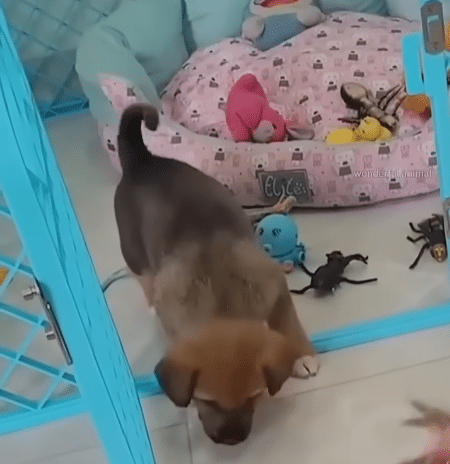
Toys were placed within reach, though at first he did not seem to know what to do with them.
A ball rolled across the floor.
The puppy watched it carefully.
A soft toy was set nearby.
He sniffed it and stepped away.
No one forced him to interact.
The objects remained available until curiosity finally became stronger than hesitation.
One day, the puppy touched a toy with his paw.
Later, he picked it up.
Before long, he was chasing it across the room.
The change was remarkable not because playing is unusual for a puppy, but because fear had previously occupied so much of his attention.
Now he had enough security to focus on something unnecessary for survival.
He could play simply because it felt good.
His movements became energetic and unpredictable in the way puppy movements often are. He ran across the floor, changed direction suddenly, and returned to the same toy again and again.
The home that had once made him nervous became his playground.
Soft blankets offered places to rest after bursts of energy. The man encouraged him with a calm voice and celebrated each new behavior without overwhelming him.
At times, the puppy even wore small outfits.
The clothing itself was less important than what the moments represented. The little dog who had once tried to disappear into the rocks was now being included, photographed, and treated as a valued member of the home.
He was no longer an unnoticed stray surviving in the shadows.
He was a puppy whose personality was finally being given room to appear.
The Outside World No Longer Meant Only Danger
Learning to feel safe inside the house was one challenge.
Going outside introduced many more.
The world beyond the door contained unfamiliar dogs, people, sounds, and movement. Cars passed in the distance. Grass shifted beneath his paws. New scents arrived from every direction.
During his first outings, the puppy remained cautious.
He stayed near the man and carefully watched everything around him.
The open space offered fewer walls and corners where he could retreat, making the environment feel very different from the home he had learned to understand.
Once again, the man did not rush him.
The puppy was allowed to observe before participating.
At the park, he encountered other puppies.
He noticed friendly cats.
He felt grass beneath his paws and warm sunlight across his fur.
At first, he remained on the edge of the activity.
Other animals played while he watched.
Their running and sudden movements could have sent him searching for shelter, but the puppy stayed.
Eventually, he stepped closer.
A cautious greeting became a brief interaction.
The brief interaction became play.
Soon, the puppy was running alongside new companions, moving freely across the grass and returning to the man whenever he needed reassurance.
The outside world was still full of surprises.
The difference was that surprise no longer automatically meant danger.
Some new animals became friends.
Some new places contained room to run.
Some unfamiliar experiences were enjoyable.
The puppy was learning to form new expectations.
Instead of assuming that every movement required retreat, he could pause, observe, and then decide whether to approach.
That ability gave him more freedom than simple physical rescue ever could.
His world was growing.
It no longer ended at the opening between two rocks or at the walls of a single room.
There were parks to explore, animals to meet, sunlight to enjoy, and a trusted person walking beside him.
The Puppy Between the Rocks Was Finally Free to Be Seen
The most striking part of the puppy’s transformation could be seen in his body.
When he was discovered, he tried to occupy as little space as possible.
He crouched between the rocks.
He kept his movements small.
His muscles remained tense, and his eyes continually searched the area around him.
Over time, that posture changed.
His tail began moving more freely.
His steps became confident.
He rested without appearing ready to jump up at every sound.
Instead of retreating when the man entered a room, he followed.
Instead of watching toys from a distance, he chased them.
Instead of remaining at the edge of the park, he joined other animals in play.
The puppy had not simply been moved from one location to another.
He had been given repeated experiences that allowed him to respond differently to the world.
A bowl of food had been offered without a trap.
A home had provided shelter without confinement.
A person had remained nearby without demanding immediate affection.
Every calm interaction added something new.
The puppy learned that hands could bring food.
Footsteps could belong to someone familiar.
A new environment could contain comfort.
Other animals could offer companionship.
Most importantly, he learned that he no longer needed to make himself invisible to remain safe.
His change did not happen because one dramatic gesture immediately removed every fear.
It happened because kindness remained consistent.
The man waited beside the rocks.
He waited inside the home.
He waited while the puppy explored.
He waited while playfulness slowly returned.
That patience allowed the puppy to make each important choice for himself.
He chose to approach the bowl.
He chose to follow from one room to another.
He chose to investigate the toy.
He chose to join the animals at the park.
Each choice carried him farther away from the frightened little dog who once believed hiding was his only protection.
Kindness Gave Him the Time He Needed
It would be easy to describe this story as a complete transformation from fear to happiness.
The truth is gentler than that.
Trust is rarely a single moment.
It is built through patterns.
Food arriving each day.
A voice remaining calm.
A hand stopping when an animal becomes uncomfortable.
A person returning again and again until their presence no longer feels unpredictable.
The man did not change the puppy’s life by forcing him to become brave.
He changed it by creating an environment in which bravery could develop naturally.
The bowl of food beside the rocks was the first invitation.
The step backward gave the puppy control.
The quiet home gave him time.
The toys, blankets, outdoor walks, and new friends gave him experiences beyond survival.
Eventually, the puppy no longer spent each day preparing to escape.
He could rest.
He could play.
He could seek affection.
He could be curious without constantly expecting something frightening to follow.
The sharp rocks that once surrounded his small body became part of his past.
They were no longer the place where he needed to return whenever the world felt uncertain.
He had somewhere else now.
A home.
A person he recognized.
Friends he could run beside.
And a life in which being noticed no longer meant being in danger.
Sometimes, rescuing an animal begins with urgent action.
Other times, the most important choice is knowing when not to rush.
One man saw a terrified puppy between the rocks and understood that kindness would need to arrive quietly.
He placed food nearby.
He stepped away.
He waited.
The puppy eventually stepped forward.
And from that first cautious movement came everything that followed—a warm home, playful afternoons, new friendships, and the freedom to live without hiding.
Once, the puppy made himself small enough to nearly disappear.
Today, he moves through the world with his tail raised, his eyes bright, and someone he trusts always nearby.
All because kindness gave him the time and space to discover that he was finally safe.


