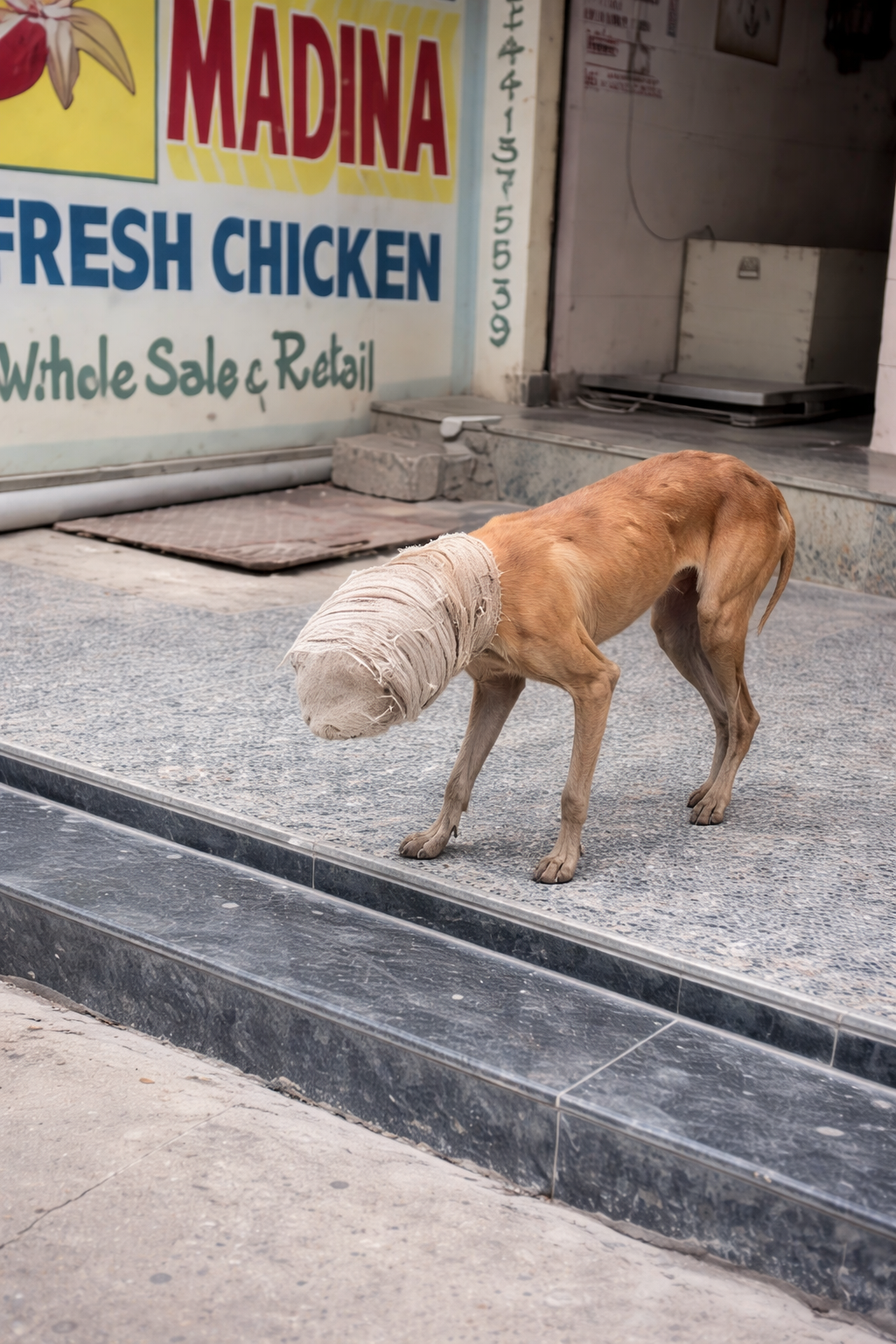
At first, people could see only a small brown dog moving strangely through the street.
He bumped into walls.
He hesitated at curbs.
He wandered between parked vehicles as though he could no longer understand where the road ended and danger began.
Then someone looked closer.
His entire head was trapped inside a large, cloudy plastic container.
The opening had slipped over his head and become lodged around his neck. He could not simply shake it off.
He could barely see through it.
Eating was impossible.
Drinking was impossible.
And every hour spent trapped inside it left the little stray weaker.
For days, he continued moving through streets filled with traffic and people.
Then Animal Warriors Conservation Society received a call.
The team went looking for him.
Finding the dog was only the beginning.
Getting close enough to remove the container would become the harder part.
The Plastic Jar Had Turned an Ordinary Street Into a Maze
The dog had somehow pushed his head into the container, most likely while searching around discarded waste.
Once it became stuck, almost everything about surviving outdoors became harder.
His vision was obstructed by the cloudy plastic.
He could not lower his mouth to eat.
He could not drink normally.
Even judging the direction of an approaching vehicle became difficult.
Still, instinct kept him moving.
He wandered from one section of the neighborhood to another, trying to navigate a world he could no longer see properly.
People might have mistaken the movement for ordinary stray behavior from a distance.
It was anything but ordinary.
Every passing hour meant more hunger.
More thirst.
More exhaustion.
And another chance that he could stumble directly into traffic.
By the time the rescue team began following him, the dog’s body was already showing the effects of what he had endured.
Yet fear remained strong enough to make him run.
That created a dangerous problem.
The people trying to save him were also the people he was trying hardest to escape.
Video: Rescuers Follow the Terrified Stray With a Plastic Container Trapped Over His Head
Every Time They Came Closer, He Ran Toward More Danger
The rescuers could not explain to the dog what they wanted.
They could not tell him that the object over his head needed to come off.
All he understood was that unfamiliar people were approaching.
So he ran.
Across streets.
Between cars.
Into narrow alleys.
Then back toward open roads.
The container made each attempt to escape even more dangerous.
His vision was already limited.
Now panic was deciding his direction.
The rescue team knew that sprinting after him could make the situation worse.
If they frightened him badly enough, he might run directly in front of a moving vehicle.
So they followed carefully.
When he moved, they tracked him.
When he created distance, they did not immediately rush to close it.
They waited for safer opportunities.
The chase stretched on.
There were moments when the dog seemed close enough to catch.
Then he moved again.
Each time, the rescuers had to balance two competing risks.
Letting him continue meant leaving the container in place.
Pushing too hard could send him into traffic.
There was no perfect option.
Only patience.
Exhaustion Eventually Did What the Rescuers Couldn’t
After so much running, the little dog’s pace began to change.
He was slowing.
Not because he had suddenly decided to trust the people behind him.
His body was simply becoming tired.
He had already spent days unable to eat or drink normally.
Then he had used what remained of his energy trying to escape the rescue team.
Eventually, there was less strength left for another sprint.
That created the opening the rescuers had been waiting for.
They needed to act quickly—but carefully.
One rescuer moved close enough to reach him.
The dog tried to escape again.
Before he could run back toward the road, the rescuer gently caught one of his hind legs.
It was an unusual-looking maneuver.
But the immediate goal was simple.
Stop the dog from launching himself into moving traffic long enough for the team to secure him.
The others moved in.
They knelt beside him.
Hands steadied his body.
Now, for the first time since the rescue began, the dog could no longer run.
The container was still there.
But the chase was finally over.
The Hardest Part Was Getting the Container Past His Head
With the dog held securely, the team could finally examine the plastic properly.
The container had not simply fallen loosely over his face.
It was wedged firmly around his head.
Pulling straight upward could hurt him or frighten him into struggling harder.
So the rescuer holding the container worked gradually.
A slight twist.
Then a lift.
Another adjustment.
The dog moved beneath the rescuers’ hands, but the team kept him steady.
The container shifted.
Not enough.
Another turn.
Another small pull.
For several tense seconds, it remained caught.
Then the edge finally cleared.
The plastic slid upward.
And suddenly the dog’s entire head was uncovered.
After days of seeing the world through cloudy plastic, there was nothing in front of his face anymore.
No barrier.
No sealed container.
No object preventing him from reaching food or water.
He was free.
For the First Time in Days, He Could See Everything Around Him
The little dog blinked rapidly.
His head moved from side to side.
The world around him was suddenly open again.
He could see the rescuers kneeling nearby.
He could smell without a plastic wall around his face.
He could move his mouth freely.
The people who had spent hours following him were finally able to release their grip.
What happened next surprised them.
The dog did not immediately disappear down the street.
Instead, he began moving excitedly around the people who had just freed him.
He hopped.
Circled.
His tail moved rapidly.
The tension of the chase gave way to laughter and relief among the rescuers.
For hours, every movement had carried the possibility that the dog might run into traffic.
Now he could move without the container blocking his vision.
There was no complicated medical procedure.
No long operation.
Just one stubborn piece of plastic finally removed.
But for this dog, that single object had controlled almost every part of his life for days.
Its absence changed everything at once.
The Rescue Was About More Than Removing One Jar
It would be easy to focus only on the moment the container came off.
That was the most satisfying part to watch.
But the rescue had started much earlier.
Someone first had to notice that the dog was in trouble.
Someone had to make the call.
The Animal Warriors Conservation Society team then had to locate him.
After that came the hours of following without pushing him into greater danger.
The rescuers had to remain patient even when the dog repeatedly ran away from the very people trying to help.
Then, when the opportunity finally appeared, they had to act quickly enough to prevent another escape without injuring him.
Only after all of that could the plastic be removed.
The final few seconds were simple because so much careful work had come before them.
A Piece of Trash Can Become a Trap for a Hungry Animal
At the end of the rescue video, viewers are given a simple reminder:
Crush or flatten plastic containers before throwing them away.
For people, an empty food container can look harmless.
For a hungry stray animal, it can smell like an opportunity.
A dog may push his head inside searching for leftover food.
A small animal may enter through an opening that is easy to pass in one direction but difficult to escape from afterward.
Once trapped, panic can make the problem worse.
The animal pulls.
Twists.
Runs.
And suddenly an ordinary piece of waste becomes something that interferes with eating, drinking, seeing, or breathing comfortably.
That is what makes this rescue useful beyond one dog’s story.
The danger was not a rare piece of specialized equipment.
It was ordinary trash.
Something almost anyone might throw away without thinking twice.
Flattening or crushing an empty container before disposal takes only a moment.
For an animal scavenging later, that small step can remove the opening that becomes a trap.
He Survived Because Someone Realized This Wasn’t “Just a Stray”
The dog had probably passed many people during the days he wandered with the container on his head.
Some may not have noticed.
Some may not have known how to approach him safely.
Others may have assumed someone else would help.
Eventually, someone made sure the problem reached people equipped to respond.
That changed the outcome.
By the end of the video, the most striking image is not the dog trapped inside plastic.
It is the same dog moving freely around the rescuers.
His face visible.
His tail active.
Nothing covering his head.
Nothing preventing him from reaching food or water again.
The difference between those two moments came down to people refusing to give up simply because the dog kept running away.
Sometimes the Animal You’re Trying to Save Will Run From You
That may be one of the most important parts of this story.
The dog did not understand rescue.
When people approached, he escaped.
When they followed, he tried harder to get away.
To a rescuer, that can be frustrating.
But fear does not disappear just because help has arrived.
A frightened stray does not know the difference between someone trying to catch him for harm and someone trying to catch him for safety.
That understanding shaped the rescue.
The team did not interpret his running as a reason to stop.
They adjusted.
They followed.
They waited.
Then, when his strength faded enough for a safe opportunity, they stepped in.
The dog had spent days trapped by the container.
The rescuers spent hours earning the few seconds they needed to remove it.
Those seconds gave him back the ability to see, eat, drink, and move normally again.
One Small Change in How We Throw Something Away Can Matter
There was nothing complicated about the object that trapped him.
No mechanical device.
No locked cage.
No chain.
Just a plastic container.
That is precisely why the ending matters.
Most people will never perform a street rescue like the one shown in the video.
But almost everyone throws things away.
That makes prevention possible long before an animal ever needs rescuing.
Flatten containers.
Crush openings where practical.
Dispose of waste securely.
Do not leave food packaging where stray or wild animals can easily reach it.
These actions take far less effort than the hours required to catch a frightened dog running blindly through traffic.
For this little stray, help arrived in time.
Someone noticed.
A rescue team followed.
One person finally reached him.
And after days of carrying a plastic prison around his head, the dog felt it slide away.
What remained was almost wonderfully ordinary.
A small brown dog.
A clear view of the street.
A wagging tail.
And the freedom to move wherever he wanted without taking the container with him.


