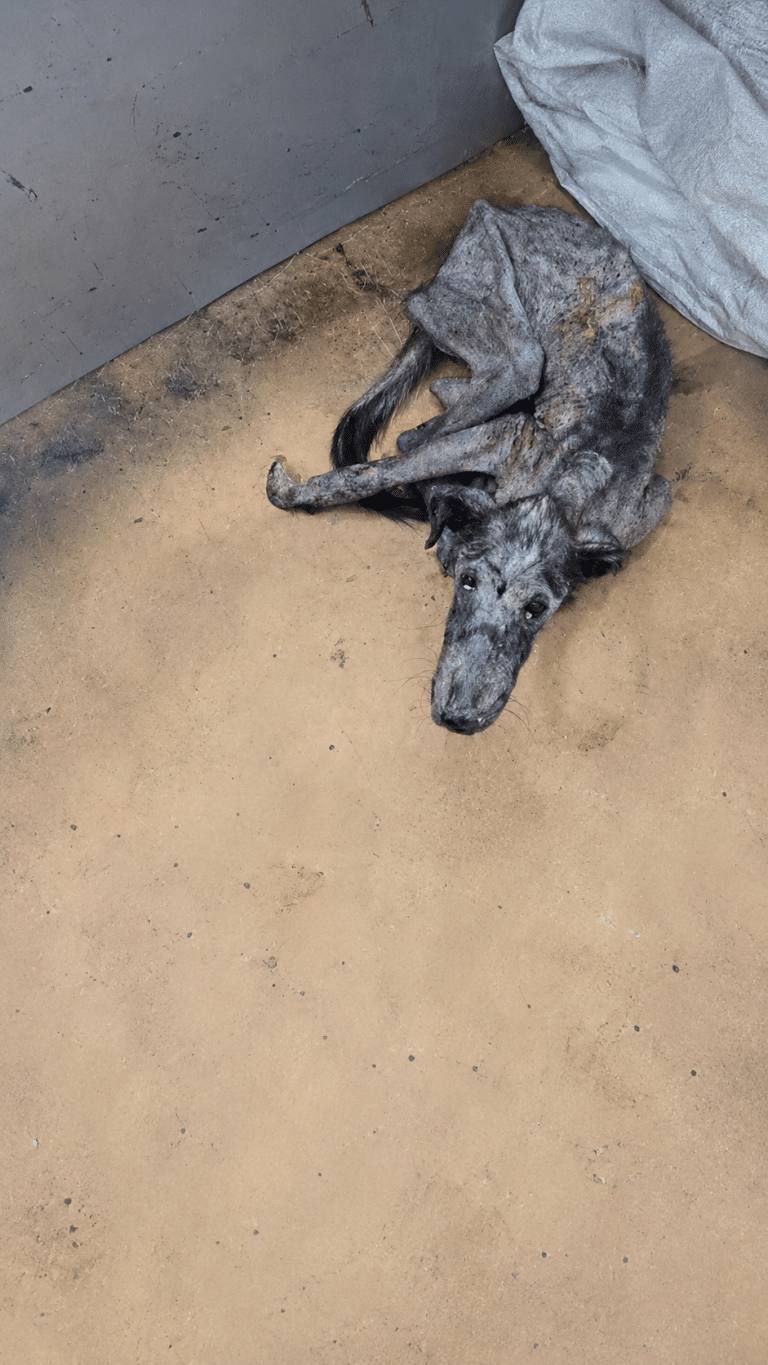
The man was driving through an unfamiliar area during a quiet vacation when something moved beside the road.
At first, it looked like a loose piece of debris shifting through the dirt.
Then it tried to stand.
A severely underweight dog was moving along the roadside on trembling legs. His coat was missing in large patches, and his thin body seemed to struggle with the effort of every step.
When the man slowed down and approached, the dog attempted to move away.
He had almost no strength left.
Still, he tried to run.
That was how he received the name Runner.
Even in His Condition, He Tried to Escape
Runner’s body revealed how difficult his recent life had been.
His ribs and hips were clearly visible beneath his damaged coat. Large areas of irritated skin had been left exposed where fur was missing, and his legs shook whenever he tried to support his weight.
He appeared severely dehydrated and undernourished.
Yet the moment someone moved toward him, Runner attempted to create distance.
His movements were slow and unsteady, but the instinct to avoid an unfamiliar person remained strong. He did not know that the man beside the road had stopped to help.
He only knew that someone was coming closer.
The man did not chase him aggressively.
Instead, he lowered himself, kept his movements calm, and placed food where Runner could reach it without being forced into immediate contact.
Hunger soon became stronger than hesitation.
Runner approached the food and began eating with intense focus. He barely paused between bites, suggesting that regular meals had been missing from his life for some time.
Afterward, he did not become playful or excited.
He simply looked exhausted.
The small amount of effort required to eat seemed to have used much of the energy he had left.
Video: Runner Was Too Weak to Wag His Tail—But Still Tried to Escape From Anyone Who Came Near
The First Challenge Was Keeping Him Stable
Once the man could approach safely, Runner was taken to a veterinary clinic.
The team immediately understood that recovery would need to happen slowly.
A dog who has gone without adequate food for an extended period cannot always return to normal portions immediately. His weakened body needed controlled meals, careful hydration, and close monitoring while it adjusted to receiving nourishment again.
The veterinary staff began treating his skin condition and checking for other problems that could complicate recovery.
His care included medication, regular cleaning of the irritated areas, and a feeding plan designed to help him gain weight without placing unnecessary stress on his body.
At first, the goal was not to make Runner look dramatically different.
It was to help him remain stable through the next meal and the next day.
His portions were measured.
His response to treatment was monitored.
And every small change mattered.
Drinking more water.
Finishing a meal.
Standing for a little longer.
Resting without repeatedly shifting from discomfort.
Runner had spent an unknown amount of time depending entirely on himself.
Now his survival no longer rested on what he could find beside the road.
A Soft Bed Did Not Immediately Feel Safe
Medical care began addressing Runner’s physical condition, but his behavior remained cautious.
He watched people closely.
An unexpected movement could cause him to pull away or lower his body. Even when food was available, he sometimes appeared uncertain about approaching while someone stood nearby.
The caregivers did not force affection.
They gave him a quiet place to rest and followed predictable routines. Meals arrived at similar times. Medication was given carefully. The same calm voices returned each day.
For a dog accustomed to searching for food and avoiding possible danger, consistency was more useful than an overwhelming display of attention.
Runner needed to learn that the bowl would not disappear.
The bed would remain his.
And the people entering the room were not there to chase him back onto the road.
At first, he rested with his body tense.
Then he began sleeping more deeply.
He stopped reacting to every movement nearby.
Eventually, he allowed caregivers to sit closer without trying to retreat.
There was no single moment when all of Runner’s uncertainty vanished.
Trust appeared through a series of ordinary experiences repeated often enough to become familiar.
His Body Slowly Began to Change
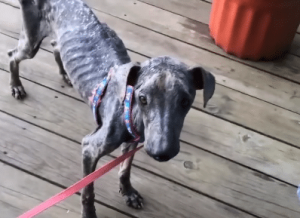
As the weeks passed, regular meals began restoring weight to Runner’s fragile frame.
The sharp outline of his ribs gradually became less visible. His legs gained strength, allowing him to stand and walk for longer periods without immediately needing to rest.
Treatment also began improving his skin.
The irritated areas became calmer, and new fur appeared across sections that had once been almost bare. The transformation was gradual, but each week revealed another visible sign of recovery.
His posture changed too.
Runner no longer moved as though every step might be his last available effort.
He began lifting his head more often.
He explored the room instead of remaining in one safe corner.
And when familiar caregivers approached, he watched them with curiosity rather than immediately searching for an escape route.
Then his tail began moving.
At first, the wag was brief.
Later, it appeared more often—especially around meals, familiar voices, and the people who had remained beside him through treatment.
The dog found beside the road was still present.
But strength was beginning to uncover a different side of him.
The Frightened Dog Became Almost Too Curious
Once Runner felt physically stronger, his personality became much harder to miss.
He wanted to investigate everything.
A toy left on the floor became something to sniff, carry, or follow across the room. An open doorway invited exploration. A person sitting nearby became an opportunity to move closer and ask for attention.
The dog who had once tried to avoid every human now began seeking familiar caregivers.
He followed them.
He leaned toward gentle touch.
And when excitement took over, he moved with an energy that seemed almost impossible compared with his first day at the clinic.
His name started to feel appropriate for a new reason.
Runner was no longer trying to flee because he felt threatened.
He simply enjoyed moving.
He had spent so long conserving what little strength remained that freedom of movement appeared to become one of his greatest pleasures.
Walks grew longer.
Play sessions became more active.
And soon, his new family began introducing him to places far beyond the roadside where he had been found.
The Beach Revealed How Far He Had Come
Runner’s visit to the beach became one of the clearest signs of his transformation.
The dog who had once struggled to remain upright now raced across the sand.
He followed the shoreline, moved through shallow waves, and explored the open space with constant enthusiasm. His legs carried him quickly over ground that would once have been impossible to cross.
There was no cautious step-by-step movement now.
Runner sprinted.
He chased the water as it moved toward him and then followed it as it returned to the sea. His ears lifted in the wind while he moved freely beside the people caring for him.
Eventually, he was even introduced to a surfboard.
At first, balancing on the unfamiliar surface required help and patience. Runner needed to understand where to place his paws as the board shifted beneath him.
But just as he had adapted to regular meals, a safe home, and a healthier body, he began adjusting to this new experience too.
Soon he could stand beside his owner on the board while the ocean moved around them.
The scene was almost impossible to connect with the first roadside footage.
There, Runner had barely been able to walk.
Here, he stood above the water with strength in his legs and wind moving through a healthy coat.
His New World Continued to Grow
The beach was only one of the places Runner eventually explored.
He walked through forests.
He played with other dogs in the snow.
He followed his family into environments filled with unfamiliar sights and scents, approaching each new experience with the curiosity that had emerged during recovery.
Not every moment needed to be adventurous.
Runner also learned the value of ordinary comfort.
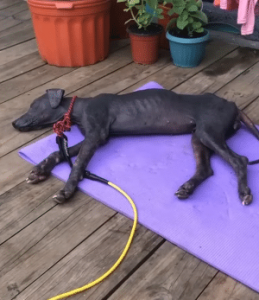
He rested on soft surfaces.
He accepted affection.
He slept without needing to remain prepared to move at the first sign of danger.
These quieter scenes were as meaningful as the images of him running.
Runner’s recovery was not simply about turning a thin dog into an active one. It was about giving him enough stability to experience different parts of life.
Food was no longer something he had to search for.
Human contact was no longer automatically something to avoid.
Movement was no longer limited to escaping or trying to survive another day.
He could run because running felt good.
He could explore because he knew someone would remain nearby.
And when he became tired, he had a safe place to return to.
His Life Was No Longer Measured by Survival
Today, Runner appears healthy, energetic, and deeply comfortable with the people around him.
The patches of damaged skin have been replaced by a full coat. The body that once seemed unable to support itself now carries him across beaches, through forests, and over snow.
His transformation is striking.
But it did not happen through one dramatic act.
The man who stopped beside the road created the first opportunity.
Veterinary treatment helped stabilize Runner’s body.
Controlled meals restored weight safely.
Medication allowed his skin to heal.
Predictable routines gave him time to become comfortable around people.
Then movement, play, and new experiences helped reveal the dog hidden beneath the exhaustion.
Runner did not need to become affectionate immediately to deserve care.
He did not need to stop trying to escape before the man decided to help him.
Care came while he was still frightened.
Trust followed when he was ready.
The name Runner once described a severely weakened dog attempting to flee despite barely having the strength to walk.
Now it describes something entirely different.
A dog racing across open sand.
A dog charging happily through snow.
A dog moving toward adventure instead of away from danger.
Once, Runner walked beside the road because survival required him to keep going.
Today, he runs because the life ahead of him is finally worth exploring.


