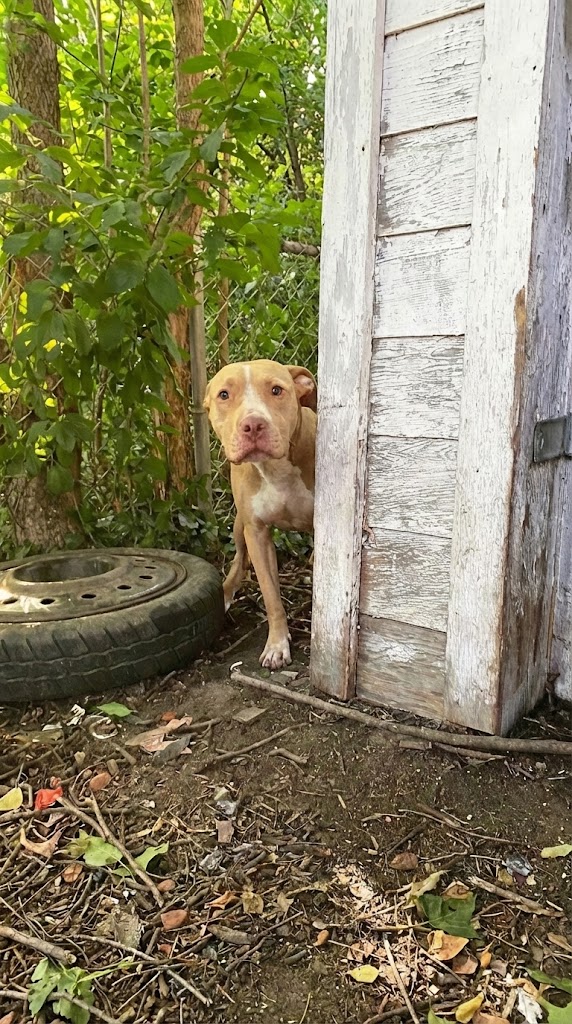
At first, he barely looked like a dog waiting to be rescued.
He was more like a shadow pressed against the side of an aging garage in a Detroit backyard—watching quietly, keeping his body low, and moving only as far as the heavy chain around his neck would allow.
The metal ran from his collar area to the structure behind him.
Every time he shifted, it moved with him.
He had nowhere meaningful to go.
No warm room to retreat into.
No soft place to lie down.
And no way to leave the small patch of ground that had become his entire world.
Then a neighbor noticed him.
That single decision to make a call brought volunteers from Rebel Dogs Detroit to the property.
And when one rescuer stepped closer, the frightened dog did something no one expected.
He made a sound.
A tiny, high-pitched “meep.”
It was the first glimpse of the personality that had been hidden behind the chain.
His rescuers would soon give him a name.
Beaker.
A Dog Hidden Behind the Garage
Beaker had been living outside in a backyard in Detroit, tethered near an old garage.
Exactly how long he had been there was unclear.
But his physical condition suggested that the restraint had not been temporary.
The chain limited his movement, and the area offered little of the comfort most companion animals know. His world had been reduced to whatever he could reach from one fixed point.
A neighbor eventually became concerned enough to contact help.
That call reached Rebel Dogs Detroit.
Volunteer Tiffany Perkins came to meet him.
For Beaker, the arrival of unfamiliar people could easily have added another layer of stress. Dogs who have spent long periods restrained may react in many different ways when strangers enter their space.
Some bark.
Some retreat.
Some freeze.
Beaker watched.
His body remained close to the garage, and his eyes followed Tiffany as she approached.
She did not rush toward him.
She spoke softly.
Then something unexpected happened.
Video: Chained Behind a Detroit Garage, Beaker Meets the Woman Who Came to Free Him
The Little “Meep” That Gave Him His Name
As Tiffany continued talking to him, Beaker’s posture began to change.
His tail moved.
At first, it was only a small motion against the ground.
Then he leaned toward her.
Instead of trying to create distance, Beaker pressed himself against her legs and sought contact.
And from his throat came that unusual sound again.
A sharp little squeak.
“Meep.”
The sound reminded rescuers of a Muppet character.
That was how Beaker got his name.
It was a strangely lighthearted moment inside an otherwise difficult scene.
Here was a dog still attached to a chain, living in conditions that had clearly taken a physical toll on him.
Yet when someone finally entered his space with patience, Beaker responded with curiosity and affection.
The rescuers could not know what he thought about the people standing beside him.
They could only observe what he did.
He leaned closer.
His tail moved.
He sought contact.
And he kept making those unmistakable little sounds.
For the team, it was an encouraging sign.
Beneath the uncertainty was a dog who still wanted to interact.
The Chain Came Off—But the Damage Remained
Freeing Beaker from the garage was only the first step.
Once rescuers were able to examine him more closely, they discovered that the chain around his neck had caused a much more serious problem.
It had become deeply embedded into the tissue around his neck.
This was not something that could simply be cleaned and forgotten.
Beaker needed veterinary treatment.
Surgery would be necessary to address the injury safely.
Still, there was one moment during the initial rescue that stayed with everyone.
When Beaker was finally detached from the garage, he did not race across the yard.
He did not sprint away from the people who had freed him.
Instead, he dropped to the ground.
Then he rolled onto his back.
His belly faced upward as he allowed Tiffany to stay close.
For an animal who had spent so much time physically restricted, freedom did not immediately look like running.
It looked like remaining near the person who had just removed the chain.
Five Hours in a Car Became Something Unexpected
Before Beaker could undergo surgery, there was a long wait.
Nearly five hours passed before the procedure.
For a dog who had just been removed from an unfamiliar environment and was now surrounded by new people, smells, and sounds, those hours could have been extremely stressful.
But Beaker surprised Tiffany again.
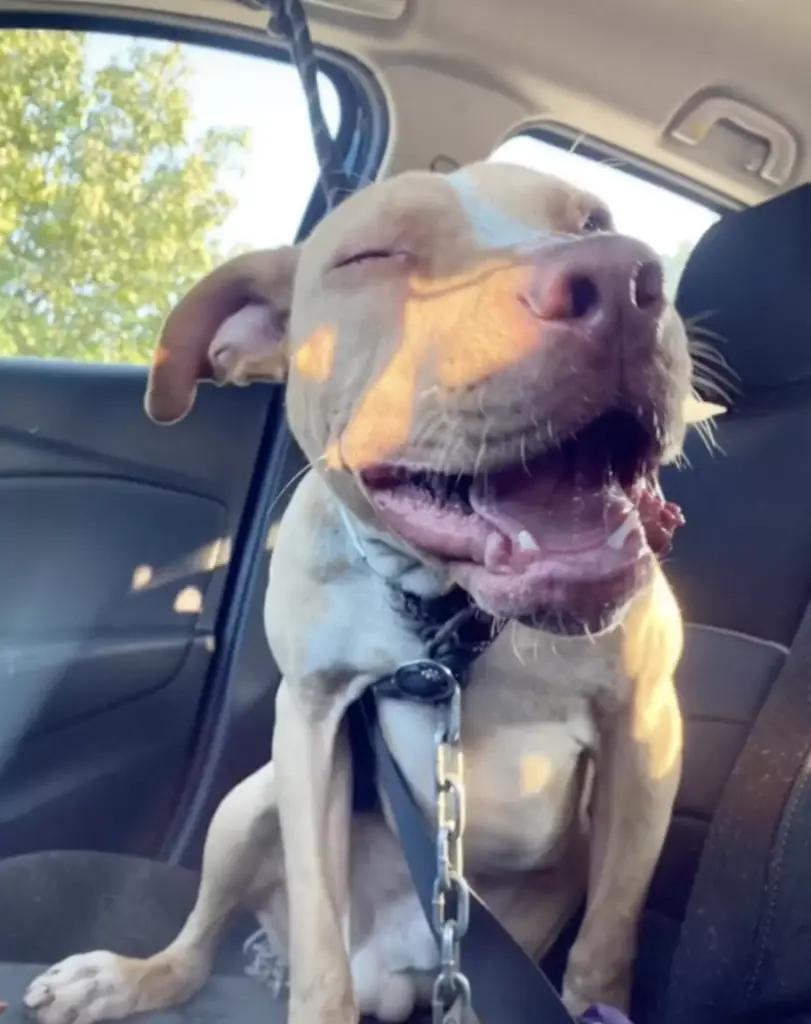
While they waited in the vehicle, he climbed closer.
Then he settled into her lap.
His head rested across her legs.
And eventually, he fell asleep.
It was a simple scene.
A tired dog.
A quiet car.
One rescuer sitting still so he could rest.
But for people involved in animal rescue, moments like this often say more than dramatic gestures ever could.
Beaker was not pacing endlessly around the vehicle.
He was not trying to escape.
He allowed himself to settle beside Tiffany.
Whether that came from exhaustion, comfort, or both, his body finally relaxed enough for him to sleep.
The chain was gone.
The injury was being addressed.
And for a few quiet hours, Beaker had nothing he needed to do except rest.
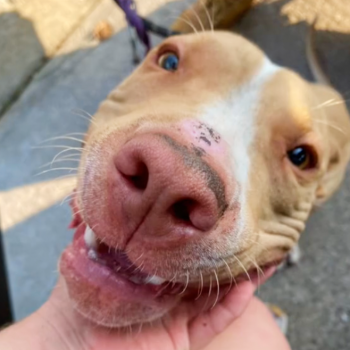
Surgery Addressed What the Chain Had Left Behind
Veterinary care was the next critical step.
Because the chain had become embedded around Beaker’s neck, the medical team needed to treat the affected tissue and remove what could not safely remain.
The procedure addressed the physical consequence of prolonged restraint.
Afterward came recovery.
That part is often less visible than the rescue itself.
There are no dramatic backyard scenes.
No moment when metal finally falls away.
Instead, recovery depends on routine.
Medication.
Keeping the area clean.
Watching for complications.
Giving the body enough time to repair itself.
Beaker needed all of that.
Fortunately, he now had people willing to provide it.
His neck could begin healing in an environment where no chain pulled against it.
He could rest without being tethered to a building.
And the strange, affectionate dog rescuers had begun meeting in small moments finally had the opportunity to show them who he was.
Inside a Home for the First Time
Once Beaker moved into foster care, his world expanded dramatically.
Indoor life came with things most household dogs take completely for granted.
Smooth floors.
Doors opening and closing.
Household appliances.
Kitchen sounds.
Furniture.
Soft places to sleep.
For Beaker, many of them were new.
His foster home became a classroom of ordinary experiences.
He learned how to move through rooms.
He investigated unfamiliar noises.
He discovered that couches were much more comfortable than the ground behind a garage.
These moments mattered because rescue is not simply about removing an animal from a bad situation.
It is also about teaching them how to live in the situation that comes next.
A dog who has spent much of life outdoors may not automatically understand household routines.
Patience becomes essential.
Beaker was allowed to learn.
And he did.
The Dog Behind the Chain Began to Appear
As his physical recovery continued, Beaker’s personality became increasingly obvious.
He enjoyed human attention.
He sought closeness.
His distinctive little vocalizations remained part of his charm.
The dog who had initially appeared like a cautious shadow near the garage turned out to be highly social once he felt comfortable enough to interact.
That did not mean the past had magically disappeared.
Rescue does not allow anyone to know exactly what memories an animal carries or how previous experiences may affect behavior later.
But Beaker’s current actions were encouraging.
He approached people.
He accepted affection.
He rested near those he trusted.
He showed interest in play and companionship.
Instead of defining him by the way he had been found, his foster family began getting to know the dog that existed beyond that moment.
A playful companion.
A dog who enjoyed being close.
A dog who made odd little “meep” sounds when excited.
A dog who seemed ready to experience much more of life.
Another Dog Could Help Show Him the Way
As Beaker settled into foster care, rescuers began thinking about the kind of permanent home that might suit him best.
Because so many household experiences were new, another friendly dog could potentially be a helpful companion.
Dogs often learn by watching one another.
A confident resident dog can demonstrate everyday routines that humans sometimes struggle to explain.
Where to rest.
How to move around the home.
When everyone goes outside.
What ordinary noises can safely be ignored.
And, perhaps most importantly, how to play.
For Beaker, a compatible canine companion could offer both social interaction and reassurance as he continued learning what domestic life was like.
The goal was not simply to find someone willing to take him.
It was to find a home that understood him.
A home prepared to continue the patient work his foster caregivers had already begun.
The Backyard Is Now Part of His Past
The strongest image from Beaker’s story may always be the chain.
It is difficult to look past.
A dog tethered behind a garage.
Metal around his neck.
A world measured by the radius of a restraint.
But that image captures only the beginning of what happened next.
There is another Beaker now.
The one resting inside a home.
The one learning household routines.
The one leaning into people instead of remaining against the garage.
The one who discovered couches.
The one whose strange little sounds make the people around him smile.
That is why rescue stories cannot end at the moment an animal is removed from danger.
Freedom is the first chapter.
Learning what to do with that freedom is another.
One Neighbor Started the Entire Chain of Events
Beaker’s rescue also began with something remarkably ordinary.
Someone noticed.
A neighbor saw a dog whose situation did not seem right and chose not to ignore it.
That person contacted help.
Help brought Tiffany and Rebel Dogs Detroit.
The rescue led to veterinary treatment.
Veterinary treatment made recovery possible.
Foster care gave Beaker a safe place to learn.
Each step depended on the one before it.
Had the neighbor simply assumed someone else would deal with the situation, Beaker’s story might have continued very differently.
Instead, one phone call created movement where there had been none.
That is often how rescue works.
Not through one heroic person doing everything.
Through people doing one necessary thing at the right moment.
A neighbor notices.
A volunteer responds.
A veterinarian treats.
A foster opens a door.
Eventually, a family says yes.
Beaker No Longer Has to Measure His World in Feet of Chain
Today, Beaker is no longer attached to the side of that Detroit garage.
His neck has received the medical care it needed.
He has experienced the comfort of living indoors.
He has learned that a lap can be somewhere to sleep rather than something to fear.
And he has discovered that a home contains a surprising number of soft places.
There is still another chapter ahead.
A permanent family.
A place where the routines he is learning now can become the routines of the rest of his life.
His rescuers hope that family will appreciate Beaker for exactly who he has shown himself to be—affectionate, playful, curious, and occasionally very vocal in his own unusual way.
Once, every movement Beaker made was limited by a chain fixed to a garage.
Now, when he moves toward someone, nothing pulls him back.
Perhaps that is the clearest way to understand how much his life has changed.
Not through imagining what he felt.
Not through pretending the past has disappeared.
But through something anyone can see.
The chain is gone.
Beaker can choose where he goes.
And more often than not, he chooses to move closer to the people who care for him.
For a dog once found hidden behind a Detroit garage, that may be the most hopeful ending of all.
Except it is not really an ending.
Beaker is finally free to begin.


