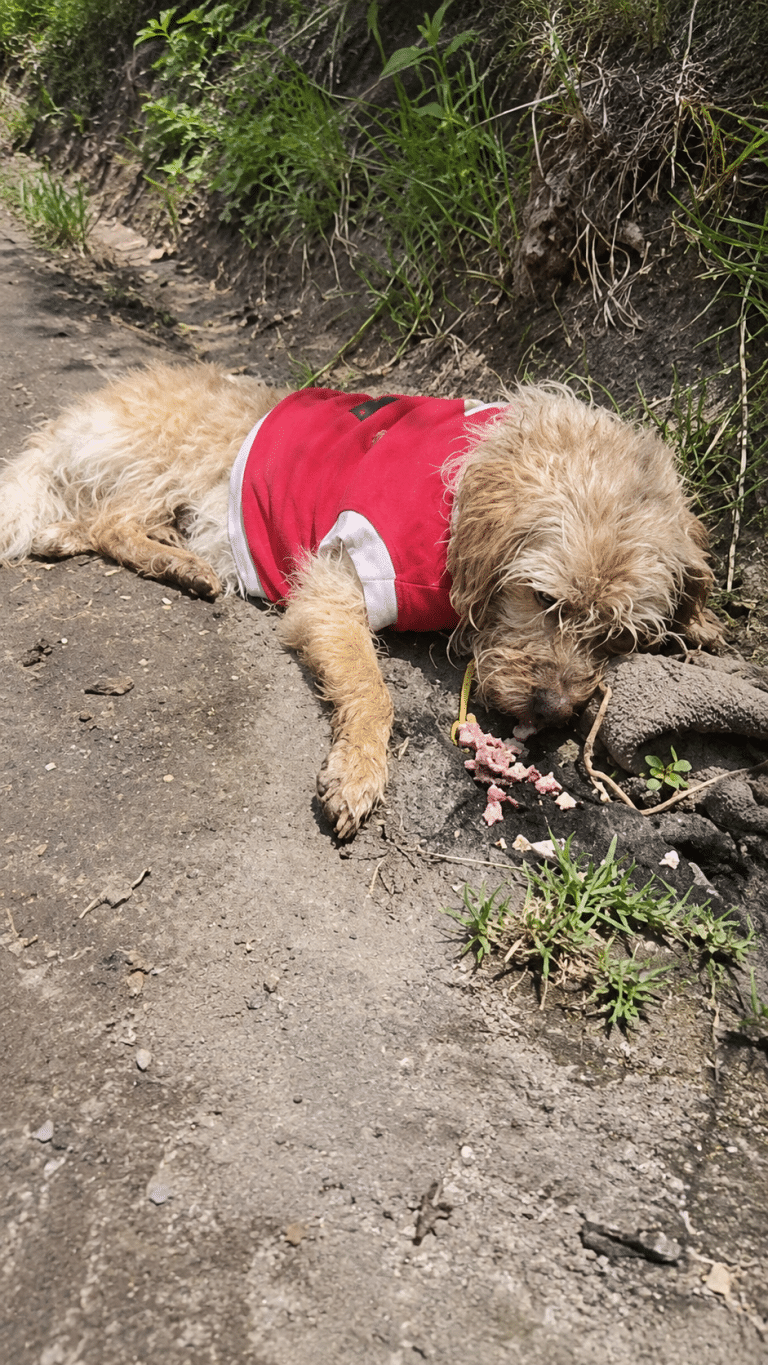
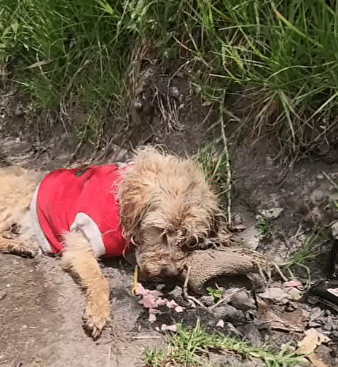
The day after Christmas, a dog lay collapsed beside a busy highway while traffic continued moving around him.
His body trembled through repeated convulsions.
His breathing came in short, uneven gasps.
Every few moments, his muscles tightened again, leaving him with almost no time to recover before the next episode began.
According to the rescue account, the dog was believed to have been poisoned and abandoned near the road.
No one knew how long he had been lying there.
No one knew who had left him.
But when rescuers arrived, one fact mattered more than every unanswered question.
The dog was still breathing.
Andrea knelt beside him on the cold roadside, offering what comfort she could while the team searched desperately for a clinic willing to help during the Christmas holiday.
The Dog Was Barely Conscious Beside Passing Traffic
The highway was one of the worst possible places for a medical emergency.
Vehicles passed only a short distance away.
The ground offered little warmth or protection.
The dog could not stand, move himself into safety, or escape the noise surrounding him.
His body remained stretched against the roadside as another seizure moved through him.
When Andrea approached, the dog showed little visible reaction.
His muscles were exhausted from repeated convulsions, and even lifting his head appeared beyond his remaining strength.
She stayed low beside him rather than surrounding him with sudden movement.
A small amount of water was offered carefully.
Her hand moved gently across his head while she spoke in a quiet voice.
The dog could not understand why his body was reacting this way.
He could not explain what he had swallowed or how long he had been suffering.
He could only remain where he had fallen while the rescuers tried to keep him calm and prevent additional injury.
According to the original narration, poison was believed to be responsible for his condition.
The footage does not include a toxicology report identifying a specific substance, so the precise cause should not be treated as independently confirmed.
What could be observed was a dog in critical distress.
He was convulsing.
His breathing was weak.
And he required emergency veterinary treatment immediately.
Video: Rescuers Find a Convulsing Dog Beside the Highway as Christmas Closures Delay Emergency Care
Christmas Closures Left the Rescuers Searching for Help
Andrea and the other rescuers began calling veterinary clinics.
Again and again, they encountered the same problem.
The Christmas holiday had left many facilities closed.
Some calls went unanswered.
Others could not accept an emergency case.
Meanwhile, the dog continued convulsing beside the highway.
Every unsuccessful attempt cost time that his body might not have had.
The rescuers could not safely provide the treatment he needed on the roadside.
A dog experiencing repeated seizures may require medication, intravenous fluids, oxygen, temperature management, and close monitoring.
If poisoning was involved, veterinarians would also need to determine what supportive procedures were appropriate based on his condition.
Andrea continued staying beside him while the others searched.
She stroked his head.
She spoke softly.
She watched his breathing and tried to keep him positioned as safely as possible during the convulsions.
There was no guarantee that the next phone call would produce an answer.
But leaving him was not an option.
Finally, after repeated attempts, an emergency ambulance agreed to transport the dog.
The team carefully lifted him from the roadside.
His body remained weak and largely unresponsive.
But he was no longer alone beside passing traffic.
Treatment Began the Moment He Reached the Clinic
Veterinary staff began working as soon as the dog arrived.
His condition remained critical.
According to the rescue account, he received intravenous fluids, oxygen support, medication, and procedures intended to cleanse his digestive system.
The goal was to stabilize his breathing, control the seizures, and help his body eliminate or recover from whatever had caused the crisis.
The first hours provided few reasons for relief.
The convulsions returned.
His breathing weakened repeatedly.
At times, his body appeared almost completely drained of the energy needed to continue.
The medical team monitored him around the clock.
His heart rate and respiration required close attention.
Fluids had to be adjusted.
Medication needed to be administered while staff watched for any response or complication.
The dog could not eat.
He could not stand.
Most of his energy was spent simply enduring the repeated stress moving through his body.
The rescuers remained involved, waiting for updates and hoping treatment had begun before irreversible damage occurred.
No one could promise that he would survive the first night.
Then another night passed.
The dog was still alive.
Treatment continued.
For Nearly a Week, His Condition Remained Uncertain
The recovery did not begin with a sudden improvement.
For several days, the dog remained in a fragile condition.
The seizures did not immediately stop.
His breathing sometimes stabilized, only to weaken again later.
Veterinary staff continued monitoring him closely because a serious change could occur with little warning.
The original account describes the first week as emotionally overwhelming for everyone involved.
That reaction was understandable.
The team had watched rescuers carry in an animal who appeared close to death.
They had provided emergency care without knowing whether his body would respond.
Each day that passed brought another mixture of concern and cautious hope.
The dog’s survival depended on more than controlling one symptom.
His body also had to maintain circulation.
His organs needed to continue functioning.
He had to remain hydrated and stable enough for the suspected toxin or illness to pass through its most dangerous stage.
For most of that week, progress was difficult to measure.
A period without a seizure mattered.
A steadier breath mattered.
A small reaction to touch mattered.
But none of those signs alone could confirm that the danger had passed.
Then the medical team noticed something new.
The dog showed interest in food.
One Small Meal Became the First Clear Turning Point
After nearly a week of critical care, the dog looked toward food.
At first, his response was limited.
He sniffed.
He showed enough interest for the veterinary team to offer a small amount.
Then he ate.
For a healthy dog, accepting food is an ordinary part of the day.
For this patient, it represented a major change.
His body had spent days struggling through seizures, weakness, and unstable breathing.
Eating suggested that he was becoming alert enough to respond to his surroundings and strong enough to begin taking nourishment again.
The medical team did not overwhelm him with a large meal.
His digestive system and overall condition still required caution.
Small portions could be introduced while staff watched how his body responded.
As his appetite returned, other improvements followed.
The convulsions became less frequent and eventually stopped.
His breathing grew steadier.
His strength began returning gradually.
According to the rescue account, veterinarians found no severe lasting damage to his internal organs.
That was especially encouraging after days of uncertainty.
The dog still required observation and recovery time.
But he was no longer moving continuously toward a medical crisis.
For the first time since he had been found, the direction of his condition appeared to be changing.
He Left the Clinic for a Quiet Place to Recover
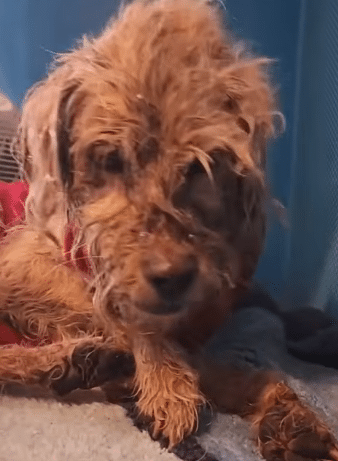
Once the dog was stable enough to leave intensive veterinary care, he was transferred to the rescue center.
The contrast with the highway was immediate.
There were no vehicles rushing past.
No cold roadside beneath his body.
No need for Andrea to search desperately for an open clinic while another convulsion began.
He received a clean place to rest.
Fresh water.
Regular food.
Medication and continued observation.
In the final scenes of the documented rescue, the dog appeared alert and calm beside Andrea.
His coat was clean.
He could look around and respond to the people near him.
The body that had once tightened through repeated seizures now rested more comfortably.
The source describes the panic in his eyes being replaced by relief and trust.
Those emotions cannot be confirmed directly, but the visible behavior had clearly changed.
He was no longer convulsing.
His breathing had stabilized.
He remained near Andrea without appearing distressed by her touch.
He accepted the presence of the rescuers who had stayed beside him from the road through the most uncertain days of treatment.
The story does not suggest that recovery erased everything immediately.
An animal surviving a severe medical crisis may still require rest, follow-up examinations, medication, and careful monitoring.
But the immediate danger had passed.
He had survived the night beside the highway.
Then he had survived the first night at the clinic.
Then several more.
Eventually, survival became recovery.
His Rescue Began With Someone Refusing to Walk Away
At the end of the documented journey, the dog was still waiting for a permanent home.
That meant his story was not completely finished.
But the most urgent part had already changed.
He was alive.
He was no longer lying beside traffic while seizures moved through his body.
He was no longer waiting for a closed clinic to answer the phone.
He had food, shelter, medical care, and people who knew how close he had come to being lost.
The rescue required several people to make difficult choices.
Someone had to notice the dog beside the highway.
Andrea had to remain near him while his body convulsed.
The team had to continue calling after multiple clinics were unavailable.
An ambulance had to agree to transport him.
Veterinary staff had to monitor him through days when improvement was far from certain.
No single action guaranteed the outcome.
Together, they created the opportunity he needed.
The rescuers could not change whatever happened before he was found.
They could not explain why a critically ill dog had been left near a busy road after Christmas.
They could only decide what happened next.
So they stayed.
They made another call.
They found transportation.
They continued treatment when the seizures returned.
And when the dog finally ate, they were there to recognize that the smallest ordinary action had become a sign of recovery.
His story is not only about a suspected poisoning.
It is about the distance between being noticed and actually being helped.
Many people may see an animal suffering.
Rescue begins when someone stops long enough to take responsibility for the next step.
For this dog, that next step became an ambulance.
Then a clinic bed.
Then a small meal after nearly a week without one.
Finally, it became a quiet resting place beside Andrea, far from the highway where his story nearly ended.
He may still have been waiting for a permanent family.
But he was no longer waiting alone.
And the people who refused to leave him on the roadside had already given him the most important gift possible:
The chance to keep living long enough for the rest of his future to begin.


