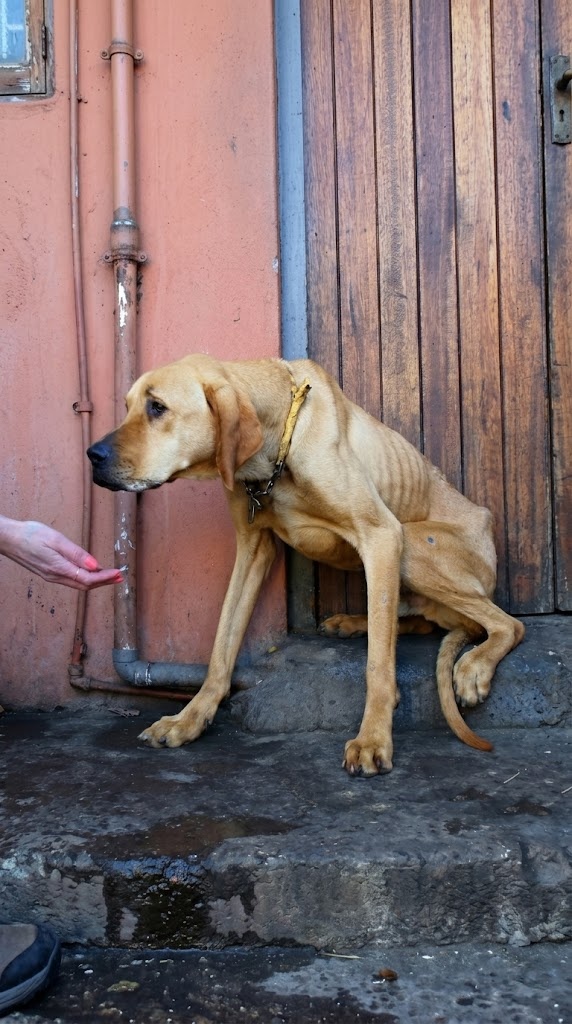
The dog standing behind the small fence should have looked powerful.
He had an enormous head, long legs, and the frame of an animal built to carry substantial weight.
But almost nothing remained around that frame.
His ribs and spine were visible beneath his coat, and a chain kept him inside a narrow dirt yard where even a few slow steps appeared exhausting.
Rescuers had walked through the neighborhood looking for animals in need.
One look through the fence told them they could not simply continue down the road.
The Giant Dog Behind the Fence
The afternoon was hot when rescuers first noticed him.
He stood quietly inside a small enclosure beside a modest home. A chain attached to his collar limited how far he could move across the dry ground.
From a distance, his naturally large size made his condition difficult to understand.
Then the team moved closer.
His hips protruded sharply.
The muscles around his shoulders and legs had diminished.
His head hung low, and he moved with the caution of a dog conserving what little energy remained.
When food was offered, he accepted it gently.
He did not rush forward or snap at the hands holding it. He ate with interest but without the frantic reaction rescuers sometimes see in severely hungry animals.
Other dogs were also nearby, and Crut did not become visibly aggressive when food was distributed among them.
His calm behavior made the scene no less urgent.
A dog can remain gentle while experiencing serious physical decline.
The rescuers spoke with the family and learned that they were struggling to provide enough food and care. The team could not know every detail of what had happened before that afternoon, but the condition in front of them was unmistakable.
Crut needed more than one meal.
Video: Rescuers Find a Severely Underweight Giant Dog Chained Inside a Small Yard
Bags of Food Were Not Enough to Restore Him
The team did not remove Crut during the first visit.
Instead, they began returning with dog food and supplies.
Their immediate hope was that consistent nutrition could help him regain weight while allowing the family time to improve his care.
For a while, this seemed like the least disruptive solution.
Crut could remain in familiar surroundings.
The family would receive practical support.
Rescuers could continue checking his condition.
During each visit, they watched him eat and looked for signs of improvement.
They hoped the sharp lines along his body would begin to soften.
They hoped his movements would become more energetic.
They hoped his posture would change as nourishment returned strength to his muscles.
But the expected improvement did not appear.
Crut continued looking dangerously thin.
Despite having access to more food, he gained little visible weight. At times, he appeared even weaker than during the team’s earlier visits.
There could have been several reasons.
His body may have required a carefully managed rehabilitation diet rather than ordinary feeding. Parasites, infection, digestive problems, or another underlying medical condition may also have prevented him from using nutrients effectively.
Only a full veterinary examination could provide answers.
Continuing to deliver bags of food was helpful, but it was no longer enough.
Crut needed medical care, regular monitoring, and an environment where every meal and physical change could be recorded.
The rescuers had reached the limit of what roadside support could accomplish.
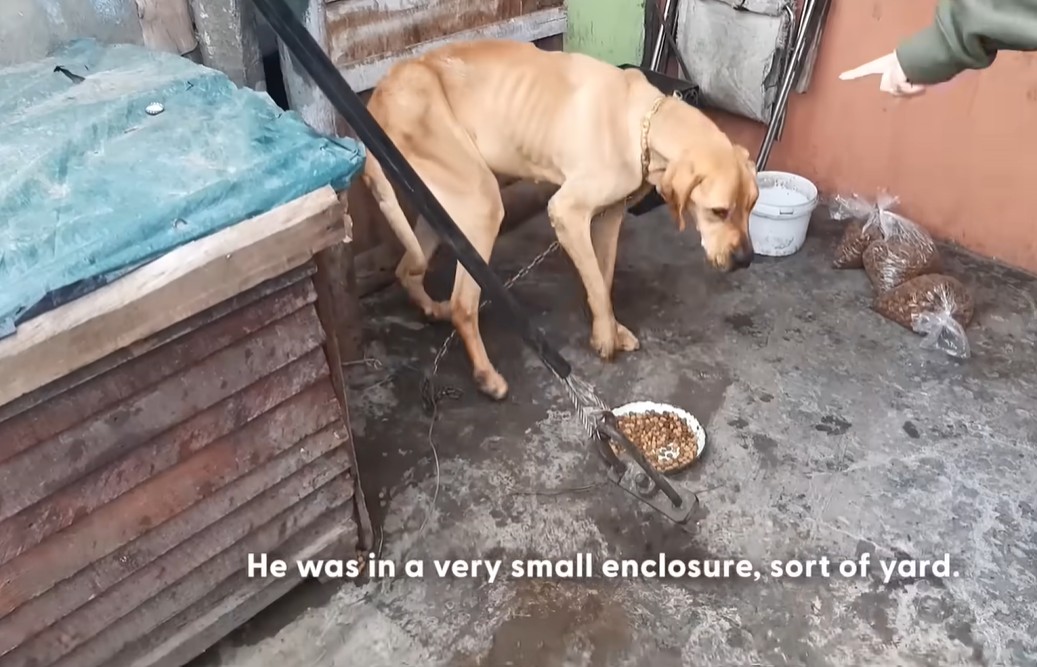
His Family Agreed to Let Him Go
The next conversation was difficult.
Crut’s family had allowed the team to visit and accepted the supplies they brought. But surrendering a dog is different from accepting help with food.
It meant acknowledging that his needs had moved beyond what could be managed at home.
It also meant the possibility that Crut would not return.
The rescuers did not want to create additional conflict around an already vulnerable animal. They explained why his condition remained dangerous and why veterinary supervision had become necessary.
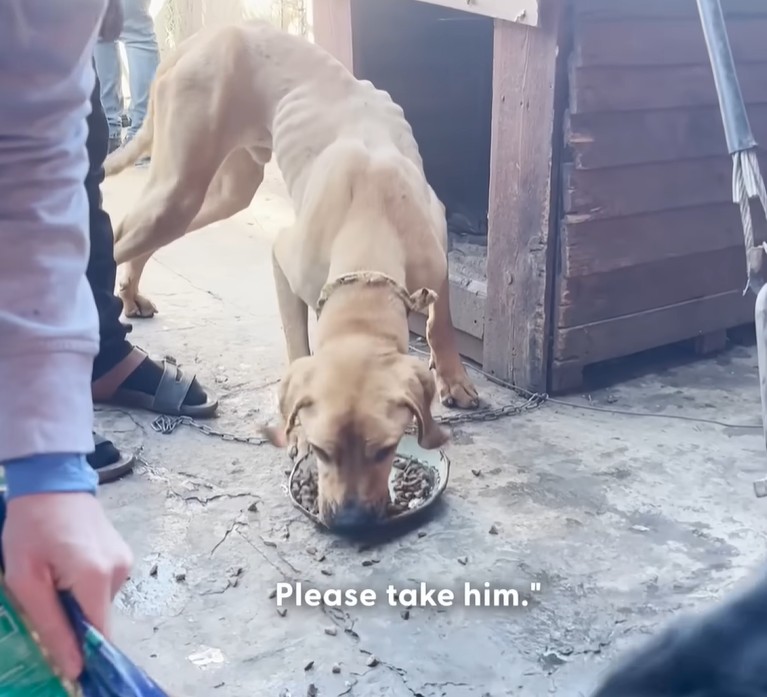
Eventually, the owner agreed to release Crut into their care.
The account describes the decision as emotional.
Whatever the history behind his condition, the handover created the first realistic opportunity for him to receive continuous treatment.
The rescuers left supplies behind for the household and turned their attention to the dog.
They removed the chain from his collar.
Crut did not pull away or attempt to return to the enclosure. He followed slowly as they guided him toward the rescue vehicle.
His movements remained weak, and the team stayed close in case his legs could no longer support him.
For the first time since they had discovered him, the fence and chain were behind him.
That did not mean he was safe yet.
It meant the work of saving him could finally begin.
Recovery Had to Move More Slowly Than His Hunger
At the veterinary clinic, Crut received a thorough assessment.
His extreme loss of weight could not be corrected by allowing him to eat as much as he wanted.
After prolonged malnutrition, the body may struggle to process a sudden increase in calories. Feeding too aggressively can produce serious complications, even when the animal appears desperately hungry.
Crut was placed on a controlled nutritional plan.
Meals were divided into smaller portions.
His hydration, digestion, weight, and general physical response were monitored. Veterinary workers adjusted his care as they learned more about what his body could tolerate.
The first goal was stability.
Not rapid weight gain.
Not an immediate transformation.
Just helping his system accept regular nourishment without creating another medical crisis.
During the earliest stage, Crut rested frequently.
His legs still lacked the muscle needed for sustained activity. Short walks were enough to exhaust him, and his caregivers limited movement while his body began rebuilding itself.
Progress appeared gradually.
He finished his measured meals.
He held his head higher.
He remained standing for longer periods.
The change could not always be seen from one day to the next, but comparisons across several weeks revealed a different outline beginning to emerge.
His ribs became less prominent.
Muscle slowly returned around his shoulders.
His coat began looking healthier as nutrition and treatment addressed the effects of prolonged physical decline.
Video: Crut Walks Freely as His Strength Returns After Months of Care
The Large Dog Who Wanted to Be Close
Rescuers had first encountered Crut in a condition that left little room for personality.
Most of his energy had been directed toward standing, eating, and getting through each day.
As his health improved, his behavior became easier to see.
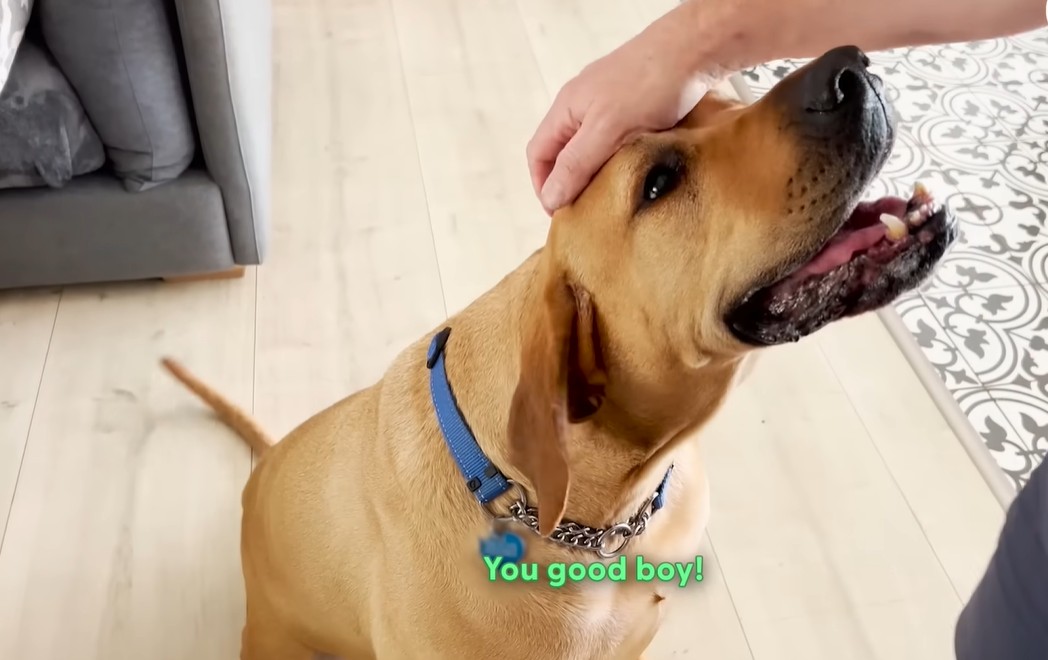
Crut enjoyed attention.
He approached familiar caregivers and remained close while they touched his head and shoulders. As he became stronger, he began rolling partly onto his side to invite contact along his chest and stomach.
Belly rubs quickly became one of his preferred forms of attention.
His size could appear intimidating to someone meeting him for the first time. But the people caring for him described a dog who regularly sought gentle interaction rather than avoiding it.
He followed caregivers through open spaces.
He became interested in play.
His tail moved more often when familiar people approached.
These behaviors did not prove that Crut carried no fear or uncertainty from his earlier life.
They showed that he remained capable of forming safe relationships.
Trust developed through repetition.
Meals arrived every day.
Hands approached without causing pain.
The chain did not return.
He could move away when he needed rest and come closer when he wanted attention.
Crut was learning that care could be predictable.
For a dog who had once stood almost motionless in a tiny yard, the ability to make those choices became an important part of recovery.
From a Dirt Enclosure to Open Ground
As Crut regained weight, his world expanded.
The weakened dog who had struggled to cross a small yard could now walk across open ground without a chain restricting every direction.
At first, his outings remained controlled.
His body was larger and heavier than it had been during the earliest stage of treatment, but newly rebuilt muscles still needed time to strengthen.
Gradually, his stride became more confident.
He began exploring rather than merely following.
He stopped to investigate smells and turned back toward his caregivers before continuing forward.
The change was especially visible in the way he carried his head.
It no longer remained lowered as though its weight were difficult to support. He looked ahead, alert to the people and space around him.
Crut’s recovery took months rather than days.
There was no single meal that restored him.
No injection or treatment immediately erased the damage caused by prolonged malnutrition.
His body returned through hundreds of ordinary acts.
Measured food.
Veterinary examinations.
Rest.
Short walks.
Another meal.
Another week.
Another small increase on the scale.
Eventually, the dog standing before the rescue team no longer resembled the skeletal figure behind the fence.
He had the full frame expected of a large dog.
But more importantly, he could use that frame comfortably.
Compassion Sometimes Requires an Honest Goodbye
Crut’s story is not as simple as one cruel person and one heroic rescuer.
A family was struggling.
A dog was visibly suffering.
People first attempted to support the situation without separating them.
When that approach failed, a harder decision became necessary.
Poverty can limit access to food and veterinary care, but it does not make an animal’s medical needs disappear. When a pet’s condition continues declining, seeking help early may be the most responsible action available.
That help can take different forms.
Community food assistance.
Low-cost veterinary services.
Temporary foster care.
Responsible rehoming.
Or, when necessary, surrender to people equipped to provide treatment.
The earlier those conversations begin, the more options may remain.
By the time rescuers met Crut, his body was already dangerously depleted. Food donations bought time, but they could not replace professional care.
His family’s eventual decision to release him was painful.
It was also the decision that allowed his recovery to move forward.
The goodbye did not erase what had happened before.
It gave Crut access to what he needed next.
The Day Someone Looked Through the Fence
It is difficult to know what would have happened had the rescuers taken a different route through the neighborhood.
Crut was not calling loudly for help.
He was not running loose where traffic would force people to notice him.
He stood quietly behind a fence, attached to a chain, becoming weaker in a place most passersby may have overlooked.
Then someone looked closely.
That first observation led to food deliveries.
The lack of improvement led to a more difficult conversation.
The surrender led to veterinary treatment.
And months of consistent care allowed Crut to become the strong, affectionate dog his depleted body had been hiding.
His story does not suggest that every struggling family should be judged from a distance.
It suggests that worsening conditions must be faced honestly.
Sometimes helping means providing supplies so an animal can remain at home.
Sometimes it means arranging medical care.
And sometimes the kindest available choice is allowing someone else to take responsibility before it is too late.
Crut once stood in a small dirt yard with every rib visible and a chain limiting his movement.
Today, he can cross open ground under his own strength.
He can approach people for affection.
He can eat without uncertainty about when the next meal will arrive.
The walk past his yard did not change everything by itself.
What changed his life was that the people who saw him kept returning—and, when the first solution failed, they were willing to find another.


