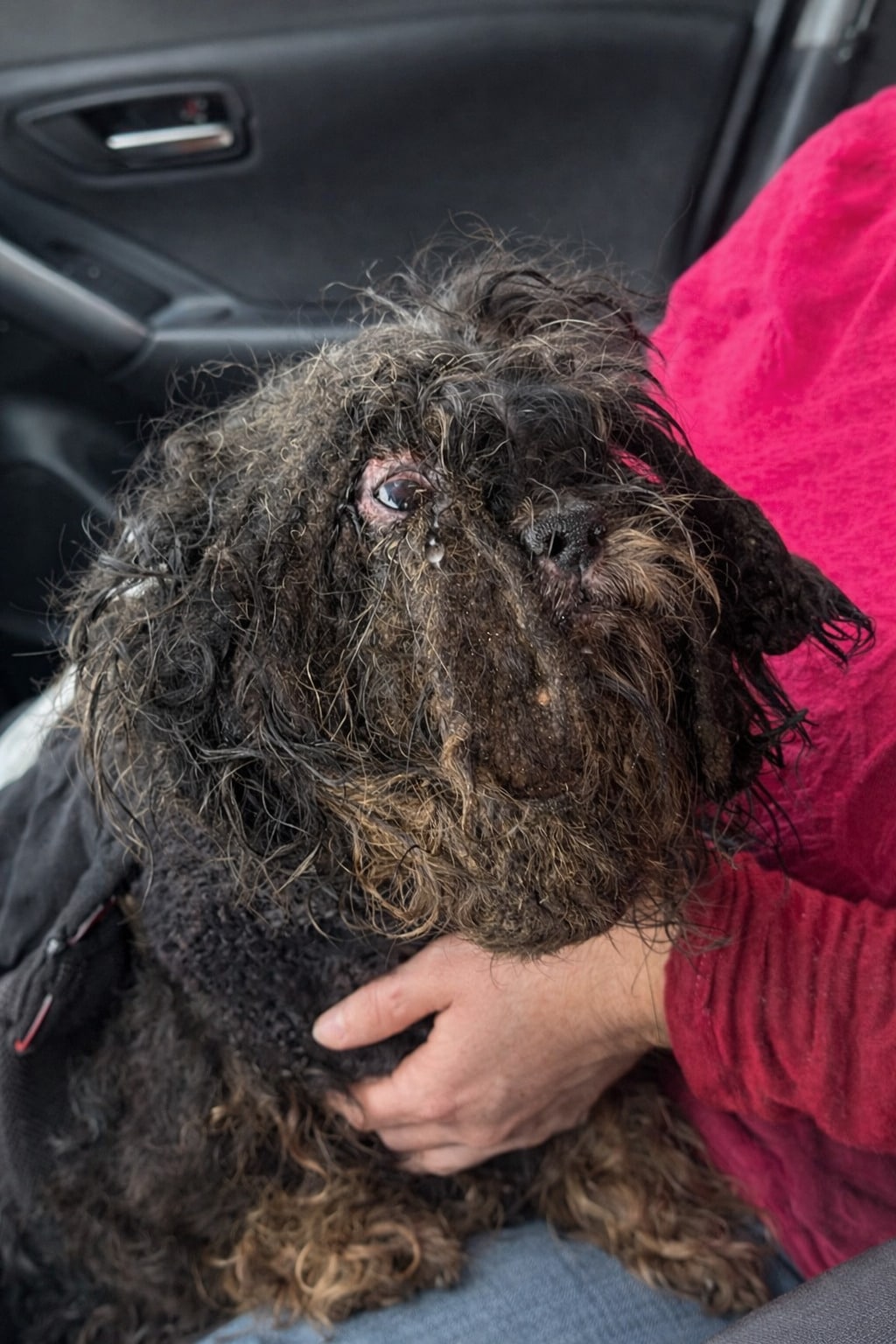
Rain was falling over the Bronx when rescuers entered a deserted apartment and found a rusted cage inside.
Something small lay within it.
At first, the figure barely resembled a dog. Thick layers of dirty, hardened fur covered his face, legs, and body, making him look like a bundle of discarded fabric.
He did not bark when someone approached.
He did not struggle as the cage door opened.
He barely moved at all.
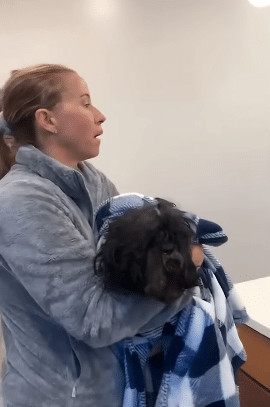
Then a rescuer reached inside, lifted his fragile body against her chest, and carried him out into the rain.
A Small Dog Almost Hidden Inside the Cage
The apartment appeared abandoned, but the dog had been left behind.
He was confined inside a rusty cage with no familiar person nearby and no way to care for himself. His coat had become severely matted, collecting dirt and debris until his natural shape almost completely disappeared.
His eyes were difficult to see.
His paws were buried beneath tangled fur.
Heavy sections surrounded his chest and belly, restricting even the smallest changes in position.
The rescuers could not confirm exactly how long he had remained in that condition. They could only see that the neglect had developed over an extended period.
When the woman reached toward him, the dog offered almost no resistance.
His stillness was concerning.
He appeared extremely weak, and his breathing required immediate attention. There was no time to begin grooming inside the apartment or wait for him to become comfortable with the people around him.
The rescuer supported his entire body and hurried toward emergency care.
Behind them, the cage remained inside the empty apartment.
The little dog was finally leaving it.
Video: Found Motionless Inside a Rusted Cage, Teddy’s Face Is Finally Revealed
The Emergency Team Found a Body Beneath the Mats
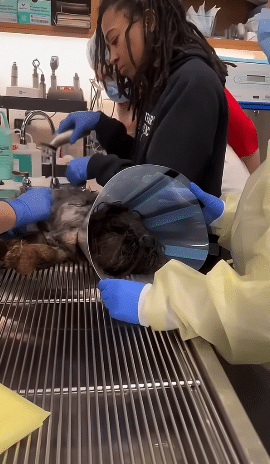
At the veterinary clinic, the medical team began examining him as quickly and gently as possible.
Up close, the coat was worse than it had appeared inside the dim apartment.
The fur had fused into dense layers pressed close to his skin. Some sections felt almost solid, while others hung heavily around his legs and face.
Ordinary brushing was impossible.
The mats concealed nearly every part of his body, making it difficult for veterinarians to evaluate his skin, weight, and overall condition.
His breathing remained one of the first concerns.
Before attempting a full grooming procedure, the team needed to make sure he was stable enough to tolerate the handling and stress involved.
Beneath the oversized coat, he was extremely small.
His body felt light in the rescuers’ arms, revealing how little of the shape inside the cage had actually been the dog himself.
Most of it had been neglected fur.
Despite his weakness, there were faint signs that he remained responsive.
His eyes followed nearby movement through the narrow openings in the mats.
His tail gave a small motion when familiar voices spoke near him.
The response was brief, but it was enough to show that he was still aware of the people trying to help.
His Coat Had to Be Removed One Section at a Time
Once the dog was stable enough, the team began the difficult grooming process.
Nothing could be pulled or rushed.
The mats were attached too closely to his skin, and their weight had changed the way his body rested and moved. Cutting too deeply beneath a section could cause injury to skin the groomers could not yet see.
The outermost layers were loosened first.
Scissors opened small spaces in the hardened coat.
Clippers then moved slowly through the sections where the skin could be identified safely.
One person supported the dog while another worked.
The room remained calm.
Tools stopped whenever his breathing changed or his body became tense. He was given frequent opportunities to rest before the process continued.
Gradually, the first heavy pieces fell away.
A paw appeared.
Then part of one leg.
The outline of his chest slowly returned.
The pile of removed fur continued growing beside the grooming table, while the animal underneath became smaller and more recognizable with every section.
Then the team reached his face.
The tangled fur around his eyes and muzzle was carefully trimmed away.
For the first time, rescuers could see the little dog who had been hidden inside the cage.
His First Steps Without the Heavy Coat
When the worst of the matting was gone, the dog looked dramatically different.
His body was thin and delicate.
His legs, previously concealed beneath heavy clumps, were finally free to move independently. His face was fully visible, revealing soft features and watchful eyes.
But he was not immediately ready to run or play.
His body had to adjust to the sudden absence of weight and resistance.
The first steps were hesitant.
He shifted one paw forward, paused, and carefully repositioned the others. Without the mats, movement felt unfamiliar.
Caregivers remained close enough to support him if he lost his balance, but they allowed him to choose when to continue.
He took another step.
Then another.
Each movement revealed how much the coat had restricted him.
Turning was easier.
Standing required less effort.
He could lift his head without tangled fur pulling across his neck and chest.
The team wrapped him in a warm towel afterward. With most of his coat removed and his body already weakened, maintaining warmth was important.
He rested quietly inside the fabric, no longer hidden and no longer confined.
Safety Had to Become a Daily Experience
The dog was first called Uni.
The name marked the beginning of his life in care, but a new name would eventually follow.
Before that could happen, however, he needed time.
Emergency treatment and grooming had addressed the most visible problems, but they could not immediately make an unfamiliar environment feel safe.
During his first days at the shelter, Uni remained cautious.
Sudden sounds made him pause.
Movement near his resting area drew his attention immediately.
When hands approached, he watched closely before deciding whether to remain or move away.
The caregivers did not force affection.
They prepared a quiet resting space and allowed him to observe the daily routine.
Food arrived at predictable times.
Water remained within reach.
His bedding stayed clean and warm.
The same people returned each day, approaching slowly and stopping when he appeared uncomfortable.
Nothing dramatic happened during most of those moments.
That was precisely why they mattered.
Uni was learning that an ordinary day could pass without fear, hunger, or confinement.
Gentle Hands Slowly Became Familiar
As the days continued, changes began appearing in his behavior.
At first, Uni accepted touch while remaining very still.
Later, he started turning toward the person petting him.
He followed familiar caregivers with his eyes and remained closer after meals instead of immediately retreating to his bed.
Then he began approaching them on his own.
The distance was small at first.
A few steps across the room.
A pause beside an extended hand.
A moment in which he allowed his body to rest against someone without pulling away.
Trust was not restored through a single rescue scene.
It grew through repetition.
A hand that approached slowly.
A touch that stopped when he needed space.
A person who left the room and returned later.
Uni began to understand that the people around him were not there only for medical procedures.
They brought meals.
They prepared blankets.
They offered companionship without demanding anything in return.
The guarded dog from the cage started showing curiosity about the world beyond his resting area.
Uni Gradually Became Teddy
As his coat began growing back and his health improved, the name Uni no longer seemed to capture the dog emerging in front of his caregivers.
His new fur was soft.
His expression had become gentler and more relaxed.
He increasingly sought warmth and closeness from the people around him.
They began calling him Teddy.
The name suited the small dog whose appearance and behavior had changed so much since the day he was carried through the rain.
Teddy explored more of the shelter.
He walked with greater confidence and responded to familiar voices. His body grew steadier with regular nutrition, rest, and continuing medical care.
The cage had taught him nothing about how to live inside a safe home.
He had to discover ordinary comforts one at a time.
A soft blanket that remained his.
A bowl that was refilled.
A person sitting nearby without restraining him.
A quiet room where sleep was not interrupted by danger.
Teddy did not need to forget where he had been found.
He needed enough new experiences to understand that his life no longer followed the same rules.
The Dog From the Cage Finally Had Room to Live
Over time, Teddy became almost unrecognizable from the motionless figure inside the abandoned apartment.
His coat returned clean and soft.
His body gained strength.
His eyes looked clearer and more attentive.
Most importantly, he could rest without the dense mats pulling at his skin or the cage limiting every movement.
He began walking through the shelter with purpose rather than remaining in one protected corner.
He approached caregivers.
He accepted affection.
He settled into comfortable spaces as though he was slowly learning they would still be there when he returned.
His progress did not erase every cautious reaction.
Unfamiliar sounds could still make him stop and observe. New people had to approach carefully.
But caution was no longer the only thing directing his behavior.
Teddy was making room for curiosity.
Comfort.
And connection.
The dog who had barely reacted when the cage door opened was now participating in the world around him.
Someone Picked Him Up—and Continued to Care
The most dramatic moment in Teddy’s rescue may have been the woman lifting him from the cage and running through the rain.
But that single act was not enough by itself.
His recovery depended on everything that followed.
Veterinarians who stabilized his breathing and examined the body hidden beneath the mats.
Groomers who worked slowly enough to avoid injuring his skin.
Caregivers who provided warmth after his coat was removed.
People who returned each day, long after the apartment and rusty cage were left behind.
Teddy did not recover because one person picked him up once.
He recovered because people continued holding responsibility for his life afterward.
The mats came off.
His body grew stronger.
And gradually, he learned that human attention did not always disappear when the emergency ended.
He Had Been Alive Beneath It All
Inside the deserted Bronx apartment, Teddy had looked like a bundle of soaked, abandoned fabric.
The fur concealed his eyes.
The cage contained his body.
His weakness made him nearly motionless.
But he had never been an empty shape.
The little dog was still there.
Watching through the mats.
Responding faintly to voices.
Waiting beneath everything that prevented the world from recognizing him.
When the rescuer reached into the cage, she did more than remove him from an abandoned room.
She gave the dog underneath a chance to become visible again.
Today, Teddy no longer lies hidden behind rusted bars.
He has clean fur, a stronger body, and people who notice when he needs food, rest, warmth, or reassurance.
Once, someone picked him up because every second mattered.
Then they stayed long enough to show him that the rest of his life mattered too.


