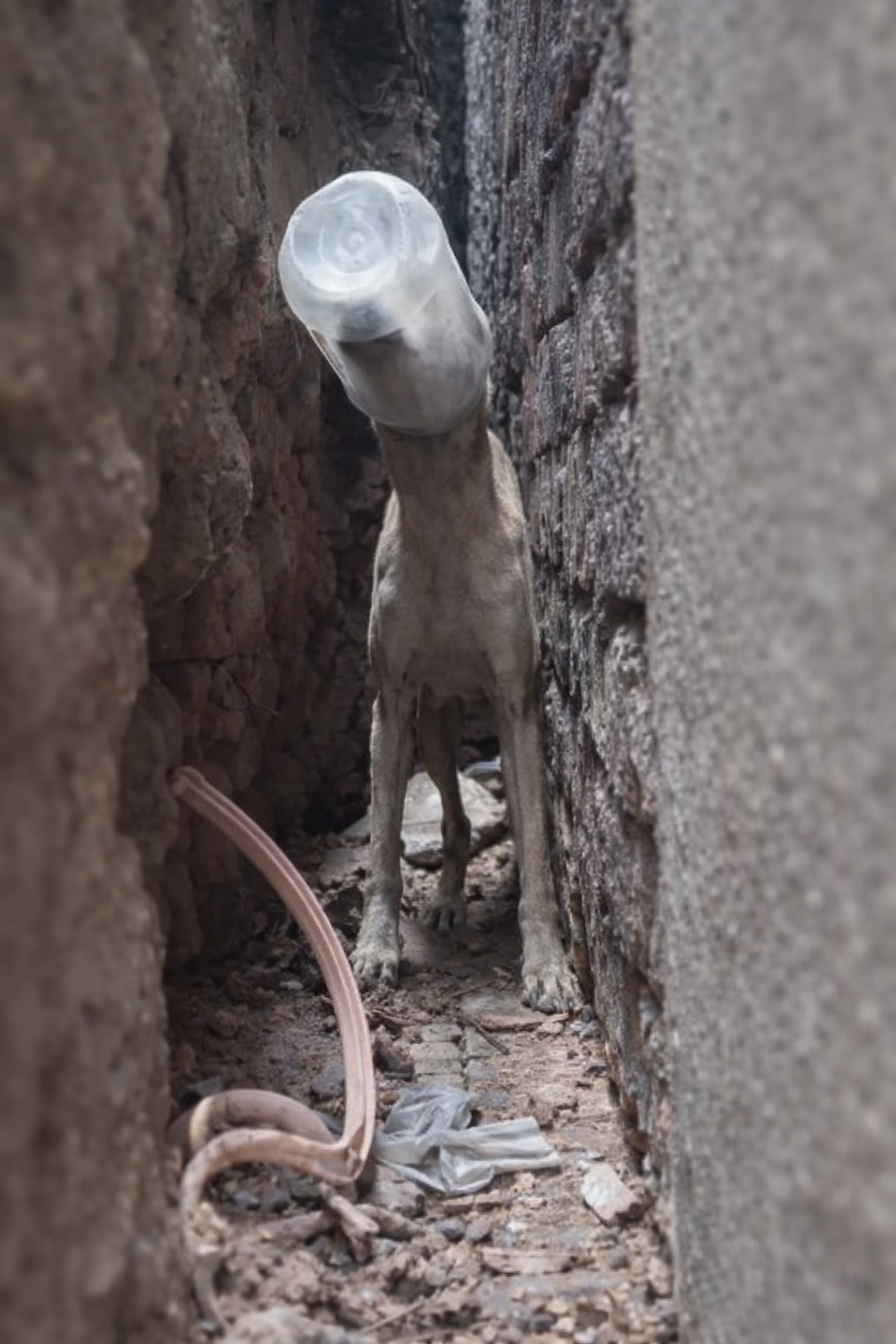
At first, there was only a small body trembling inside an impossibly narrow gap.
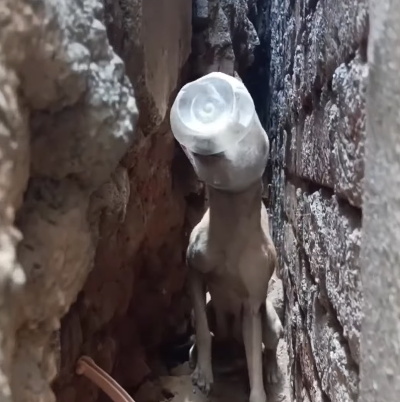
A dog had become wedged between two brick walls.
His legs scrambled against the ground.
He tried to turn.
There was nowhere to go.
Then the rescuers saw what made the situation far more serious.
A large plastic container completely covered his head.
He could not see clearly beyond it.
He could not reach food or water normally.
And every frightened movement pushed him harder against the confined space around him.
The dog had no way to understand why the container would not come off.
He only knew that something was trapped around his head—and that every attempt to escape seemed to make the situation more frightening.
Fortunately, someone noticed.
And soon, a rescue team was standing at the entrance to the narrow gap, trying to solve the problem without adding to his panic.
The Plastic Container Had Turned a Narrow Gap Into a Trap
No one could know exactly how the dog ended up with the container over his head.
But for a hungry stray, discarded food packaging can be difficult to ignore.
A container may still carry the smell of whatever was once inside.
An animal pushes its head through the opening looking for scraps.
Getting in can be easy.
Getting back out may not be.
For this dog, the plastic had become lodged firmly enough that shaking and pulling could not remove it.
Then he ended up between the brick walls.
Now he was dealing with two problems at once.
The space restricted his movement.
The container restricted his vision.
His body shook as he tried repeatedly to escape.
The more frightened he became, the harder it was for him to remain still long enough for anyone to help.
That was the situation facing rescuers from the Animal Warriors Conservation Society.
They could not simply reach into the gap and pull.
First, they needed to make sure the dog could not injure himself—or disappear farther into a place where reaching him would become even harder.
Video: Rescuers Reach the Dog Trapped Between Brick Walls With a Plastic Container Over His Head
They Had to Control the Panic Before Removing the Plastic
The dog could not see the rescuers properly.
He could only hear unfamiliar people approaching and feel movement around him.
That made every touch unpredictable.
A frightened animal in a confined space may struggle even harder when someone tries to grab him.
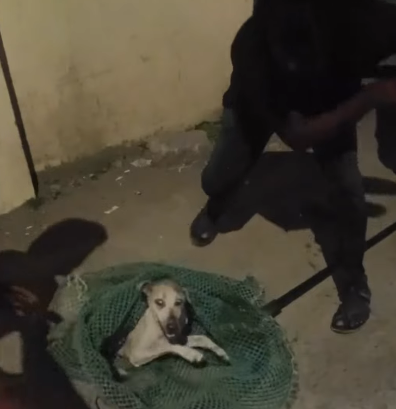
So the rescue team used a specialized net to secure him.
The purpose was not to punish or frighten him.
It gave the rescuers a way to limit sudden movement while they worked close to his head.
Once the dog was contained, the situation changed.
His muscles were still tense.
His breathing remained fast.
But he could no longer scramble blindly into another dangerous position.
Now one rescuer could begin examining how tightly the container was stuck.
There was no need for dramatic force.
Only enough control to find the safest way off.
One Careful Movement Was Better Than Pulling Hard
A rescuer reached toward the plastic and placed his hands around its edges.
The dog stiffened beneath the net.
Everyone around him stayed controlled.
The container had to pass back over the widest part of his head.
If it was pulled too aggressively, the dog might panic or the plastic could scrape against him unnecessarily.
So the rescuer adjusted his grip.
A slight movement.
A pause.
Then another careful pull.
For a moment, the container stayed exactly where it was.
The dog continued breathing heavily.
The rescuers continued holding him steady.
Then the angle changed.
The plastic shifted.
A little more.
One final controlled motion—
and the container slid free.
Suddenly, there was nothing covering the dog’s face.
For the First Time, He Could Look Around Again
The change happened in seconds.
The dog blinked.
His head lifted.
Instead of cloudy plastic surrounding his face, there was open space.
He could see the people around him.
He could turn his head freely.
He could use his mouth normally again.
Only moments earlier, every movement had been frantic and restricted.
Now the object causing much of that panic was lying away from him.
The rescuers no longer needed to hold him.
The net was loosened.
The dog paused briefly.
Then he moved.
Fast.
He left the narrow gap and headed into the open.
There was no reason to stop him.
Freedom was the entire point.
Running Away Was the Ending the Rescuers Wanted
The dog’s first reaction after release was not to remain for affection.
He ran.
That did not make the rescue less successful.
He was a stray who had just experienced an extremely stressful situation.
He had been trapped.
Then unfamiliar people had surrounded and restrained him.
Humans watching could understand that those actions were intended to help.
The dog could not.
What he understood immediately was much simpler.
He could move again.
So he used that freedom.
His body no longer had to negotiate the tight brick space with a bulky container around his head.
The frantic trembling that defined the beginning of the rescue was replaced by forward movement.
For the team, seeing him leave under his own power was enough.
This rescue did not require weeks of rehabilitation.
Its goal was immediate:
Remove the object he could not remove himself.
That objective had been achieved.
The Most Dangerous Part of the Story Had Once Held Food
There was nothing unusual about the object that trapped him.
It was an ordinary plastic container.
The kind that might once have stored food or water.
Once empty, it probably looked useless.
To a stray animal searching for something to eat, however, it could still smell interesting.
That difference matters.
Humans see trash.
A hungry dog may smell dinner.
The problem begins when the opening is large enough for an animal to push its head inside but difficult to escape from afterward.
Once the container becomes stuck, the animal may panic.
Vision can become restricted.
Normal eating and drinking can become impossible.
And the frightened animal cannot ask anyone to remove it.
It simply keeps trying.
That is why the final message in the rescue video matters beyond this single dog.
Crushing an Empty Container Takes Seconds
The rescuers leave viewers with a practical reminder.
Before disposing of suitable plastic bottles or containers, make them less likely to become traps.
Crush or flatten them when appropriate.
Then dispose of them properly.
Responsible waste handling can prevent an animal from ever reaching the situation shown in the video.
The broader principle is familiar:
Reduce unnecessary waste.
Reuse items safely where practical.
Recycle according to local requirements.
But there is an especially simple lesson here.
Think about the opening left behind.
Could a curious animal put its head inside?
Could it become stuck?
Could food residue attract a hungry stray?
A few seconds of attention before throwing something away may eliminate that risk entirely.
For this dog, people had to organize a rescue because that prevention had not happened.
Someone Had to Notice What He Couldn’t Explain
Perhaps the most important moment occurred before the rescue team ever touched him.
Someone saw that something was wrong.
The dog could not explain that he could not remove the container.
He could not point toward the opening.
He could not ask anyone to hold him still while it was pulled away.
His behavior communicated only panic.
Movement.
Shaking.
Trying repeatedly to escape.
Fortunately, someone interpreted that scene correctly.
A call was made.
Animal Warriors Conservation Society responded.
A net was brought in.
The dog was secured.
And one rescuer finally got close enough to do what the dog had been unable to accomplish on his own.
Remove the plastic.
A Small Piece of Trash Had Taken Away Almost Everything He Needed
The beginning and end of the story are separated by only one object.
At first:
A dog shaking between brick walls.
His head hidden inside plastic.
His movements frantic and uncertain.
Then:
The same dog with his face uncovered.
Space around him.
A clear path forward.
And nothing preventing him from leaving.
That transformation did not require an extraordinary medical breakthrough.
It required people recognizing an ordinary hazard before it became worse.
For this dog, rescue arrived in time.
But the story also leaves behind a responsibility that does not belong only to professional rescuers.
We all create waste.
And the things we discard continue existing somewhere after they leave our hands.
Sometimes the kindest intervention happens after an animal is already trapped.
Sometimes it happens much earlier—
when someone crushes an empty container, disposes of it securely, and makes sure no frightened animal will ever need to be rescued from it.
This little dog needed someone to notice.
He needed a net.
He needed careful hands.
Then, in one controlled movement, the plastic came away.
His face appeared again.
And moments later, he was running toward open space with nothing left covering his head.


