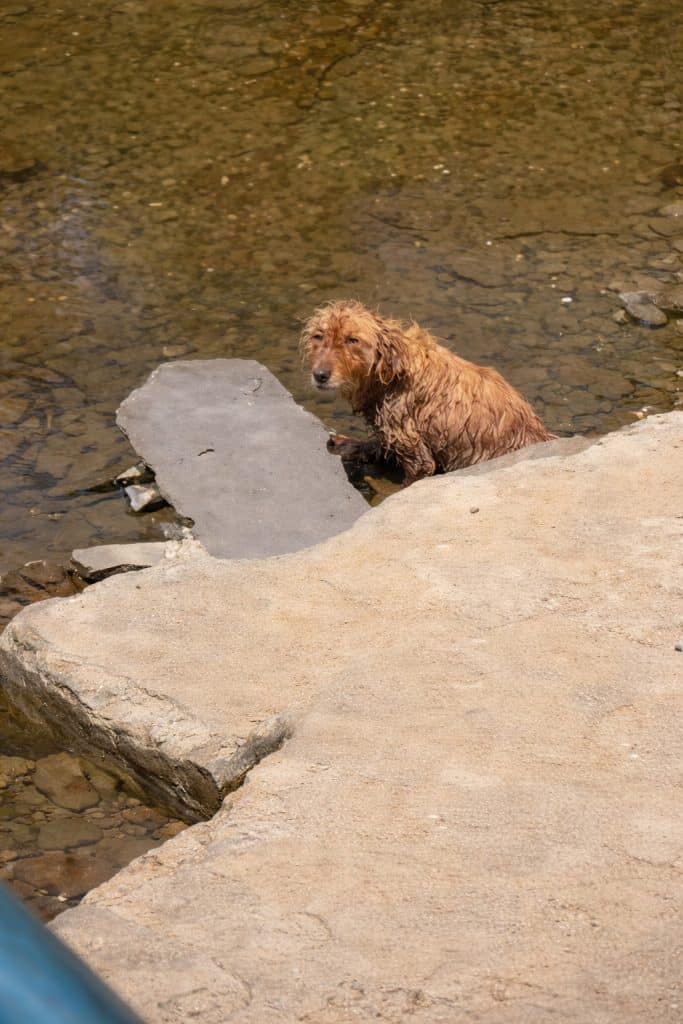
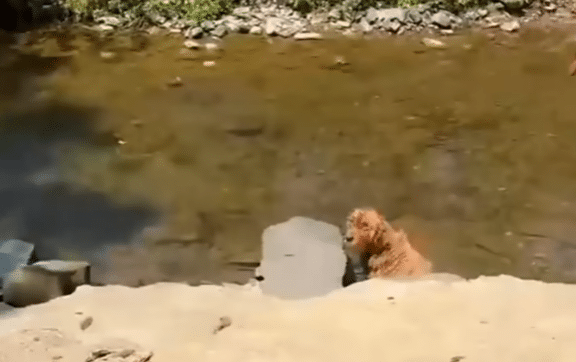
At first, the golden-coated dog looked as though he had simply wandered into the stream.
He stood half-submerged in freezing water, surrounded by rocks while the current moved around his body.
But something about the scene felt wrong.
He was not splashing.
He was not trying to climb onto the bank.
He was barely moving at all.
When someone finally stepped into the water and lifted him out, the reason became clear.
His front legs worked.
His back legs did not.
Placed carefully on the rocky ground, the dog tried to move forward.
Instead of standing, he pulled his body along using only his front legs.
Whatever had happened to him had happened long before that cold morning.
And now, alone beside an icy stream, he needed someone willing to decide that his inability to walk did not make his life worth less.
Once He Reached the Bank, the Extent of His Disability Became Clear
The dog tried to reposition himself after being removed from the water.
His front paws gripped the ground.
His shoulders worked.
But everything behind them dragged across the rocks.
There was no useful support from his back legs.
Every attempt to move required his upper body to pull the rest of him forward.
The rescuer could not know how he had ended up in the stream or what his life had looked like before that moment.
There was no way to tell from the scene alone whether someone had abandoned him because of his condition.
What was obvious was simpler.
He could not safely remain there.
Food was offered first.
Pieces of sausage and kibble were placed within reach, and the dog ate.
That response mattered.
Despite the cold and the difficulty moving, his appetite was still there.
Then the rescuer prepared to take him somewhere safe.
There was no specialized transport equipment available.
So a simple cardboard box became the temporary solution.
The dog was carefully settled inside and carried away from the river.
Later, he would be given a name.
Candy.
But before that name existed, one important thing had already changed.
He was no longer alone beside the water.
VIDEO: Candy Was Pulled From an Icy River — Then Rescuers Discovered His Back Legs Couldn’t Support Him
The Veterinary Examination Explained Why He Had Been Dragging Himself
The following day, Candy traveled with his rescuer back to their hometown.
There, another family helped care for him.
Warm boiled chicken breast was prepared so the exhausted dog could eat something nourishing while arrangements were made for veterinary evaluation.
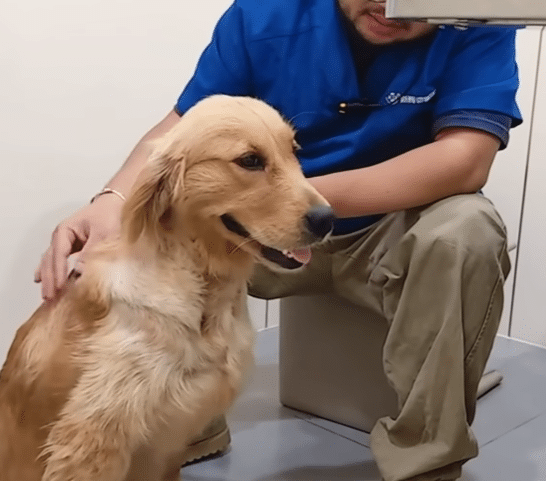
At the clinic, imaging and examination provided difficult news.
Candy’s back legs had apparently been fractured in the past.
The injuries were not recent.
They had already healed incorrectly.
According to the veterinary assessment described by his caregivers, surgery could not simply restore the legs to normal.
The damage had become a long-term condition.
That changed the question everyone had to ask.
The goal could no longer be based on an assumption that Candy would soon return to normal walking.
Instead, they needed to find a way for him to live comfortably with the body he had.
Fortunately, Candy himself gave them plenty of reasons to keep trying.
He ate eagerly.
He responded gently to the people around him.
He accepted care.
For a dog facing permanent mobility problems, those ordinary behaviors were encouraging.
Candy still wanted food.
He still wanted interaction.
There was still a great deal of life taking place above the legs that would not support him.
So his rescuer began looking for another way to help him move.
A Handmade Wheelchair Gave Candy Back the Ability to Explore
Dragging himself across the ground could not be a long-term solution.
It placed unnecessary strain on his body and limited where he could comfortably go.
So Candy’s rescuer built him a wheelchair.
It was simple.
It was not expensive professional equipment.
It only needed to do one important job.
Support Candy’s back end while allowing his front legs to propel him forward.
Once he was positioned in the wheels, everything changed.
Candy could move without dragging his body.
He could travel across the ground with his head up.
He could stop where he wanted.
He could investigate his surroundings.
During outings, he paused to smell things and nibble grass.
Those experiences may seem ordinary for most dogs.
For Candy, they represented independence.
The wheelchair did not repair his old injuries.
It did something just as useful.
It allowed him to participate in life while his caregivers continued learning what he needed.
And his needs extended far beyond mobility.
Candy required daily hands-on care.
Because he could not relieve himself normally without assistance, his caregiver helped clean him and manage his hygiene every day.
Meals were prepared carefully, including chicken, vegetables, and other balanced foods intended to help his weakened body recover.
The work was repetitive.
There was no dramatic finish line.
Yet slowly, Candy began looking different.
His Body Grew Stronger Before Anyone Knew What His Legs Might Do
Regular nutrition helped Candy gain weight.
His coat became healthier.
The depleted appearance he had carried beside the river gradually softened.
His behavior changed as well.
He became increasingly comfortable with human touch.
He rolled onto his back for belly rubs.
He rested near the people caring for him.
The tension visible during his earliest days eased.
There was now routine where there had once been uncertainty.
A place to sleep.
Food at predictable times.
Help with the parts of daily life he could not manage alone.
And wheels whenever he wanted to move farther.
But his rescuer did not completely stop working with Candy’s back legs.
Each day, the wheelchair was removed for gentle rehabilitation.
His legs were massaged.
His muscles were carefully stretched and moved.
At first, nothing visible happened.
The legs remained largely unresponsive.
The veterinary prognosis had already prepared the family for the possibility that this might never change.
Still, the exercises continued.
Not because anyone could promise Candy would walk again.
Because maintaining movement and working with the muscles was part of giving him every reasonable opportunity to improve.
Then one day, the rescuer noticed something.
A small reaction.
Barely enough to see.
But it had not been there before.
Then Candy Stood for a Few Seconds
Weeks passed.
Candy continued using his wheelchair while his daily care and exercises remained part of the routine.
Then, during a meal, something unexpected happened.
Candy pushed himself upward.
His back legs took some of his weight.
And for several seconds, he stood on all four legs.
It was not a strong stance.
It was not steady.
No one mistook those few seconds for a complete recovery.
But the moment was real.
The same dog who had dragged his back half across rocks was now briefly supporting himself.
The family continued rehabilitation rather than treating the milestone as proof that everything was fixed.
At a follow-up visit roughly a month into the process, the veterinary team encouraged them to keep working with him.
So they did.
The massages continued.
The stretching continued.
Candy practiced standing.
Sometimes progress was difficult to see.
Then he began remaining upright a little longer.
Eventually, one attempt produced something more.
A step.
Then another.
His gait was unstable.
His back legs did not suddenly become normal.
But Candy was moving them while supporting himself.
For the people who had first been told that his old injuries could not simply be surgically corrected, watching him take those steps was extraordinary.
They did not need to call it a miracle.
They could simply watch what Candy was doing.
He was walking.
The Wheelchair Had Not Been a Sign of Giving Up
Candy’s progress revealed something important about the decision to give him wheels.
The wheelchair had never meant that his caregivers had abandoned hope for improvement.
It meant they were unwilling to make his quality of life depend on improvement happening.
If Candy never regained meaningful use of his back legs, the wheelchair could still give him mobility.
If rehabilitation produced some function, that progress could be welcomed without placing his entire future on it.
That distinction allowed Candy to have a good life while everyone remained uncertain about what his body might eventually do.
There was no need to wait for perfect recovery before allowing him outside.
No need to delay affection until he could stand.
No need to judge the value of his life by whether he ever walked normally.
He could enjoy grass from his wheelchair.
He could receive belly rubs while still needing assistance.
He could sleep comfortably even if his legs remained damaged.
Then, when those first independent steps arrived, they became something extra rather than the condition for being loved.
The Dog Once Frozen in the Water Now Waits by the Door
Candy’s days now look very different from the day he was found.
In the evening, he waits near the door.
He knows there are outings ahead.
He has a soft place to sleep.
There are toys around him.
Meals arrive reliably.
And the people caring for him understand that his body may always require more attention than that of another dog.
His walking is not perfect.
The old injuries did not disappear simply because rehabilitation produced progress.
But Candy can now take steps using his own legs.
He no longer has to drag his body across sharp stones.
And even on days when support is useful, there is a wheelchair waiting.
That is what makes his transformation more meaningful than a simple before-and-after image.
His life improved long before anyone knew whether he would walk.
The home came first.
The care came first.
The food.
The cleaning.
The wheelchair.
The daily exercises.
Walking was one remarkable part of a much larger rescue.
Candy Never Needed a Promise That Everything Would Be Fixed
When the rescuer lifted Candy from the icy stream, there was no way to know what the future held.
There was only a dog who could not use his back legs.
A dog who needed food.
A dog who needed to be somewhere warmer.
The decision to help came before the diagnosis.
And when the diagnosis was discouraging, the care did not stop.
That is where Candy’s story truly changed.
Someone adapted.
When he could not walk, they built wheels.
When he needed help with hygiene, they helped him every day.
When his body was weak, they prepared nourishing meals.
When the first exercises produced nothing, they continued gently.
And when a tiny response finally appeared, they did not demand a dramatic transformation overnight.
They kept going.
Eventually, the dog who once stood motionless in freezing water found himself standing on dry ground.
Then taking one uncertain step.
Then another.
Maybe Candy will always move differently from other dogs.
Maybe he will continue needing support in some form.
None of that changes what happened when someone first saw him beside the river.
They did not ask whether he would ever walk normally before deciding whether he deserved help.
They simply carried him out of the cold.
Everything else came afterward.
And sometimes that is what a second chance really looks like.
Not knowing exactly how far a life will recover.
Only deciding that it deserves somewhere safe to begin.


