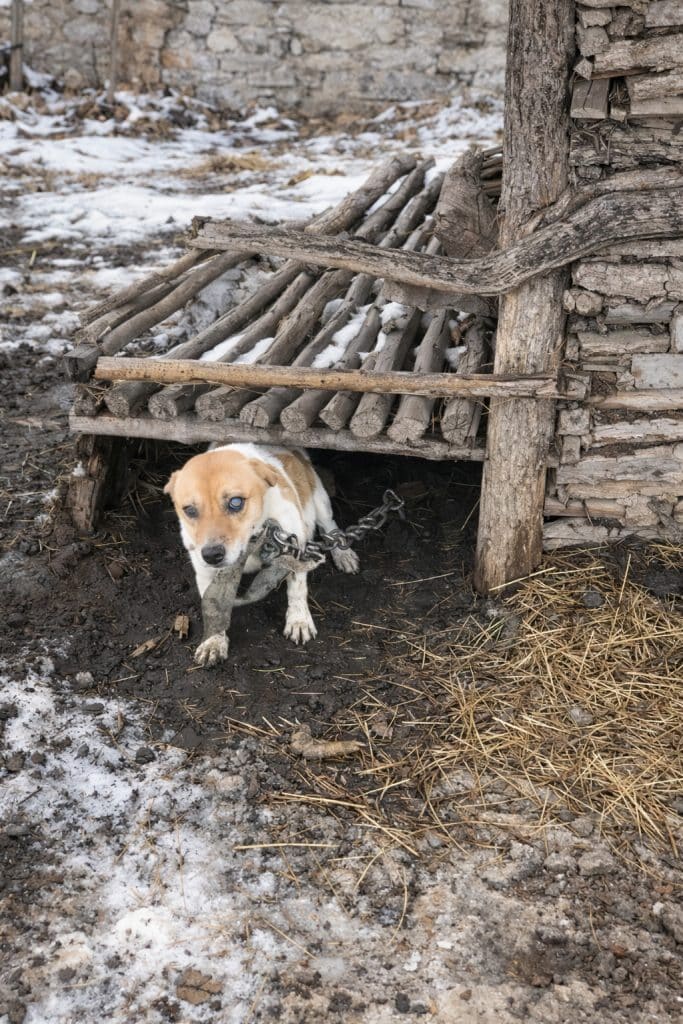
Among all the dogs in the yard, he was the easiest one to overlook.
He did not bark for attention.
He did not rush toward the fence.
When voices grew louder or someone moved suddenly, the little dog did something much quieter.
He backed away.
His head lowered.
His eyes turned toward the ground.
And whenever possible, he positioned himself where no one would pay much attention to him.
In the yard in Russia’s Krasnodar Krai, staying unnoticed appeared to have become part of the three-year-old dog’s routine.
Then the woman responsible for the property was taken away.
The dogs remained behind.
Chained outside, with reliable food and water suddenly gone, their situation became increasingly serious.
Neighbors occasionally threw pieces of bread over the fence.
For the smallest dog, already weighing only about five kilograms, scraps were not going to be enough for long.
Eventually, volunteers heard what was happening.
And when they entered the yard, the quiet little dog who had spent so much time avoiding attention became the one they could not ignore.
He Never Fought for Attention — He Moved Away From It
Several dogs were living on the property.
Each responded differently when people came near.
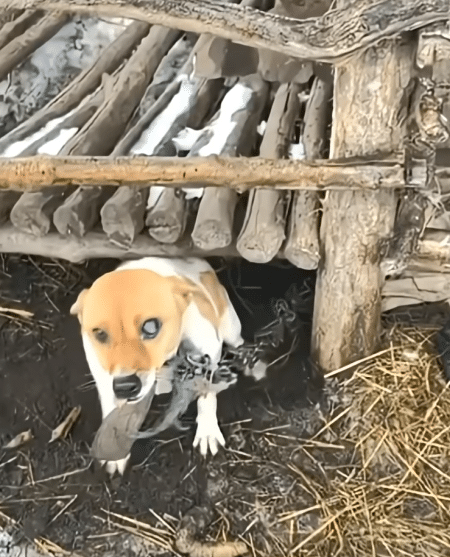
The smallest remained cautious.
Sudden movements made him flinch.
He avoided prolonged eye contact and tended to keep space between himself and unfamiliar people.
No one could know exactly what experiences had taught him to behave this way.
The volunteers could only work with what they observed.
This was a dog who appeared to feel safer when he was not the center of attention.
His body presented more obvious concerns.
At only three years old, he weighed approximately five kilograms.
Several teeth were missing.
And one eye was badly damaged.
It appeared swollen and unhealthy, and there was no indication that the problem had received the veterinary care it required.
After the dogs had been left behind, their circumstances had become even less stable.
There was no dependable routine for meals.
Clean water was not reliably provided.
Bread tossed over the fence by concerned neighbors offered temporary calories but could not replace appropriate care.
The volunteers looked at the little dog standing apart from the others.
He did not come forward asking to be chosen.
They chose him anyway.
VIDEO: The Smallest Dog Stayed Hidden at the Back of the Yard — Until Rescuers Saw His Injured Eye
Leaving the Yard Was Only the First Part of His Rescue
Getting him away from the property solved the immediate problem.
It did not reveal how much medical care he might need.
The little dog was eventually transported to Moscow for a more complete veterinary evaluation.
The damaged eye quickly became the primary concern.
It had apparently been unhealthy for a long time.
The eye was no longer providing useful vision.
Worse, chronic inflammation meant that leaving it in place could continue causing discomfort.
The veterinary team had to consider whether there was anything meaningful left to save.
There was not.
The recommended treatment was removal of the damaged eye.
For someone seeing the dog for the first time, losing an eye might sound like another tragedy added to an already difficult story.
For the veterinary team, the goal was different.
The eye was already blind.
Removing it could eliminate an ongoing source of inflammation and pain.
Sometimes treatment does not restore something to the way it once was.
Sometimes it makes life better by removing what can no longer be repaired.
The surgery was scheduled.
And the little dog who had spent so much time trying not to be noticed was suddenly surrounded by people paying careful attention to everything he needed.
The Eye Could Not Be Saved — But He Could Finally Be Comfortable
The operation removed the damaged eye.
Afterward, the focus shifted to recovery.
There was a surgical site to protect and a small body that needed time to regain strength.
But something important had changed immediately.
The chronically inflamed eye was no longer there to continue causing discomfort.
His caregivers prepared a quiet place for him.
Soft bedding replaced the hard outdoor surfaces he had known.
Food arrived consistently.
Clean water remained available.
Hands approached slowly.
Nothing required him to become affectionate immediately.
If he wanted distance, he was allowed distance.
If a movement frightened him, people slowed down.
The volunteers understood that removing a painful eye could happen in one procedure.
Changing the behavior of a dog who had become accustomed to caution would take much longer.
So they did not rush that part.
And gradually, they began noticing changes.
His head stayed slightly higher.
His body appeared less tense while resting.
He watched the people around him with his remaining eye instead of immediately trying to move away.
They were small differences.
For this dog, small differences mattered.
He Had to Learn That a Hand Reaching Toward Him Could Be Gentle
The little dog never responded to fear with aggression.
Even during the uncertain early days, he remained gentle.
But gentle did not mean comfortable.
There was a difference between allowing someone nearby and actually wanting that person there.
His caregivers gave him time to discover it.
They repeated simple routines.
Food arrived.
Someone spoke softly.
A hand approached slowly enough for him to see it.
Touch stopped when he became uncomfortable.
Then the same people returned later.
No single interaction changed him.
The repetition did.
Day after day, the little dog collected experiences that were different from whatever had made him so cautious before.
A hand could bring food.
A person sitting nearby did not necessarily demand anything.
Someone entering the room could leave peacefully and return later.
Gradually, he stopped treating every movement as something requiring an immediate retreat.
He rested more openly.
He allowed people to remain closer.
Sometimes, instead of moving away, he stayed exactly where he was.
For most dogs, remaining still while someone sits nearby would hardly be worth mentioning.
For a dog whose preferred response had been to make himself disappear, it represented progress.
Having One Eye Did Not Stop His World From Becoming Larger
Once the surgical area healed, the loss of the eye became far less important than it might have seemed.
Dogs can adapt remarkably well to changes in vision when their remaining eye is functional and their surroundings are safe.
For this little dog, the biggest adjustment appeared to be learning how different his new surroundings were.
There were indoor spaces to explore.
Soft places to lie down.
Meals that arrived without competition or uncertainty.
People who noticed whether he was comfortable.
The yard had required him to remain cautious.
His new environment allowed him to investigate.
At first, that curiosity appeared carefully.
A few steps toward something unfamiliar.
A longer look at a person nearby.
Resting without immediately shrinking when someone entered.
Then his behavior continued opening.
He no longer spent every moment attempting to remain at the edge of the room.
The dog who had once lowered his face and kept his distance was beginning to participate in what happened around him.
His missing eye remained visible.
But it was no longer the most noticeable thing about him.
His personality was becoming easier to see.
The Dog Who Tried to Disappear Began Choosing to Stay Close
Recovery stories often focus on physical milestones.
Weight gained.
A wound closed.
Sutures removed.
Those things mattered here too.
But the most meaningful changes were behavioral.
The little dog began approaching instead of always retreating.
He became more relaxed around familiar people.
His posture softened.
He could settle into a bed without remaining constantly alert to what might happen next.
The transformation was not sudden.
There was no day when fear simply disappeared.
Some movements could still make him cautious.
Unfamiliar situations still required patience.
But he no longer behaved as though invisibility were his safest option.
There were now people in his life who were looking for him for entirely different reasons.
To make sure he had eaten.
To check his healing.
To offer attention.
To invite him closer without forcing him.
For a dog who had once survived by staying out of the way, that may have been one of the most difficult lessons to understand.
Being noticed could lead to something good.
He No Longer Needs to Make Himself Small
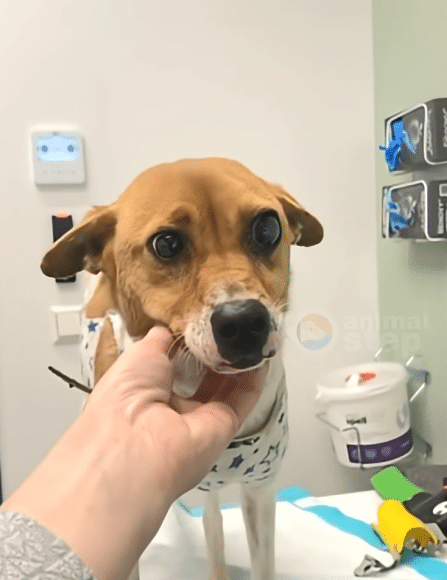
Today, the little dog lives indoors.
He has food.
Warmth.
Medical care.
And people who understand that confidence can return slowly.
He still has only one eye.
That does not prevent him from navigating the life he has now.
In fact, the eye that could not be saved is no longer causing the chronic discomfort it once did.
His world did not become smaller after surgery.
It became larger.
The yard where he once stayed back is no longer the limit of what he knows.
He can rest somewhere soft.
Move through rooms safely.
Receive attention without immediately shrinking away from it.
And most importantly, he does not have to compete with louder dogs in order for someone to notice when he needs something.
He has already been noticed.
Sometimes the Quietest Dog Is the One Most Easily Missed
When the volunteers first reached the property, several dogs needed help.
It would have been natural for attention to go first toward whichever animal barked the loudest or rushed closest.
The little dog did neither.
His strategy was the opposite.
Stay back.
Lower his eyes.
Do not attract attention.
That behavior might once have helped him navigate an unpredictable environment.
It also made him easy to overlook.
Fortunately, the rescuers looked beyond the dogs demanding attention and noticed the one who was trying not to receive any.
They saw the five-kilogram body.
The missing teeth.
The damaged eye.
The flinch when someone moved too quickly.
And instead of waiting for him to ask for help in a way he probably never would, they carried him out.
The surgery did not restore his sight.
It removed an eye that was already blind and painful.
The home did not erase everything that had shaped his cautious behavior.
It gave him safer experiences to build on.
That is how his life changed.
Not because he suddenly became fearless.
Because he finally reached a place where fear was no longer required for every decision.
Once, this little dog survived by making himself as easy to miss as possible.
Now there are people who notice when he enters a room.
And for the first time, being seen no longer means he needs to hide.


