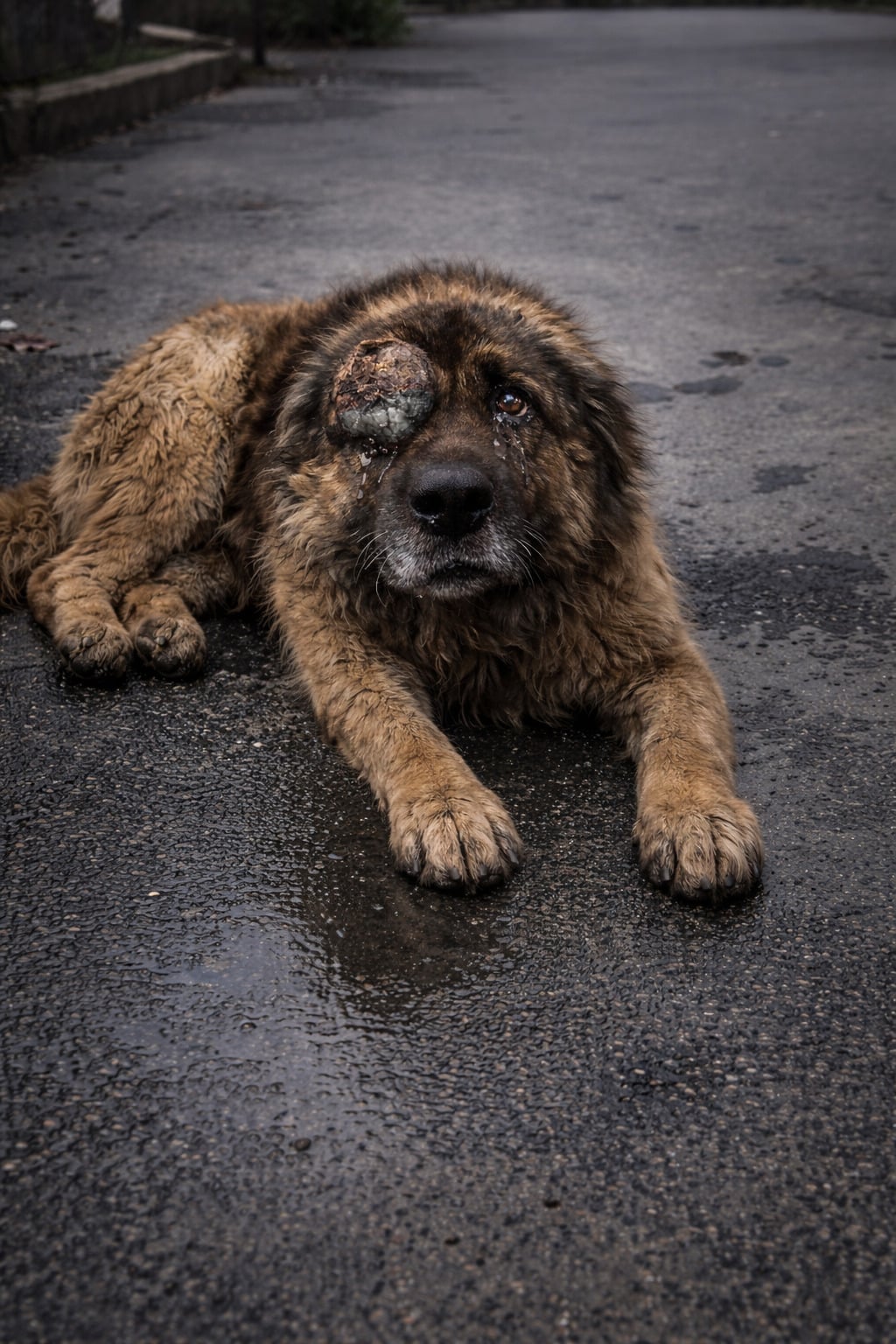
The call came shortly after sunrise.
At an abandoned construction site on a windswept hillside, a thin black dog had been seen searching through piles of debris for something to eat.
Broken bricks surrounded him.
Trash covered the ground.
There was no shelter from the cold concrete beneath his paws.
But beside all that rubble was one object the dog seemed unwilling to leave.
An old mattress.
Stained.
Worn.
Nearly as forgotten as he was.
Even when hunger forced him to search nearby for scraps, he kept returning to it.
The dog would later be named Bastian.
He was believed to be around ten years old.
And whatever life he had known before, this ruined construction site had somehow become the place where rescuers found him trying to survive.
He Kept Returning to the Same Dirty Mattress
Bastian did not look like a dog who had recently wandered away from a comfortable home.
His condition suggested a much longer decline.
His ribs were clearly visible beneath dirty, tangled fur.
Ticks clung to his body.
His movements were weak and uncertain.
Even standing seemed to require concentration.
Still, he remained close to the mattress.
No one could know exactly why.
Perhaps it was simply softer than the surrounding concrete.
Perhaps it had become the safest place he knew in an otherwise exposed environment.
Whatever the reason, rescuers noticed how reluctant he was to move far from it.
Food was scarce.
The ground was littered with debris.
And Bastian’s body was reaching a point where survival outside was becoming increasingly difficult.
He needed more than another meal.
He needed medical care.
VIDEO: Bastian Was Found Beside a Ruined Mattress — His First Days of Recovery Changed Everything
At the Clinic, His Bloodwork Revealed How Weak He Had Become
Once Bastian arrived at the veterinary clinic, the visible problems were only the beginning.
He was dehydrated.
Severely underweight.
And visibly weakened by whatever had been affecting him for some time.
Testing revealed an Ehrlichia infection, a tick-borne disease that can affect the blood.
Bastian was also severely anemic.
His gums were pale.
His body had very little reserve left.
Malnutrition added another layer of concern.
According to the veterinary assessment described in his rescue story, his condition was serious enough that even a short additional delay could have made the outcome much worse.
There was no time to focus on appearance.
No baths for cosmetic reasons.
No rush to make him look like a different dog.
First came stabilization.
Treatment Began With Blood, Fluids, and Careful Monitoring
Bastian needed support immediately.
A blood transfusion was part of his treatment.
IV fluids helped address dehydration.
Veterinary staff monitored him closely while his weakened body adjusted.
At this stage, progress looked very different from the dramatic transformations people often associate with rescue.
A steady breath mattered.
A slightly stronger response mattered.
Resting without becoming more unstable mattered.
Bastian remained quiet through much of the process.
He did not have energy to waste.
His body had been pushed too far for too long.
So the clinic gave him something he had not been able to find at the construction site.
Time to stop struggling.
He no longer needed to search through garbage.
He no longer needed to conserve enough strength to return to the old mattress.
His only job was to rest while other people handled the difficult parts.
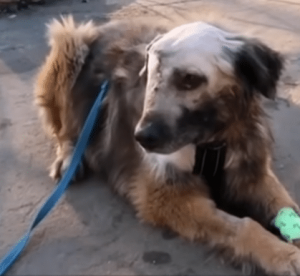
His First Meals Became Part of the Treatment
Once Bastian was stable enough to eat, food became one of the most important parts of his recovery.
Meals were kept simple and gentle.
Rice.
Chicken.
Food his weakened body could manage while beginning to rebuild.
Bastian showed interest.
Even when he remained thin and tired, he tried to finish what was placed in front of him.
That routine continued.
Meal after meal.
Day after day.
Slowly, the scale began to change.
Then came a number that meant far more than it normally would.
Bastian had gained approximately 0.8 kilograms.
Less than one kilogram might sound small.
For a dog who had arrived severely malnourished and anemic, it represented meaningful progress.
His body was finally keeping some of what it desperately needed.
Strength was returning in small increments.
And the people around him began seeing subtle changes beyond the numbers.
His trembling eased.
His expression looked more alert.
His coat gradually began to improve.
Then Someone Replaced the Mattress He Had Refused to Leave
There was one detail from Bastian’s rescue that his caregivers had not forgotten.
The mattress.
That stained cushion among the rubble had been the place he repeatedly returned to.
So during recovery, someone gave him another one.
This time, it was clean.
Soft.
Warm.
There were no broken bricks beside it.
No garbage piles.
No exposed construction site.
Bastian settled onto the new mattress.
And rested.
For a dog recovering from severe illness, sleep was not simply comfort.
It was part of healing.
His body needed every opportunity to recover strength.
But the image carried another meaning too.
Bastian had once been surrounded by rubble with an old mattress as one of his few comforts.
Now people were making sure softness did not have to come with hunger, ticks, or exposure.
The mattress was no longer something he had to cling to.
It was simply his bed.
Standing Came Before Walking
As Bastian grew stronger, another stage of recovery began.
Movement.
At first, standing for more than a short period remained difficult.
His muscles had weakened along with the rest of his body.
So no one expected him to simply rise and walk normally.
He stood briefly.
Then rested.
Later, he tried again.
Eventually, a few steps followed.
Slow.
Careful.
Unsteady.
But forward.
Over time, those short efforts became longer walks.
His body began supporting itself more reliably.
And then another small sign appeared.
His tail moved.
The dog who had arrived too depleted to do much beyond lie still was beginning to respond more actively to the people around him.
He stopped withdrawing as much.
Familiar faces began receiving different reactions.
His strength was returning.
So was more of his personality.
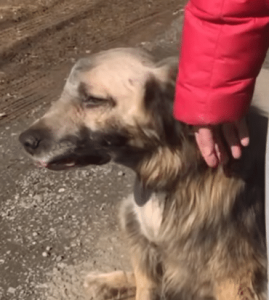
He Eventually Walked Out of the Clinic on His Own
There is a major difference between being carried into a veterinary clinic and walking out of one.
Bastian experienced both.
When rescuers first brought him in, his body required intensive support.
By the time he was ready to leave, he could walk.
Not with the weakness that had defined his first days.
Not collapsing after every few steps.
He moved under his own power.
The improvement did not erase his age.
It did not erase the Ehrlichia infection, anemia, or malnutrition that had nearly overwhelmed him.
It showed what consistent treatment had allowed him to regain.
Then another part of his future fell into place.
A woman opened her home to Bastian.
The dog who had been found living beside rubble would not be returning there.
He now had somewhere else to go.
The Old Construction Site Was No Longer the Place Waiting for Him
Bastian’s story could easily have ended with the clinic discharge.
But recovery means much less if an animal simply returns to the same conditions that caused the crisis.
Bastian needed stability after treatment.
Regular food.
A safe place to sleep.
People who would notice if his health changed again.
The woman who welcomed him gave him that next step.
For his rescuer, saying goodbye was emotional.
They had seen Bastian at his weakest.
Watched him receive a blood transfusion.
Counted the small gains on the scale.
Seen him stand again.
Then walk.
Now they were watching him leave for a home.
This goodbye was not another abandonment.
It was the opposite.
Bastian was leaving because someone was ready to keep caring for him.
The Mattress Was Never Really the End of His Story
The first image of Bastian stays with people for a reason.
An older dog.
A ruined construction site.
A body reduced by illness and hunger.
And one worn mattress he repeatedly returned to.
It would be easy to make that mattress only a symbol of everything he had lost.
But later, another mattress appeared.
Clean.
Warm.
Placed somewhere safe.
That contrast says almost everything about Bastian’s recovery.
The first mattress existed because he had nowhere better to go.
The second existed because someone was thinking about his comfort.
Between those two images came everything that changed his life.
A rescue call.
Veterinary testing.
Treatment for Ehrlichia.
A blood transfusion.
IV fluids.
Simple meals.
A gain of 0.8 kilograms.
The first stand.
The first steady steps.
And finally, the walk out of the clinic.
Bastian’s recovery was not one dramatic miracle.
It was a collection of people refusing to treat an older, badly weakened dog as though his best days were already behind him.
He had spent years growing older.
That did not make him disposable.
Age did not make hunger hurt less.
It did not make illness less serious.
And it certainly did not make comfort matter less.
Once, Bastian searched through rubble and returned again and again to a dirty mattress.
Later, he rested on a clean one while his body grew stronger.
And eventually, he stood up from that bed and walked toward a life where he would no longer have to wonder whether anyone was coming back.


