At first, there was only the sound.
A dog crying somewhere in the darkness.
It was late, the streets had grown quiet, and most people nearby had already settled in for the night. A bark or two might have gone unnoticed.
But this sounded different.
The cries kept coming.
Someone nearby finally decided to investigate.
That decision led them to Veera.
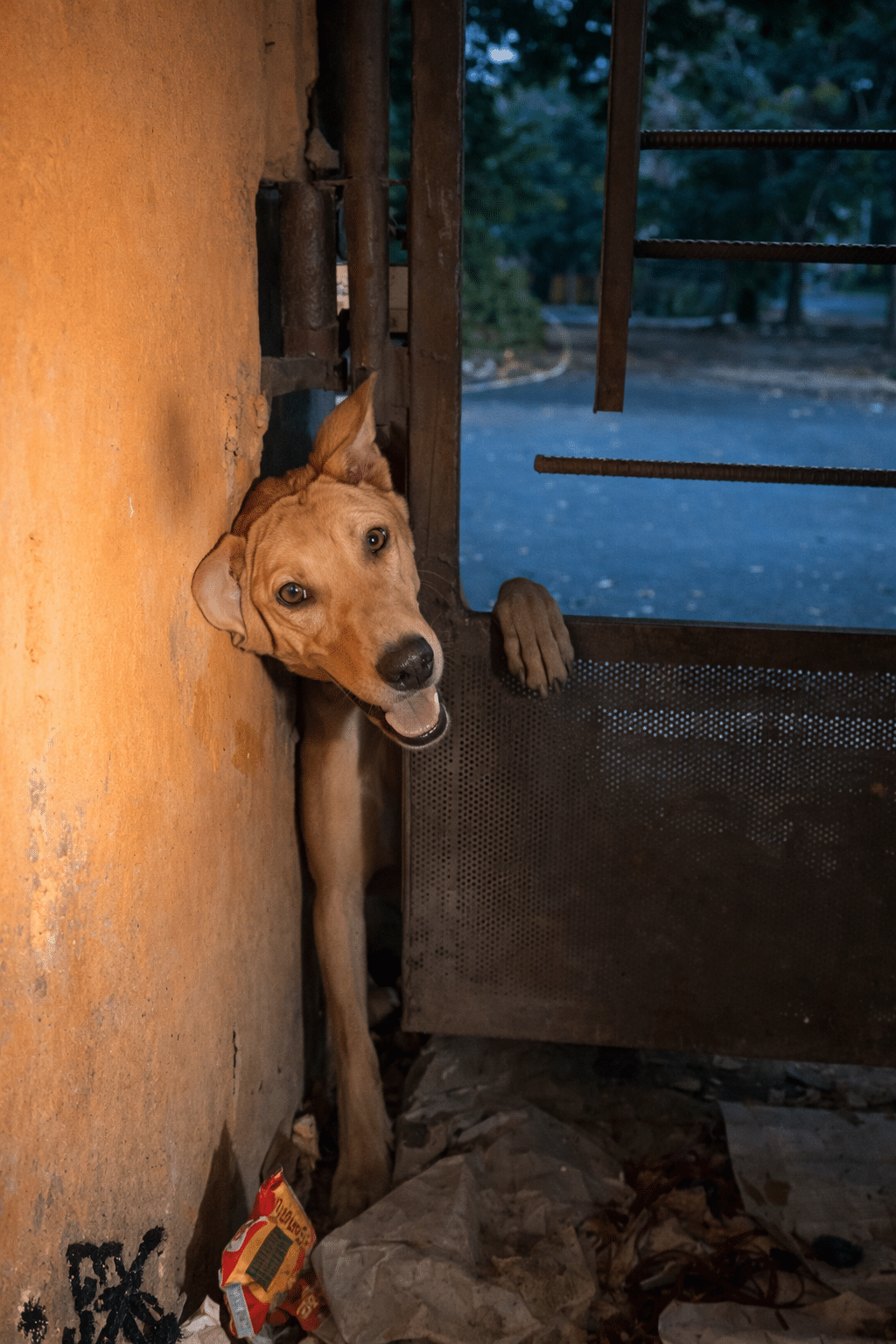
She had somehow forced part of her body into an impossibly narrow space between a concrete wall and an iron gate. Her head and chest had made it through.
Her shoulders had not.
She could neither continue forward nor pull herself back.
Every attempt to escape seemed to wedge her more firmly into place.
By the time help arrived, Veera was frightened, exhausted, and surrounded by people she did not know.
Getting her out would require more than strength.
It would require everyone to remain calmer than she could.
There Were Only Inches Between the Wall and the Gate
No one knew exactly why Veera had entered the narrow opening.
Perhaps curiosity had drawn her there.
Perhaps she had followed a scent.
Perhaps something frightened her in the darkness and she tried to squeeze through without realizing how little room there was.
Whatever happened, she had gone too far to reverse easily.
Her head and chest were through the gap, while her shoulders and the rest of her body remained caught behind it.
The hard surfaces left almost no room for adjustment.
Concrete pressed against one side.
Iron held the other.
Her front legs were awkwardly positioned, making it even harder for her to find leverage.
Veera tried twisting.
She tried pulling backward.
She tried pushing herself forward.
Nothing worked.
Eventually, the struggling gave way to cries loud enough to carry into the surrounding area.
Fortunately, someone listened.
A nearby resident realized that this was more than ordinary nighttime barking and called for assistance.
The team from Speechless.in responded.
When they arrived and saw Veera’s position, they understood immediately that simply grabbing her and pulling could make the situation worse.
They needed to slow everything down.
Video: Rescuers Find Veera Trapped Between an Iron Gate and Concrete Wall
Before They Freed Her Body, They Had to Reduce Her Panic
Veera had no way of knowing why unfamiliar people were gathering around her.
From her perspective, she was already trapped.
Now hands were approaching.
Voices surrounded her.
There was nowhere to retreat.
Even a gentle dog can react defensively under those circumstances.
The rescuers did not blame her for being afraid.
Instead of beginning immediately with force, they focused first on making the situation safer.
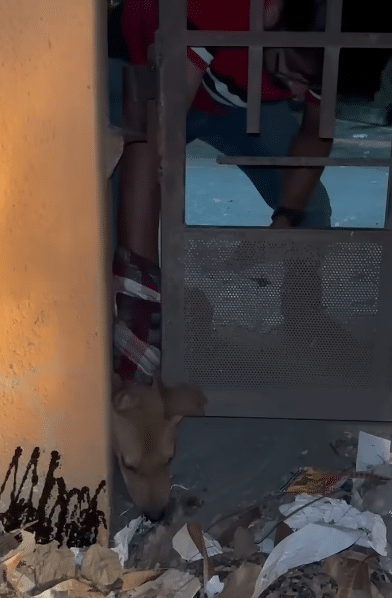
One rescuer carefully placed a soft cloth around Veera’s muzzle as a temporary precaution against a fear-driven bite.
The restraint was not punishment.
It allowed the team to work close to her face and shoulders while reducing the risk that sudden pain or panic could injure someone.
At the same time, a rescuer remained close to her head.
He stroked her gently.
His movements were slow.
His voice remained low and steady.
Veera was still frightened, but gradually her reactions became less frantic.
Her breathing appeared to settle.
The constant twisting diminished.
Those few calmer moments were critical.
The rescuers did not need Veera to understand every part of what they were doing.
They only needed enough cooperation to move her without causing unnecessary harm.
Once she stopped fighting the narrow space quite so intensely, they could begin examining how to get her out.
One Wrong Pull Could Have Made Things Worse
The difficulty was obvious once the team looked closely at her position.
There was almost nowhere to place their hands.
Veera’s shoulders were caught at the tightest part of the opening, and her front legs needed to be repositioned before the rest of her body could follow.
Pulling straight backward was not enough.
Using excessive force risked hurting her.
So the rescuers divided the work.
One person stabilized the iron gate so that it would not move unpredictably.
Another focused on Veera.
Nearby people assisted where needed, but the movements remained controlled.
A small adjustment of her front leg.
Pause.
A slight change in the angle of her shoulders.
Pause again.
The team watched her reaction after every movement.
There was no point in gaining an inch if panic caused Veera to twist herself right back into the same position.
She whimpered at moments.
But she did not begin violently struggling again.
That allowed the rescuers to continue.
The rescue became a matter of centimeters.
Not strength.
Not speed.
Position.
For Several Moments, It Looked Like Nothing Was Working
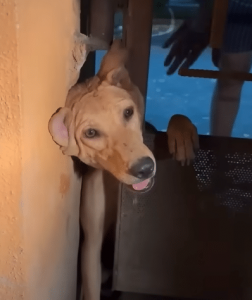
The team lifted Veera slightly.
Then they tried adjusting her angle.
Her shoulder remained caught.
They repositioned her again.
Still stuck.
From the outside, the movements looked incredibly small.
That was intentional.
When an animal is trapped between rigid surfaces, dramatic pulling can create new problems.
The rescuers needed to discover the exact position that would allow the widest part of Veera’s body to pass through the narrow opening.
They kept working.
A little rotation.
A slight push.
Then another careful shift.
Veera’s body moved only a fraction.
But it moved.
That fraction gave them something to work with.
They continued guiding her front end while maintaining control of the gate.
Then came another adjustment.
Her shoulder began to slip through.
For several tense seconds, everyone stayed focused on the same small area.
One more controlled movement.
And suddenly the resistance changed.
Veera’s shoulders cleared the narrowest point.
The rest of her body followed.
Her paws reached open ground.
She was no longer trapped.
The First Thing Veera Wanted Was Distance
For a brief moment after she was freed, Veera remained close to the rescuers.
Then she moved.
Fast.
Once the temporary restraint was removed and nothing blocked her body anymore, she ran away from the gate.
There was no long reunion with the people who had helped her.
No dramatic pause for affection.
Veera simply used her freedom.
And the rescuers let her.
After an experience like that, running was hardly surprising.
She had spent an unknown amount of time unable to move, struggling inside a narrow space while fear increased around her.
Then several strangers had needed to hold and reposition her body.
Humans could understand why those uncomfortable moments were necessary.
Veera could not.
She only knew that the obstacle was finally gone.
As she moved away, her running appeared smooth, without an obvious limp or immediate difficulty visible in those first moments.
That was the ending the team had hoped for.
They did not need Veera to stay nearby to prove the rescue had succeeded.
Seeing her move freely was enough.
The Rescue Began Before the Team Ever Arrived
It would be easy to give all the credit to the people who physically pulled Veera from the gap.
Their patience mattered enormously.
But the rescue actually began earlier.
It began with someone hearing a sound.
Then choosing not to ignore it.
At night, dogs bark for countless reasons.
A person could easily have rolled over, closed a window, or assumed the noise would stop on its own.
But someone listened carefully enough to recognize that something seemed wrong.
Then they looked.
Then they called.
By the time Speechless.in arrived, Veera had someone advocating for her despite being unable to explain what had happened.
That first decision may have been the simplest part of the entire rescue.
It was also essential.
Had Veera remained trapped much longer, exhaustion could have made an already difficult situation even more serious.
Instead, help reached her while rescuers still had the opportunity to work patiently.
Calm Hands Mattered More Than Force
Veera’s rescue could easily have become chaotic.
There was a frightened dog.
A confined space.
Hard concrete.
A metal gate.
Several people gathered around.
Those ingredients could have encouraged everyone to rush.
The team did the opposite.
They reduced Veera’s movement first.
They reassured her.
They stabilized the gate.
Then they worked carefully around the position of her legs and shoulders.
That approach was important because Veera’s fear was not separate from the physical problem.
It was part of it.
Each frantic movement could tighten her position.
Each attempt to twist away from a rescuer could make it harder to guide her through the opening.
Helping her become calmer made the physical rescue safer.
And it changed the role of the people around her.
Instead of becoming another source of chaos, they became the steady part of the situation.
Veera could panic.
The rescuers could not.
Sometimes a Cry for Help Sounds Like Ordinary Noise
Animals rarely have a clear way to tell people exactly what is wrong.
A trapped dog cannot explain:
“My shoulder is caught.”
“I can’t move backward.”
“Please move the gate.”
She can only react.
Sometimes that reaction is barking.
Sometimes growling.
Sometimes frantic movement.
For Veera, it was crying into the night.
Fortunately, the sound reached someone willing to investigate.
What they found was not a dog making noise for no reason.
It was an animal with her body locked between two unforgiving surfaces.
And once the problem was visible, strangers worked together to solve it.
There was no complicated medical transformation afterward.
No months-long recovery shown in the story.
The goal that night was much simpler.
Get Veera out without making the situation worse.
They did.
A Few Inches Had Separated Veera From Freedom
The final moment happened quickly compared with everything that came before it.
A slight rotation.
A careful adjustment.
Her shoulders cleared the opening.
Then suddenly Veera had space around her again.
That was all she needed.
She ran.
The iron gate remained behind.
The concrete wall remained where it had always been.
The only thing that had changed was that a dog was no longer trapped between them.
Veera’s story is not remarkable because someone used enormous strength.
It is remarkable because several people understood when not to use it.
They saw a frightened animal and chose patience.
They protected themselves without punishing her fear.
They moved her a few centimeters at a time instead of trying to force a quick result.
And somewhere before all of that, one person heard an unusual cry after midnight and decided it was worth getting out of bed to find the reason.
Sometimes helping an animal begins with veterinary medicine or specialized equipment.
Sometimes it begins with something far simpler.
Hearing a sound.
Looking instead of assuming.
And choosing not to walk away until you know whether someone needs help.
That night, Veera could not tell anyone where she was.
She did the only thing she could.
She cried out.
Someone listened.
And before the night was over, her paws were back on open ground.


