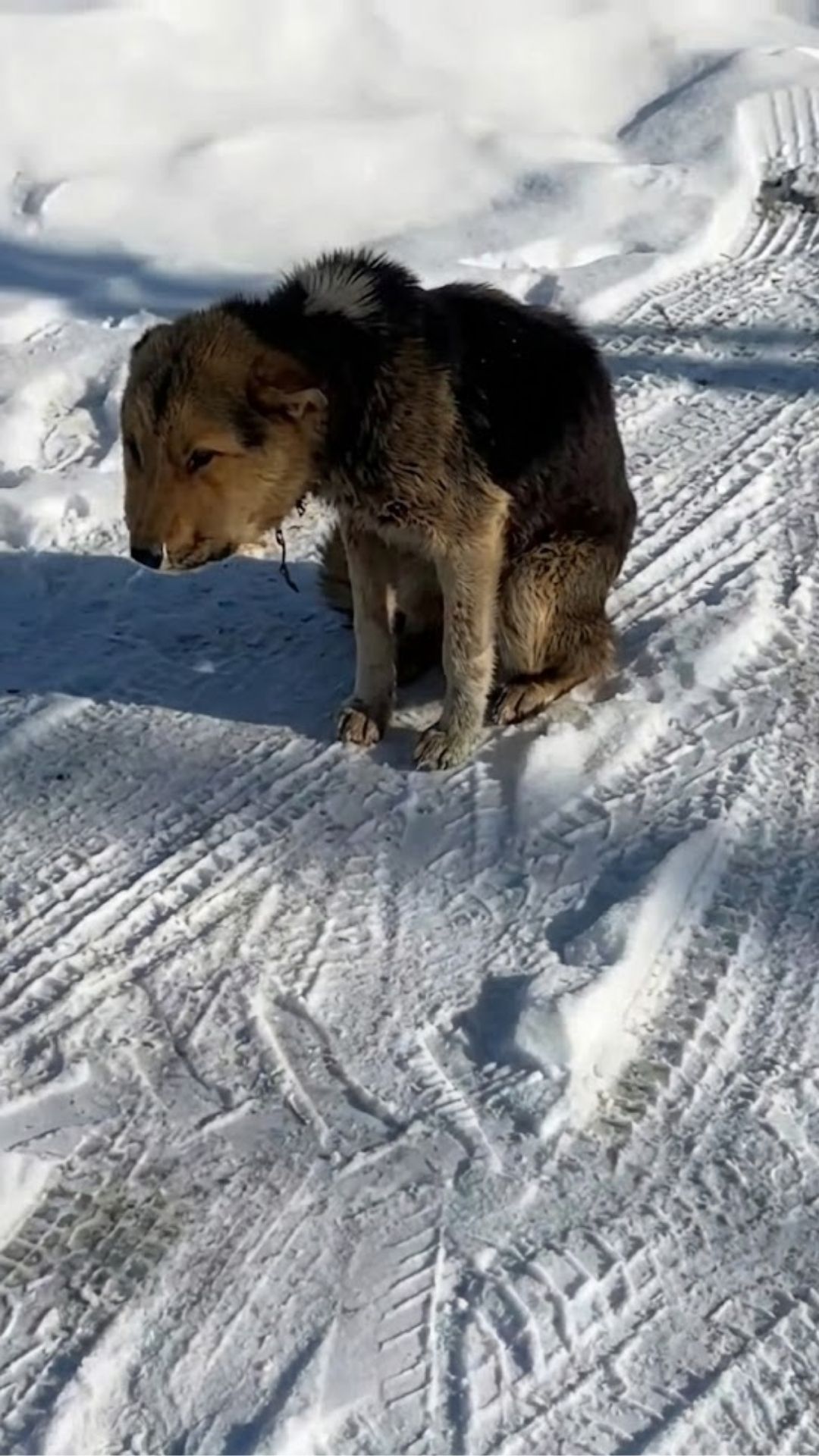
She had been left where hundreds of people could see her.
Outside a busy supermarket.
A rope still attached to her.
A collar around her neck.
At first glance, the collar looked like an ordinary detail.
Then rescuers saw what it had done.
The dog had apparently been fitted with it when she was much smaller. As she grew, the collar did not.
It tightened.
Then tightened again.
Eventually, it pressed so deeply into her neck that the surrounding tissue became badly swollen and infected.
By the time people truly understood how serious the situation was, her head had become dramatically enlarged.
She struggled to breathe comfortably.
Eating was difficult.
Yet when rescuers finally came close enough to help, something unexpected happened.
Her tail moved.
Just once.
Her Swollen Face Was Only Part of the Emergency
From a distance, the dog’s appearance was impossible to ignore.
Her head looked disproportionately large compared with the rest of her thin body.
The swelling extended around her face and neck, making every movement appear uncomfortable.
But appearance was only one part of the problem.
The collar had become embedded deeply enough that normal circulation and breathing were being affected.
She needed veterinary care.
Immediately.
Getting her there, however, would not be simple.
The dog was frightened of people.
Whenever someone approached too quickly, she ran.
The rope that had once tied her to the pole dragged behind her as she moved through the surrounding streets.
People tried to reach her.
She kept creating distance.
The rescuers understood that chasing her would only increase the fear.
So they changed their approach.
Food was placed nearby.
Then everyone stepped back.
She approached cautiously.
Took a bite.
Then retreated again.
The process had begun.
Video: Rescuers Follow the Frightened Dog With the Severely Swollen Head
It Took Nearly Two Hours Before She Stopped Running
The rescue team followed without rushing her.
They kept enough distance to avoid pushing her into another panic.
When she stopped, they stopped.
When she moved, they followed slowly.
Food remained the safest way to communicate.
She was hungry enough to approach.
But fear was strong enough to send her away again.
That pattern repeated.
Closer.
Then farther away.
Another bite.
Another retreat.
Nearly two hours passed before something finally changed.
The dog stopped putting as much distance between herself and the rescuers.
They continued speaking softly.
No sudden movement.
No crowding.
Eventually, she allowed them close enough to secure her safely.
Only then could the team examine her neck properly.
What they found explained the extraordinary swelling.
The collar was not merely tight.
Parts of it had become deeply embedded in the tissue around her neck.
The Collar Had Become Part of the Wound
At close range, the injury was much more serious than it had appeared from the street.
The collar had cut into the neck as the dog’s body continued growing around it.
The affected area was badly irritated and infected.
Swelling had spread upward toward her head and face.
The medical team now had two immediate priorities.
Remove the collar.
Then treat the damaged tissue underneath.
The procedure had to be done carefully.
Pulling aggressively at an embedded collar could create additional injury.
So the veterinary team worked gradually.
The material was separated from the surrounding tissue.
The wound was cleaned.
Treatment began.
Then came one of the first visible signs that the pressure had changed.
The dog took a deeper breath.
There was still a long recovery ahead.
But the object that had been tightening around her neck was finally gone.
Day 7 Brought the First Major Change
Recovery did not happen overnight.
For several days, swelling remained obvious.
The damaged tissue needed time to heal after the collar was removed.
Medication and wound care continued.
The dog also needed consistent food and rest after everything her body had been managing at once.
By around Day 7, the difference became easier to see.
The swelling was beginning to decrease.
The shape of her face started slowly returning.
Her eyes appeared less strained.
Her movements became more comfortable.
Then her behavior began changing too.
She responded more openly when familiar caregivers approached.
Her tail moved more often.
She seemed increasingly willing to remain close rather than immediately backing away.
That mattered because the same dog had required nearly two hours of patient pursuit before allowing anyone close enough to help her.
Now she was beginning to choose proximity.
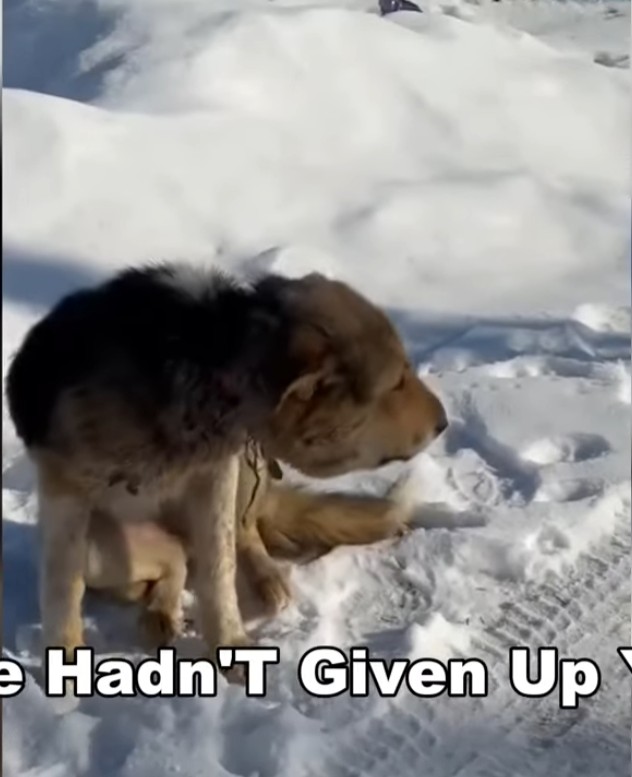
By Day 12, Her Face Looked Almost Like Her Own Again
Around Day 10, caregivers noticed another small change.
Her expression appeared softer.
The tension that had dominated the first days was fading.
By Day 12, the swelling had reduced dramatically.
Her natural facial shape was becoming visible again.
The difference between the first images and the later ones was striking.
But the most meaningful progress was not only cosmetic.
Breathing appeared easier.
Eating was no longer complicated by the same level of swelling.
She moved with less visible discomfort.
And the dog who had once bolted from approaching humans was becoming increasingly comfortable around the people caring for her.
There was no single moment when all of her fear disappeared.
Instead, trust seemed to build in the same way the swelling went down.
Gradually.
Day by day.
On Day 21, They Put Another Collar Around Her Neck
That moment carried obvious symbolism.
A new collar was placed around her.
But this one was different.
Soft.
Adjustable.
Properly fitted.
The purpose was no longer restraint.
It was part of ordinary life.
For caregivers, the contrast was difficult to miss.
The first collar had become a medical emergency because it had been left unchanged as the dog grew.
The second was fitted with care.
It could be checked.
Adjusted.
Removed.
What mattered was not the object itself.
It was the attention surrounding it.
By then, the dog appeared far more comfortable with handling.
She allowed people close.
She accepted affection.
And she no longer resembled the frightened animal running through the streets with a rope dragging behind her.
By Day 31, Running Meant Something Completely Different
At the beginning, the dog ran because people were trying to approach her.
She ran to escape.
By Day 31, she was running for another reason entirely.
Open space.
Movement.
Play.
The change was easy to see.
Her body had recovered enough for her to move freely.
Her head had returned much closer to its normal shape.
Her eyes were brighter.
Her tail moved easily.
The rope and supermarket pole were no longer part of her environment.
Instead, she could cross an open field without anything dragging behind her.
For a dog whose earliest scenes were defined by restraint, swelling, and fear, the ordinary sight of running became one of the strongest images in the story.
She was no longer fleeing from help.
She was simply running.
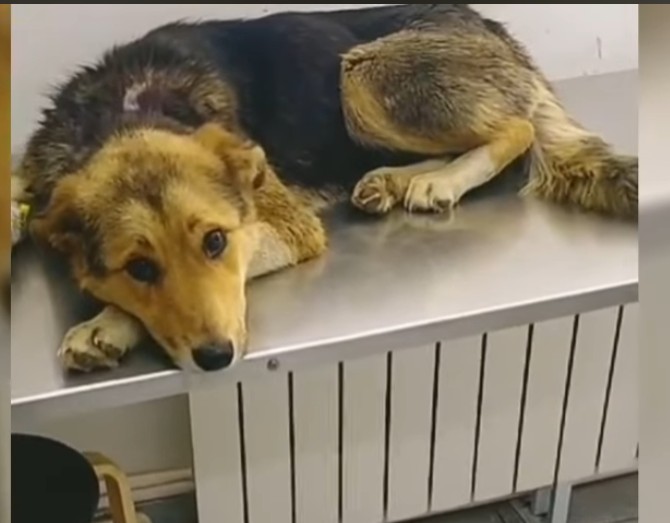
Home Turned Recovery Into Everyday Life
Eventually, the rescue moved beyond treatment.
The dog had a home environment where her needs could be managed consistently.
She had her own food bowl.
A comfortable place to sleep.
Toys.
And people close enough to notice if something was wrong.
According to the rescue account, one of her favorite toys became a squeaky duck.
She also began resting beside her caregiver, sometimes placing her head comfortably on a lap.
That simple gesture would have been difficult to imagine during the first rescue attempt.
Back then, approaching hands made her run.
Now she could relax close enough to fall asleep.
That is the kind of transformation that cannot be created through surgery alone.
Removing the collar solved the immediate physical crisis.
Trust required something longer.
Consistent care.
Gentle handling.
Predictable meals.
Time.
The Most Important Change Was Not the Shape of Her Face
The dramatic swelling is what first draws attention to this story.
It is difficult not to notice.
But the larger transformation happened after the swelling began to disappear.
The dog learned that approaching people did not always mean danger.
She learned that a collar could be adjusted rather than forgotten.
She learned that meals could arrive regularly.
She learned that a resting place could still be there the next morning.
When rescuers first saw her, nearly everything was urgent.
Her neck.
Her breathing.
The infection.
The fear preventing anyone from getting close.
Then those emergencies slowly became ordinary routines.
Medication.
Food.
Rest.
Walks.
Toys.
Affection.
That is often what successful rescue eventually looks like.
Not constant drama.
Normal life.
One Small Tail Wag Came Before Everything Else
There is one moment from the beginning that makes the ending feel different.
Before surgery.
Before the swelling had gone down.
Before the new collar.
Before the open fields.
The dog was still frightened and physically exhausted.
The rescue team was unsure how quickly they could reach her.
And yet, when she saw them, her tail moved.
Only briefly.
No one could know exactly what that gesture meant to her.
But it was enough to show that fear had not erased every response to kindness.
The rescuers kept going.
Two hours of patience led to capture.
Capture led to veterinary treatment.
Treatment led to the removal of the embedded collar.
Then came days of healing.
A new collar.
Freedom to run.
And eventually a home where her head could rest safely against someone instead of carrying the pressure of something cutting deeper every day.
The first collar had tightened as she grew.
The care that came afterward did the opposite.
It gave her more room.
More comfort.
More freedom.
And finally, a life where someone was paying attention closely enough to make sure nothing like that happened again.


