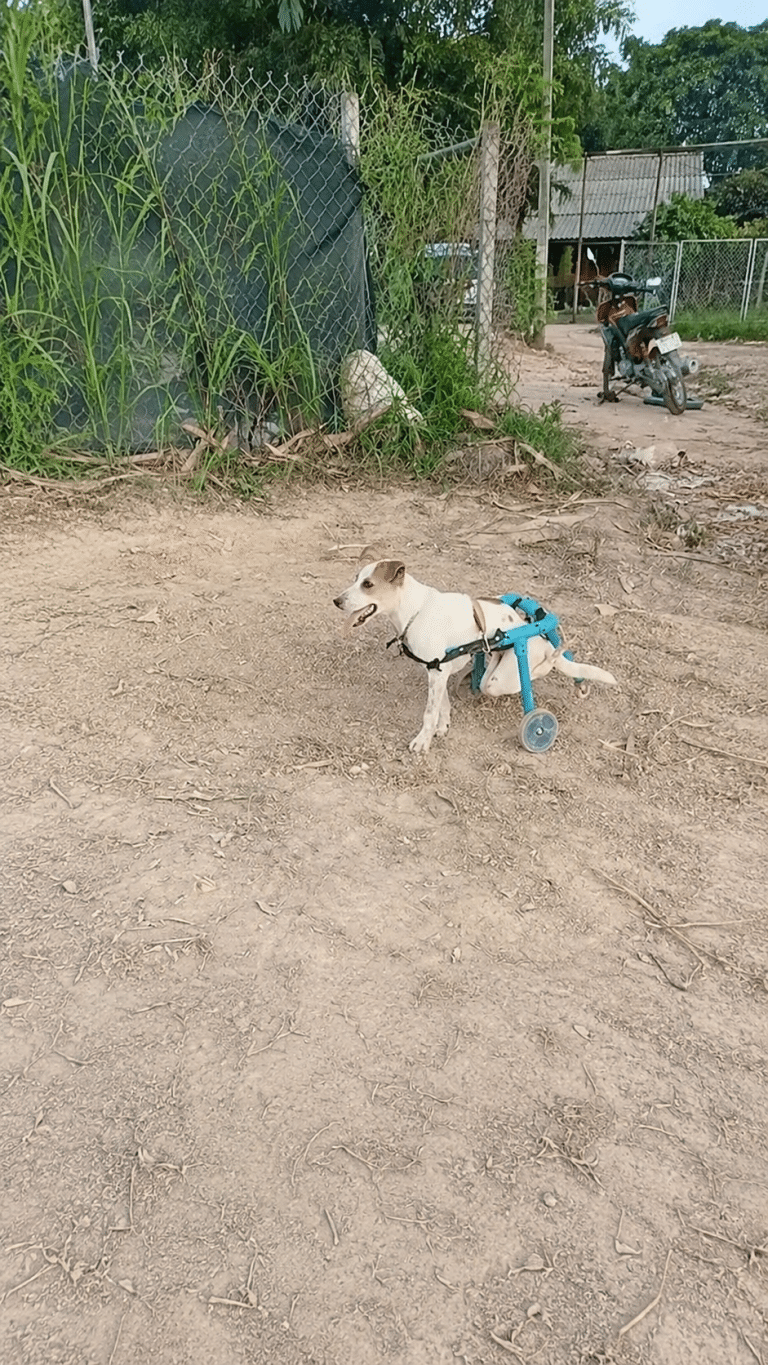
At first, the blue wheelchair is impossible to miss.
It supports the back of a tiny white-and-brown dog as he moves across a wide, sandy field. His hind legs cannot carry him normally, and the lightweight frame rolls behind him wherever he goes.
But within seconds, the equipment becomes almost secondary.
The little dog races after the woman ahead of him, barking excitedly as his wheels bounce over the uneven ground.
He is not simply moving again.
He is playing.
The Little Dog Racing Across the Sand
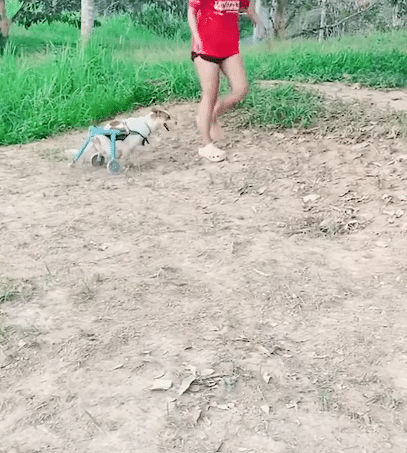
A young woman in a red shirt runs several feet ahead of him.
She turns back, calls to him, and changes direction as though inviting him into a familiar game. The response is immediate.
The little dog pushes forward with his front legs.
His wheels begin turning quickly.
Within moments, he is racing across the field after her.
The ground is not perfectly smooth. Small ridges in the sand cause the frame to bounce, and each sharp turn requires him to adjust his balance.
Still, he keeps going.
He barks as he runs, appearing increasingly excited whenever the woman changes direction. When she slows, he closes the distance. When she begins running again, he follows without delay.
Nothing about the scene feels forced.
The woman does not pull him forward or guide the wheelchair with her hands. She simply gives him something worth chasing.
And he does the rest.
Video: Tiny Dog Races After His Caregiver in the Wheelchair That Gave Him Freedom Again
When Walking Normally Was No Longer Possible
The dog’s back legs do not function well enough to support his body during ordinary movement.
Without assistance, crossing an open field would be difficult. Running after someone would be nearly impossible.
The wheelchair changes that.
A fitted harness supports his lower body while two wheels replace the stability his hind legs can no longer provide. His front legs remain responsible for pulling him forward, while the frame keeps his back end raised above the ground.
Learning to use mobility equipment can take time.
A dog must become comfortable with the harness, understand the extra width of the wheels, and learn how to turn without catching the frame on nearby objects.
This little dog appears to have practiced.
He moves with purpose rather than uncertainty. When he reaches the woman, he pivots around her and prepares to chase again. Even when the wheels shake over the sand, he quickly regains his direction.
The wheelchair does not make every surface effortless.
But it gives him the chance to explore them.
For a dog who still shows such a strong desire to move, that opportunity changes almost everything.
She Never Asked Him to Act Fragile
The woman adjusts her pace to keep the game safe, but she does not treat him as though he should remain still.
She runs.
She turns.
She encourages him to follow.
Her movements communicate something simple: he is still allowed to be a dog.
He can chase.
He can bark.
He can become excited when someone invites him to play.
At several points, she circles around him instead of running in a straight line. The little dog follows her movement, turning the wheelchair as quickly as he can while his front paws press into the sand.
When she kneels, the energy of the scene changes.
He approaches her closely, looking upward as she reaches down to touch his head. The same dog who had been rushing across the field now remains beside her, receiving a quiet moment of affection.
Then the game begins again.
Their connection is visible in this rhythm.
Run.
Return.
Pause.
Reach out.
Run once more.
She understands when to encourage him and when to let him rest. More importantly, she gives him room to decide how enthusiastically he wants to participate.
His answer is clear each time the wheels begin moving.
Two Wheels Became a New Kind of Independence
Mobility support is not only about traveling from one place to another.
For dogs with limited use of their back legs, a properly fitted cart can restore access to activities that once shaped their daily lives.
Going outside.
Following a familiar person.
Investigating new smells.
Moving without being carried everywhere.
Those experiences matter because dogs understand much of the world through motion and exploration.
In the field, the little dog chooses where to go.
The woman may provide the invitation, but he controls the pursuit. He decides when to accelerate, when to turn, and when to stop beside her.
That independence is one of the most meaningful parts of the scene.
He is not passively being transported.
He is participating.
The wheels become an extension of his movement rather than a reminder of what his body cannot do. As he gains speed, the blue frame follows the direction set by his front paws.
Even the small rattling sound of the wheels becomes part of the game.
Across the open space, he has room to test his speed without narrow furniture, steps, or tight corners blocking his path.
For a few minutes, the entire field belongs to him.
His Excitement Was Visible in Every Chase
It would be easy to tell this story only through sadness.
A small dog lost normal use of his back legs.
He now requires equipment to move freely.
Those facts are part of his life, but they are not the only things happening in the video.
He repeatedly runs toward the woman.
He barks while chasing her.
He changes direction when she does.
He looks up when she kneels beside him.
These are not abstract ideas about courage or inspiration. They are visible moments of engagement with the world around him.
His disability has changed how he moves.
It has not removed his interest in movement.
The difference matters.
Animals do not need their lives to look exactly as they did before in order to experience comfort, play, and connection. Sometimes they need treatment. Sometimes they need physical support. Sometimes they need people willing to adapt the environment around them.
For this dog, adaptation arrived in the form of a small blue frame, two wheels, and a caregiver who continued inviting him outside.
Together, those things opened the field again.
Care Means Finding Another Way Forward
The most touching part of the scene may not be how fast the dog runs.
It is the fact that someone helped him reach that moment.
A wheelchair must be selected and fitted carefully. Harnesses need adjustment. The dog’s skin and paws must be monitored, and periods of activity should be balanced with rest.
The equipment alone is only one part of the process.
Behind it is a person paying attention.
Someone noticed that the desire to move was still present.
Someone found a safer way for him to do it.
Someone stayed beside him while he learned.
Now, when the woman runs across the field, the little dog does not have to watch from a distance.
He can follow her.
His route may look different from that of other dogs, but the excitement of the chase is unmistakably familiar.
The wheels turn.
His paws move quickly.
His bark carries across the open ground.
And whenever he reaches her, she is there waiting.
The Field He Can Explore Again
The video does not erase the challenges this little dog faces.
He will continue needing assistance.
Some terrain may remain difficult.
His equipment will require care, and his activities must be suited to what his body can safely manage.
But his life is not confined to those limitations.
It also contains games in the sun.
A familiar voice calling him forward.
A hand resting gently on his head.
The freedom to choose where he wants to go next.
The wheelchair did not give him a completely ordinary way of moving.
It gave him something more important.
A practical way to return to the experiences he still wanted.
Watching him cross the field, it becomes clear that mobility is not defined by whether every leg works perfectly. Sometimes, it is created through patience, thoughtful care, and equipment designed around the life an animal is still eager to live.
This tiny dog does not run the way he once might have.
He runs with two wheels supporting him.
He runs toward the person he trusts.
And as the blue frame rolls behind him, he reminds us that losing one way of moving does not always mean losing the road ahead.


