The sound came from somewhere below.
A bark.
Then another.
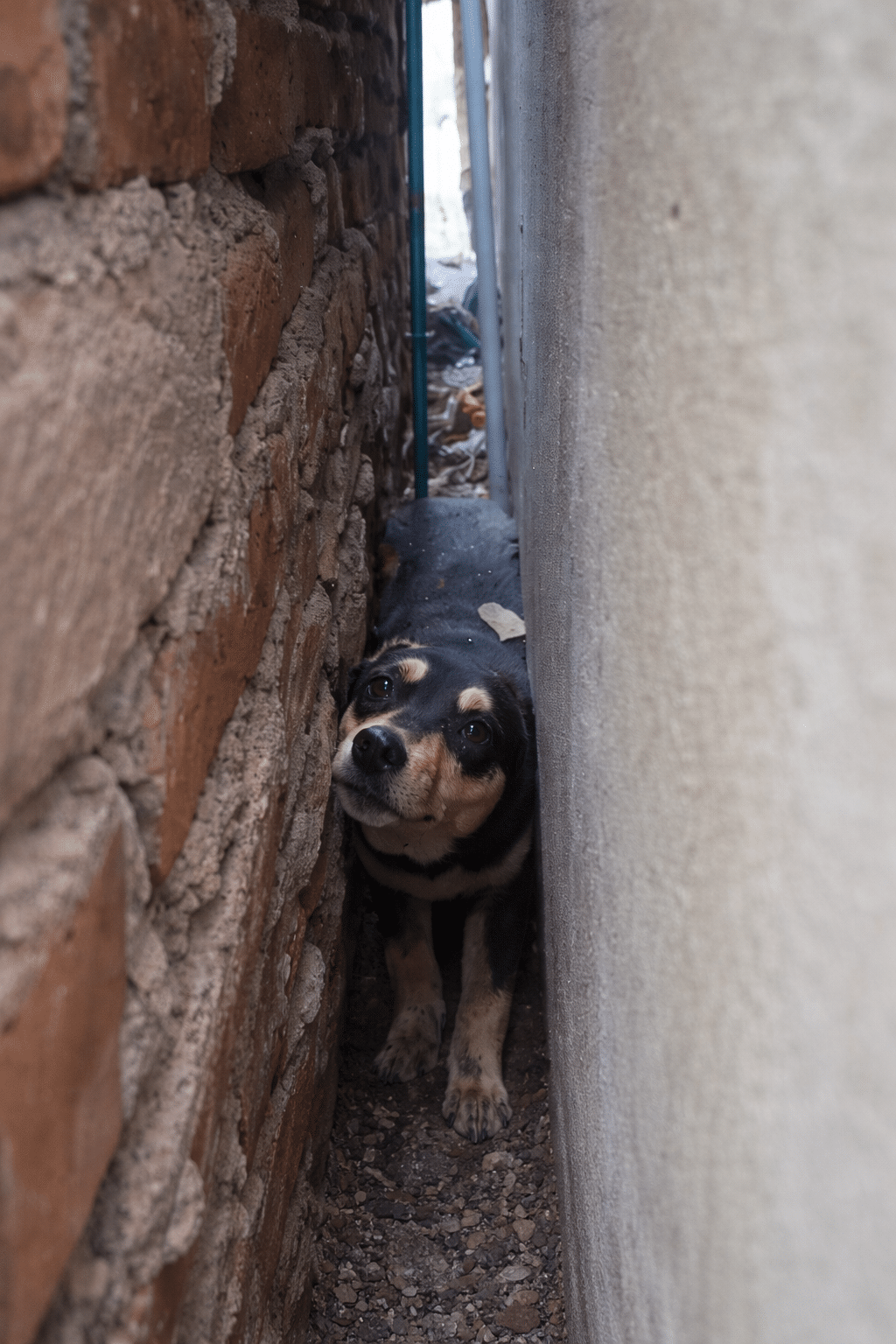
When rescuers looked into the narrow space between two walls, they finally saw where it was coming from.
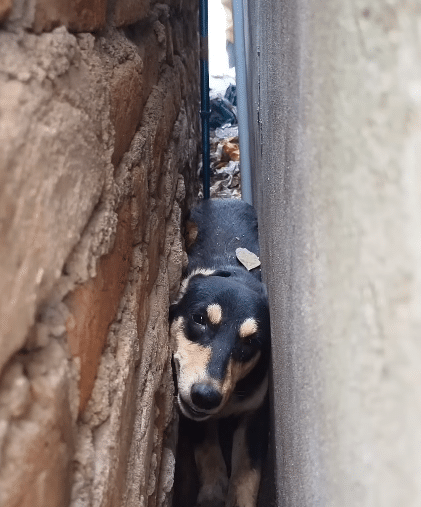
A small black-and-tan dog was trapped deep inside the gap.
Brick pressed close on one side.
Concrete boxed him in on the other.
There was barely enough room for his body.
He could not turn around.
He could not climb out.
And every attempt to move seemed to leave him in almost exactly the same position.
From above, the rescuers could see him.
That did not mean they could reach him easily.
The gap was narrow enough that one wrong movement could make the rescue more difficult.
So before anyone reached down, they first needed to understand exactly how the dog was stuck.
The Space Was Barely Wider Than His Body
The dog remained wedged between the two structures.
He barked and whined while the rescuers looked down from above.
There was no open path beside him.
No room for someone to climb into the gap.
The walls themselves created the trap.
A rough brick surface rose along one side.
A solid concrete wall stood along the other.
The distance between them was just wide enough for the dog to have entered—but not wide enough for him to easily change direction once inside.
That made the rescue deceptively difficult.
Trying to grab only his front legs could place too much pressure on them.
Pulling without knowing how his hips or body were positioned could cause pain or wedge him more tightly.
So the two rescuers from the Animal Warriors Conservation Society did not immediately start pulling.
They studied the gap first.
The dog continued moving below.
The rescuers watched.
Then one of them reached for a long pole.
VIDEO: He Was Wedged Between Brick and Concrete — Then a Rescuer Tried to Lift Him Straight Up
A Long Pole Helped Them See What Their Hands Couldn’t Reach
The pole was lowered carefully into the narrow space.
It was not being used to force the dog out.
Instead, the rescuers used it to better understand his position.
From above, only part of the trapped body could be seen clearly.
The pole allowed them to check where the dog was located inside the passage and how much room existed around him.
Every movement remained controlled.
The dog was already confined.
There was no reason to add sudden pressure or unnecessary noise.
After observing him for a little longer, the rescuers appeared to settle on the most direct option.
One person would have to reach into the gap.
That meant leaning over the wall far enough to get both arms around the dog.
There was still no guarantee he would come free immediately.
But they now had a better sense of how he was positioned.
One rescuer moved closer to the edge.
Then he leaned down.
One Rescuer Reached as Far as He Could
The wall itself limited how far the rescuer could lower his body.
He stretched downward into the gap.
One hand reached toward the dog.
Then the other.
The goal was not to grab whatever part of the animal was easiest to reach.
He needed enough support around the dog’s body to lift him safely.
The little dog continued making noise below.
The rescuer adjusted his position.
Then, finally, he managed to get his arms securely around him.
Now came the difficult part.
Up close, the narrowness of the gap became even more obvious.
The dog’s body was not simply resting between the walls.
He was wedged.
So when the rescuer first began lifting, the dog did not immediately move upward.
For a few tense moments, almost nothing changed.
The rescuer maintained his hold.
He did not jerk suddenly.
Instead, he continued applying steady upward movement while adjusting the dog’s position.
Slowly, the trapped body began to shift.
At First, the Dog Wouldn’t Move
The first pull was not enough.
Part of the dog still caught against the walls.
The rescuer adjusted again.
A small change in angle.
Another controlled lift.
This time, the dog moved slightly higher.
That small movement was important.
Once part of his body cleared the tightest section, the rest of the rescue became more manageable.
The rescuer continued supporting him.
Little by little, the dog slid upward.
More of his body appeared above the gap.
His shoulders cleared.
Then the rest followed.
Finally, the animal that had been almost completely hidden between brick and concrete came free.
The rescuer lifted him onto solid ground.
For the first time since the footage began, walls no longer pressed against either side of him.
Before Letting Him Go, They Checked Him Over
The rescuers did not immediately send the dog away.
After being confined so tightly, they first looked him over for signs of injury.
The source footage does not describe fractures or another major medical emergency.
Visibly, the dog appeared able to move once he was out.
The team stayed near him.
Food was offered.
Gentle contact followed.
One rescuer stroked him while the dog remained on the ground.
The contrast with the previous scene was simple but clear.
Minutes earlier, every movement had been restricted by two walls.
Now he had space around him again.
There was no need for a complicated procedure.
No wall had to be demolished.
The rescue had depended primarily on figuring out how he was positioned and finding a way to lift his body through the narrow opening without forcing him.
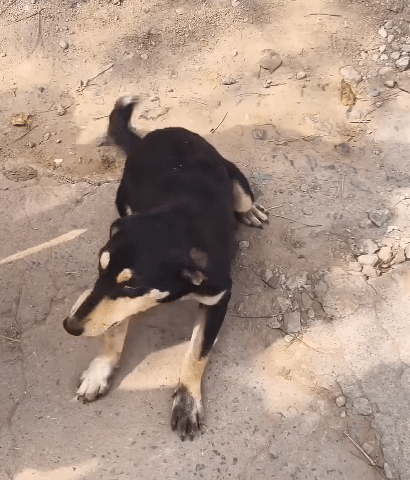
After a short period on the ground, the dog began moving on his own.
Then His Tail Started Moving
Once the dog had a little time to recover from the rescue, his behavior changed.
He stood.
His tail moved.
Then he began walking away from the spot where he had been trapped.
Within moments, walking became running.
The black-and-tan dog moved down the road under his own power.
Nothing restricted him now.
No brick against one side of his body.
No concrete against the other.
No rescuer needed to hold him.
The dog simply ran.
For the team watching him leave, that movement was the clearest possible contrast with how they had first found him.
At the beginning, he could barely shift his body a few inches.
Now there was open ground in front of him.
And he was using it.
The Rescue Didn’t Require Force — It Required the Right Angle
This case looked simple once the dog was back on the road.
Reach down.
Lift him out.
Let him go.
But the few minutes before that moment mattered.
The rescuers first needed to understand where his body was caught.
That was why the pole was used.
Then one person had to position himself carefully enough to reach the dog without falling into the gap or pulling from the wrong place.
The first lift did not immediately work.
So the rescuer adjusted instead of yanking harder.
A slightly different angle allowed the dog’s body to begin sliding upward.
That difference turned an impossible-looking space into an escape route.
Sometimes rescue depends less on strength than on patience.
Not because patience magically changes the situation.
Because it gives people enough time to see what the situation actually requires.
The Gap Was Empty When They Left
The final image of the rescue was almost the opposite of the first.
At the beginning, a small dog was visible only deep between two walls.
His movements were restricted.
His barking echoed upward from a place he could not leave by himself.
Then rescuers arrived.
They checked his position.
Lowered the pole.
Studied the angle.
Reached down.
Tried to lift.
Adjusted.
And tried again.
Eventually, the dog came free.
A little food followed.
A few gentle touches.
Then the animal who had been unable to turn around between the walls stood up and ran along the road.
The source does not tell us his name.
It does not show a later adoption.
It does not need to add anything beyond what happened there.
A dog entered a space he could not escape.
Someone noticed.
Two rescuers came.
And when they finally left, the narrow gap between brick and concrete was empty.
The dog was already somewhere farther down the road.


