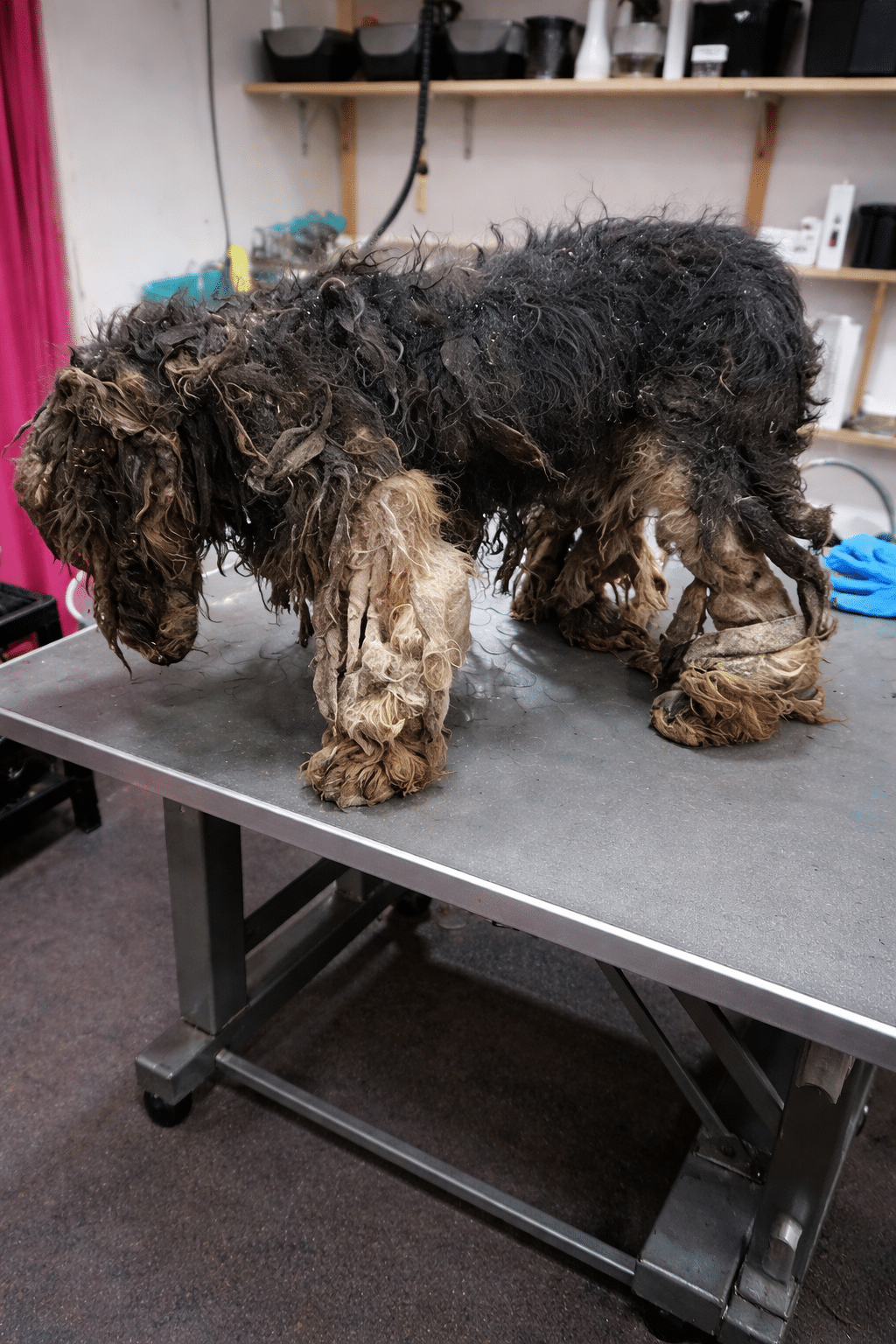
When the small dog arrived, the room became unusually quiet.
His body was almost completely hidden beneath thick layers of hardened fur. Dirt, mud, and debris had become trapped inside the coat, forming heavy sections that hung around his legs, chest, and face.
At first, it was difficult to see where the fur ended and the dog began.
He did not bark when rescuers placed him on the grooming table.
He did not struggle.
He simply stood there with a tired, distant expression while the team prepared to remove the weight surrounding his fragile body.
Then, halfway through the rescue, his breathing suddenly changed.
A Small Dog Buried Beneath His Coat
The dog’s fur had gone far beyond ordinary matting.
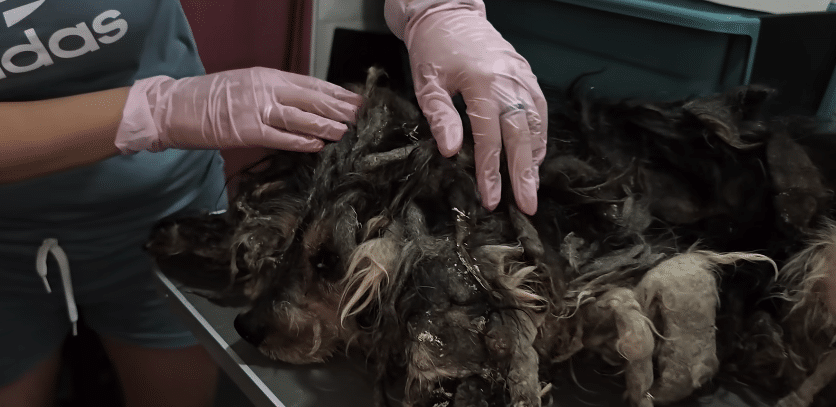
Dense knots had tightened into thick, compact layers pressed close to his skin. Some sections had collected so much dirt that they felt almost solid beneath the groomers’ hands.
His eyes were partly hidden.
His legs were difficult to distinguish.
The natural shape of his body had disappeared beneath uneven clumps of neglected fur.
Whenever he tried to reposition himself, the coat moved with him like an added burden. The mats appeared to restrict his steps and pull against the skin underneath.
The rescuers could not know exactly how long he had lived in that condition.
But severe matting of this kind does not develop in a few days.
It builds slowly when a coat receives no regular brushing, trimming, or basic care.
By the time this dog reached help, he seemed exhausted by far more than the grooming process ahead of him.
His body appeared thin beneath the coat.
His movements were limited.
And his stillness suggested that even standing required effort.
Video: His Breathing Changed While Groomers Removed the Heavy Coat Hiding His Body
The Coat Could Not Be Removed Quickly
The team knew immediately that ordinary brushing would not work.
Pulling at the mats could cause pain or damage already sensitive skin. The coat had to be opened carefully before the clippers could safely move closer to the body.
They began with scissors.
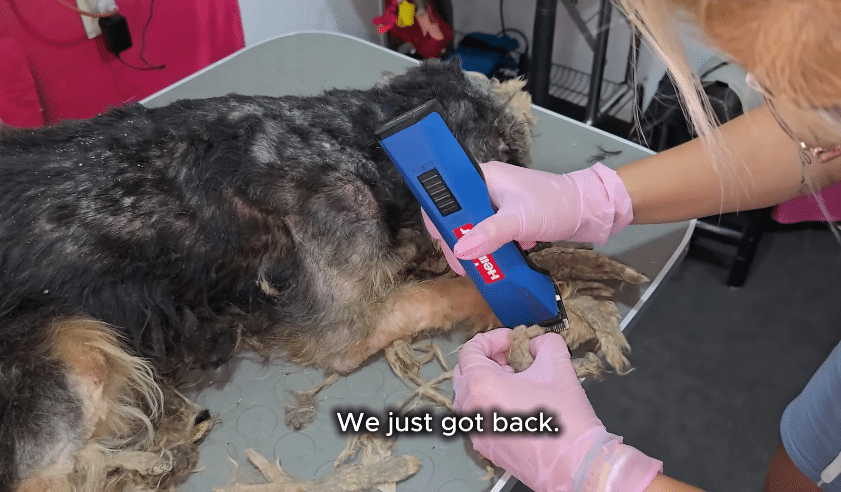
Only the outermost sections were cut at first, creating enough space to understand how tightly the fur was attached underneath.
Then the clippers were introduced.
One groomer supported the dog while another worked through a small section at a time. After every few passes, the team paused to inspect the newly exposed skin.
There was no rushing.
The dog’s condition required attention to every movement.
If he shifted suddenly, the tools stopped.
If the skin could not be seen clearly, the groomers changed direction.
Slowly, pieces of the heavy coat began falling onto the table.
A paw appeared.
Then part of his chest.
Then the outline of a much smaller body than anyone had expected.
The dog remained quiet throughout the process.
He watched the hands moving around him but offered little resistance.
Whether he was calm or simply too tired to react could not be known.
The team treated his stillness with the same caution they would have used if he had been struggling.
Red, Irritated Skin Appeared Beneath the Mats
As more fur came away, the condition of the hidden skin became visible.
Several areas were red and irritated.
The mats had trapped dirt and moisture close to the body, preventing the skin from remaining clean and dry. Constant pulling may also have contributed to the discomfort visible underneath.
The groomers continued gently.
Their goal was not to complete a dramatic transformation as quickly as possible.
It was to reduce the physical burden without placing unnecessary strain on an already weakened animal.
The dog’s natural coat appeared curly beneath the worst sections.
Without the thick mats, his body looked delicate and underweight.
Each removed piece revealed more of the animal who had been concealed from view.
But the team also began noticing how fragile he truly was.
He tired easily.
His posture became less steady.
The groomers offered frequent pauses so he could remain supported and rest.
Then one of those pauses became something far more urgent.
His Breathing Suddenly Became Shallow
The team was working through another dense section when one rescuer noticed a change.
The dog’s breathing no longer followed the same pattern.
At first, the difference was subtle.
His breaths appeared shorter.
Then his response to the people around him began to weaken.
The grooming stopped immediately.
The tools were set aside, and the team checked him closely.
Within moments, it was clear that continuing would be unsafe.
The removal of the coat was no longer the priority.
The dog needed medical help.
He was lifted carefully from the table and transported to a veterinary clinic, with much of the matting still covering part of his body.
There was no attempt to finish the grooming first.
The remaining fur could wait.
His breathing could not.
Veterinarians Found a Serious Heart Condition
At the clinic, the veterinary team began examining him immediately.
The evaluation revealed a significant heart condition.
His body was also weakened by poor nutrition and the prolonged physical stress associated with his neglected state. Under those circumstances, even careful handling and grooming could place more demand on his system than he was able to tolerate.
The mats had made movement difficult and his skin uncomfortable.
But they were not the only medical concern.
The dog had entered the rescue with an underlying condition that no one could see beneath the coat.
The change in breathing had been the first warning.
Emergency care focused on stabilizing him rather than continuing any cosmetic or grooming work. His heart and breathing needed support, and his body needed time to recover from the episode.
The rescuers waited for news while the veterinary team monitored his condition.
Eventually, he began to stabilize.
He remained extremely weak.
But he had made it through the immediate crisis.
The Remaining Fur Had to Wait
When the dog returned to rescue care, no one placed him back on the grooming table to finish the job.
A large portion of the heavy coat had already been removed, giving his legs and chest more freedom.
That was enough for the moment.
The rest would be addressed only when veterinarians believed his body could safely tolerate it.
He was given a quiet place to rest.
Warm bedding supported his small frame, while caregivers kept the environment calm and limited unnecessary handling.
For the first time, his actual size could be seen.
Beneath the oversized mass of fur was a small dog whose body had been carrying illness, malnutrition, and discomfort at the same time.
He looked fragile.
But he also looked lighter.
The remaining mats still required attention, yet there was no deadline.
His health would decide the pace from that point forward.
The rescue team had begun by trying to free his body from the coat.
Now they had to protect the body underneath it.
Recovery Became More Important Than Transformation
The dog’s care shifted toward medical support and quiet recovery.
His heart condition would require continued evaluation and an appropriate treatment plan. Nutrition also had to be introduced carefully so his weakened body could begin rebuilding strength.
There would be no dramatic overnight change.
His progress would depend on small, steady improvements.
Resting without respiratory distress.
Showing interest in food.
Responding to familiar voices.
Becoming strong enough to stand for longer periods.
Only when he was medically ready could the remaining coat be safely removed.
The groomers respected that process.
A complete haircut would make for a more striking final image, but rescue was never supposed to be about producing the fastest before-and-after result.
The dog had already communicated what his body could handle.
This time, people listened.
A Life No Longer Hidden Beneath Neglect
The little dog’s journey was far from finished.
He still needed medical treatment.
He still needed the rest of the mats removed when his health allowed.
And he would need patient caregivers willing to support a dog with a serious condition long after the most visible part of the rescue was over.
But one thing had already changed.
He was no longer alone beneath the heavy coat.
People had noticed his breathing.
They had stopped before the grooming became too much.
They had carried him to medical care and remained involved after the emergency passed.
The team had not completed everything they set out to do that day.
In a way, that became the most important part of the story.
They understood when to stop.
They chose his safety over the transformation.
And they refused to treat his fragile body as something that had to meet a schedule.
Rescue Sometimes Means Knowing When to Pause
When the dog first arrived, the mats were the most obvious problem.
They covered his face.
Restricted his movement.
And hid the condition of his body underneath.
But once the grooming began, another danger revealed itself.
His heart was struggling.
His breathing changed.
And the people around him responded before it was too late.
The heavy coat would eventually be removed.
His skin could be cleaned.
His strength might gradually return with proper treatment and nutrition.
But those possibilities existed only because the team recognized that saving him mattered more than finishing the work.
Once, he was almost invisible beneath layers of neglected fur.
Now he had veterinarians watching his heart, caregivers protecting his recovery, and people willing to move at the pace his body required.
His life had not suddenly become easy.
But it had changed direction.
And this time, he would not be expected to carry the weight alone.


