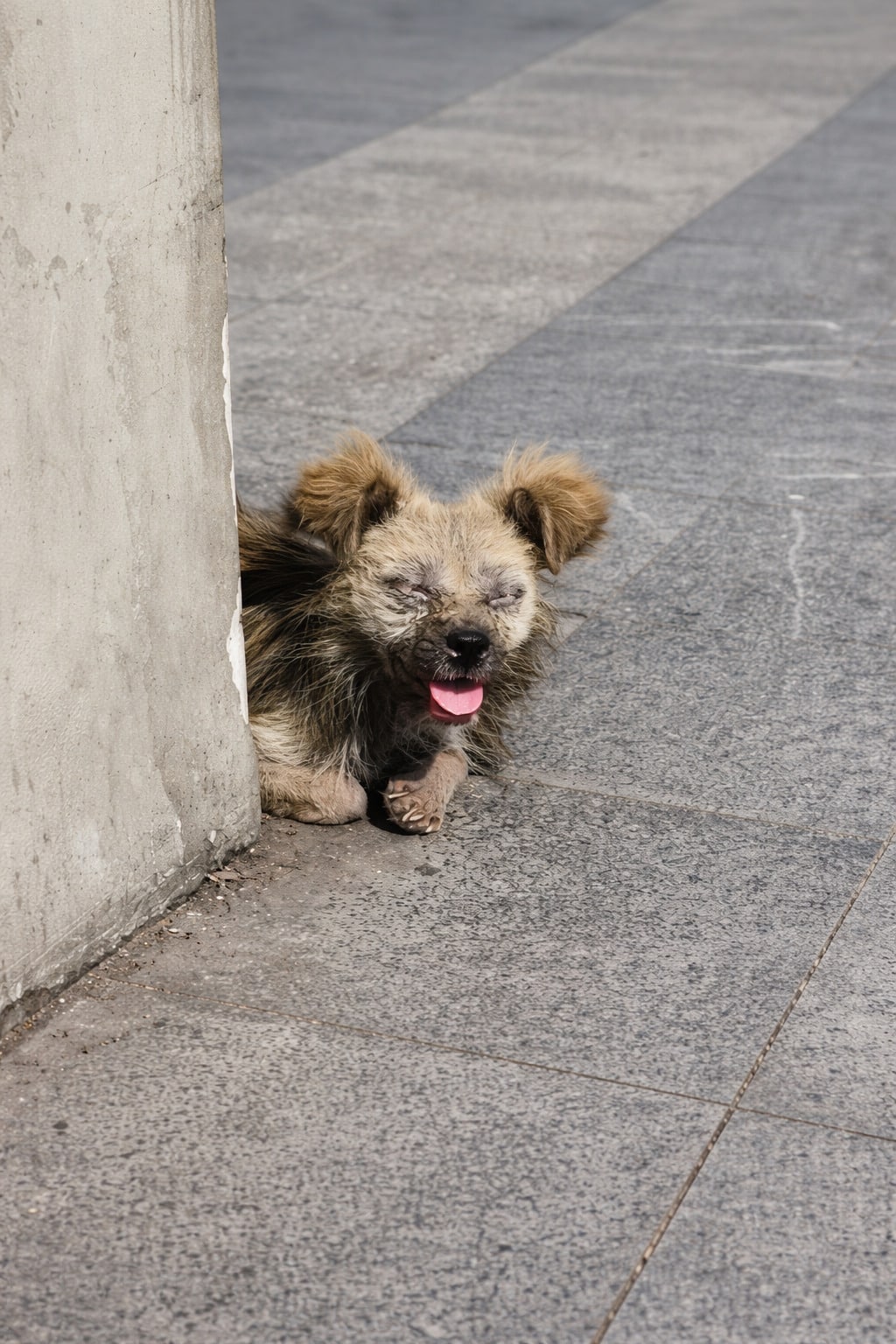
At first, he barely looked like a dog waiting to be rescued.
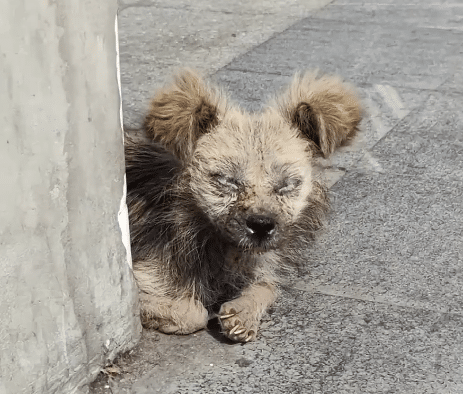
He was pressed tightly against a rough concrete wall, his body folded inward as though becoming smaller might somehow make the world leave him alone.
His coat was dirty and tangled.
His ribs showed beneath his thin frame.
But none of that was what made the person filming stop.
It was his eyes.
Both were completely sealed shut.
Thick, hardened discharge covered his eyelids, while the skin around them appeared swollen and irritated. Whatever had happened to him had gone untreated long enough that he could no longer simply open his eyes and look around.
He could hear footsteps.
He could sense movement.
But he could not clearly see what was approaching.
And when someone finally came close, he did not run.
He simply remained there.
Quiet.
Exhausted.
Waiting for whatever came next.
He Was Hiding in a Corner He Could No Longer See
The first moments of the rescue are difficult to forget because almost nothing happens.
There is no chase.
No barking.
No frantic struggle.
The little dog stays close to the wall with his paws drawn beneath him.
When a sound comes from nearby, his body flinches.
Just slightly.
That small reaction reveals that he is still paying attention to the world around him, even if he can no longer see it properly.
His fur is matted with dirt and moisture. His thin body suggests he has not been receiving the food or care he needed.
Yet his eyes remain the most concerning part.
The eyelids are covered by thick crusting.
The surrounding tissue looks inflamed.
Even attempting to blink appears difficult.
No one in that moment could know exactly how long he had been living this way.
Days?
Weeks?
What was clear was that he needed help.
The person approaching him lowers themselves carefully rather than reaching suddenly.
The dog listens.
His head barely moves.
Then gentle hands finally lift him from the cold ground.
For perhaps the first time in a long while, he is no longer left to manage the darkness on his own.
VIDEO: From Eyes Sealed Shut to Seeing Light Again — His Quiet Road Back
At the Clinic, His Eyes Needed Immediate Attention
Under the brighter lights of the veterinary clinic, the condition around his eyes became easier to examine.
There was significant discharge and inflammation affecting both eyes.
The hardened material around his eyelids had built up so heavily that simply opening them was nearly impossible.
The veterinary team began addressing the problem cautiously.
Whatever infection or irritation had developed needed treatment, but forcing the eyelids open too quickly could cause additional discomfort.
So the process began slowly.
Warm saline was used to soften the crusted material.
Instead of trying to remove everything at once, caregivers worked little by little, allowing moisture to loosen what had hardened around the eyes.
Every movement had to be gentle.
The dog remained remarkably still.
Perhaps he was simply too tired to resist.
Perhaps the quiet voices and careful hands felt different from what he had experienced before.
There was no way to know.
What mattered was that he was finally somewhere clean, warm, and safe enough for treatment to begin.
Medicated eye drops were introduced, along with other veterinary treatment intended to address the infection and inflammation.
No one could promise what his vision would be after recovery.
The condition had clearly been neglected.
But now, at least, his eyes were finally receiving care.
The First Days Were About Comfort, Not Miracles
Nothing changed dramatically during the first night.
The dog did not suddenly open his eyes.
He did not jump from his bed or begin exploring the room.
Mostly, he slept.
His body seemed to need the rest.
For a dog who had spent an unknown amount of time outside while sick, even something as simple as uninterrupted sleep in a clean space was part of recovery.
He was given soft food in small portions.
A warm blanket replaced the hard concrete where he had been found.
Fresh water remained nearby.
His face was cleaned regularly as treatment continued.
The hardened discharge around his eyes became easier to manage.
The swelling did not disappear immediately.
But over time, subtle differences began appearing.
The area around his eyelids looked less tight.
New crusting became less severe.
His face appeared slightly more relaxed.
These were not the kinds of changes that make dramatic headlines.
They were small.
Almost easy to miss.
But for the people caring for him, they mattered.
Healing often begins that way.
Not with one enormous transformation.
But with a dog sleeping a little more peacefully than the night before.
Eating a little more food.
Allowing another cleaning.
Resting without needing to press himself into a corner.
His world was still mostly dark.
But he was no longer facing that darkness alone.
Then One Eyelid Began to Move
One morning, something looked different.
At first, it was barely noticeable.
One of his eyelids trembled.
The caregiver watching him paused.
The dog blinked again.
Slowly, the lid lifted just enough to create a tiny opening.
Not fully.
Not even close.
But for the first time since his rescue, there was a visible gap where his eye had previously been completely sealed.
A narrow sliver of light could reach him.
He stayed still.
Then his head shifted slightly.
Something in the room had moved.
And this time, he seemed to notice.
It was impossible to know exactly what he could see in that moment.
Perhaps only brightness.
Perhaps movement.
Perhaps vague shapes.
But his response was different.
His head followed the change in front of him.
For his caregivers, that tiny movement carried enormous meaning.
The goal was never to force a dramatic recovery.
It was to give his eyes every reasonable chance to heal.
And now, after days of treatment, his body appeared to be responding.
The little dog who had been found facing a concrete wall in complete uncertainty was beginning to interact with the world around him again.
The World Slowly Became More Than Sound
As treatment continued, the change became easier to see.
His eyelids opened more comfortably.
He began blinking with greater control.
When someone moved nearby, his head sometimes followed.
When a hand approached, he seemed increasingly aware of its direction instead of relying entirely on sound.
The transformation was gradual.
There was no single moment when anyone could say that everything had been restored.
His eyes still required care.
The tissue around them remained sensitive.
His recovery was not finished.
But his behavior was changing.
In the beginning, he had remained curled tightly against the wall, responding to unfamiliar sounds with small flinches.
Now he showed curiosity.
He raised his head more often.
He seemed interested in what caregivers were doing.
He became more engaged during meals.
The room that had once been nothing more than voices, footsteps, smells, and uncertainty was slowly gaining shape.
And with greater awareness came another change.
He appeared less withdrawn.
Perhaps some of that came from improving vision.
Perhaps some came from simply feeling better physically.
Perhaps it was the predictable routine of people returning every day with food, medicine, and gentle touch.
Whatever the reason, the difference was visible.
He was no longer trying quite so hard to disappear.
A Soft Blanket Replaced the Cold Concrete
By the later part of his recovery, the setting around him looked completely different from the opening moments.
Instead of lying against a rough outdoor wall, he rested on a clean, soft blanket.
His coat had been cared for.
His face was cleaner.
His body appeared more comfortable.
Most importantly, his eyes were no longer completely sealed.
They were partially open.
Still healing.
Still imperfect.
But open.
The dog occasionally blinked while resting.
He responded to movement.
His expression no longer carried the same exhausted tension seen at the beginning.
Nothing about his recovery suggested that the past had simply disappeared.
He had been sick.
He had been underweight.
He had spent time unable to use one of the most important senses dogs rely on to understand their surroundings.
Those experiences had left their mark.
But now his days looked different.
Food arrived consistently.
His eyes were treated instead of ignored.
When he rested, he did so somewhere warm.
And when something frightened or confused him, someone was nearby.
Sometimes rescue changes an animal’s entire life in dramatic ways.
Other times, it begins with something much quieter.
A clean cloth.
A few drops of medicine.
A bowl of soft food.
A blanket.
And another morning of care.
His Recovery Was Measured in Millimeters
It would be easy to look at the final images and focus only on the fact that his eyes were opening.
But the deeper story lies in how slowly that happened.
His recovery was measured in tiny changes.
A little less swelling.
A little less discharge.
An eyelid that moved one millimeter farther than yesterday.
A head turning toward motion.
A more confident blink.
A longer period of comfortable rest.
None of those moments would have happened if someone had decided the little dog was too sick, too dirty, or too difficult to help.
He did not need someone to know exactly how the story would end.
He only needed someone willing to begin.
The rescuers could not change whatever had happened before they found him.
They could not return the meals he had missed.
They could not erase the days he may have spent unable to see where he was going.
What they could do was change what happened next.
And they did.
Treatment continued.
His surroundings stayed clean.
His body gained strength.
His eyes were given time.
Eventually, darkness was no longer the only thing waiting when he opened them.
The Dog Who Once Couldn’t See What Was Coming Finally Looked Forward
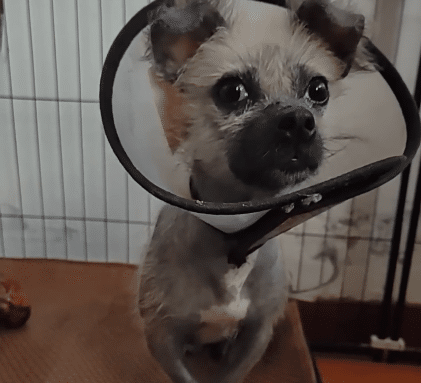
By the final moments of his recovery footage, the dog resting on the blanket hardly resembles the frightened figure pressed into the corner at the beginning.
He is still quiet.
Still gentle.
But no longer completely shut away from his surroundings.
His eyes open enough for him to observe what is happening nearby.
His head turns toward movement.
He blinks.
He watches.
These are ordinary things for a healthy dog.
For him, they represent something far larger.
They mean he can participate in the world again.
He does not have to rely only on footsteps approaching from somewhere he cannot identify.
He does not have to remain pressed against a wall because moving into an unseen space feels too uncertain.
There is light now.
There are shapes.
There are familiar people.
And there is a safe place to rest when he becomes tired.
His eyes may still require continued attention.
His past may remain visible in the condition of his body.
But his life is no longer defined by the corner where someone happened to notice him.
Sometimes Rescue Begins Simply Because Someone Looks Closer
There was nothing complicated about the first decision that changed this dog’s life.
Someone saw him.
Then they looked closer.
It would have been easy to assume he was sleeping.
Easy to walk past the small shape curled against the wall.
Easy to believe somebody else would eventually help.
But someone stopped long enough to realize the truth.
His eyes were sealed shut.
His body was weak.
And he needed more than another person passing by.
That moment led to the clinic.
The clinic led to treatment.
Treatment led to healing.
And healing eventually allowed a tiny opening where there had once been only darkness.
His story is not remarkable because medicine produced an instant miracle.
It is remarkable because care was given before anyone knew exactly what the outcome would be.
Someone cleaned his eyes when he could not do it himself.
Someone fed him when his body was weak.
Someone kept returning with medicine.
Someone waited long enough to see the first blink.
And eventually, the little dog who could not see the world approaching him was able to look toward it again.
Sometimes hope does not arrive loudly.
Sometimes it appears as the smallest opening between two healing eyelids.
A little light.
A little movement.
A little more of the world than yesterday.
And sometimes, that is where everything begins.


