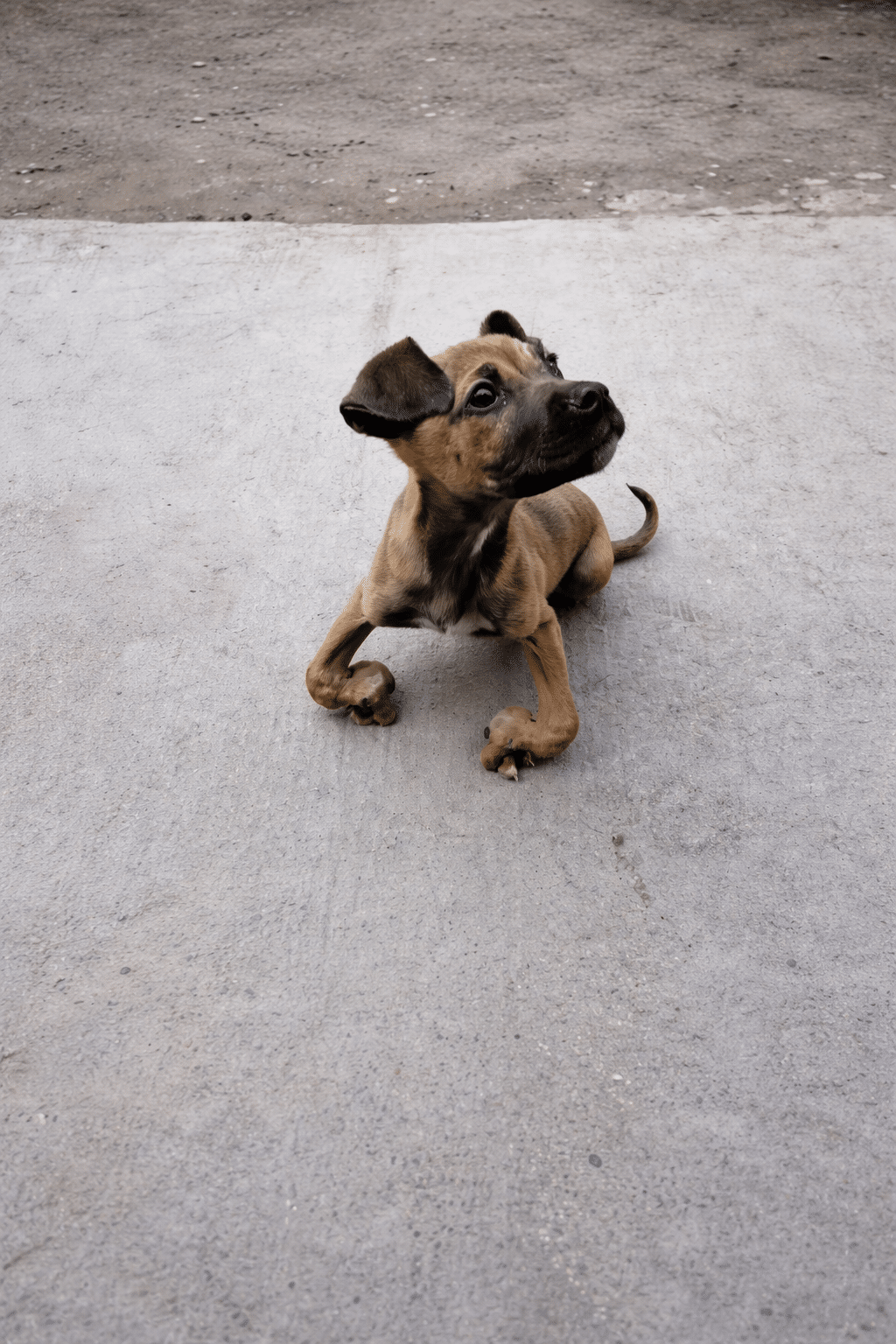
Tomy was so small that the first thing people noticed should have been his puppy face.
Instead, their eyes went straight to his legs.
Both of his front legs bent beneath him at unnatural angles.
Each time he tried to move, his body shifted awkwardly from side to side. His paws struggled to find stable ground, and even a short distance required far more effort than it should have for a puppy his age.
Yet Tomy kept moving.
Not away from people.
Toward them.
When someone stopped nearby, the little stray did not immediately hide or flee.
He approached slowly.
Sometimes he waited within reach, watching quietly.
If food appeared, he accepted it eagerly.
For rescuers, that behavior stood out almost as much as his physical condition.
Tomy was living on the street.
He was extremely thin.
He was dehydrated.
And his body was showing clear signs of nutritional deficiency.
Still, when people came close, he continued giving them a chance.
That willingness would soon lead him away from the street and into a veterinary clinic.
But first, doctors had to answer a more urgent question.
Could his fragile three-kilogram body become strong enough to begin healing at all?
Tomy’s Bent Legs Were Only Part of the Problem
Once rescuers were close enough to examine him, it became clear that Tomy needed far more than help with mobility.
His body was severely underweight.
At approximately three kilograms, the little puppy had very little reserve strength.
He was dehydrated.
He was also dealing with vomiting and diarrhea, conditions that could further weaken a small animal very quickly.
The rescue account describes significant vitamin and calcium deficiencies as additional concerns.
Those nutritional problems were especially important because Tomy was still growing.
A young puppy’s bones and muscles need proper nutrition during development.
Tomy had not been receiving enough of what his body needed.
The result was visible every time he tried to walk.
His front limbs lacked normal alignment and stability.
But there was no point beginning an aggressive rehabilitation program while Tomy remained medically fragile.
The first goal was simpler.
Stabilize him.
Get fluids into his body.
Control the gastrointestinal problems.
Provide appropriate nutrition.
And watch closely to see how he responded.
Tomy was transported to a veterinary clinic.
For the first few days, his caregivers focused less on how he walked—
and more on whether he would eat.
VIDEO: The Tiny Puppy With Twisted Front Legs Who Slowly Learned to Run Again
At First, the Biggest Victory Was Simply Seeing Him Finish a Meal
Tomy received fluids and medication.
Nutritional support was introduced gradually while the veterinary team monitored his vomiting, diarrhea, hydration, and general strength.
For such a small puppy, even minor setbacks could matter.
The team watched his appetite carefully.
Then Tomy began eating.
At first, it was simply encouraging to see him show interest in food.
Soon, that interest became much stronger.
His appetite increased from one day to the next.
Meals disappeared more quickly.
His body finally had a steady source of energy.
For the people treating him, this was the first major sign that the next stage of recovery might be possible.
Tomy was still weak.
His legs were still bent.
Nothing about his mobility had been solved yet.
But nutrition changes what a young body is capable of doing.
As Tomy began receiving enough food, his energy improved.
The fragile puppy who had arrived depleted could now devote more of that energy to growth, muscle development, and rehabilitation.
His caregivers did not treat eating as proof that everything was fixed.
It was something more practical.
A foundation.
Tomy needed strength before anyone could ask his legs to do more.
And slowly, he was beginning to build it.
Once Tomy Was Stable, Rehabilitation Became the Next Challenge
As his digestive problems settled and his strength improved, attention shifted toward the condition of his front legs.
Tomy needed more than rest.
He needed structured rehabilitation.
His muscles had to become stronger.
His balance needed work.
His body had to learn how to distribute weight more effectively despite the abnormal position of his limbs.
Therapy sessions became part of his routine.
One of the tools used during rehabilitation was a large therapy ball.
With careful support from caregivers, Tomy practiced balancing and making controlled movements against the unstable surface.
The exercise looked simple.
For Tomy, it required concentration.
His paws had to adjust.
His core muscles had to work.
His legs had to stabilize him in ways they had rarely been asked to do before.
Every session was kept within what his small body could safely tolerate.
The goal was not to force his legs into perfection overnight.
It was to build strength and coordination gradually.
A little more balance.
A little more control.
A little less wobbling.
Then the same work again the next day.
Laser Therapy Became Part of His Recovery Routine
Tomy’s treatment also included laser therapy.
According to the rescue account, the sessions were used as part of the effort to reduce inflammation and support healing during his rehabilitation.
For a puppy who had already been through illness, dehydration, nutritional deficiency, and repeated physical therapy, consistency mattered.
The clinic became familiar.
So did the people handling him.
Tomy generally remained calm during the sessions.
And there was one part of therapy he appeared particularly interested in.
Treats.
Caregivers used small rewards to make the experience positive and encourage cooperation.
The pattern soon became predictable.
Exercise.
Handling.
Therapy.
Then something tasty.
Those repetitions helped Tomy become increasingly comfortable with the treatment process.
And slowly, changes began appearing outside the clinic exercises.
His movements became more controlled.
He could support himself better.
His confidence increased as his body became stronger.
The puppy who once struggled to cross ordinary ground was beginning to discover that movement did not always have to be such hard work.
Then came the part everyone had been waiting for.
Tomy began moving faster.
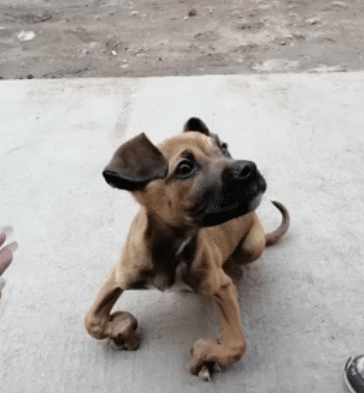
The Puppy Who Once Wobbled Forward Began Running Across the Grass
The first improvements were gradual.
Tomy stood more steadily.
He took stronger steps.
He covered short distances with less hesitation.
Then those distances became longer.
One day, he was no longer simply walking carefully across the yard.
He was running.
Not with the perfectly straight movement of every other dog.
But with energy.
Curiosity.
And enough confidence to chase after whatever caught his attention.
Grass that once would have been difficult terrain became somewhere to explore.
Other dogs became playmates.
Tomy followed them.
He investigated the yard.
He moved because he wanted to, not simply because he needed to reach food or shelter.
For the rescuers, this change mattered far beyond appearance.
When Tomy arrived, almost every movement had reflected weakness.
Now movement was becoming part of play.
His front legs still carried the history of his condition.
But they were no longer preventing him from participating in the world around him.
The small stray puppy was becoming what he had always been underneath the illness.
Young.
Energetic.
Interested in everything.
Another Dog Named Eva Was Learning a Different Way to Move
During the same period, rescuers were also caring for another dog with serious mobility problems.
Her name was Eva.
Eva’s situation was different from Tomy’s, and so was the solution.
Where Tomy worked through strengthening exercises and rehabilitation, Eva needed mechanical assistance.
Rescuers fitted her with a specially designed wheelchair that supported her body and allowed her to move with greater freedom.
The change was immediate.
Once properly supported, Eva could travel across the ground far more easily.
She moved quickly.
She explored.
The device did not erase her disability.
It gave her another way to work around it.
For the rescue team, watching Tomy and Eva side by side offered two very different examples of the same principle.
Mobility does not always return in the same way.
One animal may improve through nutrition and rehabilitation.
Another may need wheels.
Neither recovery has to look conventional to be meaningful.
What mattered was helping each dog reach the greatest level of comfort and independence possible.
For Tomy, the therapy sessions continued paying off.
And soon, his life was ready to change again.
Tomy Was Finally Ready for Something Beyond Treatment
Eventually, veterinary visits and rehabilitation stopped being the center of every day.
Tomy’s health had improved dramatically.
He had gained strength.
His appetite was good.
He could move confidently.
He could play.
The little dog who had once arrived weighing roughly three kilograms and struggling with basic movement was now ready for a different kind of transition.
A home.
Finding the right family mattered.
Tomy was no longer simply a patient.
He was a young dog with curiosity, energy, and his own routines.
His physical history would always be part of him, but it did not need to define the rest of his life.
Eventually, Tomy was adopted.
Eva also found a home.
For the rescuers, those adoptions marked the point when both stories moved beyond recovery.
They were no longer dogs being prepared for life.
They were living it.
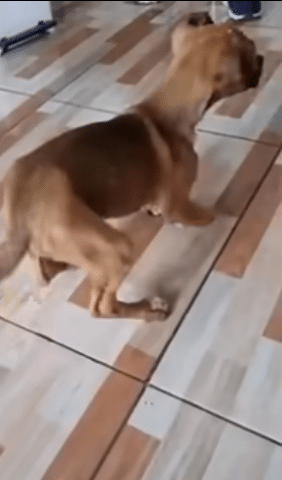
Soft Beds, New Places, and a Puppy Who Finally Had Room to Explore
Tomy’s new life looked almost nothing like the one rescuers had first seen on the street.
He had a family.
He had comfortable places to sleep.
He traveled.
He explored unfamiliar surroundings without having to search for food or safety.
Photographs and updates showed him resting on soft beds and spending quiet time near a warm fireplace.
Outside, he could move through open areas and investigate the world at his own pace.
Those ordinary experiences became some of the most meaningful parts of his transformation.
A comfortable nap.
A walk with his family.
Running through grass.
Watching something interesting from across the room.
For many household dogs, these moments barely seem worth mentioning.
For Tomy, they represented how completely his circumstances had changed.
He no longer needed to approach strangers on the street hoping they might have food.
The people around him already knew when he needed to eat.
He no longer had to use every bit of strength simply to move a short distance.
His body had grown stronger.
And he no longer had to wonder where he would sleep that night.
He had a home waiting for him.
Tomy’s Story Was Never Only About Straightening His Legs
It would be easy to look at Tomy’s rescue as a story about disability.
A tiny puppy.
Two severely bent front legs.
Weeks of treatment.
Therapy balls.
Laser sessions.
Then a dog running again.
But the most important transformation happened across his entire life.
When Tomy was found, his body lacked basic nutrition.
He was dehydrated.
He was dealing with gastrointestinal illness.
His muscles were weak.
And ordinary movement required tremendous effort.
The rescuers could not fix all of that with one procedure.
They had to begin with the smallest things.
Fluids.
Medication.
Food.
Another meal.
A little more weight.
A little more strength.
Then rehabilitation.
Balance.
Practice.
Repetition.
One steadier step.
Then another.
Eventually, running.
Tomy’s progress was built from dozens of small improvements that would have been easy to overlook individually.
Together, they changed everything.
And through all of those changes, one detail from his earliest days remained especially memorable.
Even when moving toward someone was difficult, Tomy still approached people.
He did not know which stranger might become part of his rescue.
He simply kept giving humans the opportunity to help him.
Eventually, the right people noticed.
Today, Tomy no longer has to struggle across the street looking for that opportunity.
He has food.
He has warmth.
He has room to move.
He has a family.
And when he runs now, no one sees only the puppy with twisted legs.
They see Tomy—
the little dog who finally grew strong enough to discover how big his world could be.


