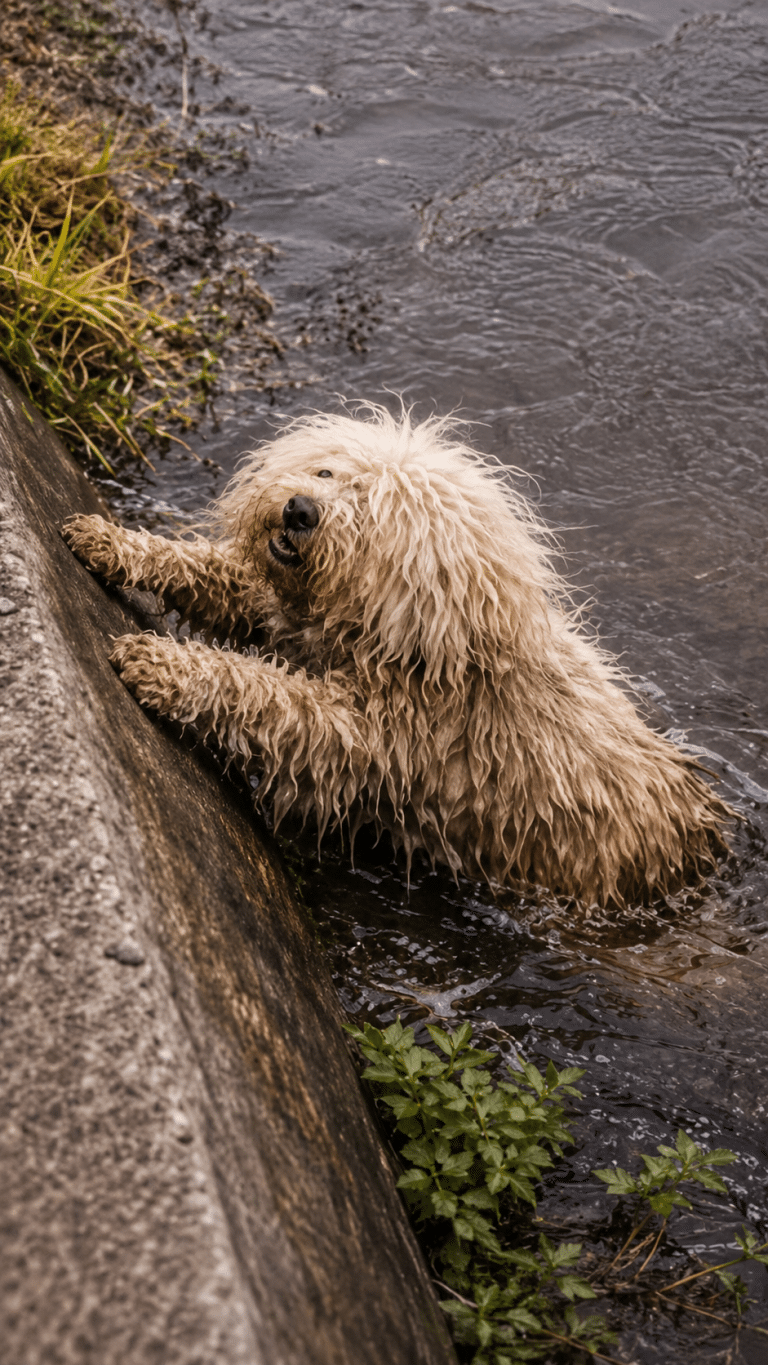
Beneath a cluster of overgrown bushes near a rural village, something dark and tangled moved slowly against the ground.
At first, it was difficult to recognize the figure as a dog.
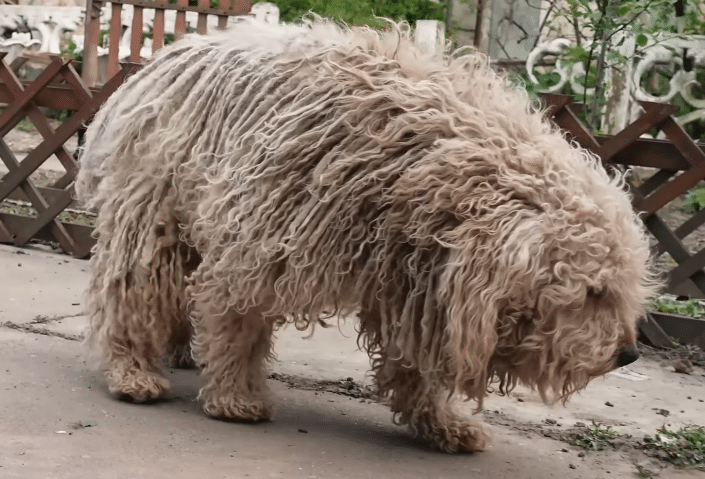
Heavy ropes of filthy fur covered nearly every part of his body. The coat hung in thick, hardened sections, collecting dirt and mud as he walked.
Only small glimpses of his face could be seen beneath the tangled hair.
The dog was identified in the original rescue account as a Hungarian Puli, a breed known for its distinctive corded coat. But what covered this dog was no longer a healthy, manageable coat.
It had become a heavy shell.
When two groomers from Groom House in Novi Sad found him hiding near the bushes, they immediately understood that an ordinary brushing would not be enough.
Then they began cutting into the mats—and discovered fleas and ticks living deep inside.
The Dog Hidden Beneath the Bushes Could Barely Move Freely
The Puli remained close to the overgrown vegetation when the groomers first approached.
His coat dragged across the ground whenever he moved.
Thick cords of hair had become joined together by dirt, moisture, and debris, forming large sections that appeared far heavier than normal fur.
The exact length of time he had lived in that condition was not confirmed.
However, the severity of the matting suggested that he had gone without proper coat care for an extended period.
The dog could not remove the tangles himself.
Each attempt to walk required him to carry the additional weight attached to his body. Fur around his legs restricted their natural movement, while the long sections beneath him collected even more dirt from the ground.
His face was also largely obscured.
The groomers could see enough to know that the dog was alert, but assessing his skin and overall physical condition would be impossible until the coat was removed.
They approached slowly.
A dog living beneath severe matting may already be uncomfortable, and pulling or handling hardened fur can increase that discomfort.
The groomers carefully guided him away from the bushes and transported him to their salon.
They knew the grooming process might be difficult.
They did not yet know how much was concealed beneath the coat.
Video: Groomers Begin Shaving a Severely Matted Puli—Then Find Parasites Deep Inside His Fur
These Were No Longer the Healthy Cords of a Puli
A Puli’s natural coat can form long cords when maintained properly.
The groomers immediately recognized that this dog’s condition was different.
His coat had become compacted.
Individual cords were fused together.
Large mats sat tightly against the body while other sections hung heavily toward the floor.
This was not simply a dog whose hairstyle had grown long.
The coat could no longer move naturally.
It trapped dirt and moisture close to the skin and made it difficult for anyone to see whether irritation or other problems had developed underneath.
Brushing the mats apart was no longer realistic.
Trying to pull through them could place painful tension on the skin and cause unnecessary distress.
The safest option shown in the rescue footage was to remove the damaged coat with electric clippers.
Before beginning, the groomers positioned the dog carefully and examined the direction in which the mats pulled against his body.
They could not simply run the clippers quickly across the surface.
Tight mats can draw skin upward, making it difficult to distinguish where the fur ends and the body begins.
Each section therefore had to be lifted and removed gradually.
The dog remained tense during the early part of the process.
The sound of the equipment was unfamiliar.
Hands were moving around parts of his body that may not have been touched safely in a long time.
But the groomers continued slowly, giving him breaks whenever needed.
Fleas and Ticks Were Living Throughout the Tangled Coat
As the first hardened sections came away, the groomers began seeing what the coat had concealed.
Fleas moved through the hair.
Ticks were attached in areas that had been hidden beneath the thick mats.
Dust and debris escaped into the air each time another section was lifted.
According to the original account, the amount of buildup became so intense that the grooming team wore protective masks while continuing the work.
The discovery showed why removing the coat was about far more than appearance.
The dog could not reach many of the affected areas to scratch or clean himself.
The mats created protected spaces where parasites could remain concealed and difficult to treat.
Even someone looking at the dog from a distance might have seen only tangled fur.
The groomers saw an animal carrying dirt, insects, and heavy sections of hair against his skin every hour of the day.
They continued clipping.
Large pieces fell onto the grooming surface.
Some retained the shape they had formed around the dog’s body, revealing how densely the fur had compacted.
With every section removed, more of the Puli became visible.
The outline of his legs appeared.
His neck could be seen more clearly.
His body looked far smaller than the enormous coat had suggested.
The dog was not receiving a cosmetic haircut.
He was being separated from a layer he could no longer escape without human help.
The Groomers Had Created an Unusual Mission for Dogs Like Him
During the transformation, the groomers explained that this was not the first neglected dog they had tried to help.
According to the source, the Groom House team had created a community initiative for animals whose owners might otherwise refuse or avoid professional care.
When they discovered a severely neglected dog through an online post or local report, they offered the owner $100 in exchange for permission to groom the animal without charging for the service.
The arrangement was unusual.
Normally, an owner pays a grooming salon.
In these cases, the groomers were willing to pay because they believed the dog might receive no help otherwise.
Their goal was to gain access to animals whose coats had already become dangerous or severely restrictive.
They could not solve every issue involving neglect in their community.
They could not provide permanent homes for every dog they encountered.
But they could use their professional skills to remove painful mats, reveal hidden skin conditions, and give an animal immediate physical relief.
The program also required them to avoid approaching owners only with criticism.
If confrontation caused someone to refuse access to the dog, the animal would remain in the same condition.
Offering money created an incentive for cooperation while allowing the groomers to begin the care that was urgently needed.
For this Puli, that decision led directly from the bushes to the grooming table.
It also meant the team was prepared to continue even after the parasites and extreme buildup made the session far more difficult than expected.
The Water Turned Dark as the Buildup Was Washed Away
After most of the heavy mats had been removed, the dog was carried to the bathing area.
Only then could the groomers begin cleaning what had remained trapped close to his body.
As water moved through the remaining coat, it quickly changed color.
Dirt, oil, dust, and debris washed away from the dog and flowed toward the drain.
The original story describes the water as becoming almost black.
The bath had to be handled gently.
After prolonged matting, newly exposed skin may be sensitive even when no specific injury is visible. Scrubbing too aggressively could create more discomfort.
The groomers carefully washed the dog and addressed the parasite infestation described in the source.
At first, he remained uncertain.
His body stayed tense while water and hands moved across areas that had previously been sealed beneath thick hair.
Gradually, his posture appeared to soften.
This should not be interpreted as proof that every fear or discomfort disappeared immediately.
But he tolerated the bathing process and appeared calmer as it continued.
The physical change was already substantial.
The largest mats were gone.
The dirt accumulated beneath them was being removed.
The fleas and ticks could finally be seen and treated rather than remaining protected inside the coat.
For what may have been the first thorough grooming in a very long time, water could reach his skin without having to pass through a hardened shell of tangled hair.
A Much Smaller Dog Slowly Emerged
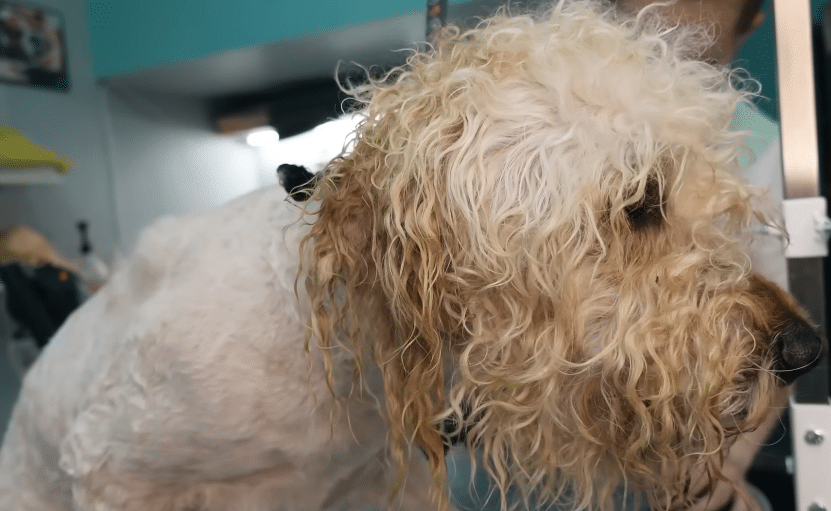
Once the bath was complete, the groomers dried the Puli and began shaping the remaining hair.
They trimmed carefully around his face.
For the first time, his eyes became fully visible.
His ears and the natural shape of his head could also be recognized beneath what remained of the coat.
The contrast with the beginning of the session was dramatic.
The animal who had arrived looking almost swallowed by fur now appeared much smaller and lighter.
His legs could move without long mats dragging beside them.
His body no longer carried the same heavy layers.
His expression could finally be seen clearly.
The source describes his personality beginning to appear as the grooming continued.
That change is better understood through his visible behavior.
He remained calmer around the groomers.
He allowed them to complete the drying and trimming.
He appeared more aware of the people around him rather than focusing entirely on the physical burden of his coat.
Grooming had not erased whatever experiences made him hide beneath the bushes.
It had not guaranteed that he would never feel uncertain again.
But it had removed one constant source of restriction.
He could stand without thick mats pulling toward the floor.
He could turn his head without his face disappearing into dirty cords.
And caregivers could now see and examine the body that had been hidden.
The enormous pile of removed fur remained nearby as evidence of how much he had been carrying.
He Returned Home Free From the Coat That Had Trapped Him
By the end of the grooming session, the Puli looked almost unrecognizable beside the before images.
Earlier that day, he had been hidden beneath bushes with filthy, hardened fur dragging across the ground.
Now he was clean.
His eyes were visible.
His body could move without the same weight and restriction.
According to the original account, the groomers returned the dog to his owner after completing the transformation.
The owner appeared surprised by the difference.
The Groom House team also followed through with the unusual agreement connected to their community initiative and provided the promised $100 payment.
The story does not explain what long-term arrangements were made to prevent the dog’s coat from returning to the same condition.
It does not confirm whether follow-up grooming, veterinary care, or monitoring occurred afterward.
Those unanswered questions remain important.
Severe matting can return if regular coat care does not continue, especially for a breed whose hair requires consistent maintenance.
The documented rescue does show one immediate and meaningful outcome.
The dog no longer carried dense mats filled with dirt, fleas, and ticks.
His skin was accessible for treatment.
His movement was less restricted.
And the small companion hidden beneath the neglected coat could finally be seen again.
This transformation was not valuable because the Puli became more attractive.
It mattered because grooming restored physical comfort that had been taken away gradually.
The clippers removed weight.
The bath removed buildup.
Parasite treatment addressed what had been living unseen beneath the fur.
And two groomers chose to do the work even though helping the dog cost them time, effort, and money.
The Puli could not schedule his own appointment.
He could not explain that his skin was uncomfortable or ask someone to remove the mats surrounding his legs.
He could only remain beneath the bushes until someone recognized that the shape in the dirt was a dog in need of help.
The Groom House team looked closer.
They saw beyond the tangled coat.
Then they carried him into the salon and began removing the burden one careful section at a time.
Sometimes rescue begins with medicine or emergency surgery.
Sometimes it begins with food and shelter.
For this dog, it began with a pair of clippers moving beneath a coat that had become far too heavy—and two people determined to uncover the life still waiting underneath.


