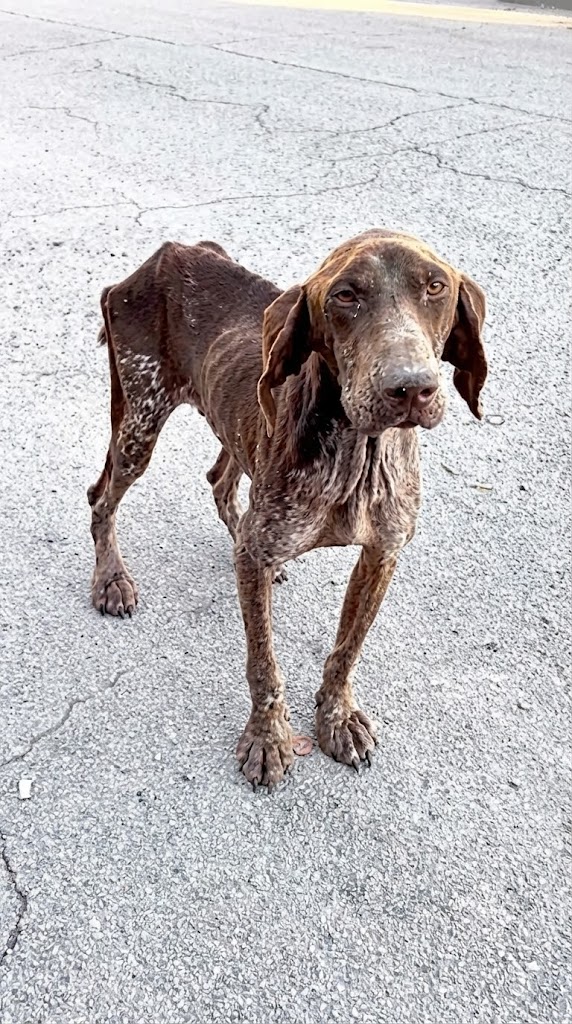
The call was about a young dog wandering alone.
He was extremely thin.
His legs shook when he tried to stand.
And by the time rescuers reached the area, he was leaning near an old cracked wall as if simply remaining upright required most of his strength.
He did not run when they approached.
He did not bark.
Instead, he stayed where he was while one rescuer slowly moved closer.
They would later name him Hopi.
At first, he looked like a dog who simply needed food.
The veterinary examination revealed much more.
Hopi Was Standing — But Only Barely
When the rescue team found him, Hopi’s ribs were clearly visible beneath his coat.
His body was depleted.
His breathing appeared shallow.
And his legs trembled underneath him.
One of the rescuers, Maria, approached slowly and allowed him to remain where he was.
According to the source, Hopi leaned into her hand rather than moving away.
That made it easier to handle him without creating a chase.
He was wrapped in a blanket and carried to the vehicle.
Walking to the truck was not something his body needed to be asked to do.
Video: Hopi Is Found Severely Underweight and Too Weak to Stand Normally
The Clinic Found Two Serious Conditions
Veterinary testing showed that Hopi’s weakness was not caused by hunger alone.
According to the original rescue account, he was diagnosed with Babesiosis and Demodicosis.
Babesiosis is a tick-borne disease that affects the blood.
Demodicosis is a skin condition associated with Demodex mites.
Hopi was also severely dehydrated and malnourished.
Together, those problems had left his body with very little reserve.
The team began treatment immediately.
His First Treatment Was About Stabilizing Him
Hopi received IV fluids to address dehydration.
Medication was started for the diagnosed conditions.
He was kept warm because his weakened body needed help maintaining normal temperature.
At that stage, he was too frail to spend much time standing.
So the team allowed him to rest.
The source describes small tail movements when familiar caregivers approached.
That behavior did not mean recovery was guaranteed.
But it did show that Hopi was remaining responsive during treatment.
Standing Again Became an Important Milestone
Progress was gradual.
Eventually, Hopi attempted to stand without being lifted.
His legs shook.
His balance was poor.
But he remained upright for several seconds.
That was a meaningful physical change from the day he arrived.
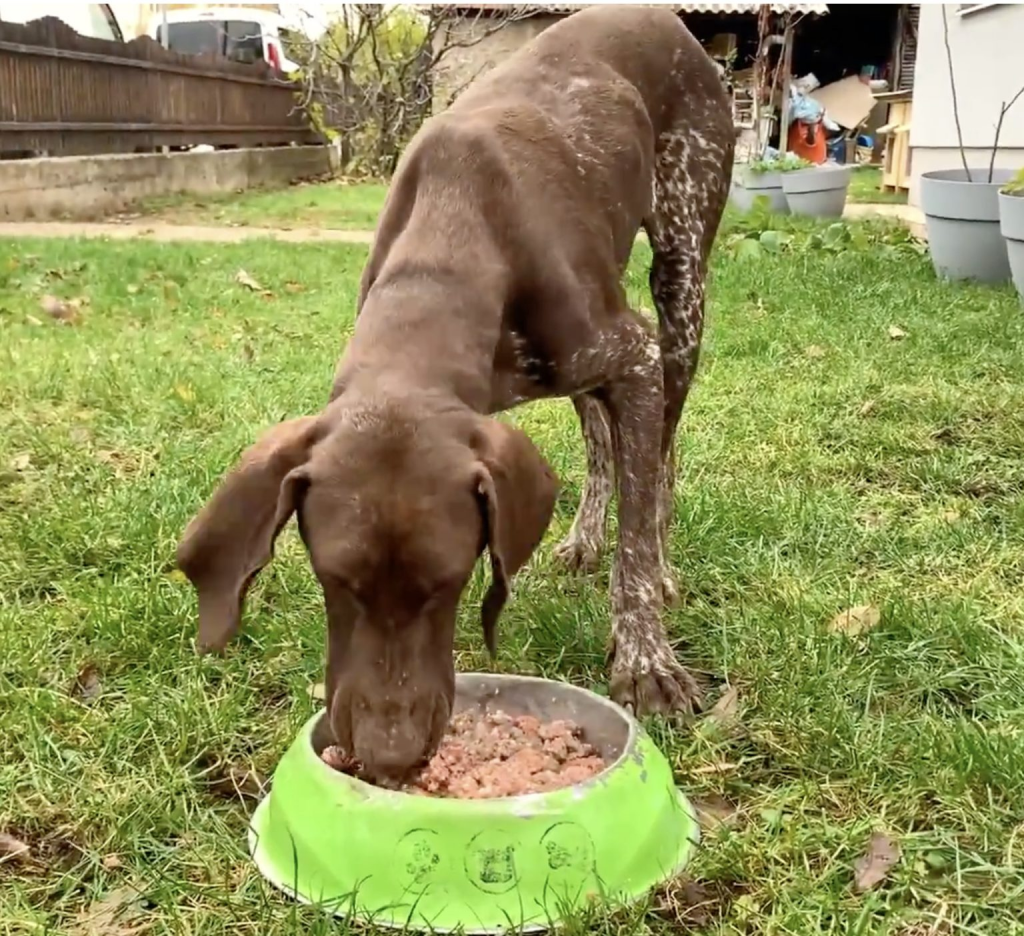
Soon afterward, he began eating more consistently.
At first, he managed only small amounts of soft food.
Then he started finishing larger portions.
Nutrition gave his body something it had been missing for some time: enough energy to rebuild.
His Skin and Coat Changed Along With His Strength
Treatment for the skin condition continued while Hopi regained weight.
Damaged areas began improving.
His coat slowly became healthier.
His movements became steadier.
And he started showing more interest in the people and objects around him.
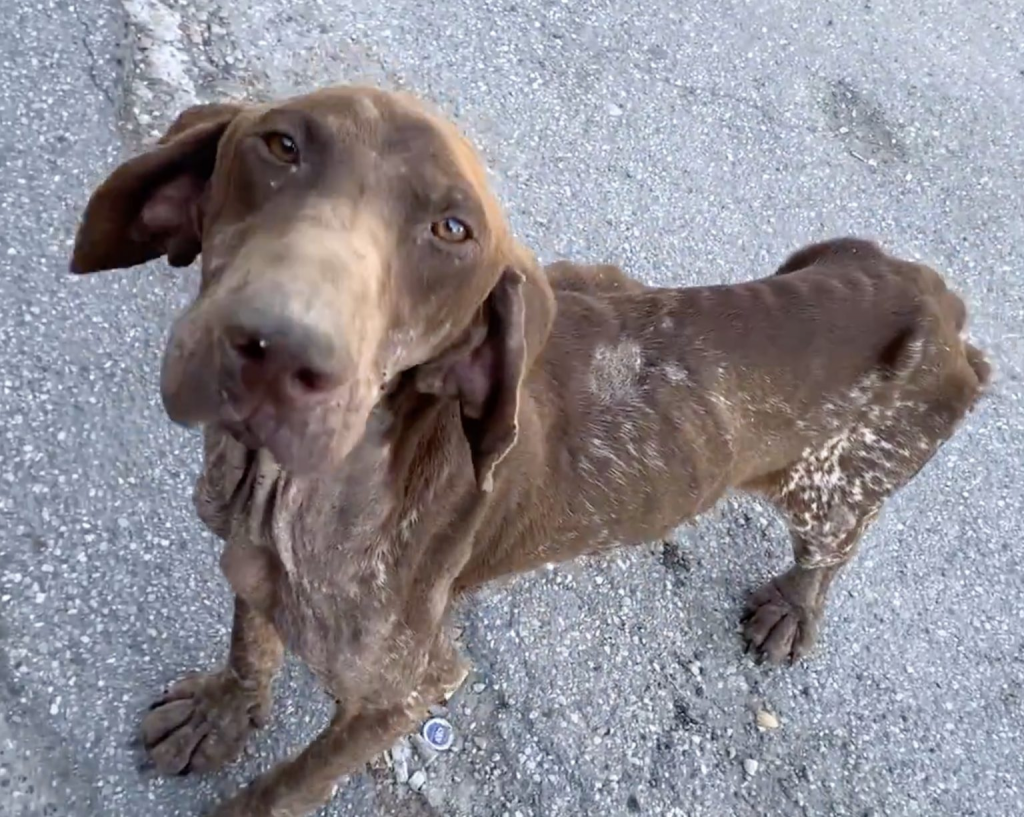
Eventually, he was strong enough to spend time outside.
He sniffed the grass.
Walked through the clinic yard.
And explored rather than simply standing still to conserve energy.
Then Hopi Started Seeking Out People
As Hopi became physically stronger, his behavior around caregivers also changed.
He approached familiar volunteers more readily.
Accepted touch.
Leaned into gentle hands.
And greeted people with more frequent tail movements.
The source presents this as his personality “returning.”
A simpler way to describe it is that Hopi now had enough energy and comfort to interact instead of focusing entirely on basic survival.
A Family Came to Meet Him
Hopi’s progress eventually drew the attention of a family.
According to the rescue account, the couple had recently lost an older dog and later visited with their young daughter.
During the meeting, Hopi approached the girl.
He rested his head in her lap and remained there.
The source interprets the moment as Hopi “choosing” her.
That cannot be known literally.
What could be seen was that he appeared comfortable around her.
The meeting went well enough that the family decided to adopt him.
The Dog Who Could Barely Stand Left Wearing a New Collar
By adoption day, Hopi no longer needed to be carried everywhere.
His strength had improved.
His skin was healing.
His appetite had returned.
And he could walk normally enough to leave with his new family.
The source describes him settling beside the young girl during the ride home.
That was a very different scene from the rescue vehicle that had first carried him away from the cracked wall.
Home Life Replaced the Clinic Routine
In his new home, Hopi’s daily life became ordinary in the best way.
He had regular meals.
Soft places to sleep.
A yard to explore.
People around him every day.
The source says he followed family members through the house and spent time near the little girl.
Those routines were possible because the medical problems that once left him barely able to stand had been treated.
 image
imageHis Eyes Did Not Need to “Ask” for Help
The original story describes Hopi’s eyes as though they were pleading with rescuers.
It is an understandable emotional interpretation.
But his physical condition already communicated everything necessary.
He was severely underweight.
Dehydrated.
Weak.
And affected by two diagnosed diseases that required treatment.
Someone reported him.
A rescue team responded.
Veterinarians identified what was wrong.
And with medication, fluids, nutrition, rest, and time, Hopi became strong enough to walk into a home of his own.
He did not need anyone to imagine what he was thinking beside that wall.
He only needed someone to notice that he could barely stay standing.
And someone did.


