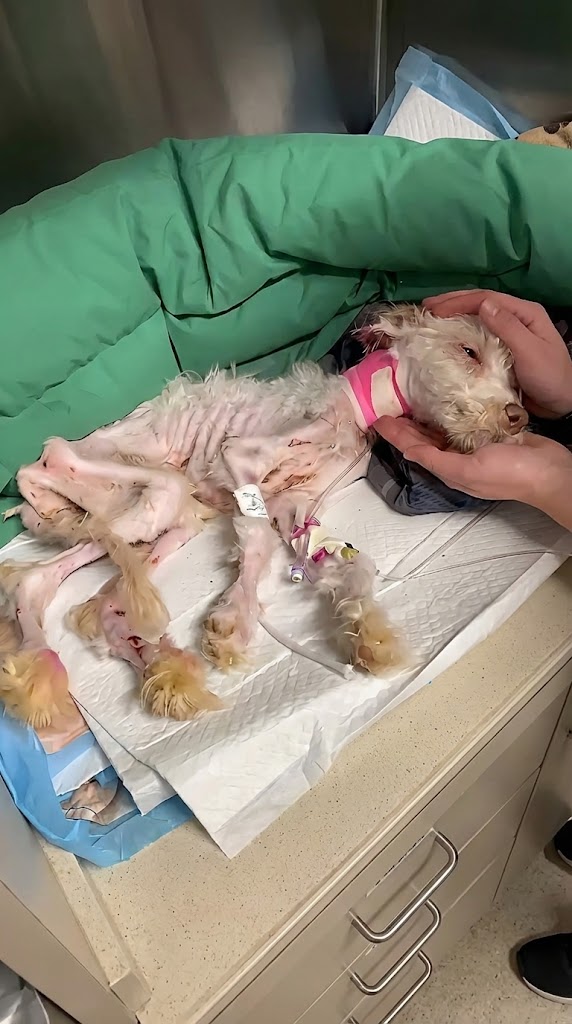
At first, the bright colors were almost impossible to understand.
Junie was lying inside a filthy crate in an open field, barely moving.
Her small body was weak and cold. Her skin had been badly damaged after prolonged exposure to unsanitary conditions, and she appeared too exhausted to respond to much around her.
Then rescuers noticed her ears.
They had been dyed bright pink and purple.
The colors looked almost playful.
Everything else about Junie’s condition was anything but.
She needed emergency medical care.
And by the time she reached the hospital, the veterinary team was already fighting to keep her alive.
Her Body Temperature Was So Low the Team Couldn’t Get a Reading
Junie arrived in critical condition.
Her blood pressure was dangerously low.
Her body temperature had dropped so severely that, according to the rescue account, it could not initially be measured.
The team moved quickly to stabilize her.
Warmth.
Fluids.
Close monitoring.
Support for a body that had been pushed far beyond what such a small dog should have endured.
For a moment, it seemed possible that Junie might begin stabilizing.
Then another crisis appeared.
Her red blood cell count suddenly fell.
She needed an emergency transfusion.
The hospital team responded immediately.
Junie made it through.
But the medical emergencies were not finished.
VIDEO: Junie Was Found Barely Alive in a Crate — Then Doctors Began Fighting to Save Her
A Dangerous Blood Clot Changed Everything Again
During treatment, Junie developed a large clot in her jugular vein.
The swelling affected her face and neck.
According to the rescue account, doctors estimated her odds at roughly fifty-fifty.
For an already weakened dog, it was an enormous complication.
The medical team continued monitoring her closely while treating the clot and supporting the rest of her body.
Then pneumonia developed.
Another serious problem.
Another threat to a dog who had already required an emergency transfusion and intensive care.
Any one of those complications would have been concerning on its own.
Junie faced them in sequence.
And still, caregivers continued seeing one small behavior whenever people approached.
Her tail moved.
Even in Intensive Care, Junie Still Responded to People
The tail wag was not proof that Junie felt well.
She was still critically ill.
She remained surrounded by medical equipment and people watching her condition closely.
But despite her weakness, she continued responding when familiar caregivers approached.
Sometimes she lifted her head.
Sometimes she leaned toward touch.
Sometimes her tail moved against the bedding.
Those small reactions became easy for staff to notice because everything else about her recovery was so uncertain.
No one could know what Junie remembered from before she was found.
There was no need to imagine it.
Her condition already showed that she had suffered prolonged neglect.
What mattered now was different.
She was warm.
She was receiving treatment.
And every time her condition changed, someone was there to respond.
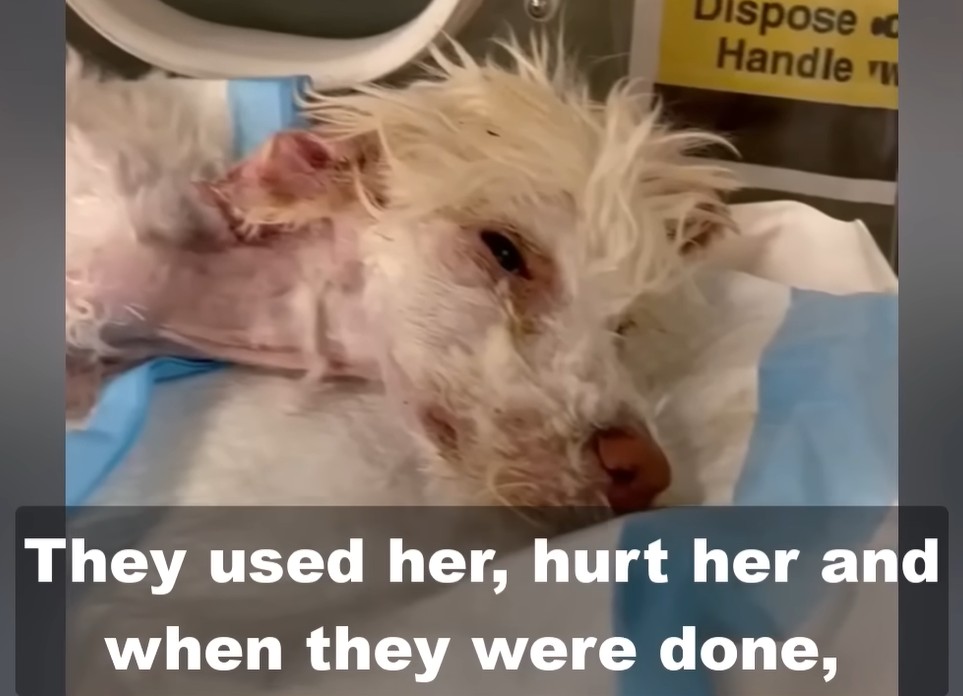
Then She Began Eating Again
Recovery arrived slowly.
Junie first became more alert.
Then she started showing interest in food.
For a dog whose body had been struggling through multiple medical emergencies, eating represented an important step.
Nutrition gave her strength.
Strength allowed more movement.
Eventually, Junie began getting up.
Then taking small steps.
The dog who had arrived unable to maintain a normal body temperature was gradually becoming active enough to move through the hospital.
There were still reasons to watch her closely.
Recovery after a transfusion, a major clot, pneumonia, and severe neglect could not be rushed.
But Junie was no longer only lying inside intensive care.
She was beginning to participate in her days.
The Hospital Staff Gathered When It Was Time for Her to Leave
Eventually, the day came when Junie was strong enough to leave the hospital.
By then, many members of the veterinary staff had been part of her care.
Doctors.
Nurses.
Technicians.
People who had watched her condition worsen and improve, sometimes within the same stretch of treatment.
When Junie was discharged, staff gathered in the hallway.
Some smiled.
Some became emotional.
The small dog walking past them looked very different from the one who had arrived in critical condition.
Her medical recovery was not simply one successful procedure.
It had required people to respond repeatedly.
To the low blood pressure.
The dangerously low temperature.
The falling red blood cell count.
The clot.
The pneumonia.
Then all the smaller needs that came afterward.
Food.
Rest.
Medication.
Time.
Junie had made it through all of them.
Leaving the Hospital Was Not the End of Her Journey
After discharge, Junie traveled to New York.
A permanent home was waiting for her there.
Her new family did not meet the dog inside the filthy crate.
They met the dog who had survived it.
Junie now had a warm place to sleep.
People who watched over her.
And another dog in the home who became part of her everyday life.
Her surroundings changed completely.
No contaminated crate.
No exposure to the elements.
No hospital room filled with monitors.
Instead, there were ordinary routines.
Soft bedding.
Play.
Companionship.
A home where people knew her name.

The Brightly Colored Ears Became Only One Small Part of Her Story
The pink and purple ears were what made Junie visually unforgettable when rescuers found her.
But they were never the most important thing about her.
The real story was in everything her body survived afterward.
Critical hypothermia.
Dangerously low blood pressure.
An emergency transfusion.
A large jugular clot.
Pneumonia.
Then the long climb back through eating, standing, walking, and eventually leaving the hospital.
The colors on her ears eventually became part of the past.
What remained was Junie herself.
A small dog who continued responding to people even during the hardest stages of treatment.
A dog who recovered enough to leave intensive care.
And eventually, a dog who traveled to a home where her days no longer revolved around medical emergencies.
Someone Found Her Before Her Body Ran Out of Time
Junie could not get herself out of the crate.
She could not explain how long she had been there.
And by the time rescuers reached her, her condition left little room for delay.
Someone still had to find her.
Someone had to open the crate.
Someone had to decide that the tiny dog inside was worth rushing to a hospital.
That decision led to everything that followed.
The warming treatments.
The transfusion.
The response to the clot.
Treatment for pneumonia.
The first meals.
The first steps.
The hallway filled with staff when she was finally discharged.
And eventually, a home in New York.
Once, Junie was lying nearly motionless inside a filthy crate, her brightly colored ears standing out against everything else that had gone wrong.
Today, those colors are no longer what defines her.
She has a bed.
A companion.
A family.
And a life that continued because, when Junie could no longer help herself, someone else chose to.


