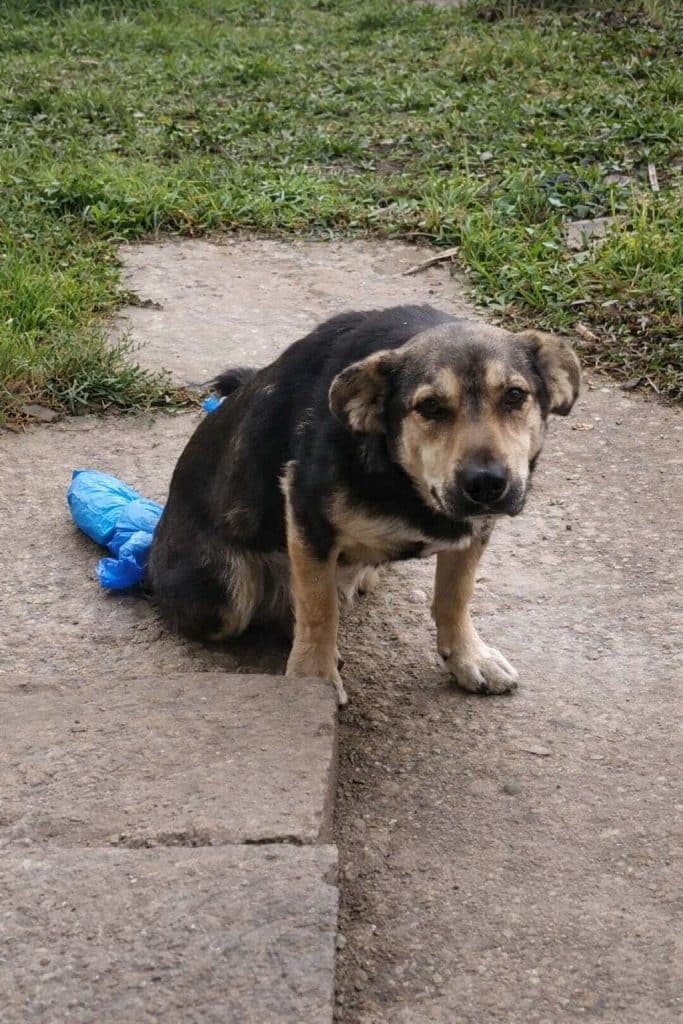
The first thing the woman noticed was how friendly he was.
A stray dog had appeared near her home, and unlike many frightened animals living on the streets, he did not immediately retreat.
His tail wagged.
He accepted the food she offered.
Then he began following her.
Only when she watched him move did she realize something was terribly wrong.
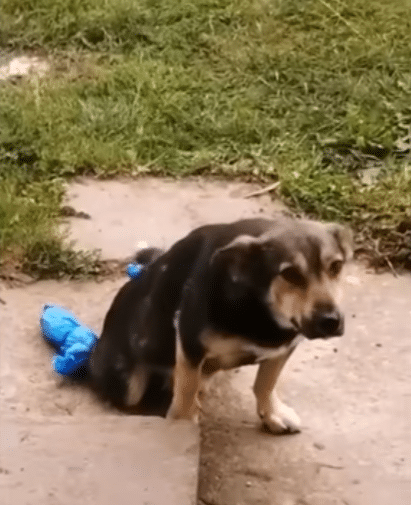
Lambroshka was not walking on four legs.
His hind legs dragged motionless behind him while his front legs pulled the rest of his body across the ground.
And somehow, through all of it, his tail kept moving.
He Followed Her Home Without Being Able to Walk
The woman could see that Lambroshka’s condition was not new.
His hind legs showed little useful movement and were loosely wrapped in fabric that did not appear to provide meaningful support.
No one knew exactly what had happened to him.
The injury may have come from an accident or another form of trauma, but the source account does not establish a clear cause.
What was obvious was how thoroughly Lambroshka had adapted.
When he wanted to move, he pulled himself forward using his front legs.
The back half of his body followed behind.
He had apparently been surviving this way for some time.
Yet when food appeared, he remained interested.
When the woman moved toward her home, Lambroshka followed.
He did not know where she was taking him.
He simply chose not to leave.
She contacted rescuers soon afterward.
VIDEO: Lambroshka Dragged Himself Across the Ground—But His Tail Never Stopped Wagging
The Examination Brought Difficult News
Rescuers took Lambroshka to a veterinary clinic for a full evaluation.
The unfamiliar environment initially made him tense.
New sounds.
New people.
New hands examining a body that had already endured significant damage.
But the nervousness did not last long.
Once he became more familiar with the people around him, the gentle behavior seen during his rescue returned.
The medical findings were more difficult.
According to his rescue story, the damage involved both the structures of his hind legs and the nervous system.
Because the condition had apparently gone untreated for a long time, veterinarians could not promise that Lambroshka would ever walk normally.
The chances were described as very limited.
That did not mean there was nothing left to try.
His caregivers decided to focus on rehabilitation and see how much function his body might still recover.
In Water, His Back Legs Could Finally Move Differently
One of the first therapies introduced was hydrotherapy.
Lambroshka was fitted with a flotation vest and carefully supported in warm water.
On land, his body weight made meaningful movement extremely difficult.
Water changed that.
Buoyancy supported much of his weight, giving his legs an opportunity to move without having to carry his entire body.
At first, the movements were awkward.
His hind legs had been inactive for a long time.
Muscles were weak.
Coordination was limited.
But caregivers began noticing responses.
The legs moved.
Even small movement mattered because rehabilitation had started from almost nothing.
Later, Lambroshka was transferred to a rehabilitation clinic where therapy could become more intensive and consistent.
Rehabilitation Revealed the Dog Behind the Injury
Lambroshka quickly became known for more than his medical condition.
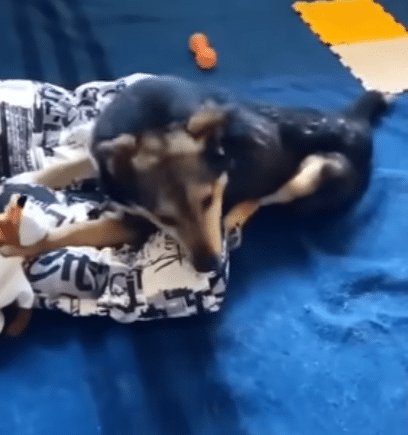
He liked carrying a tennis ball.
A small stuffed teddy bear also became one of his favorite belongings.
Those details gave caregivers a glimpse of the personality that paralysis had never taken away.
But the clinic environment was not always easy for him.
He became excited when familiar rescuers visited.
Their departures seemed harder.
The team began noticing that although Lambroshka needed intensive physical rehabilitation, emotional comfort also affected how well he settled.
A clinical setting could provide therapy.
It could not always provide the calm and familiarity of a home.
So his caregivers made another adjustment.
Lambroshka moved into foster care.
A Foster Home Changed the Rhythm of His Recovery
The quieter environment suited him.
His days became more predictable.
He could spend time outside.
Feel grass beneath his body.
Rest somewhere familiar after therapy.
Caregivers continued working with him every day.
A support harness helped lift his hindquarters while he practiced placing his paws beneath himself.
At first, standing lasted only seconds.
Then he rested.
After each session, his muscles were gently massaged to help with stiffness and circulation.
The process was repetitive.
Stand.
Support.
Rest.
Massage.
Then try again another day.
Some sessions showed little obvious change.
Others offered a tiny improvement.
With Lambroshka, those tiny improvements became the entire point.
First One Paw Responded—Then Another
Gradually, his caregivers noticed that Lambroshka was gaining more control.
One hind paw began responding more deliberately.
Then the other.
He started lifting his hips slightly from the ground.
The amount of time he could remain upright increased.
None of this meant his neurological damage had disappeared.
His movement remained imperfect.
Balance still required enormous concentration.
But the body that had once simply dragged behind him was beginning to participate.
The progress was slow enough that each change could have seemed insignificant to someone seeing him only once.
To the people working with him every day, it was unmistakable.
He was doing more than he had before.
Then came the moment they had been working toward.
One Day, Lambroshka Pushed Himself Up
It happened outside on the grass.
Lambroshka positioned his paws beneath himself.
Then pushed.
His body rose.
His legs trembled.
His balance shifted uncertainly beneath him.
But he stayed upright.
For a dog whose back legs had once dragged completely behind him, simply standing was an enormous milestone.
Then he attempted to move.
One step.
Unsteady.
Careful.
But his.
There was no need to pretend that one step meant complete recovery.
Lambroshka was not suddenly running normally.
He still had limitations.
He still needed rehabilitation.
But the goal had never been to create a perfect before-and-after ending.
It was to discover what his body could still do with consistent support.
And that day, it did more than anyone had been able to guarantee.
Lambroshka Never Needed a Perfect Recovery to Have a Life Worth Fighting For
When the woman first saw Lambroshka, he was already moving forward in the only way available to him.
Front legs pulling.
Back legs dragging.
Tail still wagging.
That image captures something important about his story.
Lambroshka did not recover because optimism alone repaired his nervous system.
He needed veterinary care.
Hydrotherapy.
Rehabilitation.
A support harness.
Daily exercises.
Massage.
A quieter foster environment.
And people willing to continue even when nobody could promise what the final result would be.
His progress came in pieces.
A movement in the water.
A paw responding.
Hips lifting from the ground.
A few seconds standing.
Then one uncertain step.
Perhaps Lambroshka will always move differently from other dogs.
His source story does not give us a perfect medical ending, and it does not need one.
What it gives us is something more grounded.
A dog who once had to drag himself everywhere was given enough support to discover that his body still had possibilities left.
And through every stage, the thing rescuers noticed at the beginning remained.
His gentleness.
His curiosity.
And that tail that seemed determined to keep moving long before his legs could.


