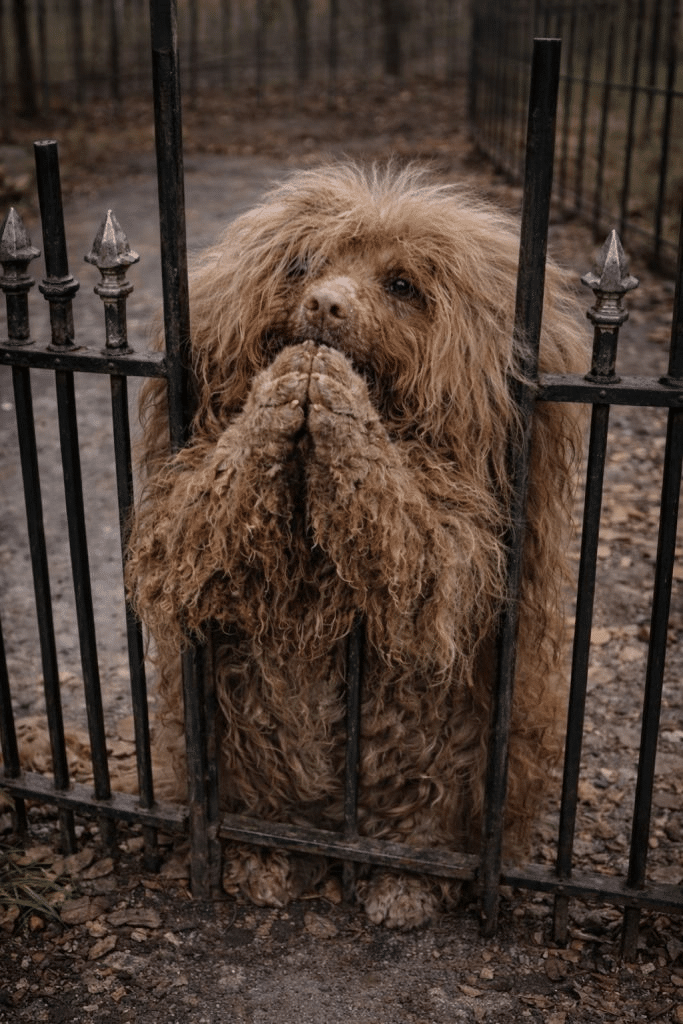
For weeks, perhaps longer, Tukhang watched the world through the bars of a rusted gate.
The property behind him was empty. The person who had once been responsible for him was gone, but the gentle dog had been left inside with no way to follow.
Occasionally, strangers noticed him and passed food through the gate. Those small gestures helped keep him alive, but they could not free him from the neglected property or provide the medical care he increasingly needed.
Whenever someone approached, Tukhang made an unusual gesture.
He lifted his front paws and brought them together, almost as though he were quietly asking not to be forgotten.
One day, the people watching him finally did more than leave food.
They opened the gate.
The Dog Waiting Behind the Bars
Tukhang’s world had become painfully small.
He could walk around the abandoned property, but the locked gate prevented him from reaching the road or following anyone who passed outside. The empty house offered no dependable care, and there was no owner returning with meals or fresh water.
No one knew exactly how much Tukhang understood about what had happened.
What people could see was a dog who continued waiting near the entrance.
When footsteps approached, he came closer to the bars.
He did not bark aggressively or attempt to frighten visitors away. Instead, he watched them quietly, hoping for food or attention.
Some compassionate residents began tossing meals through the gate when they could. Their kindness mattered, but Tukhang’s needs were becoming too serious for occasional feeding alone.
His body was extremely thin.
His energy had declined.
His coat had grown into long, dense mats that hung heavily around his legs, chest, and face. Dirt and moisture had collected inside the tangled fur, creating an environment where parasites could remain hidden.
Even his nails had become overgrown, making it more difficult for him to stand and walk comfortably.
Yet the detail people remembered most was the way he held his paws.
Whenever someone paused outside the gate, Tukhang brought his front legs together and looked toward them.
Perhaps it was simply a behavior he had developed while trying to gain attention.
Whatever its origin, the gesture carried a clear message.
This dog needed more than another meal passed through the bars.
He needed someone to bring him out.
Video: Tukhang Raises His Paws Behind the Locked Gate—Then Rescuers Finally Set Him Free
The Day the Gate Finally Opened
By the time rescuers learned about Tukhang, his condition appeared urgent.
The team traveled to the abandoned property prepared to remove him and take him directly for medical care.
As they approached the gate, Tukhang came forward.
He was cautious, but he showed no aggression. His body trembled, whether from weakness, uncertainty, or both, and the heavy coat surrounding him made his true size difficult to see.
Once access to the property was secured, the rescuers moved slowly.
They did not rush toward him or surround him.
After spending so long alone, Tukhang could not be expected to understand immediately that unfamiliar people had come to help. Calm voices and gentle movements gave him time to observe what was happening.
Tukhang remained still as they came closer.
When hands finally reached him, he did not fight or attempt to escape.
He allowed the rescuers to lift and carry him away from the property.
For the first time since being left behind, Tukhang crossed the gate.
The bars that had separated him from the outside world were now behind him.
But freedom alone could not resolve the physical effects of prolonged neglect. His weak condition, tangled coat, parasites, and overgrown nails all required professional attention.
The rescue team transported him directly to a veterinary clinic.
There, the true extent of what he had been carrying began to emerge.
More Than Two Hours to Remove the Heavy Coat
Tukhang’s fur was not simply long.
It had hardened into thick, interconnected mats that sat close to his skin. Entire sections moved together when he shifted his body, pulling across sensitive areas and restricting his legs.
The veterinary team understood that ordinary brushing was not an option.
Trying to pull through knots this severe could cause unnecessary discomfort and increase the risk of damaging the skin underneath. The safest approach was to carefully clip the coat away in sections.
The work required patience.
The doctor began by identifying places where the clippers could safely pass between Tukhang’s skin and the compressed fur.
Small pieces came away first.
Then larger sections loosened from his sides and legs.
Underneath the mats, the team discovered large numbers of ticks and fleas. Dirt and moisture had also remained trapped close to his body, hidden from view by the dense coat.
Every newly exposed area had to be inspected.
The process continued for more than two hours.
Throughout it all, Tukhang remained remarkably calm.
He stood when he was able and rested when necessary, allowing the medical team to work around his body. The unfamiliar sound of the clippers and the handling of sensitive areas could have frightened him, but he offered little resistance.
Piece by piece, the burden became lighter.
His legs appeared.
The shape of his small body emerged.
His face, once surrounded by neglected fur, became easier to see.
When the final heavy sections were removed, Tukhang looked dramatically different.
But appearance was only part of the transformation.
He could shift his weight without the entire coat pulling against him.
He could bend his legs more freely.
The team could finally reach his skin, remove parasites, and identify areas needing further treatment.
The dog had not changed.
The weight hiding him had simply been taken away.
Warm Water and the First Signs of Relief
After the clipping was complete, Tukhang’s overgrown nails were carefully trimmed.
Long nails can change the way a dog places his feet and make walking uncomfortable, especially when the animal is already weak. Shortening them gave Tukhang a better chance of standing naturally again.
Then came his bath.
The team introduced him to the warm water gradually.
At first, Tukhang appeared uncertain. He remained still, watching the people around him as water began flowing across his newly exposed coat and skin.
Gentle grooming products helped remove the dirt, loose fur, and traces of parasites that remained after clipping.
The water darkened with grime.
Each rinse revealed cleaner skin underneath.
Tukhang did not try to climb away.
As the bath continued, some of the tension in his posture appeared to ease. He allowed the caregivers to support his body and clean areas that had likely been inaccessible for a long time.
For the first time, warm hands were not reaching through a gate to leave food and disappear.
They stayed.
They washed him.
They checked whether he was comfortable.
They paused when he needed rest.
After nearly four hours of grooming, treatment, and cleaning, Tukhang was finally dry and free from the coat that had covered him.
His appearance was strikingly different.
The heavy mats were gone.
The parasites had been removed.
His face was visible.
He remained thin and would need continued medical care, proper nutrition, and time to rebuild his strength. No one expected one afternoon at the clinic to undo everything he had experienced.
Still, something important had already changed.
Tukhang was comfortable enough to take his first careful steps.
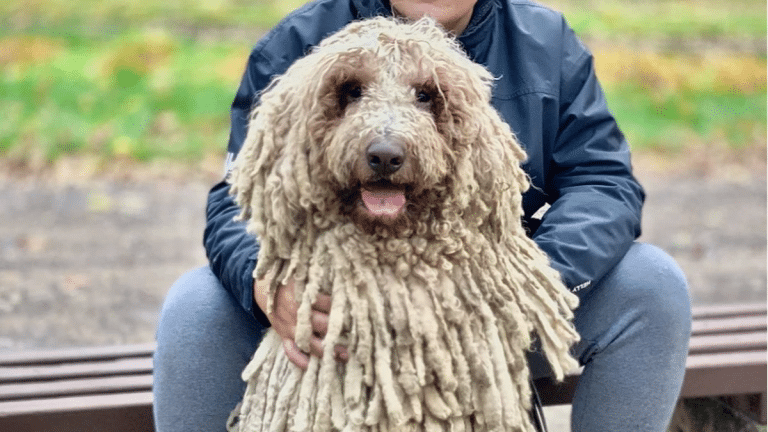
Without the Mats, He Could Finally Walk More Freely
Tukhang rose slowly.
His body was tired, and his muscles had not yet recovered from the long period of limited care. But without the dense coat restricting his legs and overgrown nails affecting his footing, movement became easier.
He took one step.
Then another.
The team remained beside him, ready to provide support if he became unsteady.
Tukhang moved cautiously across the floor, exploring the unfamiliar space with his newly uncovered face turned toward the people around him.
There was no sudden burst of energy.
Recovery rarely happens that way.
Instead, his transformation appeared through quieter details.
He could reposition his feet more naturally.
He could turn without dragging heavy mats around his body.
He could lie on clean bedding without resting on compacted sections of fur.
When caregivers approached, Tukhang watched them carefully but did not retreat.
At times, he leaned gently toward their hands.
The same dog who had once greeted strangers from behind iron bars was now standing beside people who had chosen not to leave.
Food was provided in appropriate portions so his weakened body could begin rebuilding safely. Fresh water remained within reach, and the team created a quiet resting area where he could recover from the long day.
For Tukhang, these ordinary comforts were part of a completely new routine.
A meal that did not have to be thrown through a gate.
A clean place to sleep.
Medical care when something hurt.
People who returned after walking away.
His Future Is No Longer Behind Locked Gates
Tukhang’s rescue did not end when the gate opened.
Freedom was the first step.
His body still needed time to recover from poor nutrition and the effects of parasites. His skin would require monitoring, and his coat would need regular care as it grew back.
He would also need patience while adjusting to life around people again.
But the most immediate dangers were behind him.
Tukhang was no longer trapped on an empty property.
He was no longer dependent on brief encounters with strangers for survival.
He no longer carried a heavy coat that restricted his movement and concealed his condition.
Now, each day could bring something he had been missing.
Regular meals.
Treatment.
Rest.
Gentle attention.
And the possibility of a permanent home.
Tukhang’s story is not powerful because one grooming session made him look different.
It matters because people finally recognized that surviving behind the gate was not enough.
Someone had to find a way inside.
Someone had to transport him to safety.
Veterinary professionals had to spend hours carefully removing the physical effects of neglect.
And after the dramatic rescue was over, someone still had to remain beside him through the slower work of recovery.
For so long, Tukhang watched life through metal bars and raised his paws whenever kindness came near.
Today, he no longer has to ask people outside the gate to notice him.
The gate is open.
The burden is gone.
And for the first time in a long while, Tukhang can walk toward a future where care does not disappear.


