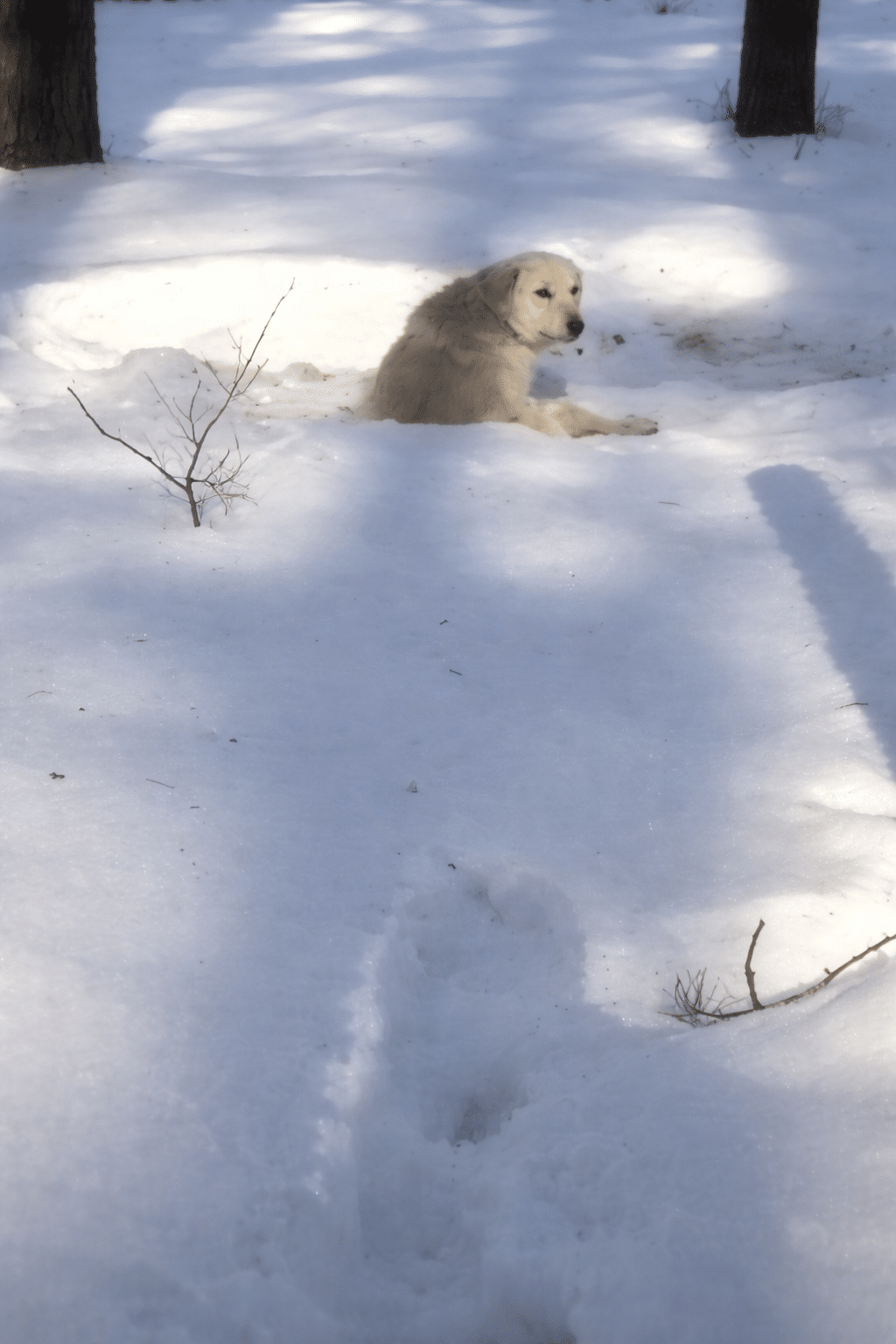
The snow around Luna was almost perfectly still.
So was she.
When she was found alone in the cold, her body was trembling and injured, but the most frightening detail became clear when she tried to move.
Her back legs did not follow.
Severe trauma had affected her spine, leaving her unable to use them normally. In that frozen landscape, with no way to simply stand and walk toward safety, Luna depended entirely on someone noticing her in time.
Help did come.
But getting her out of the snow would prove to be only the beginning.
She Could Not Move Away From the Cold
There was little Luna could do for herself when she was discovered.
The snow pressed against her body, and every attempt to reposition herself appeared difficult.
Her hind legs remained motionless.
Her condition immediately raised concerns about serious spinal damage, and keeping her outside was no longer an option.
She needed warmth.
She needed medical attention.
And she needed answers about what had happened inside her body.
Luna was carefully moved from the snow and taken to a veterinary clinic, where the focus shifted from simply getting her somewhere safe to understanding the extent of her injuries.
The first examinations confirmed that the situation was serious.
Her difficulty moving was not temporary weakness from the cold.
There had been extensive damage affecting the nerves around her spine.
For Luna, the next chapter would depend on what the veterinary team could safely do—and how much function her body might eventually regain.
Video: Luna — The Paralyzed Dog Who Refused to Give Up
The Scans Revealed Why Her Back Legs Would Not Respond
At the clinic, veterinarians examined Luna carefully.
Tests showed significant spinal trauma and nerve damage.
There were also bone fragments pressing against the area surrounding her spine.
Some could be removed surgically.
Others presented a much more difficult decision.
The veterinary team was able to remove several fragments that were creating pressure, but one piece was lodged so deeply that attempting to reach it carried additional risk.
It had to remain in place.
That meant surgery could address only part of the problem.
No procedure could guarantee that Luna would suddenly stand again afterward.
Her recovery would depend on time, rehabilitation, her neurological response, and the way her body adapted following treatment.
The uncertainty remained.
But now there was also a plan.
Rather than measuring Luna’s future by what she could not do that day, her caregivers began concentrating on what could be encouraged safely.
Circulation.
Muscle strength.
Balance.
Small nerve responses.
Even the slightest movement could matter.
Recovery Began With Movements Almost Too Small to Notice
There was no dramatic moment when Luna suddenly returned to normal.
Her rehabilitation began quietly.
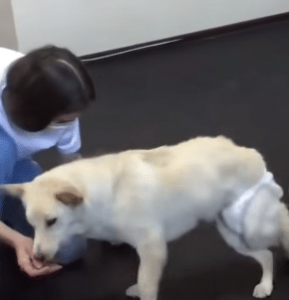
Massage became part of her routine, helping caregivers work with muscles that were receiving far less natural movement than before.
Physical rehabilitation focused on gently stimulating her body and maintaining as much function as possible.
During assisted standing exercises, Luna was supported while her caregivers helped place her body into positions she could not yet maintain independently.
At first, these exercises could look almost uneventful.
A leg being guided into position.
A body held upright for a short period.
A paw placed carefully against the ground.
But rehabilitation after a serious spinal injury is often built from precisely those kinds of repetitions.
For Luna, progress could not be measured only by whether she was walking.
It had to be measured in much smaller ways.
Could she hold herself differently?
Could she remain upright a little longer?
Was a muscle responding that had previously remained still?
Those were the questions her caregivers watched closely.
Day after day, they continued.
In Warm Water, Her Body Had a Different Kind of Freedom
One of the most important parts of Luna’s rehabilitation took place in water.
Hydrotherapy allowed her body to experience movement without carrying its full weight.
Supported by warm water, Luna could work her legs in a way that was much more difficult on a solid floor.
The water did not cure her injury.
But it changed the conditions under which she could exercise.
Her body was supported.
The pressure of standing was reduced.
Her caregivers could guide her movements while allowing her legs more freedom.
For a dog whose hindquarters had been almost completely inactive, that opportunity mattered.
Session after session, Luna continued working.
There were no guarantees that every movement would lead to lasting improvement.
There were no shortcuts.
Instead, there was repetition.
Patience.
Careful observation.
And the willingness to celebrate progress that another person might have overlooked.
For Luna’s rehabilitation team, a tiny response could be meaningful because they knew where she had started.
Motionless in the snow.
Unable to use the back half of her body.
Now she was moving those muscles in warm water with people supporting her on every side.
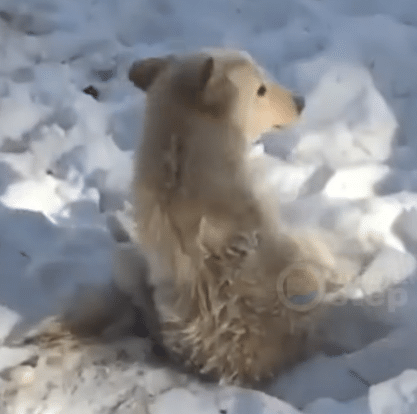
Then Luna Managed to Sit Up
One of the first milestones looked simple.
Luna sat up.
At first, she could maintain the position only briefly.
For a healthy dog, sitting requires almost no thought.
For Luna, it represented something entirely different.
Her body had to stabilize itself in a position that had previously required assistance.
The moment did not mean her recovery was complete.
It did not mean she would suddenly be able to walk normally.
But it showed that change was possible.
Her muscles were becoming stronger.
Her balance was beginning to improve.
And movements that had once seemed completely beyond her were slowly entering her daily routine.
Those caring for Luna continued watching for signs of coordination.
Little by little, they saw more.
She was learning how to work with a body that had been changed by trauma.
Some days brought visible improvement.
Other days were simply about maintaining the progress already made.
That uneven pace became part of Luna’s story.
Recovery was not a straight line.
It was a collection of small victories separated by long stretches of patient work.
No Single Person Could Have Carried Luna Through This Alone
Luna’s rehabilitation required more than one pair of hands.
Veterinarians handled the medical decisions surrounding her spinal injury.
Rehabilitation specialists guided exercises designed around her limitations.
Volunteers helped with daily care.
Supporters contributed to the ongoing treatment that a long recovery demanded.
Each role was different.
Together, they created the structure Luna needed.
Someone had to help position her body during exercises.
Someone had to stay consistent with therapy.
Someone had to notice subtle changes from one day to the next.
And someone had to keep going even when progress seemed painfully slow.
That community became part of Luna’s recovery.
Not because encouragement alone could repair spinal damage, but because rehabilitation requires time and resources.
Luna had both because people continued showing up.
Her care did not stop after the emergency passed.
That may have been one of the most important decisions made for her.
Being removed from the snow saved her from immediate danger.
Continuing to care for her afterward gave her the opportunity to discover what her body might still be capable of doing.
Her Progress Was Measured in Possibility, Not Perfection
It would have been easy to look at Luna during those first days and focus entirely on what had been lost.
She could not use her hind legs.
Her spinal injuries were significant.
One bone fragment could not safely be removed.
Her recovery had no guaranteed outcome.
All of those things remained true.
But rehabilitation gradually added something else to the picture.
Possibility.
Luna could sit.
Her strength could improve.
Her coordination could change.
Her muscles could respond to repeated therapy.
She could participate in hydrotherapy and assisted exercises.
None of those milestones erased the severity of what had happened.
They simply showed that her condition on the day she was found did not necessarily describe everything that might follow.
Her caregivers did not need each day to produce a miracle.
They needed Luna to have the opportunity to keep trying.
And she did.
Again and again.
Luna’s Story Is Still About Moving Forward
Luna’s journey did not end the moment she left the snow.
It did not end after surgery.
And it did not end with one successful rehabilitation session.
Her recovery continued through repetition and patience.
What began with a dog lying injured and unable to move her back legs gradually became a story about rebuilding strength one small milestone at a time.
There were still limitations.
There was still work ahead.
But Luna was no longer lying alone in the cold with no one beside her.
She had veterinary care.
She had rehabilitation.
She had people watching every small change and helping her body do as much as it safely could.
Perhaps that is what makes her story so moving.
Not that everything suddenly became easy.
It didn’t.
Luna’s progress mattered precisely because it was difficult.
A few seconds sitting upright mattered.
A new response from her muscles mattered.
A little more coordination mattered.
Each small achievement created another reason to continue.
Once, Luna could do little more than remain still while the snow gathered around her.
Then someone found her.
Others treated her.
And many more stayed for the long recovery that followed.
Her future may still require patience, therapy, and careful support.
But it is no longer being decided by the moment she was found.
Luna is still writing it.
One movement at a time.


