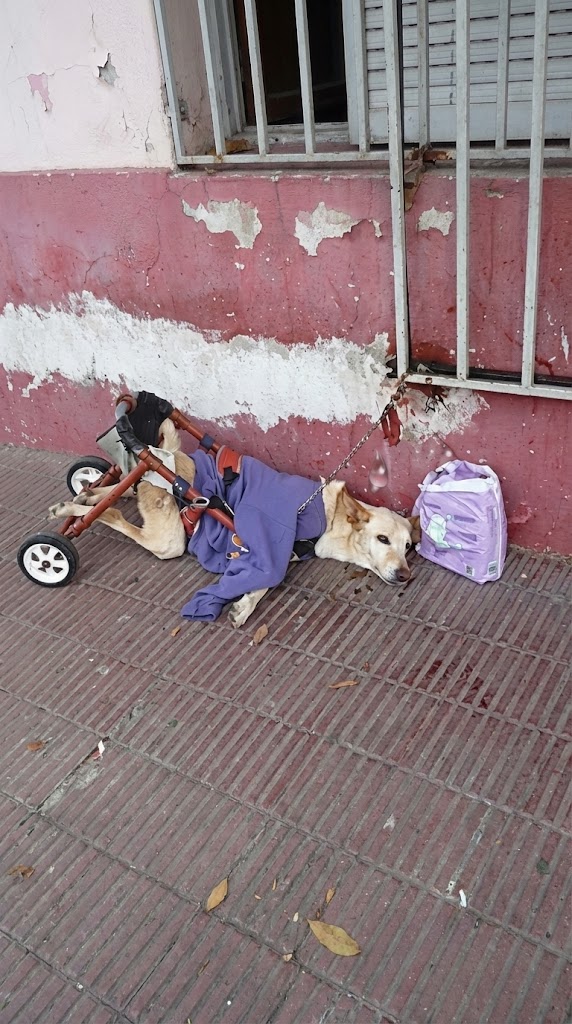
Lunita could not use her back legs.
So when she was left tied to a railing outside a grooming shop in Salta, Argentina, there was nowhere for her to go.
Beside her sat an old wheelchair, a bag of diapers, and a note explaining that the people who had cared for her could no longer continue.
Then they were gone.
Lunita remained on the sidewalk, dependent on whoever happened to notice her next.
For a dog already living with paralysis, abandonment created an especially vulnerable situation.
But someone did notice.
And although Lunita’s path would include setbacks no one expected, that sidewalk would not become the final chapter of her life.
Beside Her Was Everything She Owned
When members of the rescue group LUBA Salta learned about Lunita, they found a dog whose needs were impossible to ignore.
She was paralyzed from the waist down and relied on assistance for mobility and everyday care.
The belongings left beside her told part of the story.
A wheelchair.
Diapers.
A note.
They also showed how dependent Lunita was on people.
A dog with her condition could not simply wander off and begin surviving independently.
She needed someone to manage her mobility, hygiene, skin care, and physical health.
The rescuers took her in and began arranging what she needed.
Among the first priorities was giving Lunita a wheelchair that fit her properly.
Once supported by wheels, something important changed.
Her back legs still did not work.
But Lunita could move.
She could choose where she wanted to go.
And for a dog who had recently been left unable to leave a sidewalk, that freedom mattered.
VIDEO: Lunita Was Left Beside Her Wheelchair—Then Rescuers Gave Her Another Chance to Move
Her First New Home Wasn’t the Ending Everyone Hoped For
Lunita’s story eventually reached people far beyond Argentina.
A family in the United States expressed interest in taking her in.
It appeared to be the beginning of the stable home everyone wanted for her.
But caring for a paralyzed dog can be demanding.
According to the rescue account, the placement did not provide the level of care Lunita required.
When people involved in her rescue stepped in again, her physical condition had deteriorated significantly.
She weighed only about 35 pounds.
Her skin was badly affected.
Mange had caused extensive fur loss.
Urine irritation had damaged sensitive areas of her body, and infections had become another serious concern.
Touching some of those areas caused obvious discomfort.
Lunita had already been rescued once.
Now she needed to be rescued from another difficult situation.
This time, the people caring for her understood that improving her life would require more than finding any home willing to accept her.
She needed a home prepared for the realities of her condition.
Recovery Began With the Work No One Sees
A dedicated foster caregiver became central to Lunita’s recovery.
There was no immediate transformation.
Her body needed consistent daily attention.
Medicated baths were used to help manage her damaged skin.
Her diet was adjusted to help rebuild weight and strength, including fresh chicken and turkey described by her caregivers.
Her hygiene required close attention because paralysis made her more vulnerable to irritation and infection.
Then there was physical rehabilitation.
Although therapy could not simply reverse her paralysis, keeping Lunita active and supporting the parts of her body she could use helped her remain stronger and more mobile.
Day after day, the changes accumulated.
Her skin became healthier.
Her coat began recovering.
She gained weight.
Her energy increased.
The dog who had returned to rescue painfully thin and uncomfortable gradually became more interested in everything happening around her.
And when Lunita felt better, her personality became impossible to miss.
Wheels Didn’t Slow Lunita Down
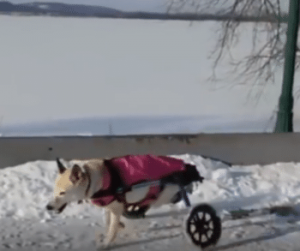
Lunita received a custom wheelchair designed to support her body while allowing her front legs to provide movement.
Once she was comfortable using it, she moved with surprising speed.
The wheelchair was not treated as something that made her less of a dog.
It was simply the equipment that helped her participate.
Lunita explored outdoors.
She crossed bridges.
She experienced snow.
She spent time with other dogs and joined their noisy group howls.
Her caregivers also became known for dressing her in a purple tutu, an accessory that eventually became part of the joyful image people associated with her.
Photographs of Lunita during this period looked very different from the dog who had once been tied beside an old wheelchair.
But the most meaningful difference was not the tutu.
Or even the new wheels.
It was participation.
Lunita was no longer waiting for the world to come to her.
She could move through it.
Disability Became One Part of Her Life, Not the Whole Story
Lunita never stopped being a dog with special needs.
Her paralysis still required daily management.
Her caregivers still had to pay attention to her skin, hygiene, mobility, and general health.
But those responsibilities existed alongside ordinary pleasures.
Food she enjoyed.
Time outside.
Other dogs.
Attention from people she trusted.
Movement.
Rest.
Play.
Her wheelchair made those experiences easier to access.
Instead of focusing entirely on what Lunita could not do, the people around her learned what she could do with the right support.
She could explore.
She could race forward using her front legs.
She could join the other dogs.
She could become excited about outings.
She could form strong bonds with the people caring for her.
For Lunita, quality of life was not measured by whether she could ever use her hind legs normally again.
It was measured by whether she could live comfortably, participate in the world around her, and be cared for consistently.
For years, she did exactly that.
Her Eleventh Birthday Became a Celebration of How Far She Had Come
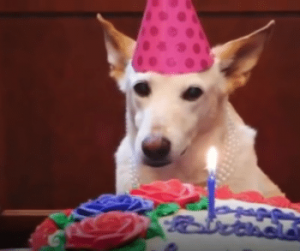
In June 2018, Lunita reached her eleventh birthday.
Her family celebrated.
There were special treats.
Attention.
The people and animals who had become part of her everyday life were around her.
For anyone who remembered how her story began, the milestone carried particular meaning.
Years earlier, Lunita had been left tied to a railing with her belongings beside her.
Later, she had endured another serious decline when a placement did not meet her medical needs.
Yet here she was at eleven.
Still moving in her wheelchair.
Still surrounded by people who had learned exactly what caring for her required.
Still unmistakably Lunita.
The birthday was not proof that every medical difficulty had disappeared.
It was something simpler.
A day when an older dog with significant disabilities was celebrated because her life mattered to the people around her.
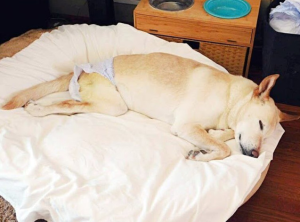
Then, about a month later, Lunita became seriously ill.
Her Final Days Were Surrounded by the Care She Had Waited So Long to Find
Lunita was taken to intensive veterinary care when her condition worsened.
Despite treatment, she did not recover.
She died shortly after her eleventh birthday.
The ending was painful for the family that had cared for her, particularly because they had spent years watching her overcome so many earlier challenges.
But Lunita did not leave this world in the same circumstances in which rescuers had first found her.
She was not alone on a sidewalk.
She had a family.
She had been known.
Photographed.
Celebrated.
Accommodated.
Loved through the complicated parts of caring for a disabled dog rather than only the easy ones.
Her caregiver later described how deeply Lunita had affected her life.
That bond had grown through ordinary days of feeding, cleaning, lifting, adjusting equipment, going outside, and watching a determined little dog race forward on wheels.
Those moments became Lunita’s real second chance.
Lunita’s Life Was Never Defined by the Sidewalk Where Someone Left Her
The photograph of Lunita tied beside a railing is difficult to forget.
A paralyzed dog.
An old wheelchair.
A bag of supplies.
And no familiar person remaining beside her.
But that image captures only one moment.
It does not show the dog who later raced in a custom wheelchair.
It does not show the purple tutu.
The snowy outings.
The other dogs.
The birthday celebration.
Or the family willing to organize daily life around the care she needed.
Lunita could not choose what happened to her at the beginning of the story.
But once the right people entered her life, disability stopped meaning that her world had to remain small.
Her wheels carried her farther.
Care kept her comfortable.
And consistency gave her the kind of home that had once seemed uncertain.
Lunita eventually reached the end of her life, as every dog does.
What changed was everything between the sidewalk and that final day.
She had been left unable to move away.
Years later, people remembered her for how eagerly she moved toward life.
And perhaps that is the most fitting way to remember Lunita.
Not as the dog someone abandoned beside a wheelchair.
But as the dog who finally received the right one—and then used it to go everywhere she could.


