The street around her never seemed to slow down.
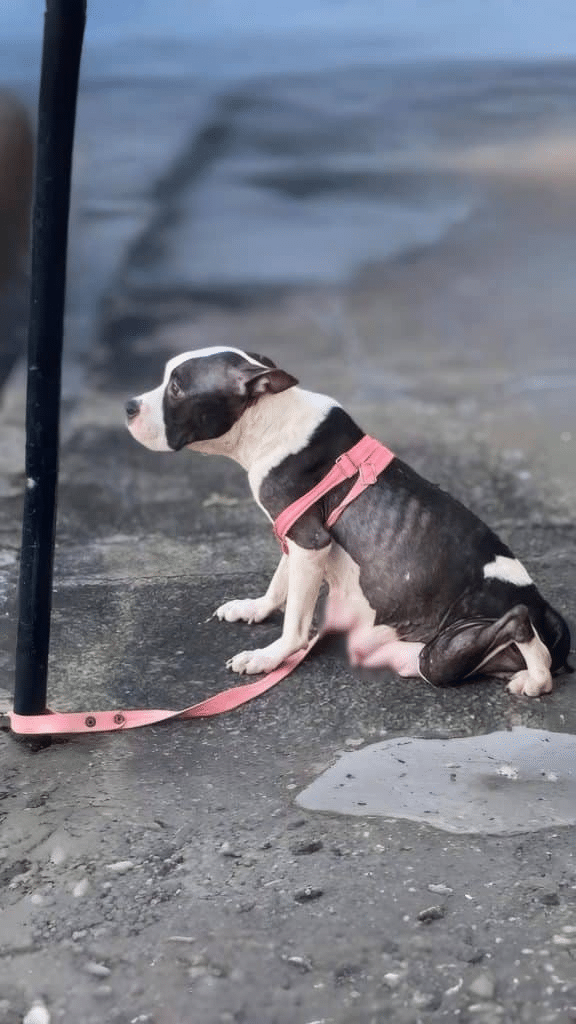
Cars passed beneath the afternoon heat. Pedestrians moved along the sidewalk, occupied with their own destinations. In the middle of all that motion, a thin mother dog stood tied to a pole with nowhere to go.
Her body revealed something the empty pavement did not.
Milk was still dripping from her.
She appeared to have given birth recently, yet there were no puppies resting beside her, no small cries coming from nearby, and no sign of where they might have gone.
The dog repeatedly turned toward every sound and movement around her.
Later, rescuers would call her Pandora.
When they first saw her, she was still searching.
Tied Beneath the Heat, She Kept Looking Around
The rope restricted Pandora to a small section of concrete beside the pole.
She could take only a few steps in each direction before being pulled back. Still, she repeatedly scanned the street, turning her head whenever someone approached or a sound rose above the traffic.
Her body was noticeably thin.
Her coat looked dull, and ticks could be seen across parts of her skin. The heat offered little relief, and there was no visible food, clean water, or shelter beside her.
The milk from her body suggested she had recently been nursing.
But the rescuers could not know what had happened to the puppies.
They might have been removed.
They might have become separated from her.
There was no information in the scene that could answer the question.
All the team could see was a nursing mother restrained beside a busy street, repeatedly looking beyond the small space the rope allowed her to reach.
Video: Nursing Mother Dog Found Tied to a Pole With No Puppies Anywhere Nearby
The First Approach Sent Her Into Panic
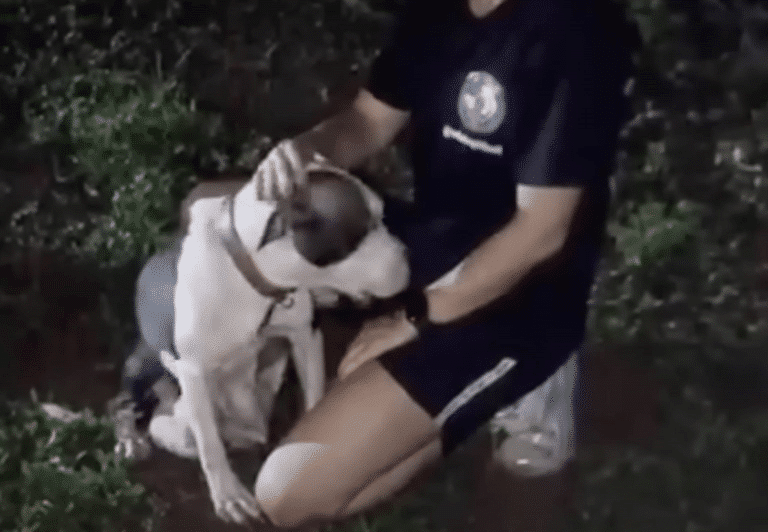
When the rescue team moved closer, Pandora immediately pulled against the rope.
Her body stiffened.
She shifted away from the approaching people and continued watching the activity around the street. Each attempt to reduce the distance between them caused another defensive reaction.
The rescuers did not know what experiences had shaped her response.
They could only see that direct contact frightened her.
So they stopped advancing.
Instead of surrounding Pandora or attempting to grab her quickly, the team lowered themselves nearby. They spoke in calm voices and placed food and water within the limited area she could reach.
At first, she remained hesitant.
She leaned toward the offerings, then pulled back when someone moved. Hunger encouraged her forward while uncertainty kept drawing her away again.
The rescuers allowed the process to unfold at her pace.
They stayed where she could see them.
They avoided sudden movements.
And they waited for her breathing and posture to become less tense before trying again.
Patience Finally Brought Her Away From the Pole
Pandora’s body trembled as the rescuers worked around her.
She appeared physically exhausted, and standing in the heat had likely consumed much of the limited energy she still had. Several times, she lowered her body as though remaining upright had become difficult.
Still, the team did not rush the final approach.
They offered food.
They spoke softly.
They allowed her to smell the hands coming near her before attempting to handle the rope.
Gradually, Pandora stopped pulling with the same intensity.
She remained wary, but she allowed the rescuers close enough to secure her safely and remove the restraint holding her beside the street.
That moment did not instantly transform her behavior.
She did not begin wagging her tail or seeking affection.
She simply left the pole.
For the first time in the footage, Pandora could be moved away from the traffic, concrete, and heat toward a place where her condition could be properly assessed.
The search for her puppies could not be resolved by the information available.
But the mother dog herself was no longer being left behind.
Her Body Needed Immediate Care
At the shelter, veterinarians examined Pandora more closely.
She was underweight and carrying a heavy tick infestation. Her physical condition suggested she had gone without consistent nutrition and basic care.
The veterinary team also focused on her mammary glands.
Because Pandora was still producing milk without puppies visibly nursing, the glands had become swollen and uncomfortable. Milk buildup can create additional medical concerns if it is not monitored and treated appropriately.
The team began addressing her condition carefully.
The ticks were removed and treated.
Her skin was cleaned.
She received food in portions suited to her weakened body, along with water and a quiet place to rest.
The swollen areas also required attention to reduce discomfort and watch for signs of infection.
Pandora had been brought away from the pole, but recovery would involve more than simply untying the rope.
Her body needed nourishment.
Her skin needed treatment.
And her behavior showed that safety around people would have to be learned gradually.
She Still Reacted to Sounds Around the Kennel
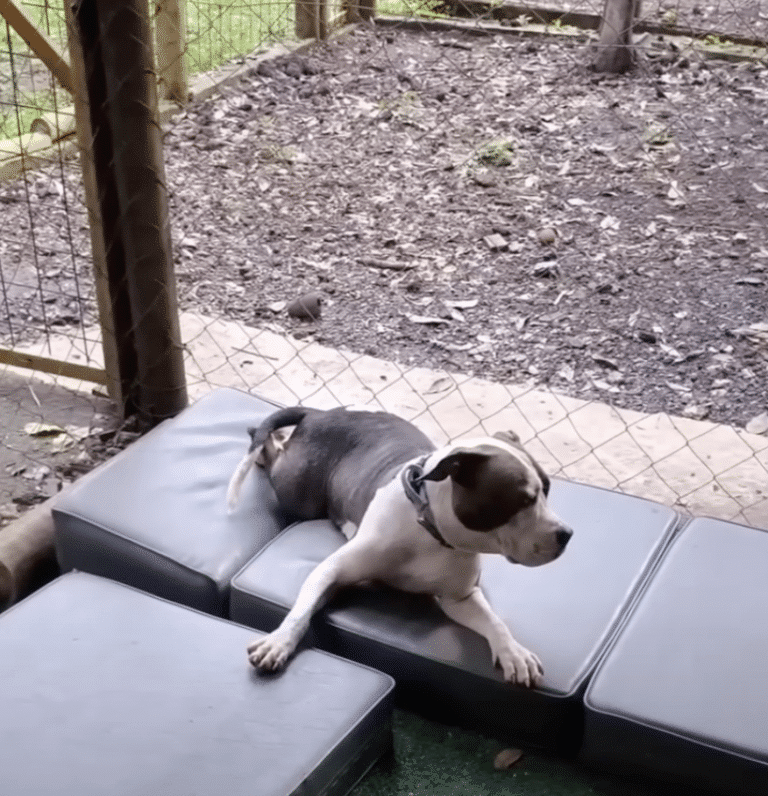
During her early days at the shelter, Pandora spent long periods lying quietly.
She often rested with her head low, showing little interest in exploring the unfamiliar environment. When caregivers entered, she watched them closely before deciding whether to accept their presence.
Sounds from other dogs drew an immediate response.
Whenever barking or whining came from another area, Pandora sometimes lifted her head and listened.
The staff could not know what those sounds meant to her or whether she associated them with the puppies that had not been found beside her.
They avoided assigning a definite explanation to the behavior.
What they could see was that the nursing mother remained highly alert to the animals around her.
Caregivers began sitting near her without demanding interaction.
Some visits involved gentle conversation.
Others involved simply replacing food, checking her treatment, and remaining nearby for a few quiet minutes.
Pandora did not respond the same way every day.
At times, she accepted a careful touch.
At other times, she preferred distance.
The team respected both reactions.
Trust was not treated as something she owed them in return for being rescued.
Another Dog Helped Her Become More Curious
A noticeable change began after Pandora was introduced carefully to another rescue dog.
The first interactions were cautious.
Pandora watched the dog closely and kept some distance. The other animal did not rush toward her or force play, allowing the two to share space without pressure.
Over time, Pandora began following.
The dogs walked together through the shelter yard.
They explored nearby areas at a calm pace and rested within sight of one another. Familiar canine company appeared to help Pandora engage more comfortably with the environment.
Then caregivers noticed her tail move.
It was not a dramatic reaction.
The movement was brief and gentle, but it was one of the first visible signs that Pandora was beginning to relax during her time outside the kennel.
More changes followed.
She accepted treats with less hesitation.
Her movements around familiar caregivers became calmer.
She spent more time walking and observing rather than remaining withdrawn in one place.
Her physical treatment continued throughout this period. As regular food improved her strength and the swelling in her body was addressed, Pandora gained more energy to participate in the world around her.
A Family Saw More Than Her Difficult Beginning
Eventually, a family learned about Pandora and came to meet her.
The shelter did not present her as a dog whose past had been instantly erased.
She had made progress, but new surroundings and unfamiliar people could still require patience. Her adopters would need to continue the predictable routines that had helped her settle at the shelter.
During the meeting, the family approached quietly.
They gave Pandora space to observe them and did not demand immediate affection. After some time, she moved closer and accepted their touch.
The connection developed without a dramatic display.
There was no sudden leap into their arms.
Instead, Pandora stayed near them.
For a dog who had once pulled desperately against a rope whenever strangers approached, that decision carried its own meaning.
The family chose to bring her home.
Pandora left the shelter not because every uncertainty had disappeared, but because someone was prepared to continue helping her feel secure beyond the rescue center.
She No Longer Has to Search From the End of a Rope
In later footage, Pandora moves through open grassy spaces without the restriction that once held her beside the road.
She runs.
She rolls across the ground.
She approaches her family with a relaxed body and a moving tail.
The contrast is unmistakable.
When rescuers first encountered her, she could only circle a pole while milk dripped onto the concrete beneath her. She repeatedly looked toward the busy street, but the rope prevented her from following any sound or movement beyond its reach.
The available story never explains what happened to her puppies.
That unanswered part should not be replaced with a more comforting version simply because the truth is difficult.
What is known is that Pandora was found alone, still nursing, physically depleted, and tied where hundreds of people could pass her.
One team stopped.
They did not expect immediate trust.
They did not punish her for pulling away.
They provided treatment, time, and the company of another dog while she slowly began participating in life around her again.
Pandora could not recover what had already disappeared before rescuers arrived.
But she could be freed from the pole.
She could receive medical care.
And she could eventually enter a home where food, shelter, and familiar people would remain part of her daily life.
Once, she searched the street from the end of a rope.
Now she can move freely—and no longer has to face every unfamiliar sound alone.


