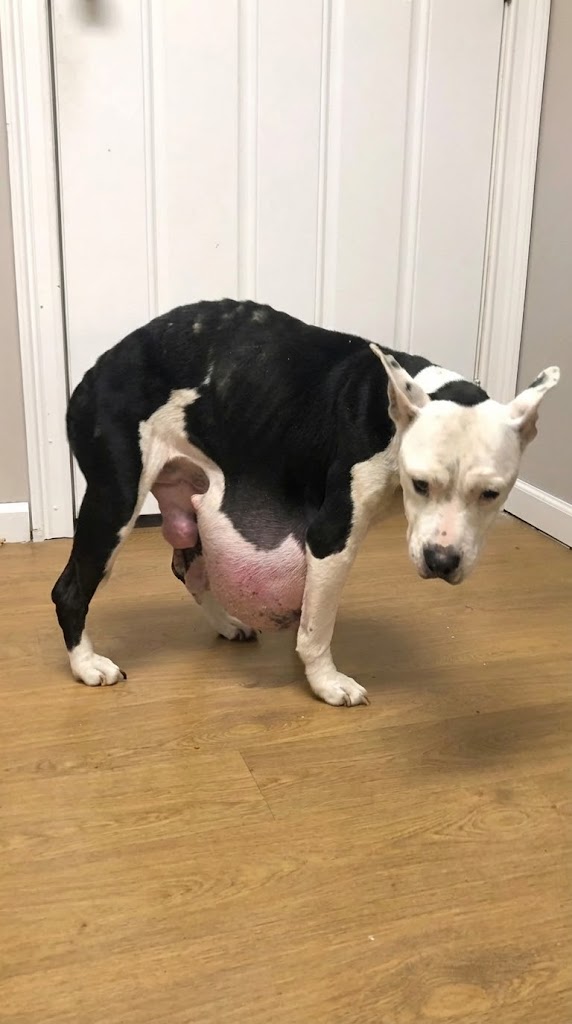
The call about Nina came late at night.
An older dog had reportedly been found living inside an abandoned car in northern Memphis.
She was thin.
Sick.
And carrying two large masses beneath her abdomen.
By the time arrangements were made to transfer her to Wright-Way Rescue in Illinois, the team already knew she would need more than a simple examination.
But even they were not prepared for how much her body had been carrying.
Nina was about eight years old.
And the largest tumor hanging from her abdomen was so substantial that immediate surgery was considered too dangerous.
The Largest Tumor Pulled Heavily From Her Abdomen
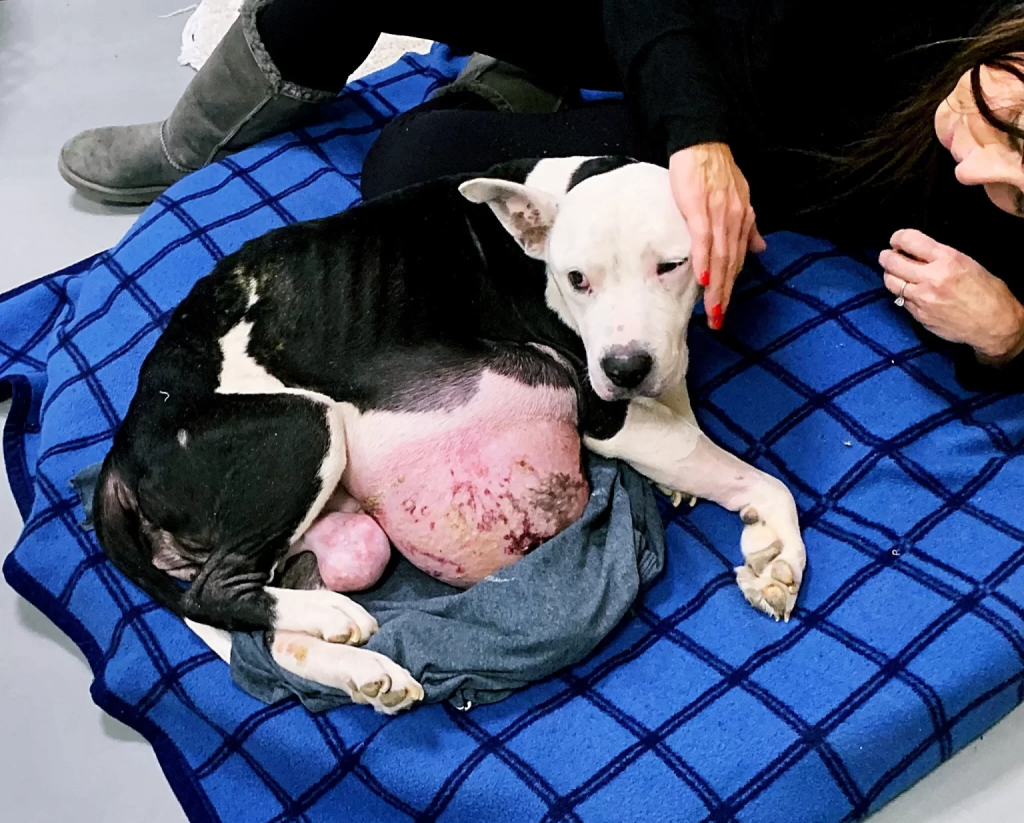
When Nina arrived, her condition was impossible to overlook.
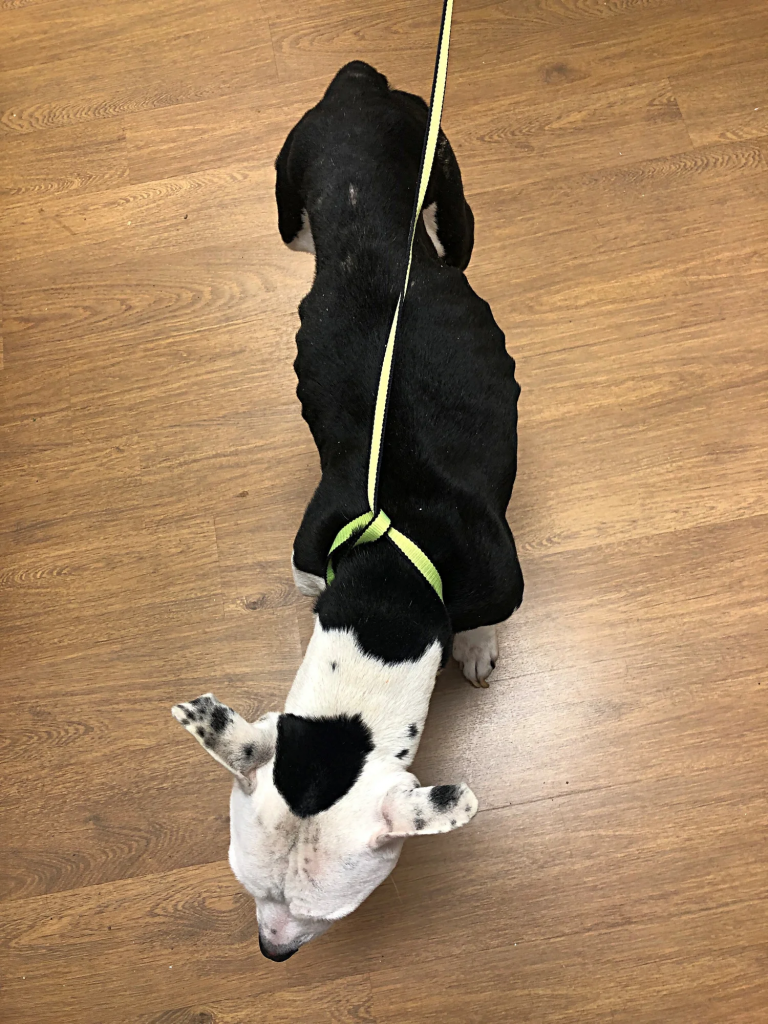
Her ribs were visible beneath a thin coat.
Two masses hung from her abdomen.
One was especially large and heavy.
Her back legs were swollen and irritated, with sores associated with a severe untreated skin problem.
Walking required effort.
Even so, Nina remained calm enough for the team to begin evaluating her.
Because of staffing complications related to COVID exposure, she was first assessed at an admissions facility before being transferred for more extensive testing.
Video: Eight-Year-Old Nina Arrives With a Massive Tumor Hanging Beneath Her Abdomen
Doctors Needed Answers Before They Could Consider Surgery
Nina underwent several tests.
Bloodwork.
X-rays.
Ultrasound imaging.
And tissue biopsies.
The medical team quickly discovered that the tumors were highly vascular, meaning they contained a significant blood supply.
That made surgery much more complicated.
Operating immediately on a dog already severely underweight and medically fragile could create serious bleeding and anesthesia risks.
So the team made a deliberate decision.
Nina first needed to become stronger.
Food, hydration, pain control, treatment for infection, and rest had to come before a major operation.
X-Rays Revealed Another Injury From Her Past
The imaging found something unrelated to the tumors.
According to the rescue account, X-rays showed evidence that Nina had previously been shot in the left shoulder.
The source does not explain when that injury occurred or provide further details about the incident.
It also reports that Nina’s former caretakers were struggling with serious addiction problems and connects that situation to her neglect.
Those details come from the rescue account and are not independently documented in the article.
The same source states that Nina had spent years living in or around the vehicle where she was found.
Whatever the full history was, her current medical condition showed that important problems had gone untreated for a long time.
For Now, Her Treatment Was About Making Her Stronger
Nina was given a quiet place to rest.
Soft bedding replaced the hard environment she had reportedly been living in.
Meals were offered carefully.
Pain medication and anti-inflammatory treatment helped keep her comfortable.
Antibiotics were used to address infection concerns.
IV fluids supported hydration.
She also needed ongoing attention for the damaged skin around her hind legs.
The goal was not dramatic improvement overnight.
It was stabilization.
Every meal she finished and every normal response mattered because surgery could not even be considered until her body was better prepared.
Some Test Results Brought Relief — Others Raised New Concerns
As Nina continued treatment, several updates were encouraging.
Her fever resolved.
Her appetite improved.
Ultrasound did not show an abscess inside the large tumor.
Imaging also reportedly ruled out hernia involvement.
Then repeat bloodwork brought a more concerning result.
According to the source, Nina’s white blood cell count was approximately five times higher than normal.
That raised concern that cancer might be involved.
The article does not provide a final cancer diagnosis at this stage.
So the elevated count should be understood as a warning sign that required further investigation, not proof of a specific cancer.
Six Veterinarians Agreed That Surgery Could Not Be Rushed
Nina’s case was reviewed by six veterinarians, according to the rescue account.
They reached the same general conclusion.
Operating immediately was too risky.
The largest mass was reported to weigh close to half of Nina’s body weight, making both her overall condition and the surgical challenge unusually serious.
For a dog already underweight and medically compromised, the team believed more preparation was necessary.
So treatment continued.
Nina ate.
Rested.
Received medication.
And slowly began taking short walks.
Those ordinary improvements were important because they gave doctors more options than they had on the day she arrived.
She Became More Comfortable Around the People Caring for Her
As her physical condition stabilized, Nina also became more interactive.
She accepted affection.
Her tail moved more often when familiar staff approached.
She began walking short distances.
Volunteers spent time sitting near her between treatments.
None of that solved the tumors.
But it changed the quality of her days while the medical team worked through a difficult case.
Nina was no longer simply waiting inside a vehicle with untreated problems.
She was being watched closely by people who knew exactly how medically complicated her situation was.
The Next Major Step Was a CT Scan
The medical team still needed to understand how the tumors were connected internally.
A consultation with a surgical specialist was scheduled.
The next planned step was a CT scan.
That imaging would help determine where the masses attached, what structures were involved, and whether surgery could eventually be performed with an acceptable level of risk.
Until then, the team continued doing what Nina’s body could tolerate.
Nutrition.
Medication.
Monitoring.
Rest.
And careful movement.
Nina’s Story Was Still Unfinished
The original account ends before a final surgical outcome is given.
There is no confirmed tumor removal in the source.
No final pathology result.
No adoption ending.
At that point, Nina was still undergoing evaluation.
That uncertainty is part of the story.
She had reached rescue.
Her immediate infections and discomfort were being treated.
Her appetite had improved.
And multiple veterinarians were working toward a safer plan for the enormous tumors she carried.
But the hardest medical decision was still ahead.
Nina had spent long enough with problems nobody was treating.
Now, for perhaps the first time in years, every change in her condition was being noticed.
And instead of rushing into an operation her body might not survive, the people around her were giving her something she needed just as much as surgery—
time to become strong enough for whatever came next.


