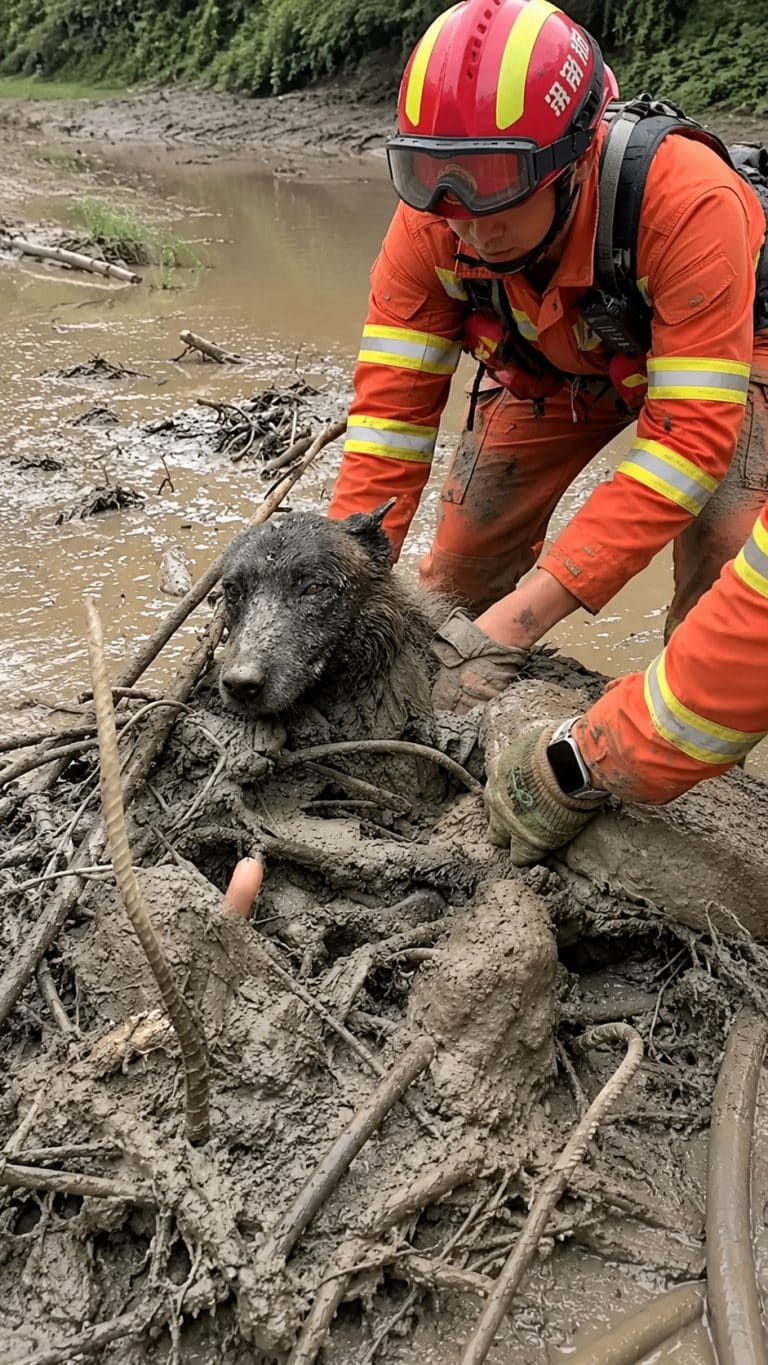
At first, rescuers could not tell whether anything was moving.
The landslide had left behind a wide field of thick mud, tangled roots, and broken debris. Almost everything beneath the surface had disappeared.
Then someone noticed two eyes.
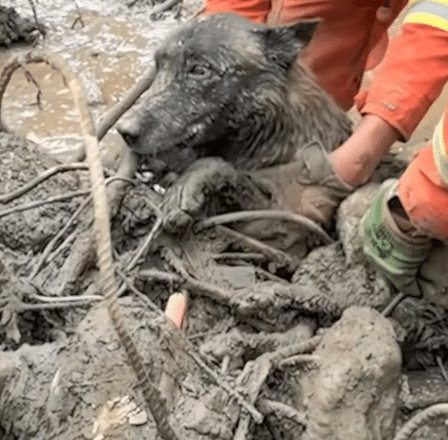
A dog was buried in the mud with only his head exposed.
According to reports accompanying the rescue footage, he had been trapped there for nearly 30 hours—unable to stand, turn around, or pull himself free.
He was exhausted.
But he was still alive.
His Entire Body Was Locked Beneath the Earth
The mud had packed tightly around the dog’s body.
Roots and debris appeared to hold him in place, leaving almost no room for movement. He could not use his legs to push upward or shift into a more comfortable position.
Only his head remained above the surface.
That small opening allowed him to breathe, but even breathing appeared difficult. Mud surrounded his neck, and the weight below prevented his chest and body from moving normally.
The firefighters understood that reaching him would require more than simply pulling.
They did not know what injuries might be hidden beneath the mud.
A leg could be caught under a root.
His body might be pressed against sharp debris.
And after so many hours trapped in one position, a sudden movement could create additional harm.
So the rescuers knelt beside him and began digging carefully with their hands.
Video: Firefighters Find a Dog Alive After Nearly 30 Hours Buried Beneath Landslide Mud
They Could Not Risk Pulling Him Too Soon
The dog watched the rescuers as they worked around his head and shoulders.
His eyes remained open, following the hands moving through the earth beside him. He did not have enough freedom to retreat or defend himself if he became frightened.
The firefighters spoke softly while removing small amounts of mud at a time.
They cleared the area around his neck first, creating more space for him to breathe. Then they began working downward toward his shoulders and front legs.
The mud was heavy and wet.
Each handful revealed more packed earth beneath it. Roots and pieces of debris had to be loosened without shifting them suddenly against the dog’s body.
Using large tools could have saved time, but it also could have injured the animal hidden below the surface.
The rescuers continued with their hands.
Slowly.
Carefully.
Always checking how the dog responded before moving farther.
Each Handful of Mud Revealed a Little More
Progress came in small sections.
First, more of the dog’s neck became visible.
Then part of his upper body emerged from the mud.
The rescuers adjusted their positions and continued clearing the soil around him. Their clothing and gloves became coated in the same thick earth that had held the animal for so long.
The dog remained remarkably still.
That stillness may have helped the rescue, but it also revealed how exhausted he had become. After nearly 30 hours of pressure, cold, and immobility, he appeared to have very little energy left.
The firefighters did not mistake his quietness for comfort.
They continued supporting his head and speaking to him as they worked.
At several points, one rescuer kept a hand near the dog’s face while others dug. The contact appeared to help keep him steady as more of the trapped body was uncovered.
Gradually, the outline of the dog beneath the mud began to appear.
But the team still could not pull him free.
His lower body remained buried.
The Final Lift Had to Be Gentle
After enough mud had been removed, the rescuers were finally able to reach beneath the dog’s body.
They checked for resistance before lifting.
The animal did not need to be dragged upward against whatever remained below. Instead, the firefighters continued loosening the earth until his body could move without being forced.
Then they lifted together.
For the first time in more than a day, the dog rose above the mud.
His coat was completely covered in dirt. His legs hung weakly, and his body trembled as the rescuers carried him away from the hole.
There was no sudden burst of energy.
He did not stand immediately or begin running around the rescue site.
He appeared too exhausted for any of that.
But he was no longer buried.
The earth that had held him in place for nearly 30 hours was finally beneath him rather than surrounding him.
A Wooden Board Became His First Safe Place
The firefighters placed the dog carefully onto a wooden board.
It served as a temporary stretcher, keeping his weakened body supported while the team began checking his condition.
Several rescuers gathered around him.
One wiped mud from his face so he could breathe and see more comfortably. Others examined his legs and body for visible injuries.
A bandage was wrapped around one affected leg.
The team continued speaking and touching him gently while the first aid was completed.
The scene was very different from the urgent digging that had come before it.
There was still work happening all around them, and the destruction caused by the landslide had not disappeared.
Yet for a few moments, the rescuers focused on one exhausted animal lying across a simple wooden board.
Their expressions showed relief.
The dog had survived the burial.
Now he needed to survive what came afterward.
Saving Him Was Only the First Stage
Being freed from the mud did not mean the dog had fully recovered.
Prolonged pressure and immobility can affect an animal in ways that are not immediately visible. His body would need to be examined for fractures, circulation problems, dehydration, exposure, and other complications.
Mud could also hide cuts or irritated areas beneath his coat.
The rescuers prepared to transport him for medical treatment, keeping his body supported rather than encouraging him to stand before he was ready.
That decision mattered.
The dog had already spent nearly 30 hours unable to change position. Asking him to walk immediately could have placed additional strain on injured or weakened limbs.
Instead, he remained on the makeshift stretcher.
He was surrounded by people.
His face had been cleared.
And for the first time since the landslide, his body was no longer carrying the full weight of the earth around him.
One Small Life Still Mattered in the Middle of Disaster
Landslides leave rescuers with overwhelming responsibilities.
There may be damaged homes, blocked roads, unstable ground, and people who need urgent assistance. Every movement must be made carefully because the earth itself may continue shifting.
In the middle of such destruction, a trapped animal can be difficult to notice.
This dog was almost completely hidden.
There was no visible body moving across the surface.
No clear path leading toward him.
Only a small head and a pair of eyes remained above the mud.
Someone looked closely enough to see them.
Then the firefighters spent the time required to free him safely rather than pulling quickly and risking further injury.
They dug with their hands.
They paused when necessary.
And they continued until the dog’s entire body could be lifted without force.
His Eyes Were No Longer the Only Part of Him Above the Mud
The final footage shows the dog resting on the wooden board as rescuers prepare to move him away from the landslide area.
He remains covered in dirt.
His body is weak.
And the full extent of any injuries cannot be determined from the rescue scene alone.
But the most immediate danger has ended.
At the beginning, only his head could be seen.
Everything below it was trapped beneath heavy mud, roots, and debris.
Nearly 30 hours later, his entire body was finally above the surface.
His survival cannot be credited to determination alone. The position of his head, the arrival of rescuers, and the careful way they removed the mud all played essential roles.
What can be seen clearly is that the dog remained alive long enough to be noticed.
And once firefighters found him, they treated that small life as worth the same patience and care as any other survivor.
The landslide had buried almost everything around him.
It did not manage to hide his eyes.
Someone saw them.
Someone began digging.
And one careful handful of mud at a time, the dog was brought back into the light.


