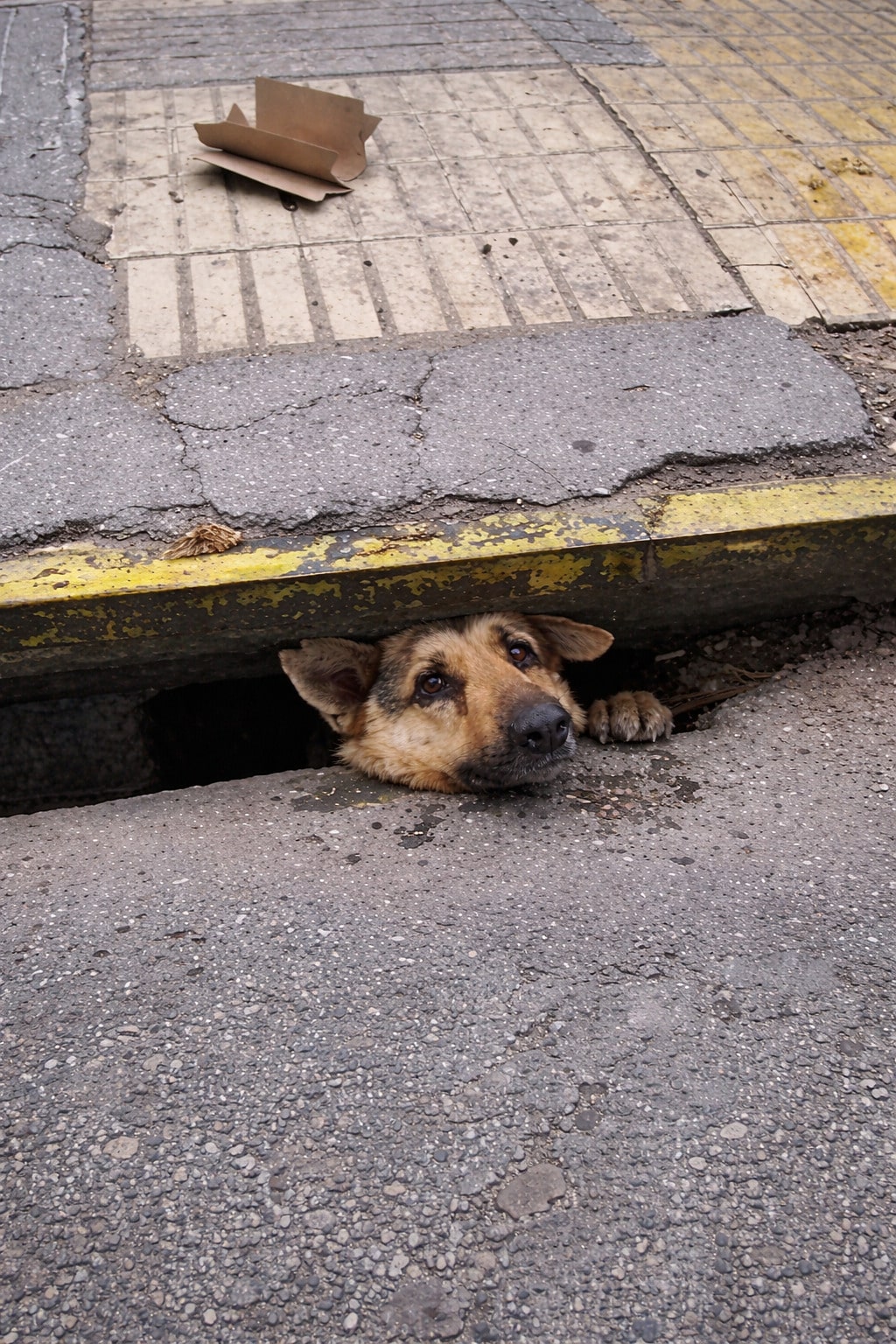
At first, residents noticed only a pair of frightened eyes looking up from beneath the pavement.
A dog was trapped deep inside a sewer system in Bahía Blanca, Argentina. His body remained hidden underground, while his head and front paws barely reached a narrow opening near the drain.
No one knew how he had fallen inside.
What they did know was that he had already been there for four days.
Weak, frightened, and unable to climb out, the dog had only one option left.
He had to trust the strangers gathering above him.
A Frightened Face Beneath the Pavement
The discovery was made near the intersection of Roca and Terrada.
Residents had noticed something unusual around one of the street drains. When they moved closer and looked down, they found a dog staring back at them from inside the sewer.
Most of his body was trapped somewhere beneath the street.
Only his head and front paws could reach the opening.
He did not bark continuously or struggle wildly. After several days underground, he may no longer have had the strength.
Instead, he remained in the same cramped position and watched the people above him.
The sewer was dark and narrow. Every passing vehicle sent vibrations through the pavement, while unfamiliar noises echoed through the pipes surrounding him.
There was no clear path back to the surface.
No place to rest comfortably.
And no way for the dog to understand whether anyone would return once the crowd moved away.
But the residents did not leave.
They began asking questions and soon learned that the dog may have been trapped beneath the street for more than four days.
How he survived that long was remarkable.
He had found one small opening where he could breathe and see the outside world. It was barely enough to keep him connected to the surface.
But it also allowed someone to notice him.
Video: For Four Days, Only His Head Could Reach the Street Above
The Neighborhood Refused to Look Away
Once residents understood what they had found, concern quickly spread through the neighborhood.
The dog could not climb out on his own. The opening was too narrow, and no one could tell exactly where the rest of his body was positioned inside the sewer system.
While calls were made to emergency services, neighbors began helping in the only ways immediately available to them.
They carefully lowered food through the opening.
They offered water.
They remained close so the dog would not be left alone again.
Those small actions became essential.
After several days without dependable nourishment, even a little food and water could help him hold on until trained responders arrived.
More people gathered near the drain as news of the trapped dog traveled through the area.
Some watched quietly.
Others helped contact local authorities.
Everyone understood that attempting to pull the dog out without proper equipment could frighten him or cause an injury.
Patience was necessary.
The residents had found him, but freeing him would require a coordinated effort.
Until then, they continued speaking to him from above.
The dog could not understand their words.
But he could hear the calm voices.
He could see that people kept returning.
And for the first time since becoming trapped, he was no longer facing the darkness alone.
Rescuers Faced a Complicated Underground Mission
Civil Defense officials and local emergency responders soon arrived at the scene.
They began by assessing the drain, the underground passage, and the dog’s position.
A sewer rescue can become dangerous very quickly.
The space is narrow.
Visibility is poor.
Access points may be far from the trapped animal.
Even a frightened movement from the dog could push him deeper into the system or place him beyond the rescuers’ reach.
The team needed to understand the layout before acting.
They examined several possible approaches and prepared the equipment necessary to reach him safely.
Above ground, residents waited anxiously.
Below them, the dog remained unusually calm.
He had already spent days surrounded by darkness and echoing sounds. Now new noises filled the sewer as equipment was moved into place and rescuers communicated with one another.
Still, he did not panic.
Perhaps exhaustion kept him still.
Perhaps the food, water, and voices from above had reassured him.
Or perhaps he simply understood that the activity around him was different from the silence of the previous four days.
Someone was finally trying to reach him.
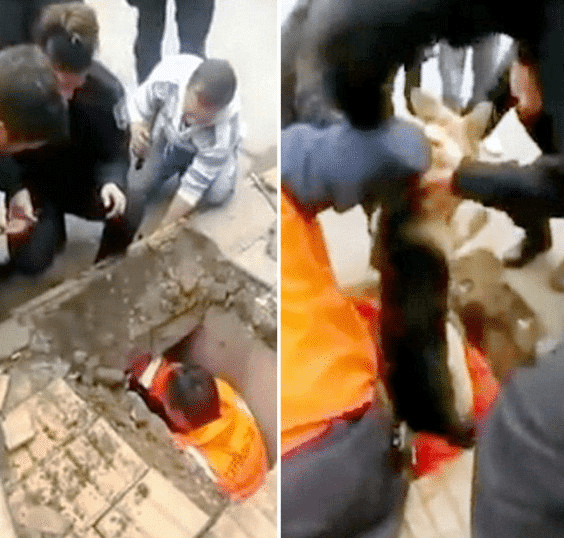
The Moment He Rose Into Open Air
The rescue operation moved slowly.
Every movement had to be coordinated. The responders needed to secure the dog without placing unnecessary pressure on his body or causing him to retreat deeper beneath the street.
Progress was difficult to see from above.
Minutes passed.
Then more time.
But no one gave up.
The residents who had first discovered the dog remained nearby, watching the rescuers work and hoping the animal still had enough strength to endure the final stage.
Then the long-awaited moment arrived.
After considerable effort, the rescue team managed to lift the dog from the sewer.
For the first time in four days, his entire body emerged into the open air.
He was frightened and exhausted.
But he was alive.
The relief among those gathered around the drain was immediate.
People who had begun as strangers were now connected by one shared goal: getting a vulnerable animal safely out of the darkness.
The dog no longer had to hold his head near the opening just to breathe.
He no longer had to wait beneath passing traffic.
And he no longer had to wonder whether the people above him would disappear.
They had stayed until he was free.
Resting After Four Days Underground
Following the rescue, the dog was taken to a local facility where he could be examined and given time to recover.
His ordeal had placed his body under enormous stress.
For days, he had remained in a confined position with limited food and water. Even without visible injuries, dehydration, exhaustion, and prolonged fear required careful attention.
Staff provided him with nourishment and a quiet place to rest.
There were no echoing pipes.
No hard concrete pressing around him.
No need to keep his head lifted toward a tiny opening.
Only safety.
Understandably, the dog was shaken by what he had experienced. But he also began showing encouraging signs as he rested and regained his strength.
His rescuers had reached him before the situation became irreversible.
The frightened animal who had spent four days beneath the city now had people monitoring his health and making sure his needs were met.
His life was no longer defined by the underground space where he had been found.
A new chapter had begun.
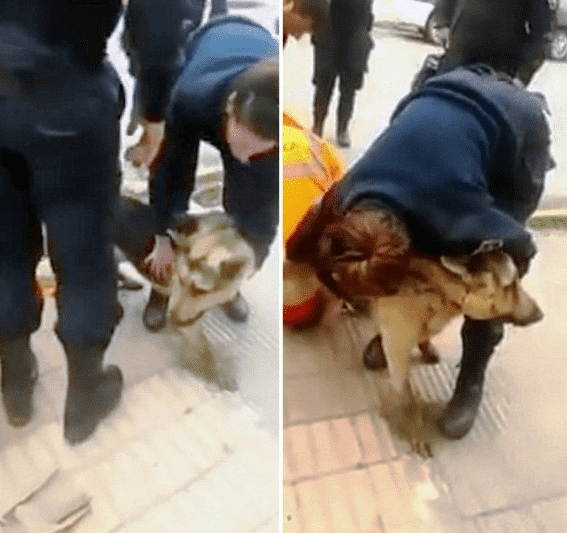
Waiting for Something Better This Time
After recovering from the immediate stress of the rescue, the dog became available for adoption.
Once, he had waited beneath a street without knowing whether help would ever come.
Now, he was waiting for something entirely different.
A family.
A permanent home.
A place where food and water would always be available, and where he would never again have to search for safety alone.
The people caring for him hoped his story would reach someone prepared to offer patience, stability, and affection.
His experience had been frightening, but it did not have to define the rest of his life.
The dog who had survived four days underground had already shown remarkable resilience.
What he needed next was not another dramatic rescue.
He needed the ordinary comforts every dog deserves.
A bed.
A familiar voice.
Daily meals.
Someone who would notice when he was missing and always make sure he returned home safely.
His future, once hidden beneath concrete, was finally open.
The Rescue Belonged to an Entire Community
Footage of the operation later circulated online, allowing people far beyond Bahía Blanca to witness the moment the dog was brought to safety.
But the most powerful part of the story was not one heroic act.
It was the way many ordinary actions came together.
One resident noticed something unusual.
Someone looked more closely.
Neighbors lowered food and water.
Others contacted emergency services.
Civil Defense officials and local responders brought the training and equipment needed to complete the rescue.
Caregivers then provided the dog with a safe place to recover.
No single person changed the outcome alone.
The dog survived because an entire chain of people decided that his life was worth their time.
They could have assumed someone else would help.
They could have walked away after making one phone call.
Instead, they stayed involved until the dog was safely above ground.
That choice made all the difference.
Rescue does not always require one extraordinary hero.
Sometimes it requires a community willing to share responsibility.
Someone notices.
Someone calls.
Someone brings water.
Someone arrives with the right tools.
And everyone remains until the life in danger is finally safe.
For four days, the dog waited beneath the streets with only his head reaching the world above.
Then the world looked back.
And this time, it refused to leave him there.


