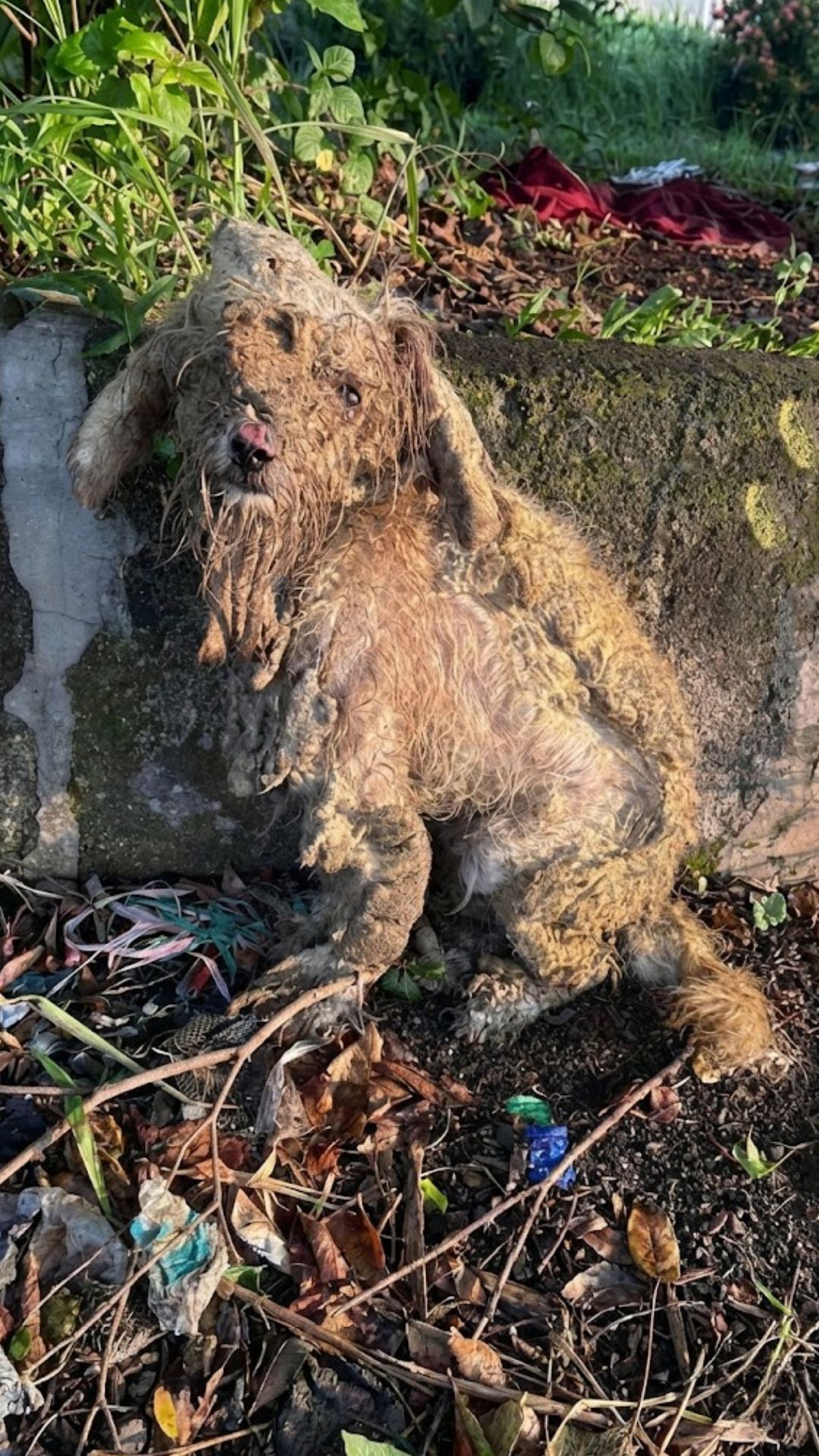
The street was almost empty.
Dust sat quietly along the roadside, and near the edge of it was a small shape that barely moved.
At first glance, it was difficult to tell where the dog ended and the tangled fur began.
Her coat had grown into dense, hardened mats that covered almost every part of her body.
The clumps pulled tightly against her skin.
Her face was partly hidden.
Her movements were slow.
And when rescuers stepped closer, she did not run.
She simply lifted her head.
The little dog would later be named Pening.
She was only about two years old.
Yet when she was finally picked up and weighed, the number was startling.
Just 4.3 kilograms.
Her small body was carrying far more than its own weight should ever have had to endure.
The Fur Had Become a Burden She Could Not Escape
Pening’s coat was not simply overgrown.
The mats had become part of the problem.
Thick sections of hair had twisted together so tightly that they restricted normal movement and pulled against the skin underneath.
Walking looked uncomfortable.
Changing position required effort.
Even seeing her actual body condition was difficult because the fur hid almost everything beneath it.
Rescuers approached slowly.
Pening remained quiet.
She did not attempt to flee.
She did not protest when they came close enough to touch her.
Whether from exhaustion, weakness, or simple caution, she appeared to have very little energy left.
There was no reason to keep her on the roadside any longer.
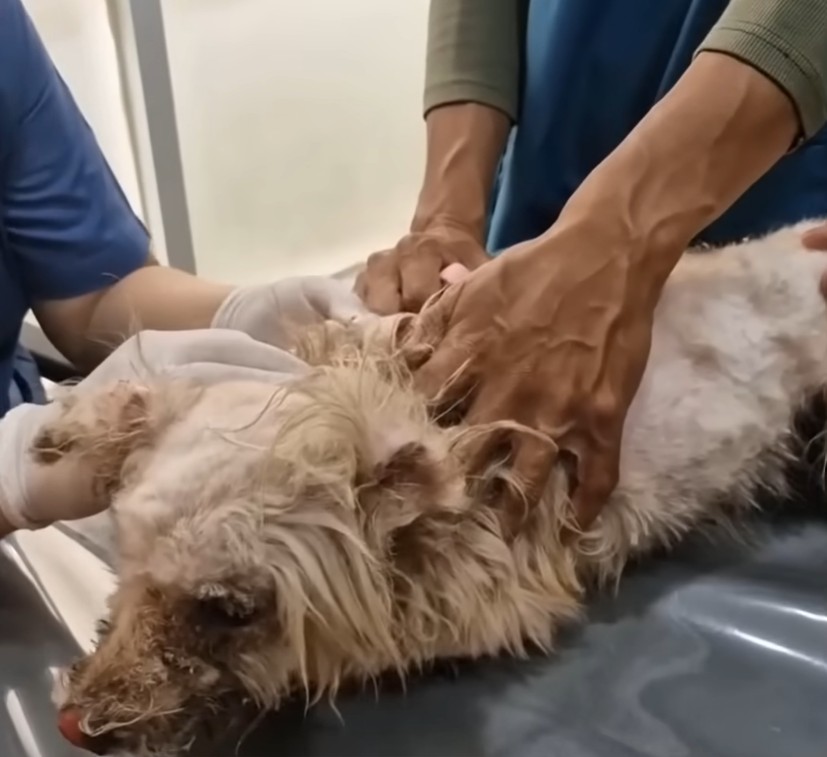
Pening was lifted carefully and taken for veterinary care.
Only then would the team begin to understand how much the mats had been hiding.
VIDEO: Covered in Painful Mats and Hidden Wounds, Pening Finally Learns What Safety Feels Like
Blood Tests Revealed Problems the Fur Could Not Show
At the clinic, Pening’s body temperature was relatively stable.
That offered some reassurance.
But the bloodwork told a more concerning story.
According to the rescue account, signs of infection were already present.
She was also anemic.
For a dog weighing only 4.3 kilograms, both problems mattered.
Her body had little reserve to begin with.
Now it was also trying to respond to inflammation and illness.
The veterinary team needed to address more than the coat.
Pening required medical treatment.
Nutrition.
Monitoring.
And enough time for her body to recover from problems that had likely developed over a long period.
Before her skin could be treated properly, however, the mats had to come off.
That process needed to be slow.
No one knew what was hidden directly beneath them.
Each Layer of Fur Revealed Another Part of the Damage
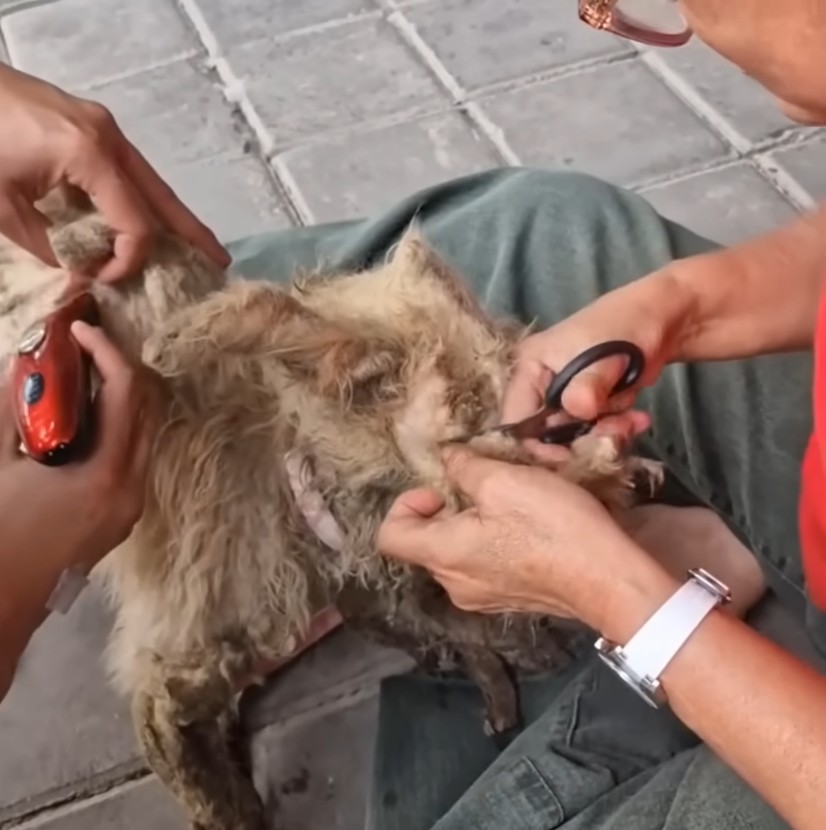
The clippers began carefully.
A section of matting was loosened.
Then another.
Heavy pieces of fur fell away from Pening’s body.
As the coat disappeared, the condition of her skin became visible.
There were sores.
Areas of irritation.
Raw patches that had been hidden underneath dense fur.
Fleas scattered as the groomers worked through the tangled coat.
The mats had trapped dirt and moisture close to the skin, making proper cleaning almost impossible before rescue.
Now the team could finally reach those areas.
Pening stayed relatively still through much of the grooming.
The clippers buzzed.
Hands repositioned her carefully.
Sensitive spots were avoided whenever possible.
Once the dense coat was gone, the difference was immediate.
Her body looked much smaller.
The medical team could finally inspect the wounds directly.
And treatment could become much more precise.
Recovery Began With the Same Small Tasks Every Day
Pening did not need one dramatic solution.
She needed many simple things repeated consistently.
Antibiotics were introduced to help control the infection described in her medical evaluation.
Nutritional supplements and vitamins were used to support her weakened body and help address her poor condition.
Her eyes also needed attention.
Eye drops were applied twice daily to reduce irritation.
Healing ointments were placed over damaged areas of skin.
Then came regular bathing.
Pening was washed with Sebazol medicated shampoo, according to the rescue account.
The bath helped remove dirt, oils, and debris from skin that had been trapped beneath the mats.
For perhaps the first time in a long while, her body could be properly cleaned from head to paw.
None of these steps looked dramatic on their own.
Together, they formed the structure of recovery.
Sleep Became One of the Clearest Signs That She Was Settling
At the clinic, Pening finally had somewhere clean and protected to rest.
No roadside noise directly beside her.
No dirt beneath her body.
No mats pulling against her skin every time she shifted position.
Caregivers noticed that she began sleeping for longer stretches.
Deep rest can be difficult for an animal that is uncomfortable or constantly alert to the environment.
Now Pening had a quieter space.
She could lie down.
Close her eyes.
And remain there without having to immediately search for food, shelter, or another safe corner.
The change did not need to be described as an emotional breakthrough.
Her behavior already showed enough.
She rested more.
Her body became less tense.
She tolerated regular care more easily.
Those were practical signs that the environment around her had become more manageable.
Her Eyes Changed Before the Rest of Her Body Did
As the days passed, Pening became more alert.
Caregivers first noticed it in the way she looked around.
Her eyes no longer stayed dull and unfocused for long periods.
She followed movement.
Watched familiar people.
Showed more interest when something happened nearby.
Then came another small milestone.
Her tail moved.
At first, only slightly.
A brief response when someone approached.
Then it happened again.
For the people who had met Pening beside the road, the change was easy to understand.
She was no longer simply lying still while care happened around her.
She was beginning to react.
To participate.
To respond to the people now part of her daily routine.
That tiny tail wag did not mean recovery was complete.
But it did mean Pening was becoming more engaged with the world around her.
The Next Stage Was About Preventive Care, Not Emergency Survival
Once Pening’s condition stabilized, the focus could begin shifting.
The emergency stage was giving way to longer-term care.
Vaccinations were planned.
Deworming would follow.
Spaying was also expected once her body was ready.
These steps were far less dramatic than removing mats or treating open sores.
But they mattered just as much.
Rescue is not only about pulling an animal away from immediate danger.
It is also about giving that animal a healthier baseline for the future.
Pening needed protection from preventable disease.
She needed parasites addressed.
She needed routine care that should have been part of her life from the beginning.
The goal was no longer simply to get her through the day.
It was to build the conditions for the days ahead.

The Dog Hidden Beneath the Mats Was Still There
The most striking part of Pening’s rescue was how much of her had been physically hidden.
Her body shape.
Her skin.
Her wounds.
Even parts of her face.
All of it had disappeared beneath the coat.
But once the mats came away, something else became visible too.
Pening herself.
A young dog.
Small.
Gentle.
Able to respond to people.
Interested in what was happening around her.
The mats had made her look almost unrecognizable.
The neglect had made her appear older and more exhausted than her actual age.
But neither of those things defined the dog underneath.
They were conditions that needed treatment.
Not an identity.
Pening Is No Longer the Still Shape Beside the Road
The first image of Pening was almost motionless.
A tiny dog beside an empty street.
Dust around her.
Heavy mats covering her body.
Only 4.3 kilograms beneath all that fur.
The later images are different.
Clean skin.
Medical treatment.
Food.
Rest.
A dog looking toward caregivers.
A small tail movement.
A body gradually beginning to recover.
The road ahead still includes routine veterinary care and continued monitoring.
There is no reason to pretend every problem disappeared instantly.
But one major thing has already changed.
Pening no longer has to survive unnoticed.
People know her name.
They know what her skin needs.
They know when her eyes need drops.
They know what food she is receiving.
They know when she rests.
And they notice when her tail moves.
Once, the mats hid almost everything about her.
Now, there is finally room for Pening herself to be seen.


