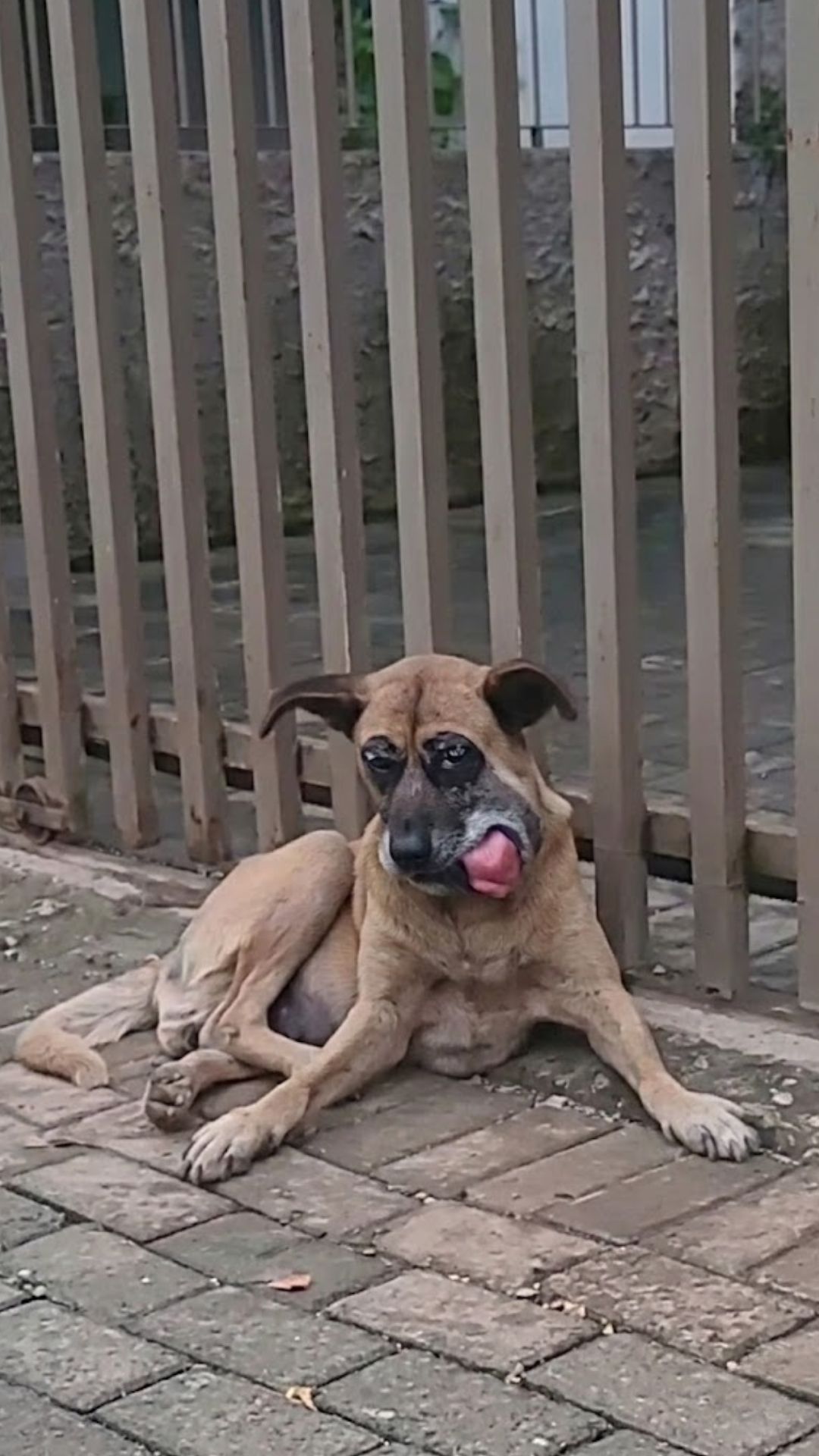
Ruth had learned to make herself small whenever people came near.
She was an older stray dog with a large growth distorting the left side of her face, and according to rescuers, some people responded to her appearance with fear and cruelty.
She was shouted at.
Chased away.
And at times, stones were thrown in her direction.
So when rescuers finally reached her, Ruth did not move toward them for comfort.
She shrank back.
Her body trembled.
Human hands were not something she seemed ready to trust.
The mass on her face was impossible to ignore.
But once veterinarians examined her, they discovered something even more serious.
Ruth was not facing one medical problem.
She was facing two.
Her Face Made People Look Away
Life on the streets had already been difficult for Ruth.
She was older.
Thin.
And living without dependable food or care.
Then the growth on her face became more pronounced.
It altered the shape of her jaw and made her appearance unusual enough that people noticed immediately.
Unfortunately, attention did not always bring help.
According to the rescue account, Ruth was repeatedly driven away from sidewalks, markets, and doorways.
Some people shouted at her.
Others threw stones.
Over time, her behavior around humans reflected that experience.
She flinched.
She kept her distance.
She did not approach strangers easily.
For rescuers, that fear mattered just as much as the visible tumor.
They could not simply walk up, place a leash around her neck, and expect cooperation.
Ruth needed help.
But she had little reason to believe the people approaching her were safe.
Video: Ruth Was Chased Away Because of Her Face—Then Rescuers Finally Reached Her
Veterinarians Could Not Examine Her Without Sedation
Once Ruth was brought to veterinary care, the team tried to assess her condition carefully.
But she was extremely frightened.
Even gentle handling caused visible distress.
To perform a proper examination and imaging safely, sedation was required.
Only then could the team understand the full extent of what was happening.
The large facial mass involved the left side of Ruth’s jaw and extended dangerously close to her eye.
The growth was serious enough that immediate planning was necessary.
But during the workup, another concern appeared.
Ruth’s abdomen was enlarged.
An ultrasound revealed a nodule on her spleen.
That finding created a second medical risk.
The veterinary team now had to think about more than removing the facial tumor.
They also had to address the spleen.
For an older dog already weakened by poor condition, the situation was complicated.
Any major surgery carried risk.
Ruth potentially needed two.
The Spleen Had to Be Addressed First
The team decided to treat the abdominal problem before moving on to the facial mass.
Ruth underwent a splenectomy, removing the spleen containing the concerning nodule.
For a dog of her age and condition, the procedure required careful monitoring.
The rescuers waited.
The surgery ended.
Then Ruth began waking from anesthesia.
She was groggy.
Weak.
But breathing.
That moment brought cautious relief.
One major procedure was behind her.
However, the most visible problem remained.
The tumor on her face still needed to be addressed.
Further evaluation confirmed that the mass was malignant.
The source account noted that it had not fused directly to the bone, but it was aggressive enough that a substantial surgery would be required to remove it appropriately.
The next operation would change Ruth’s appearance permanently.
But the goal was not cosmetic.
It was to remove diseased tissue and give her the best chance at comfort.
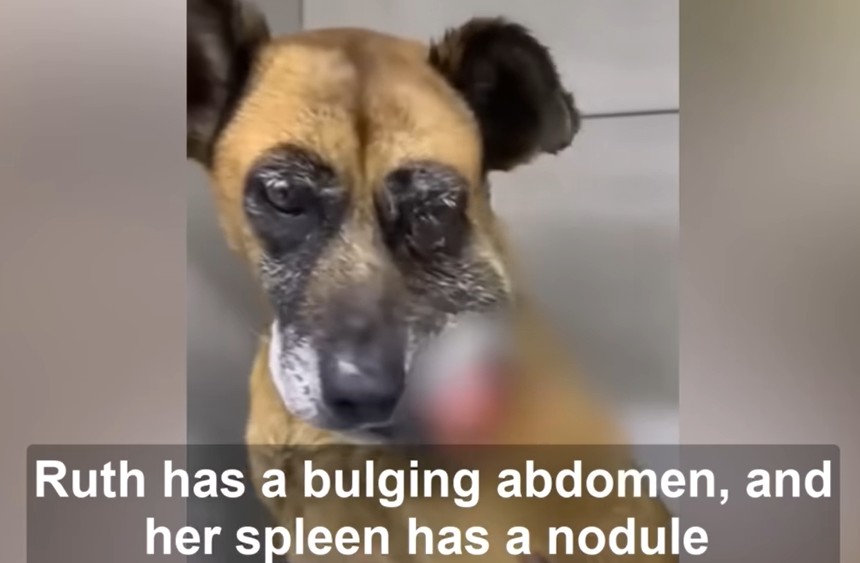
The Second Surgery Was Even More Extensive
Ruth returned to surgery.
This time, the veterinary team performed a left-sided mandibulectomy, removing part of the affected jaw.
The eye on that side was also removed because it had been involved in the disease process.
It was a major procedure.
When Ruth woke, the enormous mass that had distorted her face was gone.
But recovery would not be simple.
Her mouth now functioned differently.
Swelling and healing tissue made eating and drinking difficult.
She could not simply return to a normal bowl of food.
A feeding tube was used to provide nutrition directly while her surgical site recovered.
Pain management and close observation became part of each day.
For the veterinary team, the next question was practical.
Could Ruth adapt?
Basic Things Had to Be Learned Again
Most dogs never have to think about how their jaw works.
They lower their head.
Move their tongue.
Swallow.
Drink.
For Ruth, those ordinary actions had suddenly become unfamiliar.
Part of her jaw was gone.
Her mouth had changed.
So the recovery process focused on helping her adapt safely.
At first, the feeding tube did most of the work.
It allowed Ruth to receive calories while her body healed.
Meanwhile, the team watched for small signs that she could begin managing more on her own.
Could she control her tongue?
Could she swallow?
Would she attempt to drink?
The progress was slow.
Then, on the fourth day after surgery, something important happened.
Ruth pulled her tongue back into her mouth by herself.
She stood.
Then she approached the water bowl.
And drank.
For a healthy dog, drinking water would barely be worth mentioning.
For Ruth, it was a major milestone.
Her body was adapting to what surgery had changed.
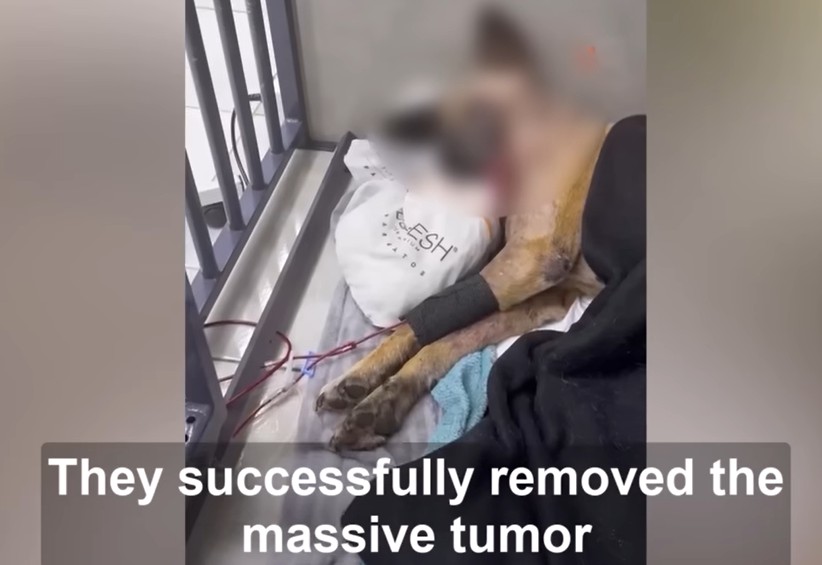
The Fourth Day Became a Turning Point
Ruth’s first independent drink did not mean recovery was finished.
She still needed support.
The feeding tube remained part of her care.
Her strength was limited.
Physical rehabilitation continued.
But the moment showed that she was beginning to regain basic function.
She could move more purposefully.
Respond to her surroundings.
Drink without complete assistance.
These changes gave the team something concrete to build on.
Ruth had survived two major operations.
Now she was entering the slower phase.
Healing tissue.
Rebuilding strength.
Learning how her body worked differently.
And gradually becoming more comfortable around the people caring for her.
The dog who had once trembled whenever hands approached was now experiencing a different pattern.
Hands brought medication.
Food.
Support.
Gentle touch.
Her fear did not vanish overnight.
But the environment around her had changed completely.
Trust Returned More Slowly Than Strength
Some of Ruth’s physical progress could be measured.
Bloodwork.
Weight.
Healing.
Ability to drink.
Trust was harder to measure.
For a dog who had reportedly been chased and struck with stones, caution around people was understandable.
The caregivers did not demand affection.
They allowed Ruth to set the pace.
A person approached slowly.
A hand stopped when she became uncomfortable.
Voices remained calm.
Repeated experiences gradually replaced older expectations.
Ruth began accepting touch more easily.
She appeared more curious about what was happening around her.
The same human presence that once caused her to shrink away could now mean food, comfort, or help.
This was not a sudden personality transformation.
It was the result of consistency.
Ruth needed time to discover that the people around her now were different from the ones she had learned to avoid.
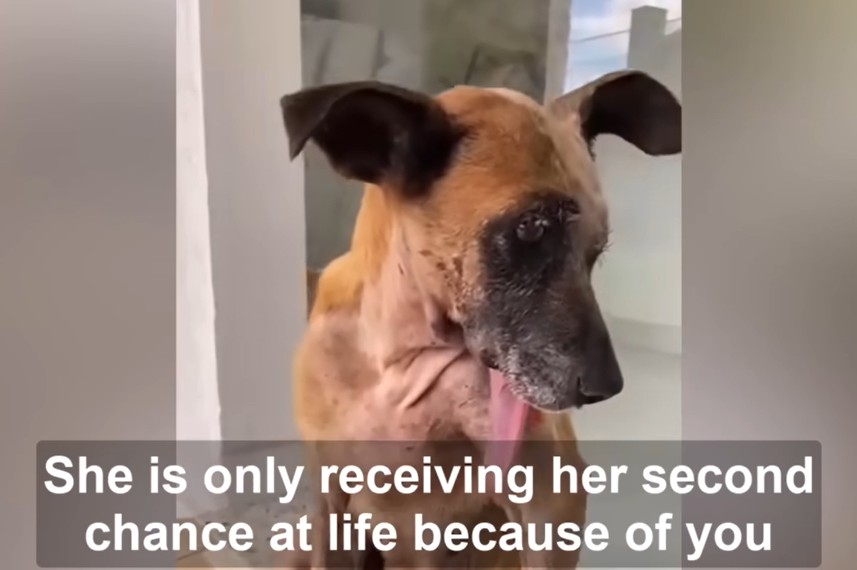
Ruth’s Recovery Was Not About Making Her Look “Normal”
After surgery, Ruth’s face looked different.
Part of her jaw had been removed.
She had lost one eye.
But the goal of treatment had never been to make her fit someone else’s idea of beauty.
It was to reduce disease and improve her comfort.
Before surgery, the tumor had become a serious medical problem.
After surgery, Ruth faced the challenge of adaptation instead.
She still required care.
Supplemental feeding continued.
Physical therapy helped rebuild her strength.
Her body would never be exactly the same as it had been before.
That did not make her recovery less meaningful.
Ruth could stand.
Drink.
Interact.
Rest somewhere safe.
Receive treatment instead of being chased away.
Those were the measures that mattered.
What Ruth Needed Next Was Quiet, Stability, and Time
Ruth’s story did not end with a confirmed permanent adoption in the source account.
What she needed next was clear.
A calm home.
People willing to move slowly.
Regular medical follow-up.
A place where her appearance would not determine how she was treated.
After everything she had experienced, Ruth deserved an environment that did not ask her to prove anything.
No crowds.
No stones.
No constant need to defend herself.
Just routine.
Food.
Rest.
Gentle voices.
And enough time for trust to continue growing.
Her medical journey had already been extraordinary.
She had survived a splenectomy.
A major jaw surgery.
Removal of the affected eye.
Tube feeding.
And the difficult first days of learning how to use her mouth again.
But perhaps the most meaningful change was simpler.
People had stopped looking at Ruth as something frightening.
They were finally looking at her as a dog who needed help.
The Face People Feared Was Never the Whole Story
Ruth’s appearance made her impossible to ignore.
But it also caused some people to misunderstand her.
The large tumor drew attention before anyone saw the older dog carrying it.
Rescuers changed that perspective.
They looked past the shape of her face.
They noticed fear.
Weakness.
Medical need.
And a life still capable of responding to care.
That choice opened the door to everything that followed.
Sedation for a safe examination.
Imaging.
The discovery of the splenic nodule.
Two surgeries.
A feeding tube.
The first drink of water on day four.
Continued rehabilitation.
None of those moments erased Ruth’s past.
They changed what came after it.
She had spent too long being treated as though her appearance made her unworthy of kindness.
Now the same face that once caused people to recoil had become part of a story about something much more important than looks.
Dignity.
Care.
And the decision to help an animal even when recovery would be complicated.
Ruth was never a “monster.”
She was an older dog with serious medical problems who needed people to stop judging what they saw long enough to ask what she needed.
Eventually, someone did.
And once that happened, Ruth was finally given something the streets had denied her for far too long.
A real chance.


