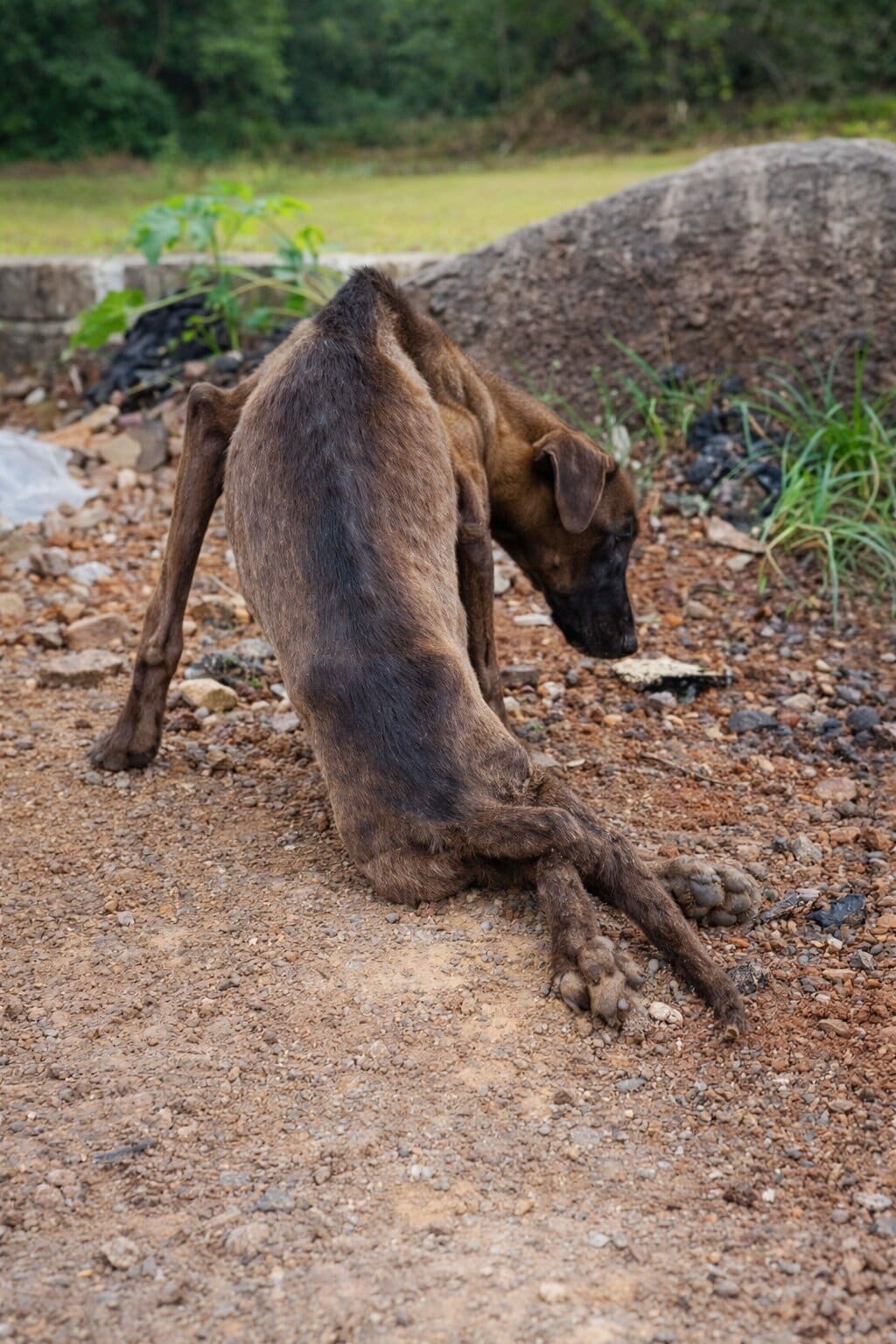
Leandrinha had learned to move through the street using only half of her body.
Her front legs pulled.
Her back legs followed behind.
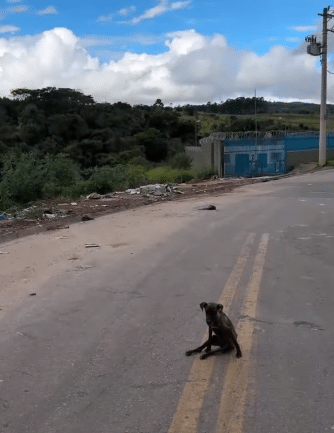
On the rough pavement of a busy road, the tiny dog dragged herself forward a few inches at a time.
Cars passed.
People walked by.
Some stopped long enough to look.
Others reportedly raised their phones and recorded the unusual sight.
Then they continued on.
Leandrinha remained beside the road.
Painfully thin and unable to use her hind legs normally, she searched through piles of discarded trash for whatever food she could find.
She had been seen.
She had been filmed.
What she still needed was someone willing to do more than watch.
Eventually, one man saw the videos.
And instead of scrolling past, he went looking for her.
Every Few Feet Required Her Front Legs to Do All the Work
Leandrinha’s movement was impossible to miss.
Her hind legs did not support her.
To get anywhere, she planted her front paws against the ground and pulled the rest of her small body forward.
Again.
Then again.
The street beneath her was not designed for an animal moving this way.
Hard pavement rubbed against the lower half of her body as she dragged herself along the roadside.
She could not simply stand and walk toward a bowl of food.
She could not easily move away from approaching traffic.
Even crossing a short distance required far more effort than it would for another dog.
Still, Leandrinha moved.
Food had apparently been difficult to find.
Her body was thin, and the roadside trash became one of the places she searched for scraps.
She pushed herself toward discarded bags and piles of waste, investigating whatever might contain something edible.
People in the area noticed her.
According to the account, some filmed her condition and the videos began circulating online.
That attention eventually mattered.
But not because a video itself could lift Leandrinha from the street.
Someone still had to go there.
VIDEO: Leandrinha Could Only Drag Herself Forward — Then One Man Decided to Find Her
He Saw the Videos and Went Searching the Streets
One man came across the footage of Leandrinha.
He now knew roughly what she looked like.
He knew the area where she had reportedly been seen.
What he did not know was whether she would still be there when he arrived.
So he traveled to the location and began looking.
A small disabled stray can be surprisingly difficult to find in a neighborhood full of side streets, buildings, parked vehicles, and places to hide.
Leandrinha was not waiting at an arranged meeting point.
The man had to search.
Eventually, he found her.
Up close, the reality matched what the videos had shown.
She was small.
Thin.
Her hindquarters remained low against the ground.
When she needed to move, her front legs still carried most of the effort.
The man approached slowly.
Leandrinha did not run.
In her condition, running would have been difficult anyway.
She remained there while he came closer.
He crouched beside her and spoke gently.
Then he carefully lifted her from the ground.
There was no need to interpret the look in her eyes or imagine what she understood in that moment.
The important change was physical and immediate.
For the first time in the story, Leandrinha no longer had to drag herself toward the next place she needed to go.
Someone else was carrying her.
At the Clinic, the Question Became: Could Her Legs Improve?
Leandrinha was taken for veterinary examination.
Her inability to use her hind legs raised an obvious concern.
Was the damage permanent?
If her spinal cord had been completely severed or severely destroyed, the possibility of recovering meaningful movement could be very limited.
But according to the rescue account, the veterinary findings offered a different explanation.
Leandrinha’s paralysis was attributed to a mild spinal deformity, rather than a completely severed spine.
That distinction created room for cautious hope.
Her condition was still serious.
No one could simply place her on the floor and expect her to begin walking normally.
Her hind legs had not been functioning properly, and the muscles needed rehabilitation.
But the diagnosis suggested that treatment and repeated physical work might help improve her mobility.
The plan therefore focused on rehabilitation.
Massage.
Gentle exercises.
Repeated stimulation of the back legs.
Slow work intended to strengthen muscles that had not been supporting her properly.
This was not the kind of recovery that could be measured in one dramatic afternoon.
Leandrinha would have to practice.
Again and again.
Rehabilitation Began With Movements Almost Too Small to Notice
The early therapy sessions were simple in appearance.
Caregivers gently massaged Leandrinha’s legs.
Her limbs were moved through controlled exercises.
The goal was to encourage muscle activity and improve her ability to use the back half of her body.
There was no reason to force her upright before she was ready.
Her body needed time to respond.
So progress was measured differently.
Could she place a paw more firmly?
Could she support slightly more weight?
Did a leg respond during an exercise that had previously produced little movement?
Small changes mattered.
Week after week, Leandrinha continued the rehabilitation program.
The dog who had once used only her front legs to cross the street was now being given repeated opportunities to engage the muscles behind her.
At times, the progress would have been easy for an outsider to overlook.
She was not suddenly running.
She was not even walking normally yet.
But rehabilitation rarely moves in dramatic leaps.
It builds through repetition.
One exercise.
Then another.
Another day.
Another attempt.
And eventually, Leandrinha did something she had not been able to do on the roadside.
She pushed herself upward.
One Day, Her Back Legs Held Her for a Few Seconds
The first attempt was not graceful.
Leandrinha pushed up.
Her hind legs responded.
Her body rose from the ground.
For a few seconds, she stood.
Then her balance failed.
She came back down.
It would have been easy to focus on how short the moment was.
The people caring for her saw something else.
Her back legs had supported her.
Even briefly, the dog who had once dragged them behind her had used them to hold herself above the ground.
That changed what the next therapy session meant.
Now they were not only working toward a theoretical possibility.
They had seen movement.
So the exercises continued.
Massage continued.
Leandrinha tried again.
The next attempts were still shaky.
But those few seconds gradually became longer.
Standing became something her body could repeat rather than a single isolated event.
Then came the next challenge.
A step.
Standing Was Only the Beginning
Remaining upright and moving forward are two different tasks.
Leandrinha now had to learn how to coordinate muscles that had not been functioning normally during her time on the street.
At first, the steps were small.
Uncertain.
Her balance still needed work.
The veterinary team and caregivers continued supporting her through the process.
One step became another.
Her hind legs began participating in movement instead of simply trailing behind her.
That contrast was especially striking for anyone who had seen the original footage.
Then, Leandrinha had pulled herself along using her front legs while the rest of her body dragged across the pavement.
Now she was beginning to lift that body.
Support it.
Move it.
There was no single instant when she transformed from “paralyzed dog” into “recovered dog.”
The change happened between sessions.
Between attempts.
Between tiny improvements that became more stable over time.
Eventually, she was no longer merely practicing how to stand.
She was learning to walk again.
The Street Was Replaced by Grass
Leandrinha’s surroundings changed along with her body.
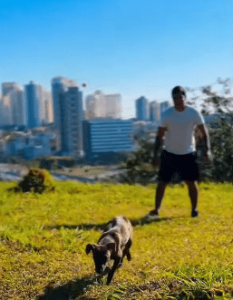
The rescue account describes her later living in a home where she could move through open outdoor space.
Instead of dragging herself along hard pavement beside traffic, she could step across grass.
Instead of searching through trash for something to eat, she had people responsible for her care.
Her days were no longer organized around the immediate problem of survival.
She could rest somewhere safe.
Move without traffic rushing beside her.
Interact with people who already knew her limitations and had helped her work through them.
And as her mobility improved, more ordinary dog behavior became possible.
Walking.
Playing.
Moving across open ground.
Eventually, the account describes Leandrinha running.
That word carries more weight when placed beside the beginning of her story.
At first, even moving several feet required her to drag half of her body behind her.
Now all four legs were participating.
The Most Important Person Was the One Who Did More Than Watch
Leandrinha’s story contains an uncomfortable detail.
People had already seen her before she was rescued.
Her condition was visible enough to attract attention.
Videos circulated.
Strangers could watch the small dog pulling herself along the street.
But observation and intervention are not the same thing.
The person who changed the direction of the story did something very ordinary.
He went to the place where she had been seen.
He searched.
He found her.
Then he picked her up and brought her to veterinary care.
Everything after that depended on additional people doing their own part.
Veterinarians evaluated the spinal problem.
Caregivers performed massages.
Physical therapy was repeated over weeks.
Leandrinha practiced movements that did not come easily.
No single person created the entire recovery.
But someone had to start the chain.
For Leandrinha, that beginning came when one viewer stopped being only a viewer.
The Dog Who Once Dragged Herself Forward Eventually Ran
The first image of Leandrinha is difficult to forget.
A tiny dog beside a busy road.
Front paws reaching forward.
Back legs dragging behind.
Trash nearby.
People passing.
Then the story begins moving in the opposite direction.
A video reaches someone willing to search for her.
Hands lift her from the pavement.
A veterinary examination finds that her spinal condition may allow some improvement.
Massage begins.
Physical therapy follows.
Her back legs respond.
She stands.
Falls.
Tries again.
Then she takes a step.
Eventually, there are many steps.
The source describes Leandrinha later running and playing in a home environment—a remarkable contrast to the dog who once had to pull herself through the street a few inches at a time.
There is no need to call every step a miracle.
The visible process is powerful enough on its own.
Her recovery required someone to notice.
Someone to act.
Veterinary care.
Weeks of repeated rehabilitation.
And a small dog whose body gradually responded to that work.
Once, Leandrinha could only drag herself toward whatever food she might find beside the road.
Later, she crossed green grass on four legs.
The distance between those two moments was far greater than any street she had ever pulled herself across.


