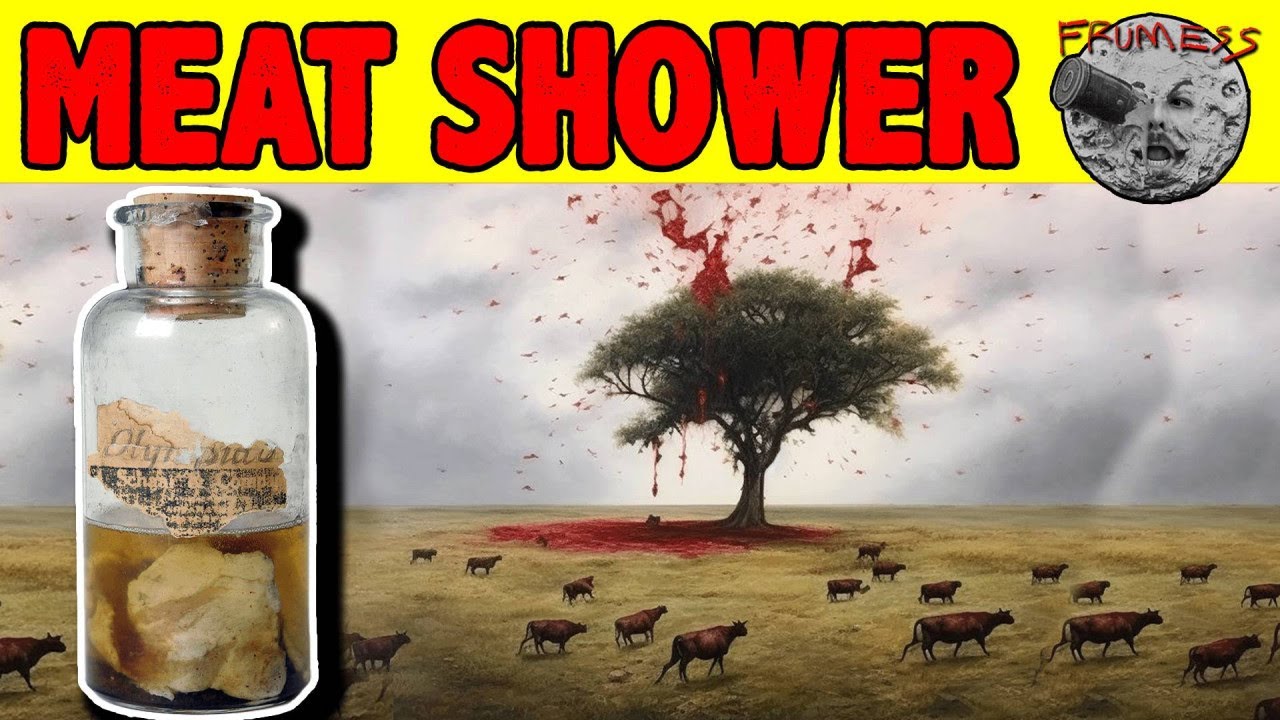
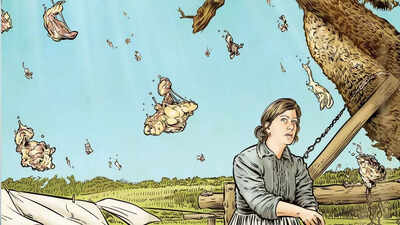
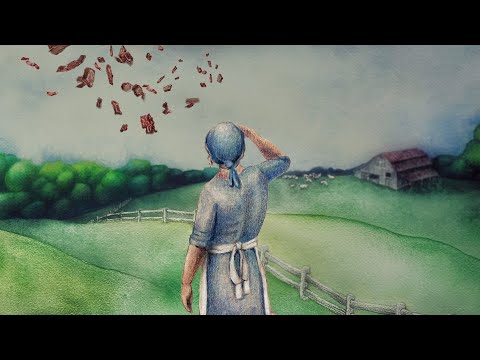
The sky over the Crouch farm was clear on the morning of March 3, 1876. Sunlight reached the narrow valley near Olympia Springs, and a light wind moved across the hills of Bath County, Kentucky. Rebecca Crouch was outside working near the family home while her young grandson remained in the yard.
Then something began falling.
It was not rain, hail or drifting leaves. Small pieces of pale, flesh-like material descended across the property. Some were no larger than flakes. Others were several inches long. One reportedly struck the ground close to Crouch with enough force to make a sharp sound.
The shower lasted only a minute or two. By the time other members of the household came outside, pieces were hanging from fences, caught on vegetation and scattered across the ground. The first widely circulated report estimated that the affected strip measured approximately 100 yards long and 50 yards wide.
This is a documented 1876 report with a plausible but unproven natural explanation. Samples were collected and examined, and several investigators concluded that at least some pieces were animal tissue. However, no observer documented the source while the material was falling. The event was real enough to reach newspapers and scientific journals, but its cause remains an inference rather than a witnessed conclusion.
What Witnesses Reported
The first account to travel beyond Bath County appeared only days after the incident. A dispatch published by The New York Times on March 10 repeated information from the local Bath County News. It placed the fall near the home of Allen Crouch, two or three miles from Olympia Springs in southern Bath County.
According to that report, Mrs. Crouch was making soap in the yard when pieces resembling beef began to fall around her. She compared the smaller pieces to large snowflakes, while one fragment was described as three or four inches square. Harrison Gill, who visited the property the following day, reportedly found material still attached to fences and scattered over the ground.
A longer investigation appeared in the New York Herald on March 21. Its correspondent traveled to the Crouch farm and interviewed Rebecca Crouch directly. She placed the event between 11 a.m. and noon and said the fall continued for no less than one minute and no more than two. The sun was shining, the sky was clear and a light wind was moving from the west.
Her grandson was apparently the only other person in the yard when the fall began. Other people inside the house came out after it had ended, meaning the number of direct witnesses was extremely small. Harrison Gill openly acknowledged that he had not seen anything descend. He saw only the material left behind and repeated what the family had told him.
That distinction matters. The record strongly supports that unusual tissue-like pieces were present on the Crouch property and were collected by visitors. It also preserves Rebecca Crouch’s statement that she watched them fall from above. It does not provide a second adult observer who independently watched the entire shower or identified its source.
Even the affected area was recorded imperfectly. The first newspaper account gave a strip of about 100 by 50 yards. Gill offered a similar rough measurement, while a schoolteacher staying with the family described the material as scattered irregularly across approximately two acres, with some sections receiving nothing. The event left a field of fragments, not a uniform layer covering every inch of ground.
YOUTUBE EMBED 1 — PRIMARY SEARCH QUERY: “Kentucky Meat Shower 1876 documentary”
The Physical Clues Left Behind
The Kentucky Meat Shower did not survive only as a witness story. Pieces were picked up, placed in containers and sent to people who claimed they could identify them.
That should have made the case easier. Instead, it produced a confusing series of conclusions.
J. Lawrence Smith, a respected Louisville chemist, initially examined a small preserved specimen and thought its gelatinous interior resembled frog spawn. He later received additional material and revised his judgment. After examining prepared slides and consulting microscopists A. T. Parker and L. D. Kastenbine, Smith concluded that the samples included muscular, cartilaginous, gelatinous and fatty matter. His original frog-spawn explanation had to be abandoned.
Leopold Brandeis proposed a very different identification. He argued that the substance was Nostoc, a gelatinous cyanobacterium historically associated with reports of mysterious material appearing after rain. His explanation was repeated as though the mystery had been resolved.
The problem was that other investigators examining pieces attributed to the same incident reported recognizable animal structures. The American Journal of Microscopy and Popular Science described striated muscle fibers, cartilage and lung tissue. It named histologists J. W. S. Arnold and A. Mead Edwards among those who identified the lung material. Later summaries divided seven examined samples into lung, muscle and cartilage categories.
These differences do not prove that every person received material from the same source. Samples passed through numerous hands, were stored in alcohol or glycerin and were sometimes examined weeks or months after the fall. Labeling and custody standards were far less controlled than they would be in a modern laboratory investigation.
The most reasonable conclusion is therefore narrower than the confident statements made in 1876: several specimens linked to the event were genuine animal tissue, but the full collection was mixed, inconsistently documented and never established as biologically identical.
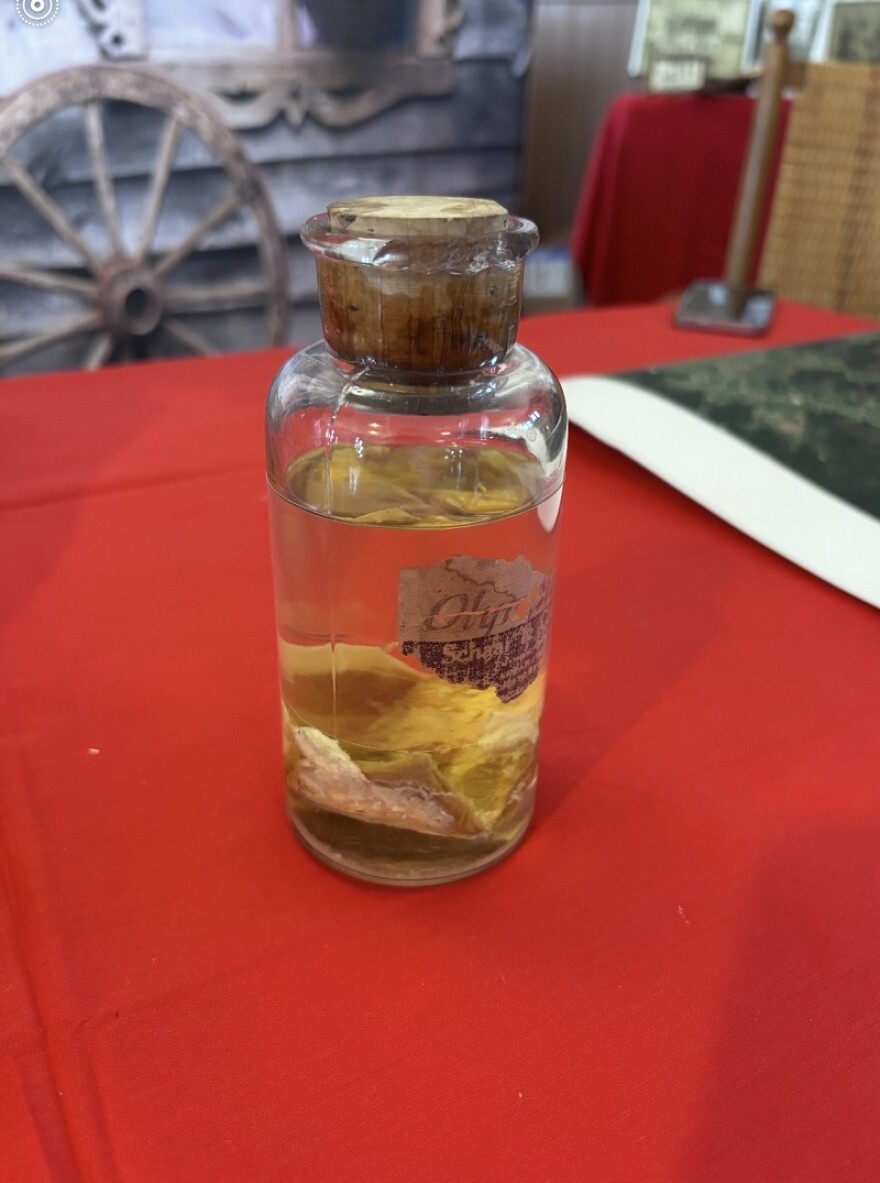
A physical reminder of the case may still survive. In 2004, Transylvania University professor Kurt Gohde found a labeled jar in university storage containing a preserved piece associated with Olympia Springs. Attempts to obtain a conclusive genetic identification were unsuccessful because the material was old and contaminated. More recent testing reportedly produced fragments closest to goat DNA, but the strands were too incomplete to establish a definite result. The jar, believed to contain the last securely known specimen associated with the event, has since been displayed in Bath County.
How the Reports Spread
The original story moved quickly through the nineteenth-century newspaper network.
The Bath County News supplied the first widely repeated account. Newspapers in New York, Georgia and other states reprinted its central details: the clear sky, the Crouch farm, the estimated area and the pieces that appeared to resemble fresh meat. Each repetition carried the event farther from the witnesses while giving editors new opportunities to sharpen the language.
The New York Herald attempted something more substantial. Its correspondent traveled to Olympia Springs, interviewed the family and spoke to people who had visited the property. That report preserved valuable limitations. Rebecca Crouch had not examined the material closely while it was falling. Allen Crouch was away from home. The schoolteacher had remained indoors until the shower ended. Gill arrived later. Only Rebecca and her grandson claimed to have seen the pieces in descent.
At the same time, the story accumulated details that were not equally well supported. Some newspapers expanded the affected area. Others said the flesh continued to move after landing or covered trees in extraordinary quantities. Animals were said to have consumed it, and two local men became famous for tasting pieces and comparing them with mutton or venison.
The incident also invited humor. A satirical newspaper argument suggested that belts of meat might orbit the sun and periodically strike Earth like meteorites. Later retellings sometimes removed the comic context and presented “cosmic meat” as though it had been a sincere scientific proposal.
Beneath the exaggerations, however, a stable core remained: an unusual fall was reported on March 3, 1876; tissue-like material was found across part of a Kentucky farm; pieces entered private and scientific collections; and investigators disagreed about what they had received.
The Leading Explanation
The strongest explanation is that a flock of vultures discharged recently eaten material while flying over the farm.
The suggestion appeared during the original scientific discussion. Robert Peter of Lexington proposed that buzzards had fed heavily on an animal carcass and then collectively emptied their overloaded stomachs. L. D. Kastenbine developed the same basic idea in the Louisville Medical News, arguing that falling material could have been scattered by wind as vultures passed high above the property.
In American usage of the period, “buzzard” commonly referred to vultures. Both Turkey Vultures and Black Vultures are scavengers that gather at carcasses and may feed in groups. They are also capable of regurgitating recently consumed material when disturbed, threatened or too heavily loaded to take flight efficiently. Modern accounts from the National Park Service and Cornell Lab of Ornithology confirm that this behavior is real, not an explanation invented specifically for the Kentucky case.
The theory explains several otherwise disconnected clues.
First, it accounts for the material’s animal origin. Muscle, connective tissue, cartilage, fat and lung could all come from scavenged remains.
Second, it explains why different pieces were not identical. A carcass is not made from one tissue type, and vultures feeding at the same source would not necessarily carry the same portions.
Third, it fits the clear sky. No storm, waterspout or tornado is required. Birds flying high against a bright sky could have escaped the notice of a frightened witness concentrating on what was falling around her.
Fourth, the distribution resembles material released from a moving aerial source. The shower crossed an irregular strip, with some fragments caught on fences and vegetation and other areas left untouched.
Finally, the reported freshness is compatible with recently consumed carrion. The material did not need to travel through the atmosphere for miles or remain inside a storm system.
The theory is unpleasant, but it is mechanically ordinary. It requires only animals known to live in the region, feeding behavior they regularly perform and a flock passing over the wrong farm at exactly the wrong moment.
It remains a reconstruction, however. No one reported seeing vultures above the Crouch property, no particular carcass was identified and no investigator observed the regurgitation itself. The vulture explanation fits the evidence better than its competitors, but it was never directly proven.
YOUTUBE EMBED 2 — SECONDARY SEARCH QUERY: “Scientific American Kentucky Meat Shower explanation”
The Alternative Explanation
The most important competing explanation was Nostoc.
When dry, Nostoc colonies can be difficult to notice. After absorbing water, they swell into dark or translucent gelatinous masses. Their sudden appearance after wet weather helped create old stories about “star jelly” or material that had fallen from the sky.
Brandeis argued that the Kentucky substance belonged to a flesh-colored form of Nostoc. The explanation offered a known natural organism and avoided the need for an aerial source. It also sounded scientific enough to be repeated by publications eager to close the case.
Yet it conflicts with the strongest parts of the record.
Rebecca Crouch described material actively falling during clear weather, not jelly appearing on damp soil after rain. Pieces reportedly struck the yard, became caught on fences and were found above ground on vegetation. More importantly, several microscopists identified animal structures that should not appear in cyanobacteria.
The Nostoc conclusion may have resulted from a poorly preserved specimen, a mislabeled sample, contamination or simple diagnostic error. Smith’s initial frog-spawn judgment demonstrates how misleading a small gelatinous fragment could be before better sections were examined.
Other proposals have even less support. A whirlwind could theoretically lift organic material, but no suitable source or transporting storm was documented. A deliberate hoax would require someone to distribute a considerable quantity across the property without being seen and then send genuine tissues into scientific circulation. Supernatural rain and unknown aerial creatures add assumptions without explaining the mixed animal anatomy.
The alternative theories are useful because they show how uncertain samples can generate incompatible answers. None fits the combined witness reports, tissue findings and known animal behavior as well as the vulture explanation.
The Detail That Still Does Not Fit
The largest weakness in the leading theory is not biological. It is observational.
Rebecca Crouch looked upward during the event, yet she did not report seeing birds. The sky was clear, and the fall continued for up to two minutes. A flock large enough to distribute material across a strip approximately 100 yards long might seem difficult to miss.
There are reasonable answers. Vultures can soar high on rising air and may appear as tiny dark points against a bright sky. The witness was frightened, moving toward the house and watching fragments strike the yard. Her attention may not have remained fixed on the upper sky. Wind could also have carried the material away from the birds’ actual flight path.
But those are possibilities, not observations.
The timing of a collective discharge is another uncertainty. Nineteenth-century writers claimed that one bird beginning to regurgitate could trigger others. Modern sources confirm that individual vultures regurgitate and that the birds often gather in groups, but the exact synchronized behavior proposed for Olympia Springs was not documented there.
The sample record creates a second unresolved problem. The surviving jar has an old label connecting it to Olympia Springs, yet its complete transfer history is unclear. Inconclusive genetic testing cannot establish that its contents represent the material Rebecca Crouch saw falling. The same caution applies to slides and fragments distributed in 1876.
We are therefore left with a plausible mechanism supported by known behavior, but without the final connecting evidence: no bird observation, no identified meal and no uncontaminated specimen whose origin can be independently reconstructed.
How the Event Entered Strange History
The Kentucky Meat Shower survived because it occupies an unusual position between folklore and laboratory history.
Unlike a story created entirely through oral tradition, the incident entered newspapers within days. A reporter later visited the location. Named witnesses were interviewed. Pieces were preserved, mailed and placed under microscopes. Scientific publications changed their conclusions in public as new specimens arrived.
Yet the investigation never produced closure.
That open space allowed the story to move easily into collections of strange weather, unexplained falls and American curiosities. The title alone did much of the work. “Meat shower” could be understood instantly, while the explanation required a longer and less elegant discussion about vultures, mixed tissue and uncertain sample custody.
Retellings gradually made the event larger and cleaner than the original record. The farm became covered uniformly. Every fragment became the same mysterious meat. The number of witnesses increased. Satire became theory, and theory became certainty.
Bath County eventually reclaimed the story as local history. A museum exhibit now presents the event, and the preserved jar associated with the shower has become its central object. In 2026, residents marked the incident’s 150th anniversary, showing how an unsettling rural report became part of the county’s cultural identity.
The celebration does not prove what happened above the Crouch farm. It confirms something else: the event left enough documentary and physical residue to resist being dismissed as a simple folktale, even though the evidence remains too incomplete to turn the leading explanation into a demonstrated fact.
What the Evidence Actually Supports
What most likely caused the Kentucky Meat Shower?
The best-supported answer is a flock of vultures regurgitating recently eaten animal material while passing over the Crouch farm. The theory explains the mixed tissues, irregular distribution, apparent freshness, clear weather and absence of any known meteorological system capable of producing the fall.
The evidence also supports a real historical core. Newspapers reported the event in March 1876. A correspondent interviewed Rebecca Crouch and later visitors. Material was collected from the property, and several nineteenth-century investigators identified muscle, cartilage, fat or lung tissue. A preserved specimen believed to be connected to Olympia Springs remains in a Kentucky collection, although its genetic identity and custody history are not conclusive.
What the evidence does not support is certainty.
No witness identified vultures while the fall was taking place. No source carcass was found. No surviving laboratory record links every tested piece through an unbroken chain to the Crouch farm. The reports disagree on the exact coverage, quantity and appearance of the material. Even the alleged surviving specimen cannot tell us exactly what animal supplied it.
The case is therefore partly explained rather than solved.
On a clear March morning, pieces of animal tissue were reported across a quiet Kentucky property. People collected them, examined them and argued over them. The simplest explanation was not rain, a supernatural sign or matter from an unknown creature. It was a group of ordinary scavenging birds performing an extraordinary-looking act high above the ground.
That is where the record closes.
Not with proof of something impossible, but with a natural explanation strange enough to sound almost as unbelievable as the shower itself.

