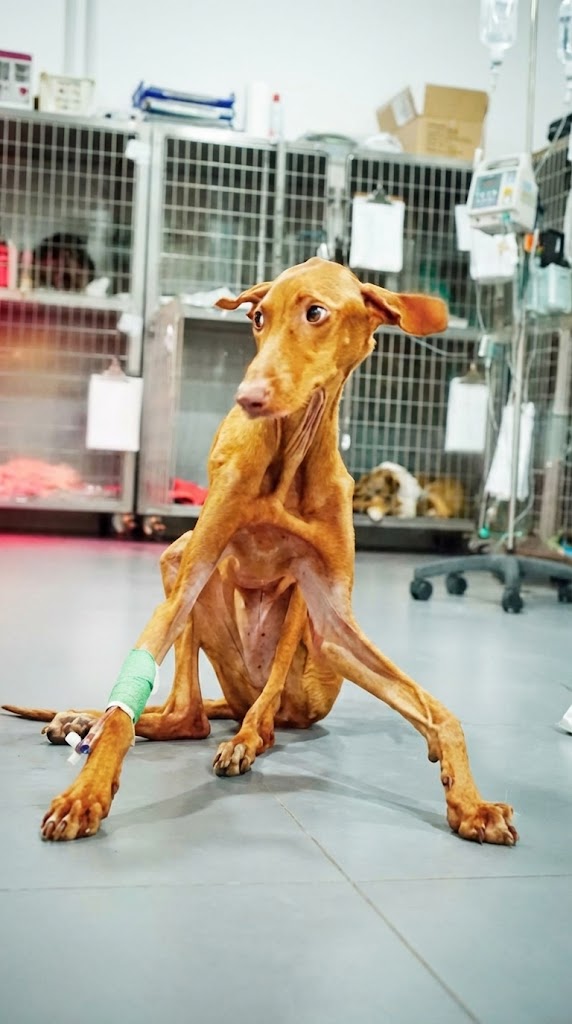
At first, Pippa barely looked strong enough to remain standing.
She had been found alone in the countryside, hidden among tall grass with no one beside her.
Her body was painfully thin.
Every rib seemed visible beneath her coat, and even keeping her balance required effort.
According to the rescuers who found her, Pippa had once been used by a hunter before being left behind when she was no longer considered useful.
But hunger was not the only reason she struggled to move.
Something deeper was affecting her body.
And when rescuers finally reached her, they realized Pippa was facing both severe malnutrition and a neurological condition that made even simple movements difficult.
She Swayed on Her Feet but Never Tried to Run
Pippa did not bolt when the rescuers approached.
She did not bark.
She did not have the strength for either.
Instead, she remained where she was, swaying slightly as her legs tried to keep her upright.
The rescuers moved slowly.
Whatever Pippa had experienced before they arrived, there was no reason to add more fear.
They spoke gently.
They closed the distance little by little.
When they were finally close enough to lift her, Pippa did not resist.
Her body simply settled against them.
Up close, the extent of her weakness was even more obvious.
She had almost no reserve left.
The countryside around her may have looked peaceful, but Pippa was in no condition to survive there alone.
She needed veterinary care.
Immediately.
VIDEO: Pippa Was Found Too Thin to Walk Properly—Then Rescuers Learned Why Her Body Kept Failing Her
The Clinic Revealed Two Problems at Once
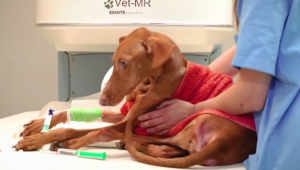
At the veterinary clinic, examinations confirmed that Pippa was severely malnourished.
Her body needed food, hydration, rest, and time to rebuild basic strength.
But veterinarians were also concerned about the way she moved.
Pippa struggled with coordination and balance in a way that could not be explained by hunger alone.
According to her rescue story, she was diagnosed with degenerative neurological damage affecting the brain.
That meant her recovery would not be as simple as gaining weight.
Even if her muscles became stronger, Pippa’s nervous system still had to manage movements that most dogs perform automatically.
Standing.
Balancing.
Taking a step without falling.
Turning.
Adjusting her weight.
All of it demanded more from her than anyone could see from the outside.
The prognosis was uncertain.
No one could promise how much function she might regain.
So her caregivers focused on something much smaller.
Helping Pippa through one day at a time.
Recovery Began With Food, Rest, and Repetition
There was no dramatic change during Pippa’s first days in care.
Her body had been depleted for too long.
Meals had to be planned carefully so she could regain weight without overwhelming her system.
Her environment was kept calm.
She needed somewhere safe enough to rest without constantly struggling to protect herself or search for food.
Then came gentle rehabilitation.
The goal was not to force Pippa onto her feet before she was ready.
Instead, caregivers supported her body and encouraged movement in small amounts.
Her legs needed strength.
Her coordination needed practice.
Her confidence needed time.
Some days, progress was almost impossible to measure.
She might hold herself upright for only a little longer than the day before.
Her balance might improve for only a few seconds.
But the team noticed those seconds.
They mattered.
Because Pippa was still trying.
The Smallest Improvements Became the Ones Everyone Watched For
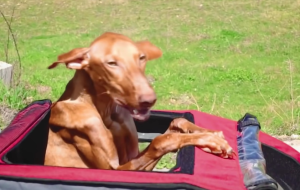
As the weeks passed, her body slowly began to change.
Regular nutrition filled out the frame that had once looked so fragile.
Her coat improved.
Her eyes became more alert.
But the most important changes appeared when she tried to move.
Pippa began holding her position more steadily.
The constant swaying eased slightly.
She became better at placing her paws beneath herself.
When caregivers supported her, she seemed increasingly able to participate rather than simply being held upright.
Nothing happened in a straight line.
There were stronger days.
Then difficult ones.
Her neurological condition did not disappear because she was finally receiving care.
But neither did it prevent every improvement.
Pippa continued learning how to work with the body she had.
And eventually, the effort began producing something her caregivers had been waiting to see.
One Morning, Pippa Stood Without Being Lifted
The moment did not arrive with any warning.
There was no dramatic buildup.
Pippa simply tried.
She placed her paws beneath herself and pushed upward.
For a dog who had once struggled merely to remain upright, the movement immediately caught everyone’s attention.
She stood.
Not perfectly.
Not without effort.
But she was supporting herself.
Then Pippa shifted her weight.
One paw moved forward.
A step.
Then another.
The distance was small.
The movement was uneven.
But she was walking under her own power.
For her caregivers, the importance of those steps had little to do with how far she traveled.
Weeks earlier, Pippa had been found alone in the grass with a body weakened by starvation and a neurological condition interfering with basic movement.
Now that same dog had stood up and chosen to move forward.
It did not mean her medical challenges had vanished.
It meant her body had gained enough strength and coordination to do something that once seemed far away.
Walking Was Only One Part of Becoming Pippa Again
Once she became more mobile, other changes followed.
Pippa explored more.
She paid greater attention to what was happening around her.
Her tail began moving more freely when familiar people approached.
As her weight returned, her appearance changed as well.
The sharp outline of her bones softened.
Her coat became fuller.
Her face looked increasingly alert.
She still had limitations.
Her neurological condition remained part of her life, and movement could require more concentration than it would for another dog.
But her caregivers stopped measuring her only by what she could not do.
Pippa could enjoy food.
She could seek attention.
She could move through a room.
She could rest somewhere comfortable.
She could respond to people she trusted.
Those were not small things.
They were pieces of a life becoming larger again.
Then Someone Offered Her More Than a Temporary Safe Place
Medical recovery gave Pippa stability.
But eventually, she needed somewhere permanent to belong.
Someone learned about her story and was willing to welcome a dog whose needs might never be completely ordinary.
That mattered.
Pippa did not need a home that expected perfection.
She needed one willing to understand her.
A place where an awkward step would not make her less loved.
Where she would have time when she needed it.
Where food, warmth, and care would arrive consistently.
She found that home.
The dog who had once been left alone in the countryside now had people expecting her at the end of each day.
Her life no longer depended on whether she could prove herself useful to someone.
She was simply family.
Pippa Never Needed to Become Perfect to Deserve Her Second Chance
The easiest version of Pippa’s story would end with the words:
She recovered completely.
But that is not what makes her journey meaningful.
Pippa began with two serious challenges.
Her body had been severely weakened by malnutrition.
And her neurological condition affected the very movements she needed in order to regain independence.
Her rescuers could help one meal at a time.
One rehabilitation session at a time.
One attempt to stand at a time.
What they could not do was guarantee the outcome.
They helped anyway.
That decision gave Pippa the chance to show what her body could still learn.
First, she survived.
Then she grew stronger.
Then she balanced.
Then came the morning when four paws held her upright.
And finally, those first uncertain steps.
Today, Pippa’s value is not measured by how smoothly she walks or whether every trace of her past has disappeared.
She has food.
Safety.
People who know her needs.
A home.
And a life that no longer depends on what someone else thinks she can provide.
Once, Pippa was left behind because someone no longer saw a purpose in keeping her.
The people who rescued her never asked her to prove one.
They simply gave her the chance to live.
And little by little, Pippa stood up and took it.


