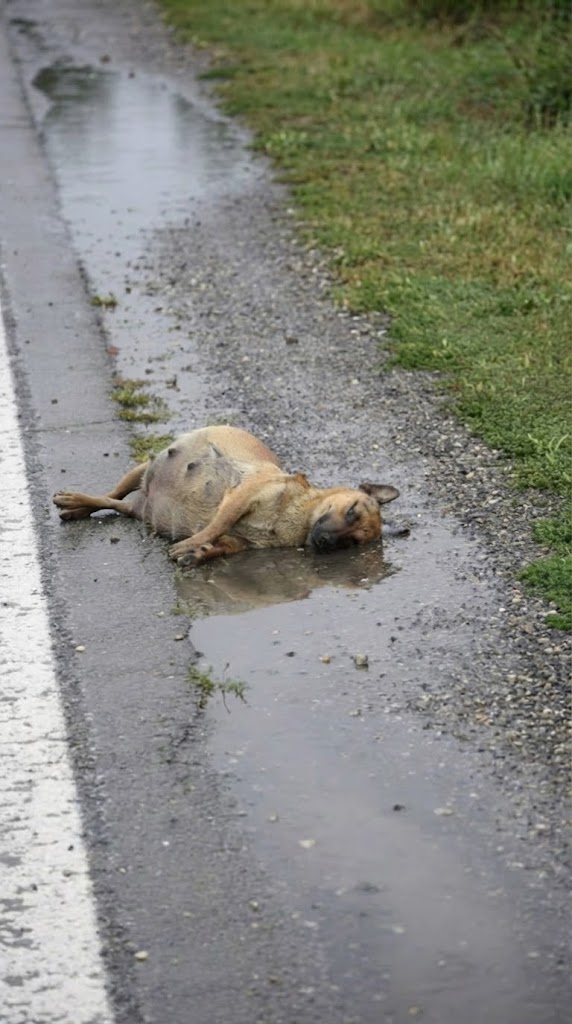
The first report described a pregnant stray dog lying beside a rural road.
She was thin.
Weak.
And exhausted enough that her body had collapsed against the ground.
Rescuers headed to the area as quickly as they could.
But by the time they arrived, the dog was gone.
There was no mother waiting beside the road.
No obvious place where she had hidden.
Only the knowledge that somewhere nearby, a heavily pregnant dog in poor condition was moving alone.
For the rescuers, finding her became urgent.
Then, days later, they finally saw her again.
And immediately, they realized something had changed.
Lisa was no longer pregnant.
They Searched for Days Without Knowing Where She Had Gone
Volunteers began checking the surrounding area.
They walked along quiet roads.
Searched fields and empty lots.
Looked through places where an exhausted stray might hide.
But Lisa remained out of sight.
Every passing day created more uncertainty.
She had already appeared physically depleted when first reported.
Pregnancy placed additional demands on a body that looked as though it had little strength left to spare.
Then came the breakthrough.
Someone spotted her again.
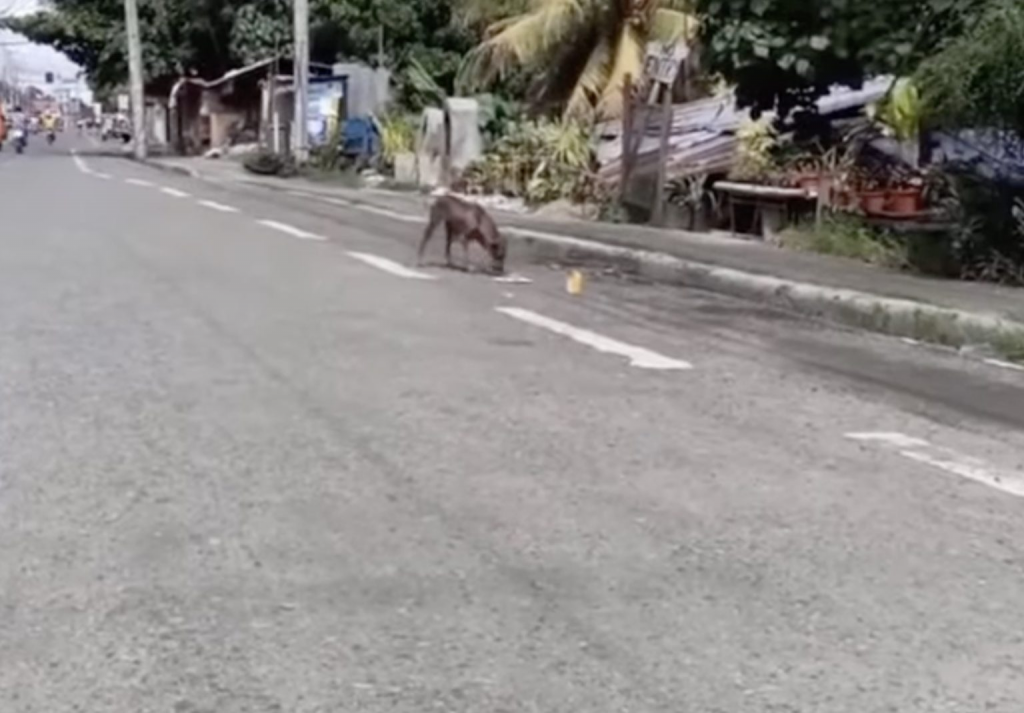
This time, Lisa was walking near a busy roadway.
Her ribs were visible.
Her steps were unsteady.
And the pregnancy that had defined the first sighting was gone.
The source account describes Lisa as having lost the pregnancy, although the exact medical circumstances surrounding the puppies were not fully established.
Whatever had happened between the two sightings, Lisa now appeared even weaker than before.
And she was still alone.
Video: Lisa Was Found Pregnant and Collapsed — Days Later, Rescuers Found Her Walking Alone Without Her Puppies
Hunger Brought Her Closer — Fear Sent Her Back
Finding Lisa did not mean rescuers could simply walk over and pick her up.
She was extremely wary of people.
So they began with food.
A meal was placed within reach.
Then everyone stepped back.
Lisa moved toward it cautiously.
Hunger encouraged her forward.
But whenever someone shifted too close, she retreated again.
The pattern repeated.
Approach.
Stop.
Move away.
Then slowly return.
There was no benefit in chasing her.
If frightened badly enough, Lisa could disappear again—and this time, rescuers might not find her so quickly.
So they waited.
They spoke quietly.
Allowed her to decide when the distance felt manageable.
Eventually, the gap between Lisa and the people trying to help became small enough.
A blanket was carefully placed around her.
Then she was lifted from the roadside.
She did not struggle.
The search was finally over.
At the Shelter, Even Drinking Required Help
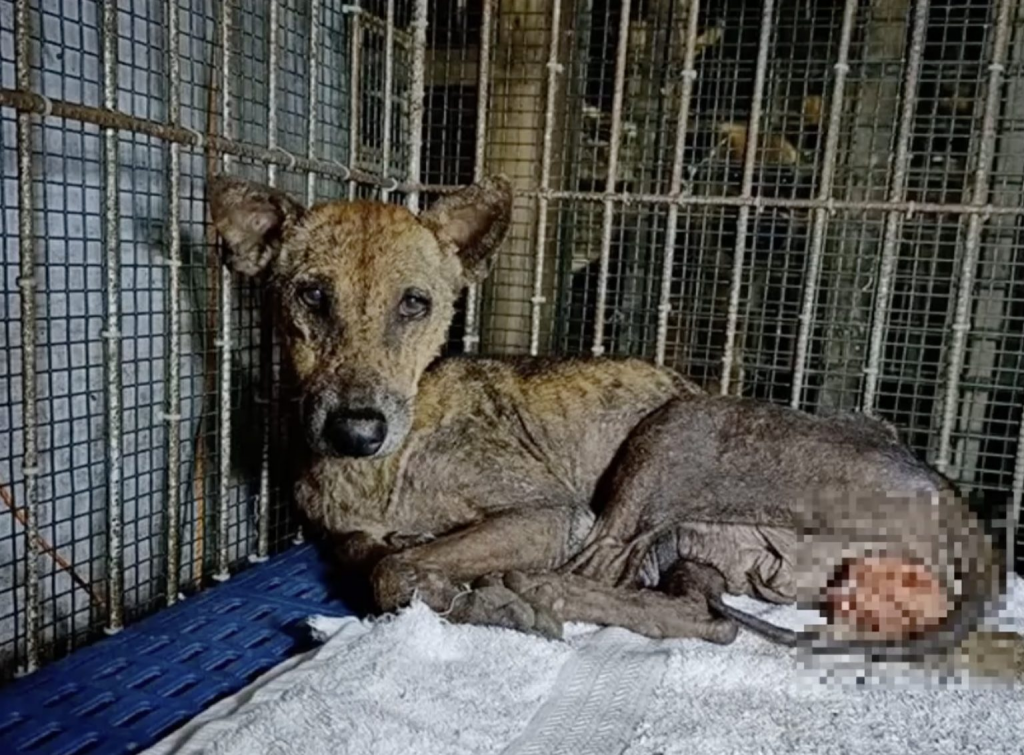
Once Lisa reached safety, caregivers could begin addressing what the road had taken from her body.
She was dehydrated.
Underweight.
And visibly exhausted.
At first, she would not readily drink on her own.
So caregivers offered water slowly with a syringe, giving her small amounts at a time while watching her response.
Food was available too.
But Lisa did not immediately begin eating.
For several days, she showed little interest.
That created another concern.
Her body urgently needed nutrition, yet everything about the unfamiliar environment appeared difficult for her to process.
So instead of forcing interaction, volunteers stayed nearby.
They spoke softly.
Kept her warm.
Placed food where she could reach it.
And returned again later.
There was no expectation that trust would appear simply because Lisa had been rescued.
She was allowed time.
Then One Morning, She Walked Toward the Bowl
The change was easy to miss.
Lisa approached her food.
She sniffed it.
Then she began eating.
Slowly.
Carefully.
For most dogs, walking toward a bowl would be completely ordinary.
For Lisa, it marked an important change.
Eating meant her body could finally begin receiving the calories and nutrients needed to regain strength.
It also meant she was comfortable enough in the shelter to engage with something in front of her rather than remaining completely withdrawn.
Nobody treated one meal as proof that everything had been repaired.
The next day still mattered.
So did the meal after that.
But something had begun.
Lisa was eating.
And once that became more consistent, other changes followed.
Video: After Days of Refusing Food, Lisa Finally Walked to Her Bowl — Then Her Recovery Began to Show
Her Tail Moved Before Her Fear Completely Disappeared
As Lisa’s physical condition improved, caregivers noticed subtle differences in the way she responded to them.
She became less tense around familiar people.
Gentle touch did not always cause the same immediate reaction.
Her breathing appeared calmer while she rested.
Then one day, her tail moved.
Only slightly.
It was not the enthusiastic wag of a carefree dog.
It was simply another small response from an animal who had initially wanted very little interaction.
Those moments added up.
Lisa looked toward people more often.
She tolerated closeness.
Then she began accepting affection.
Her recovery was not a straight line, and unfamiliar sounds could still make her hesitate.
But she was no longer responding to every part of the world as though she needed to get away.
Her First Leash Walk Asked Her to Trust in a New Way
Weeks into recovery, Lisa was strong enough to begin walking on a leash.
That brought an entirely different set of challenges.
The outside world was full of unpredictable sounds.
Movement.
Vehicles.
People.
Lisa hesitated frequently.
Her caregivers did not drag her forward.
They matched her pace.
If she stopped, they waited.
Then they continued when she was ready.
Little by little, Lisa began moving farther.
A leash that might once have felt restrictive became associated with something different:
A familiar person remaining beside her.
A controlled walk.
And a return to the safe place she now knew.
Her body was stronger.
But equally important, she was beginning to participate in life beyond simply eating and resting.
The Dog They Found Again Was No Longer Trying to Disappear
Lisa’s transformation did not happen through one dramatic event.
It happened through repeated experiences.
Food arriving every day.
Water always being available.
People approaching without forcing contact.
Warm bedding.
Quiet voices.
Short walks.
Then longer ones.
Each experience gave Lisa another reason to react differently the next time.
The dog who had once retreated whenever rescuers moved closer began looking toward familiar caregivers.
She started leaning into gentle attention instead of immediately shrinking away.
Nothing could undo the difficult period between her first roadside sighting and the day she was finally secured.
But her future no longer depended on surviving alone.
Lisa’s Story Is Also About What Rescuers Could Not Know
There is a painful uncertainty at the center of Lisa’s story.
She was first seen heavily pregnant.
When rescuers found her again, she was no longer carrying the puppies.
The rescue account attributes this to pregnancy loss, but the exact sequence of events and medical circumstances were not fully documented.
That uncertainty matters.
It is tempting to give an animal a human explanation for what happened afterward—to say she understood the loss exactly as we would, or that every expression reflected grief.
We cannot know that.
What rescuers could observe was enough.
Lisa returned weaker.
She was frightened of people.
She initially struggled to eat and drink normally.
Then, with continued care, those behaviors gradually changed.
That is the story her recovery clearly shows.
She Kept Moving Until Someone Could Finally Stay Beside Her
When Lisa was first reported, she was lying beside a road while pregnant and physically depleted.
Then she disappeared.
Days later, rescuers found her again—thinner, no longer pregnant, and still trying to survive near traffic.
The story could have ended during any of those missing days.
Instead, volunteers continued searching.
Once they found her, they did not expect fear to disappear immediately.
They used food.
Distance.
Patience.
Then a blanket and careful hands when Lisa finally allowed them close enough.
Everything afterward followed the same pattern.
A little water.
A little food.
A little more trust.
A short walk.
Another day of care.
Lisa did not return to life through one extraordinary miracle.
She did it through hundreds of ordinary moments made possible because people kept showing up.
Once, she was the dog rescuers could not find.
Today, she no longer has to keep moving alone.


