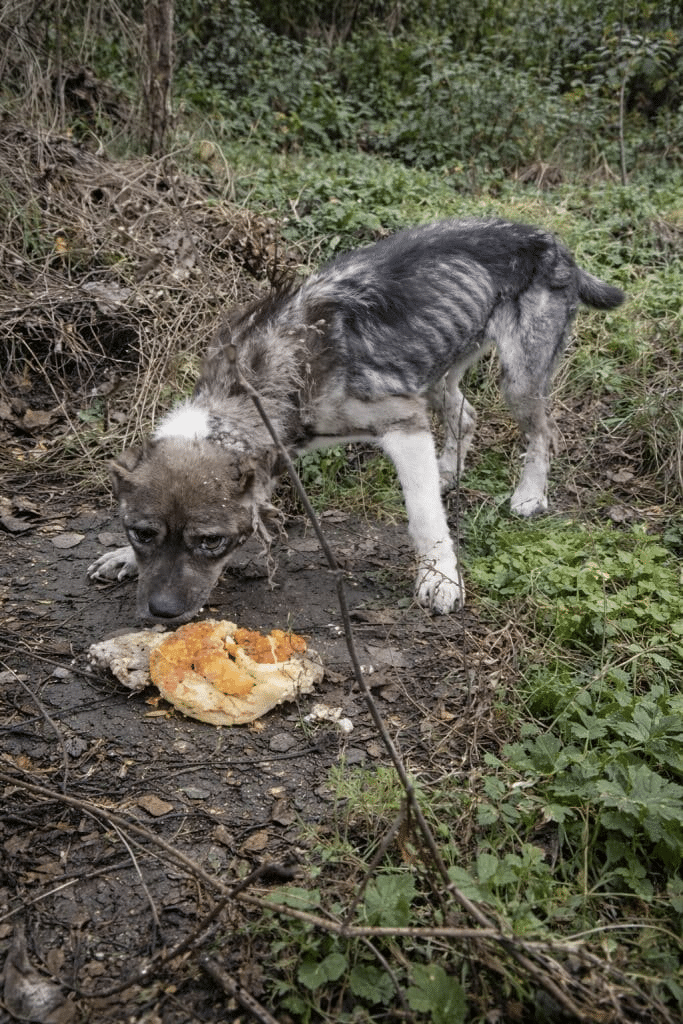
Rico was still walking.
That was almost the only encouraging thing about him.
The stray dog moved slowly along the roadside, stopping often as though each stretch of pavement demanded more energy than the last.
Sometimes he searched for scraps.
Sometimes he simply stood still.
His body looked weak, and the little interest he once had in food appeared to be disappearing.
To someone passing quickly, Rico might have looked like another stray making his way through the day.
But a few people looked longer.
And once they did, it became clear that Rico was not simply wandering.
He was running out of strength.
His Body Was Beginning to Lose the Fight
Rico’s condition could not be explained by hunger alone.
He was exhausted.
His appetite had dropped.
His movements had slowed.
Even remaining alert seemed to require effort.
The people who noticed him understood that leaving food on the roadside would not be enough.
Something was wrong with his body, and without proper care, there was no way to know how much longer he could continue.
So instead of walking away, they approached.
Rico did not try to flee.
He did not growl or challenge them.
He allowed the strangers to come closer and eventually take him for veterinary care.
For a dog who had been facing each day alone, that simple decision changed everything.
He no longer had to keep moving until his body could not move anymore.
VIDEO: Rico Was Growing Weaker by the Hour—Then Someone Finally Stopped Beside Him
At the Clinic, Recovery Had to Begin Slowly
The first priority was stabilization.
Rico was weak enough that the veterinary team could not expect his body to recover simply because food and water were finally available.
He needed fluids to address dehydration.
Warmth.
Rest.
Careful monitoring.
Food was introduced gradually in small portions so his depleted system could adjust.
During those early days, every response mattered.
Would he eat?
Would he remain alert?
Would his body begin holding onto the support it was being given?
There was no single treatment that suddenly transformed him.
The work was quieter than that.
A bowl placed nearby.
Fluids administered.
Someone checking on him again an hour later.
Then another night in a protected place.
For Rico, that was enough to begin.
The First Signs Were Small Enough to Miss
At first, progress showed itself in tiny changes.
Rico lifted his head more often.
He stayed awake a little longer when people entered.
His eyes followed movement around the room.
Then familiar voices began getting a response.
Nothing about those moments looked dramatic.
But the caregivers watching him every day understood what they meant.
Rico was becoming more present.
His body was still weak, but he was no longer slipping quietly in the wrong direction.
His appetite began returning.
Small portions became meals he could finish.
Water no longer had to be constantly encouraged.
With nutrition and hydration coming consistently, his body finally had something to rebuild with.
Slowly, the dog who had looked exhausted beside the road began finding strength again.
Rico Never Seemed to Forget How to Trust
One part of his behavior surprised the people caring for him.
Even when he was at his weakest, Rico remained calm around them.
He watched quietly.
Accepted gentle handling.
And seemed increasingly comfortable when familiar caregivers stayed nearby.
That did not mean anyone could know what Rico had experienced before rescue.
A calm dog may still be frightened or exhausted.
So no one rushed him.
Touch remained gentle.
Voices stayed soft.
Rico was given space whenever he needed it.
The result was not one sudden moment of trust.
It was a collection of smaller ones.
Remaining relaxed when someone sat beside him.
Looking toward a familiar voice.
Accepting a hand near his head.
Resting while people moved around the room.
Those ordinary interactions helped turn the clinic from an unfamiliar place into somewhere Rico could finally lower his guard.
His Recovery Became Bigger Than One Rescue Team
As people learned about Rico, more support began arriving.
Veterinary staff handled his medical needs.
Caregivers managed the daily work of feeding, cleaning, monitoring, and comforting him.
Others followed his progress and contributed whatever help they could.
Rico’s recovery was not built by one dramatic act.
It was built by many people doing smaller things consistently.
That mattered because recovery from serious weakness takes time.
There are quiet days when nothing looks different.
There are setbacks.
There are moments when progress can only be measured against how an animal looked a week earlier.
The people around Rico stayed for those days too.
And eventually, the difference became impossible to miss.
Weeks Later, Rico Was Walking With Strength Again
His appetite returned.
Weight began coming back onto his frame.
The slow, exhausted steps that had first worried rescuers became steadier.
Rico could move for longer without needing to stop.
His posture changed.
His attention sharpened.
And the dog once struggling merely to make it through the day began taking an interest in what was around him.
He rested comfortably instead of collapsing from exhaustion.
He reacted when people approached.
He moved through the recovery area with greater confidence.
There was no need to describe the change as miraculous.
Rico’s body had been given what it had been missing.
Food.
Hydration.
Veterinary care.
Rest.
Consistency.
And enough time for all of those things to matter.
Rico’s Story Is Still Moving Forward
Today, Rico is no longer facing the street alone.
He has people around him.
People who notice when he eats.
Who watch how he walks.
Who recognize when he needs rest.
His condition has changed dramatically from the day someone first saw him struggling beside the road.
But his story is not presented as completely finished.
There may still be more recovery ahead.
More strength to gain.
More routines to learn.
Perhaps another home still waiting somewhere beyond the care he has already received.
What has changed is the uncertainty that once surrounded every day.
Rico no longer has to depend entirely on whether he can find enough food to continue.
Someone is paying attention now.
Everything Changed Because Someone Looked Twice
Rico did not create a dramatic scene.
He did not collapse in front of a crowd.
He did not run toward the first person he saw.
He simply walked slowly beside the road while his body became weaker.
That made him easy to overlook.
But someone noticed the pauses.
The exhaustion.
The disappearing appetite.
They understood that the dog in front of them needed more than scraps.
Then they acted.
That decision led to veterinary care.
Care led to stability.
Stability gave Rico time.
And time allowed his strength to return.
His story is a reminder that rescue does not always begin with something spectacular.
Sometimes it begins with a person noticing that one dog is walking a little too slowly.
Stopping a little too often.
Looking a little too tired.
Rico did not need everyone who passed him to stop.
He only needed someone to look closely enough to understand that he could not keep going alone.
Someone finally did.
And that was where his second chance began.


